

Table of Contents
- Understanding Your Cracked Acoustic Guitar Bridge
- Assessing Whether to Repair or Replace a Cracked Guitar Bridge
- How to Repair a Cracked Bridge: Step-by-Step
- Addressing a Crack Between Guitar Bridge Pins
- Dealing with Acoustic Guitar Bridge Lifting
- When to Choose Guitar Bridge Replacement
- Professional Repair: When to Seek Help
- Frequently Asked Questions
Last Updated: 20 October 2026
Understanding Your Cracked Acoustic Guitar Bridge
A cracked acoustic guitar bridge is a common problem. Your bridge is under enormous tension from the strings, so cracks develop over time due to wood movement, humidity changes, or impact damage. Understanding what causes these cracks helps you prevent them and know when action is needed.
The bridge holds your strings in place and transfers vibration to the guitar's body. Without a solid bridge, your instrument simply won't play properly. A crack here isn't just a cosmetic issue, it affects tone, intonation, and playability.
What causes bridge cracks
Wood naturally expands and contracts with humidity changes. Acoustic guitars are particularly vulnerable because they're made entirely of wood. When your home gets too dry in winter or too humid in summer, the wood moves. The bridge bears the brunt of this stress.
Other common causes include:
- Dropping or bumping the guitar
- String tension pulling unevenly on the bridge
- Poor storage conditions with extreme temperature swings
- The wood simply ageing over decades of use
- Manufacturing defects in cheaper guitars
At MusicStreet, we recommend keeping your guitar in a stable environment. Aim for 40-50% humidity year-round. This simple step prevents most bridge problems before they start.
How to spot the damage early
Early detection makes repair much easier. Look for these warning signs:
- A visible line or split running across the bridge
- The bridge pulling away from the guitar body
- Gaps appearing between the bridge and the top
- Loose bridge pins that won't stay tight
- Changes in how your guitar sounds or feels
Run your finger across the bridge surface. You'll feel a crack if one exists. Small hairline cracks catch light differently too. Check your guitar monthly, especially if you live somewhere with dramatic seasonal changes.
Assessing Whether to Repair or Replace a Cracked Guitar Bridge
Not every cracked bridge can be repaired. Some cracks are too severe, and attempting a fix wastes time and money. You need to assess the damage honestly before deciding your next step.
Minor cracks versus severe damage
Minor cracks are small, thin splits that don't go all the way through the bridge. These might be repairable with careful work. They typically run lengthwise along the grain.
Severe damage includes cracks that go completely through the bridge, chunks missing from the bridge, or cracks that branch into multiple directions. These almost always require replacement. Gluing a severely cracked bridge rarely holds under string tension.
A bridge with structural damage beyond repair is often safer to replace than to attempt fixing. A failed repair can damage your guitar's top if the bridge shifts under tension.
Cost and time considerations
Repair work depends on the crack's size and location. Simple glue-and-clamp jobs might take a few hours. More complex repairs involving reinforcement can take longer.
Bridge replacement is a more involved job. A luthier removes the old bridge, cleans the glue residue, fits a new bridge, and sets it up properly. This process takes considerably more time than a simple repair.
At MusicStreet, we offer both repair and replacement services. We assess each bridge individually and recommend the approach that gives you the best result. Sometimes a new bridge costs less than attempting a repair that might fail.
How to Repair a Cracked Bridge: Step-by-Step
If your bridge has a minor crack, you might attempt a repair yourself. This requires patience, the right materials, and careful technique.
What you'll need before starting
Gather these items before you start:
- Thin superglue or wood filler designed for guitars
- Clamps (at least two, ideally four)
- Sandpaper (120-grit and 220-grit)
- A clean cloth
- A straightedge or ruler
- Masking tape
- A well-lit workspace
- Your guitar
Don't skip any of these. Proper tools are essential for a successful repair.
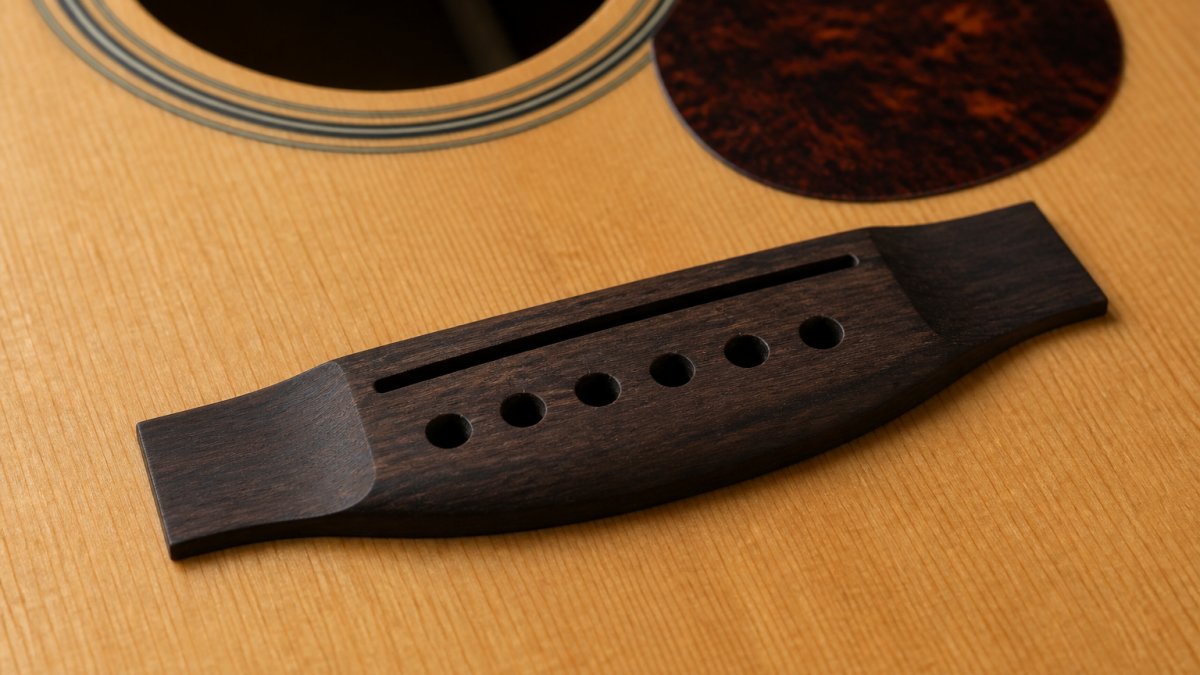
Luthier carefully applying wood glue to a cracked acoustic guitar bridge with clamps on a workbench
The repair process
Step 1: Clean the crack thoroughly
Remove any dust or debris from inside the crack. Use a thin cloth or compressed air to clear it completely. A dirty crack won't bond properly.
Step 2: Apply adhesive carefully
Work thin superglue into the crack using a small applicator. Don't oversaturate, just enough to fill the gap. Wipe away excess immediately with a damp cloth.
Step 3: Clamp and wait
Position clamps to hold the crack closed. Apply even pressure without over-tightening, which can damage the bridge. Let the glue cure for at least 24 hours.
Step 4: Sand smooth
Once dry, sand the bridge gently with 120-grit paper, then 220-grit. Work carefully to avoid rounding the bridge's edges.
Step 5: Test the repair
Retune your guitar slowly. Listen for any changes in tone or feel. If the crack reopens or the repair fails, professional replacement is your next option.
Common mistakes to avoid
Don't apply too much glue. Excess adhesive squeezes out and creates a mess. It also prevents the crack from closing properly.
Don't over-clamp. Excessive pressure can split the wood further or damage surrounding areas.
Don't rush the cure time. Superglue needs time to set fully. Playing the guitar too soon will break the repair.
Don't ignore warning signs. If the repair fails immediately after you finish, stop playing and seek professional help. Continuing to play risks further damage.
Addressing a Crack Between Guitar Bridge Pins
Bridge pins hold the strings in place. A crack between pins is common but often overlooked. This type of damage requires careful attention because it affects how the pins sit.
Cracks in this area typically develop from the downward pressure of the pins and string tension. The wood splits along the grain between pin holes.
Minor cracks between pins can sometimes be repaired with careful gluing. Sand the area smooth first, apply thin adhesive, and clamp gently. Ensure the pins still fit snugly after repair.
If the crack is severe or won't hold glue, replacement is safer. A new bridge eliminates the problem completely and restores full functionality.
Dealing with Acoustic Guitar Bridge Lifting
Bridge lifting is different from cracking, though they sometimes happen together. Your bridge is lifting when it starts to separate from the guitar's top. This creates gaps and changes how your guitar plays.
Lifting happens when glue fails or when wood movement pulls the bridge away. High humidity can swell the bridge. Low humidity shrinks it. Either extreme can cause separation.
Minor lifting might be glued back down if you catch it early. The bridge must be removed, the old glue cleaned away completely, and new adhesive applied. This is delicate work that requires proper clamps and knowledge of guitar construction.
Severe lifting, where large sections have separated, usually requires bridge replacement. Attempting to glue a severely lifted bridge often fails because the wood has already moved too far.
When to Choose Guitar Bridge Replacement
Sometimes replacement is the only sensible option. A new bridge restores your guitar to proper playing condition and eliminates ongoing problems.
Replace your bridge if:
- The crack goes completely through the bridge
- Multiple cracks branch in different directions
- The bridge has chunks missing
- Previous repair attempts have failed
- The bridge is lifting significantly
- The bridge is warped or twisted
A quality replacement bridge costs less than multiple failed repair attempts. It also gives you peace of mind knowing the problem is solved properly.
At MusicStreet, we source replacement bridges that match your guitar's specifications. We fit them carefully and set up your guitar so it plays perfectly after installation.
Professional Repair: When to Seek Help
Some situations require professional expertise. Knowing when to stop and call a luthier saves your guitar from further damage.
Seek professional help if:
- You're unsure whether repair or replacement is needed
- The crack is complex or in a difficult location
- Previous repairs have failed
- You lack the tools or experience for the job
- Your guitar is valuable or vintage
- The bridge is lifting significantly
A professional luthier assesses the damage, recommends the best solution, and executes the work properly. Professional repair can prevent further damage caused by unsuccessful DIY attempts.
At MusicStreet, our in-house repair team handles bridge repairs and replacements regularly. We examine your guitar thoroughly, explain your options clearly, and complete the work to professional standards. You can visit our workshop to discuss your guitar's needs in person.
A cracked acoustic guitar bridge affects how your guitar sounds and plays. Whether you repair or replace depends on the crack's severity. Minor cracks might be fixable with patience and care. Severe damage calls for professional replacement.
Don't let a bridge problem linger. The longer you wait, the more damage spreads. Visit MusicStreet to have your guitar assessed. Our team offers expert repair services, professional bridge replacements, and setup work to get your instrument playing beautifully again. Explore our repair services and in-house workshop capabilities to learn more about how we can help restore your guitar to perfect playing condition.
Frequently Asked Questions
Can a cracked acoustic guitar bridge be repaired?
It depends on the crack's severity and location. Minor cracks, particularly those running along the grain away from the bridge pins, can often be repaired using wood glue and clamping techniques. However, cracks that pass through the bridge pins, extend into the wing areas, or show signs of warping typically require full replacement. Some cracks that appear repairable may not hold under string tension long-term, making professional assessment essential before attempting a fix.
What should you do if you notice a crack between guitar bridge pins?
A crack between guitar bridge pins is serious because it compromises the structural integrity that holds the strings in place. This type of damage almost always requires bridge replacement rather than repair, as the pins rely on solid wood for proper grip and tension distribution. If you spot this damage, avoid playing the guitar until you've had it professionally evaluated, as continued use risks further splitting and potential damage to the guitar's top.
Is it safe to play an acoustic guitar with a cracked bridge?
Playing with a cracked bridge carries risk. Minor surface cracks may not immediately affect playability, but they can worsen rapidly under string tension. If the crack is near the bridge pins or extends into the wing areas, the bridge could fail suddenly, potentially damaging the guitar's soundboard. It's best to have the damage assessed by a professional before playing, especially if you're unsure of the crack's extent.
How do I know if my bridge needs replacing rather than repair?
Replace the bridge if the crack passes through the bridge pin holes, the bridge is warped or lifting from the soundboard, the crack is deep and runs across the grain, or the damage affects more than one-third of the bridge's width. If you're uncertain, a professional luthier can evaluate the damage and recommend the most cost-effective and reliable solution for your specific guitar.




Share:
How to Use a Capo: Placement, Tuning and Chord Shapes