

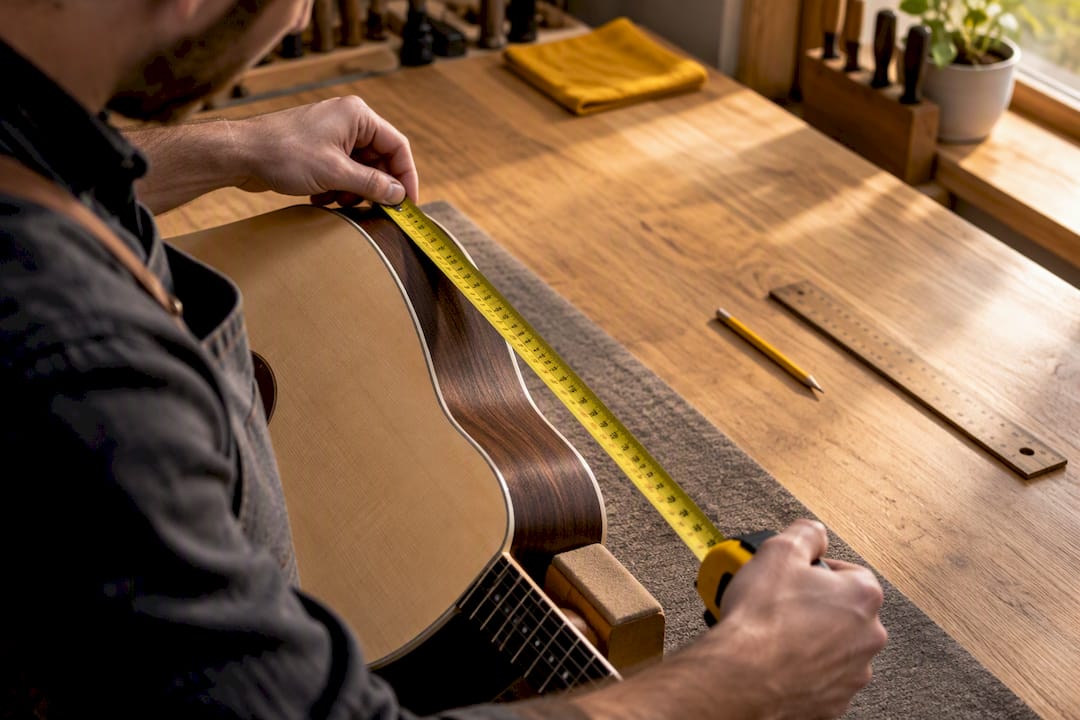
Most smaller adults, children and travel players do better with a guitar around 38 inches, while most average to taller adults get more comfort and fuller tone from one around 41 inches. That said, a professionally set-up larger guitar is often easier to play than a poorly adjusted smaller one, so inches matter less than setup. If you are unsure, try both sizes in person or book a professional setup before deciding.
Table of Contents
- What the measurements actually mean: total length, scale length, body width and depth
- Playability and ergonomics: matching size to your body and posture
- Sound and tone: what a 41in typically gives you and what a 38in keeps
- Which to choose: concise recommendations by use case and player profile
- Why setup and professional adjustment matter more than inches
- Quick in-store and online test checklist
- Impact of guitar weight differences on playing comfort
- Suitability of 38 inch vs 41 inch guitars for various music genres/styles
- Portability and storage considerations for each guitar size
- Price range differences typically seen between 38 inch and 41 inch guitars
- Availability and variety of models in each size category
- A note from the retailer
- How a specialized guitar retailer can help: guitars, setup and accessories
- Sources
- FAQ
What the measurements actually mean: total length, scale length, body width and depth
The number on a spec sheet, 38in or 41in, is the guitar’s total length from the top of the headstock to the base of the body. It tells you almost nothing about how the guitar will feel in your hands, because scale length (the vibrating string length between nut and bridge), lower bout width and body depth all vary independently of that overall figure.

Manufacturer data helps make sense of this. Yamaha’s classical guitar specifications show full-size instruments landing around 39 to 41in overall, with smaller 3/4-size models measuring closer to 36in. Compiled size charts on Guitar Chalk put concert and grand-concert bodies at roughly 38in total length with narrower lower bouts, while dreadnoughts and orchestra models cluster near 41in with wider, deeper bodies.
Body shape changes how identical total lengths feel against your torso:
- Concert and grand-concert bodies tend to sit close to 38in with a narrower waist and shallower depth.
- Dreadnought and grand-auditorium bodies commonly reach 41in with a wider lower bout and deeper sides.
- Parlor and travel shapes can share a similar total length to either category but taper the body for portability.
A guitar’s lower bout width and body depth affect comfort more than its total length, according to Guitar Chalk’s size comparisons, because those dimensions determine how far the instrument projects from your chest and how your strumming arm rests over the top.
Playability and ergonomics: matching size to your body and posture
Height is a rough starting point, not a rule. Shorter players, younger teenagers and anyone with a smaller frame usually find a 38in concert or grand-concert body easier to wrap an arm around, while average to tall adults often prefer the reach and balance of a 41in dreadnought or grand-auditorium.
Nut width, neck profile and string spacing matter just as much as body size. A slim neck on a 41in guitar can suit small hands better than a chunky neck on a 38in body, so these specs deserve equal attention when you compare instruments.
- Body depth changes how the guitar sits against your ribs when seated.
- Lower bout width determines how far your strumming arm has to stretch over the top.
- Neck profile and nut width decide how easily your fretting hand wraps around chords.
Pro Tip: Sit down with the guitar for five minutes before deciding. Standing tests hide a lot of ergonomic problems that only show up once you settle into a normal playing posture.
Sound and tone: what a 41in typically gives you and what a 38in keeps
Body size has a direct relationship with tonal character. Martin Guitar’s body size guide explains that larger bodies, like dreadnoughts, push more air and deliver stronger bass and projection, which suits summer, singer-songwriters and buskers who need volume without amplification. Smaller bodies favour clarity and balance across the frequency range, which fingerstyle players and home recordists often prefer because individual notes stay distinct rather than blurring into a wash of bass.
- 41in bodies: stronger low end, more volume, better for full-strum accompaniment and stage projection.
- 38in bodies: tighter bass, clearer trebles, better note separation for finger picking and studio work.
- Amplified or mic’d playing: reduces the practical gap, since a pickup or microphone can compensate for a smaller body’s lower natural volume.
Martin’s guidance also notes that retailers routinely recommend trying both shapes seated and standing, because the way a body rests against you changes the tone you hear as much as the tone a listener hears.
Which to choose: concise recommendations by use case and player profile
Matching size to player and purpose narrows the decision quickly.
- Children or very small adults: a 38in concert or 3/4-size body is easier to reach around and fret comfortably.
- Average to tall adults wanting full acoustic tone: a 41in dreadnought or grand-auditorium gives more bass and volume for strumming.
- Fingerstyle players and home recordists: a smaller concert or grand-concert body keeps notes distinct and balanced.
- Buskers and live strummers: a 41in dreadnought projects better without amplification.
- Frequent travellers or students without a car: prioritise a lighter, smaller-bodied guitar for portability over projection.
Before buying, run through a short checklist in-store: sit with the guitar for several minutes, check the neck profile against your hand size, listen for balance between bass and treble, and ask whether a setup is included or available.
Why setup and professional adjustment matter more than inches
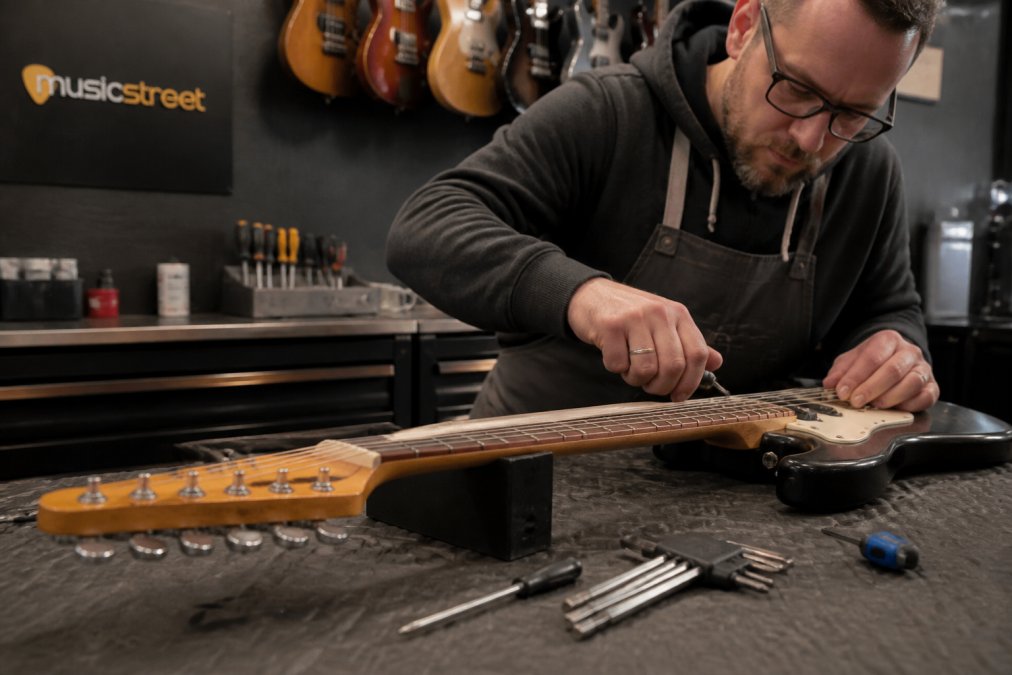
Factory setups on new guitars are often left with higher action than necessary, which makes chords harder to fret and bends harder to control regardless of body size. Strings Magazine’s guide to string height explains that correcting action, adjusting the nut and saddle, and setting intonation properly can transform how a guitar plays, often more than switching to a different size ever would.
- Action: the height of the strings above the frets, adjusted at the nut, saddle and truss rod.
- Intonation: fine-tuning so notes stay in tune up the neck, not just at the open string.
- Neck relief: a small forward bow set by the truss rod to prevent buzzing.
Pro Tip: If a guitar feels hard to play, ask for a setup before assuming the size is wrong. Many playability complaints disappear once action and intonation are corrected.
Booking a setup, trying instruments that have already been adjusted, or requesting a restring with basic adjustment are all practical ways to test a guitar properly rather than judging it on inches alone.
Quick in-store and online test checklist
A short, repeatable sequence makes comparing guitars far less confusing.
- Hold the guitar seated and standing to check how the body sits against you.
- Fret a first-position chord and a barre chord to test neck feel and string spacing.
- Check action at the first and twelfth frets by pressing lightly and listening for buzz.
- Strum a chord progression and play a simple single-note run to compare sound and feel.
- Record the scale length, nut width and body depth so you can compare models later.
- Ask about setup options and return policies before committing to a purchase.
Impact of guitar weight differences on playing comfort
Weight is easy to overlook next to total length, but it changes how a guitar feels within minutes of picking it up. A 41in dreadnought with a solid top and back typically weighs more than a 38in concert body simply because there is more wood and bracing involved, and that extra weight rests on your strumming forearm and shoulder during long sessions.
For seated players, weight matters less because the body rests on the thigh and the strap is not load-bearing. Standing players feel the difference immediately: a heavier dreadnought pulling on a strap for an hour can tire the shoulder in a way a lighter concert body will not.
Neither size is inherently too heavy for a healthy adult, but for children, smaller-framed players or anyone recovering from an injury, a lighter 38in body reduces fatigue during extended practice. If you plan to stand and play for long sets, factor weight into your decision alongside tone and reach, since a guitar that feels fine sitting on a stand can feel very different an hour into a gig.
Suitability of 38 inch vs 41 inch guitars for various music genres/styles
Genre often points towards one size before comfort even enters the conversation. Fingerstyle players, folk guitarists working through intricate picking patterns and jazz players who value clarity tend to gravitate towards 38in concert and grand-concert bodies, because the tighter bass response keeps busy passages from turning muddy.
Strummers, singer-songwriters performing solo and country or bluegrass rhythm players usually lean towards a 41in dreadnought, since the stronger bass and projection carry a full chord progression without needing amplification. Buskers fall into the same category: a 41in body pushes more volume acoustically, which matters when there is no PA system to rely on.
Neither size is off-limits for any genre. Plenty of fingerstyle players use dreadnoughts, and plenty of strummers use concert bodies, especially once amplification is involved. But if you already know your primary style, matching the body’s natural tonal strengths to that style saves you from fighting the instrument later, according to Martin Guitar’s body size guide.
Portability and storage considerations for each guitar size
Smaller footprints make a real difference once you start moving a guitar around regularly. According to size comparisons compiled by Allaxess, travel and parlor guitars sit in the 34 to 38in range and are built specifically to fit into smaller cases, overhead lockers and tight storage spaces, while standard dreadnought and grand-auditorium models commonly reach around 41in and demand a full-size case or gig bag.
For students walking or cycling to lessons, commuters fitting a guitar into a small flat, or anyone who travels with their instrument, a 38in body is easier to store in a wardrobe, under a bed or in a car boot. A 41in dreadnought needs more dedicated space, both in transit and at home, and a hard case adds noticeable bulk and weight on top of the guitar itself.
Wall storage narrows the gap somewhat. A wall-mounted hanger keeps either size off the floor and out of the way, which matters in smaller rooms where floor stands take up valuable space regardless of the guitar’s dimensions.
Price range differences typically seen between 38 inch and 41 inch guitars
Size alone does not set a guitar’s price, but there are some general tendencies worth knowing. Entry-level 38in concert and parlor guitars are common at the budget end of the market because smaller bodies use less wood and often accompany simpler bracing, making them a frequent choice for children’s instruments and first-time buyers. Entry-level 41in dreadnoughts are just as widely available at similar budget price points, so size itself is not a reliable predictor of cost at the lower end.
Higher up the market, the picture depends far more on materials, brand and craftsmanship than on total length. A solid-wood 41in dreadnought and a solid-wood 38in concert body from the same tier of manufacturer tend to sit in a similar price bracket, with construction quality, tonewood choice and hand-finishing driving the difference rather than the inch measurement. Pre-owned instruments, such as a used dreadnought that has already had a professional setup, can also offer better value than a new budget model of either size.
If cost is your main constraint, focus on build quality and setup rather than assuming one size is inherently cheaper.
Availability and variety of models in each size category
Both sizes are widely produced, but the mix of models differs. 41in dreadnoughts and grand-auditoriums dominate the standard acoustic market, appearing across almost every major manufacturer’s beginner, intermediate and premium ranges, which means more choice in tonewoods, finishes and price points at this size.
38in concert, grand-concert and parlor models are still common but represent a smaller slice of most manufacturers’ catalogues, often positioned as a second or third body shape alongside a brand’s dreadnought range rather than the flagship option. Children’s and 3/4-size instruments, which frequently fall closer to 36in, are a separate category again and worth checking separately if you are buying for a younger player.
In practice, this means a 41in shopper usually has more models to compare directly, while a 38in shopper may need to look slightly harder or consider a wider mix of brands to find the right combination of tone, neck profile and price. Trying instruments in person, or asking a retailer what is in stock in both sizes, remains the most reliable way to see the real spread of options rather than relying on an online catalogue alone.

A note from the retailer
We always tell customers to prioritise feel and setup over the number on the spec sheet. Come try instruments in person or book a setup, we are glad to help you find the right fit.
— Music
How a specialized guitar retailer can help: guitars, setup and accessories
Whichever size feels right, the difference between a guitar you love and one you abandon usually comes down to setup, not inches. That is why many retailers have instruments inspected and adjusted properly before sale, and why in-store tryouts let you compare body shapes side by side rather than guessing from a spec sheet.

- The Larrivee OM-40 Mahogany Guitar suits players wanting a 41in-style body with balanced projection for strumming and fingerstyle alike.
- The USED - Gibson G45 Studio is a pre-owned dreadnought option for players who want established tone and volume without paying new-instrument prices.
- The Hercules GSP38WB Plus Wooden Guitar Hanger keeps either size safely stored on the wall, useful once you have found your fit and want it within reach.
Browse our full acoustic guitars collection, or book a setup to get the guitar you already own playing the way it should.
Sources
- Proper string height maximizes your instrument’s sound | Strings Magazine
- Acoustic guitar dimensions: full-size, 3/4, dreadnought & travel — Guitar Chalk
- Guide to acoustic guitar body sizes & shapes — Martin Guitar
- Complete guide to acoustic guitar sizes: find your perfect fit (Allaxess)
FAQ
Is 41 inches big for a guitar?
A 41in guitar is on the larger end of standard acoustic sizes, typically a dreadnought or grand-auditorium body, but it is not unusually large. It is the common size for full-size adult acoustics, according to manufacturer size charts.
Is a 38 inch guitar small?
A 38in guitar is smaller than a standard dreadnought, usually a concert or grand-concert body, and suits smaller players, fingerstyle guitarists or anyone prioritising portability. It is not a child’s size, since those instruments typically measure closer to 36in.
Is a 41 inch guitar full size?
Yes, 41in is generally considered full size for a standard adult acoustic guitar, matching the dreadnought and grand-auditorium bodies most manufacturers list as their standard adult models, per Yamaha’s specifications.
Which guitar is better for beginners, a 36 inch or a 41 inch?
Neither is universally better: a 36in guitar suits children or very small adults, while a 41in suits most average-sized adult beginners wanting full acoustic tone. The better choice depends on the player’s height and hand size rather than a fixed rule, and a proper setup matters more than the size itself, according to Strings Magazine.



Share:
Best Bass Guitar Brands for Intermediate Players 2026