

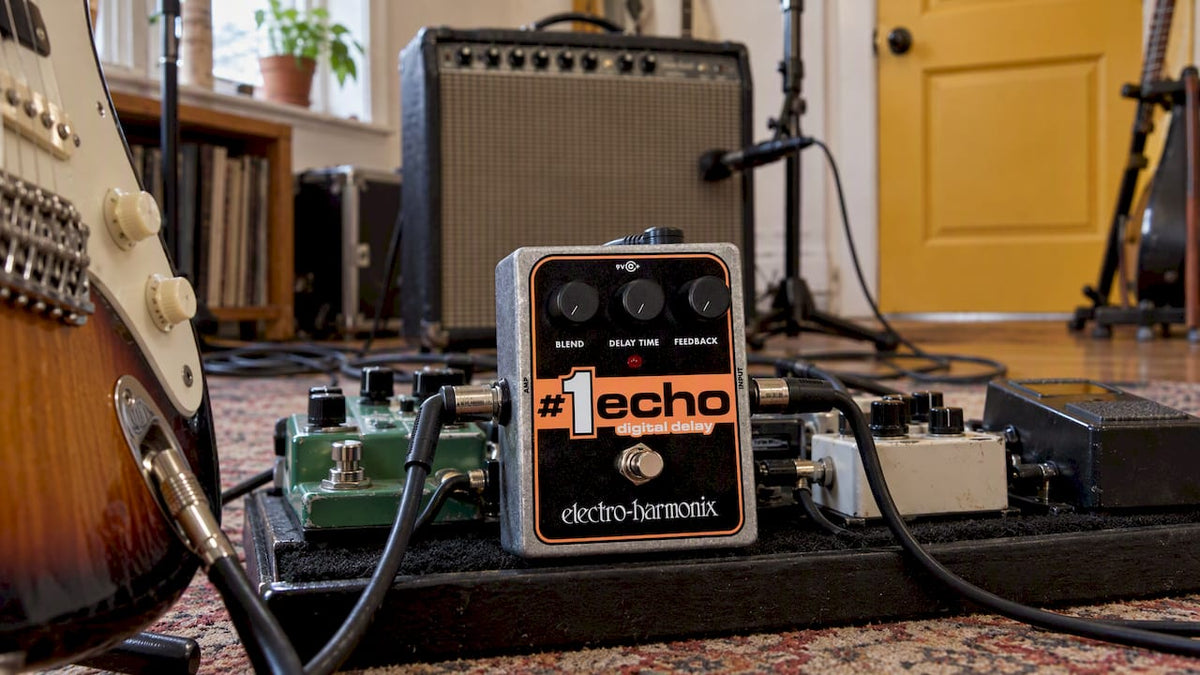
An echo, in music, is a distinct repeat of a sound, modelled on the way a sound bounces back from a distant surface. On a guitar, an echo effect makes that happen electronically: it copies your playing, delays the copy and mixes it back in with the original, once or many times. This guide is about echo as a sound and as a pedal. If you came looking for the heart scan, your GP or the hospital letter that booked your appointment is the place to ask.
Below, we cover how echo works, how it differs from delay and reverb, what each control does, and how to use it without turning your tone to mud.
Table of Contents
- Echo in music: a distinct repeat
- How an echo effect works
- Echo, delay and reverb: what is the difference?
- Three ways echo is made: tape, analogue and digital
- The controls: what time, repeats and level actually do
- Using echo in your playing
- Echo beyond the guitar
- Choosing an echo pedal
- Try echo before you buy
- Our view: echo is a seasoning, not the meal
- FAQ
- Sources
Echo in music: a distinct repeat
Shout across a valley and, a moment later, your voice comes back. That is an echo in its natural form. Guitar.com describes echo as a distinct repeat of a sound, modelled on a reflection from a distant surface. Fender makes the same point with acoustic delay, sound returning from something like a canyon wall.
The key word is distinct. You hear the original, a gap, and then the repeat as a separate event. That gap is what makes echo useful musically. It adds space, rhythm and depth to a part without changing the notes you play.
In a studio or on a pedalboard, we recreate that bounce with electronics. Nobody needs a canyon, only a signal path that can hold a sound for a fraction of a second and play it back.
How an echo effect works
The principle is the same whatever the box looks like. The effect takes the signal coming from your guitar, which engineers call the dry signal, and stores a copy. It plays that copy back after a set time and blends it with the dry sound. Sound On Sound explains that echo and delay are made by copying the original signal and replaying it later, then mixing the delayed signal with the dry one.
There are two ways that copy can return:
- A single repeat. You play a note, you hear it, and you hear one echo.
- Multiple repeats. Part of the delayed signal is fed back into the input, so each echo is itself echoed. This is called feedback, and it is what gives you a trail of repeats that fade away.
How long the gap needs to be before your ear hears a separate echo is a matter of perception. Native Instruments notes that once a delay passes roughly 30 milliseconds, listeners commonly hear a distinct echo. Shorter than that and the copy tends to thicken the original sound rather than repeat it.
Echo, delay and reverb: what is the difference?
These three words get used loosely, and in a music shop you will hear them swapped all the time. Here is a practical way to separate them.
| Effect | What you hear | Typical use |
|---|---|---|
| Echo | A distinct repeat of the original sound | Rhythmic repeats, slapback, atmosphere |
| Delay | The general term for playing a signal back later; echo is what a delay produces when the gap is long enough to hear | Anything from subtle thickening to long repeating trails |
| Reverb | Many reflections so close together that they blur into a continuous wash | Placing your guitar in a room, hall or cathedral |
Guitar.com puts the difference simply: echo is a distinct repeat, while reverb is multiple echoes so close together that they sound continuous. Fender adds that short reflections in a room can blur into reverb, which is why a small tiled bathroom sounds so different from an open field.
In practice, “delay” is the name most modern pedals carry, and “echo” is the older word that stuck for the sound and for certain vintage-style units. If you want the reverb side of things, a pedal such as the Electro Harmonix Holy Grail Reverb sits in a different category from the delay and echo units below.
Three ways echo is made: tape, analogue and digital
Echo effects have been built in several ways, and each has its own character. Astral Sound lists tape, analogue bucket-brigade electronics and digital processing as the three methods, with digital now the most widespread. Guitar.com adds that the parameters are usually the same whichever technology is used, so what you learn on one transfers to the others.
Tape echo
The classic. A loop of tape passes over separate erase, record and playback heads. Roland explains that tape echo combines the live input with the later playback from those physically separated heads. Because the playback head sits some distance from the record head, the sound arrives late.
The repeats are not perfect copies. Roland says tape-echo repeats are filtered compared with exact digital copies, which contributes to the warm, slightly dark vintage sound players still chase.
Analogue bucket-brigade delay
Bucket-brigade devices pass the signal along a chain of electronic stages, holding it briefly at each step. They need no moving tape, so they fit into a compact pedal. The repeats tend to be soft and dark, and they break up gracefully when you push them.
Digital delay and modelling
Digital units convert your signal to numbers, store it in memory and read it back later. That makes them precise: long delay times, clean repeats and tap tempo are easy. Many modern pedals also model older echoes, so one box can give you a tape-style sound, an analogue-style sound and a crisp digital one. Guitar.com notes that digital modelling devices replicate older echo sounds alongside rack effects and pedals.
If you like the idea of vintage voicing in a compact format, the Strymon Dig Vintage Delay is one to look at. For a simple, characterful budget route, our used stock sometimes includes pedals like the Danelectro Dan-Echo or the DLS Echotap. Stock changes, so check the pages for what is currently available.

The controls: what time, repeats and level actually do
Pick up any echo or delay pedal and you will find the same handful of knobs, however they are labelled. Here is what each one changes.
Time (interval). This sets the gap between the original sound and the echo. Astral Sound defines the interval as exactly that: the spacing between your note and its echoes. Short times, tens of milliseconds, give a doubling or slapback feel. Longer times give obvious, spacious repeats.
Repeats (feedback, regeneration, sustain). This sets how many echoes you hear. Sound On Sound describes feedback as returning part of the output to the input, which controls the number of echoes. Turn it up too far and the unit can self-oscillate, building into a runaway swirl of sound. That is a deliberate technique in dub music, but it will surprise you if you were not expecting it.
Level (mix, wet/dry). This sets how loud the echoes are relative to your original note. Guitar.com lists wet/dry mix among the common parameters, along with delay time, sustain or feedback, modulation and record level.
Tone or modulation. Many pedals let you darken the repeats or add a little pitch wobble, mimicking the age and imperfections of tape and analogue circuits.

Starting settings that work
These are starting points, not rules. Adjust by ear, through the amp you will actually play.
- Slapback. Short time (roughly 80 to 150 ms), one repeat, mix just audible. Good for rockabilly, country and a bit of life on a rhythm part.
- Subtle ambience. Medium time, two or three repeats, low mix. The echoes sit behind your playing and add space without being noticed until you turn them off.
- Obvious rhythmic echo. Time set to the tempo of the song, three or four repeats, mix at a clear level. Ideal for lead lines and clean arpeggios.
- Long, washy trails. Long time, high feedback, modest mix. Best for ambient playing, where notes bloom and fade slowly.
Interestingly, Sound On Sound makes the case that progressively less distinct echoes can be more musically useful, because they create distance and perspective without competing as strongly with the original note. If your echoes are fighting your playing, make them fade faster or sit darker rather than just turning them down.
Using echo in your playing
Play in time with your echoes
Echoes that land on the beat feel part of the groove. Echoes that land off it can feel messy. Astral Sound notes that musicians can synchronise echoes to a song’s beat, and tap-tempo controls let you set the interval by tapping a switch in time with the band. If your pedal has tap tempo, use it. Tap four times at the song’s pace and the repeats fall into the rhythm.
A famous example is rhythmic echo on a riff. Premier Guitar quotes session guitarist Pete Thorn explaining that a 300 ms echo with one repeat helps create the feel of Van Halen’s “Ain’t Talkin’ 'Bout Love”. One repeat, set to the right time, can do far more than a long tail.
Where echo goes in your signal chain
Order matters. Echo placed before a distortion pedal feeds its repeats into the gain, and the result can blur. Premier Guitar recommends placing delay or echo after distortion, or in an amp’s effects loop, because clean, prominent repeats run into distortion can become muddy. The same article documents deliberate exceptions, so treat it as a sensible default, not a law.
Our own guide to a five-stage pedal chain walks through where delays sit among your other pedals, and it is a good companion to this page.
Common mistakes
- Too much mix. The echoes drown the notes. Back it off until you only miss it when it is bypassed.
- Time at odds with the tempo. Repeats that clash with the beat make a band sound loose. Use tap tempo or count the milliseconds.
- Feedback too high on stage. Runaway repeats are exciting once and embarrassing twice. Find the feedback limit at home first.
- Echo in front of heavy gain. See above: move it after the drive, or into the effects loop.
Echo beyond the guitar
Echo is not a guitar-only effect. It is a general audio effect that works on any source. Vocals are the obvious example: a short echo on a vocal adds depth, and a throw of echo on the last word of a line is a staple of live sound. Astral Sound’s guide is written around echo units in live sound, where the same box may be used on voices and instruments alike. Sound On Sound’s guide also covers vocal doubling and applying delay to multiple tracks.
Bass players use it too, though with more care: low frequencies repeated at length can crowd a mix quickly, so keep the repeats short or filtered. Keyboard players, drummers using electronic pads and producers working in software all reach for the same time, repeats and level controls.
Choosing an echo pedal
When you shop for one, these questions narrow the field quickly:
- What sound do you want? Vintage tape or analogue warmth, or clean digital precision?
- Do you need tap tempo? If you play in a band, probably yes.
- How many repeats and how long a delay do you need? Slapback players need little. Ambient players want long times.
- Do you want looping as well? Some units combine delay with a looper, like the TC Electronic Alter Ego Delay/Looper or, for dedicated looping, the Electro-Harmonix 360 Looper.
- How much space is on your board? Compact options such as the Ernie Ball Ambient Delay, the TC Electronic Nova Delay and the Boss TE-2 are worth a look.
Try echo before you buy
The best way to choose an echo is to hear it through a real amp with your own guitar. At our shop in Huntingdon, Cambridgeshire, you can try pedals in store, and our staff will talk you through the controls above so you leave with something you will actually use.

You can browse our full range of effects, setups and repairs, or pair a new echo with the right guitar amp or combo to hear it at its best. If your guitar needs attention before you add effects, our setup and repair service can help, and every instrument we sell is inspected and set up by us first.
Our view: echo is a seasoning, not the meal
We spend a lot of time watching people try pedals in the shop, and the pattern is consistent. Almost everyone starts with too much echo. The repeats sound magical in the first ten seconds, then the playing gets lost in them.
Our advice is to set the mix lower than feels exciting, set the time to the song, and keep one repeat or two. Then play something you know well. If you can still hear every note of your own playing, the echo is helping.
We would also say that the guitar and amp matter before the pedal does. An echo exaggerates what is already there, good and bad. A guitar that is properly set up, with fresh strings and clean intonation, gives the repeats something worth repeating. That is why we inspect and set up every instrument, and why we are happy to help you check your guitar before you spend on effects.
— Music
FAQ
What is an echo in simple terms?
An echo is a sound that repeats after a short gap, like your voice coming back across a valley. In music, an effect creates it by copying your signal, delaying the copy and mixing it back in. Guitar.com describes it as a distinct repeat of a sound.
Is echo the same as reverb?
No. Echo gives you separate, countable repeats. Reverb is many reflections packed so tightly that they sound like one continuous wash. Many players use both together: a delay for rhythm and a reverb for space.
What is the difference between echo and delay?
Delay is the general process of playing a signal back later. Echo is what you hear when that gap is long enough to register as a separate repeat. Most modern pedals are called delays, while “echo” is often used for vintage-style or tape-inspired units.
Should echo go before or after distortion?
Usually after, or in the amp’s effects loop, so the repeats stay clear. Premier Guitar explains that clean repeats fed into distortion can turn muddy, though it also covers deliberate exceptions where the blend is the point.
Can I use an echo pedal on bass or vocals?
Yes. Echo works on any audio source. On bass, keep repeats short or darker so the low end stays tight. On vocals, a short, quiet echo adds depth without hiding the words.
Sources
- All About… Echo, Guitar.com
- Effects: All You Need To Know… And A Little Bit More, Sound On Sound
- How to use delay and echo in music production, Native Instruments
- Echo Units in Live Sound, Astral Sound
- Demystifying the Magic of Tape Echo, Roland UK
- Tone Tips: Echo and the Dirty Amp, Premier Guitar
- What is Delay? A Guide to Making Things Happen Later, Fender


Share:
How to Estimate Used Guitar Trade-In Value Online