

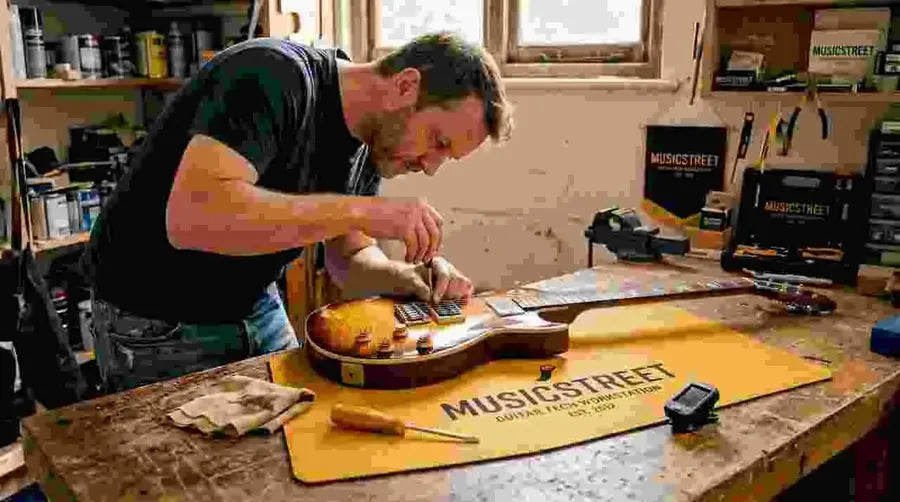
- Fixed bridges offer exceptional tuning stability and straightforward maintenance, making them ideal for many playing styles. They lack the pitch-shifting capabilities of tremolo systems but excel in sustain and tonal consistency. Proper setup and matching to your playing needs maximize their performance and reliability.
Some guitars seem to hold their tuning through entire gigs, temperature changes, and aggressive playing without missing a beat. Others drift out after a few aggressive chords. The difference often comes down to the bridge. Many players assume all bridges work the same way or that tremolo systems are the default standard, but that assumption leads to confusion, frustration, and poorly matched gear. Fixed bridges are, in fact, the dominant design across countless professional instruments, and understanding exactly how they work will help you make smarter choices about the guitars you buy, play, and maintain.
Table of Contents
- What is a fixed bridge?
- How fixed bridges differ from tremolo or vibrato systems
- Precision and tone: the technical benefits of fixed bridges
- Choosing and maintaining a fixed bridge guitar
- Fixed bridges: what most guides don’t tell you
- Find your ideal fixed bridge guitar and expert support
- Frequently asked questions
Key Takeaways
| Point | Details |
|---|---|
| Fixed bridge basics | A fixed bridge anchors guitar strings directly to the body without any moving tremolo mechanism. |
| Stability and simplicity | Fixed bridges provide tuning stability and are easier to set up and maintain than vibrato systems. |
| Precision and tone | With designs like the Tune-o-Matic, fixed bridges allow precise intonation and excellent sustain. |
| Choosing and care | Selecting the right fixed bridge and proper setup ensures maximum playability and sound quality. |
| Setup matters most | Your technique and setup have as much impact on stability as the bridge type itself. |
What is a fixed bridge?
A fixed bridge is exactly what the name suggests: a bridge that stays put. As defined in guitar hardware guides, a fixed bridge anchors the strings to the guitar body without a moving vibrato or tremolo mechanism. There are no springs, no floating platforms, and no pivot points. The strings run over the saddles, transfer their vibration directly into the body, and that is the entire mechanical picture.
When you explore the types of guitar bridges available on the market, a few fixed designs come up repeatedly:
- Hardtail bridges: Used widely on Fender Stratocaster hardtail models and Telecasters. The strings either pass through the body or load from the back of the bridge plate. Simple, reliable, and very easy to set up.
- Tune-o-Matic bridges: Associated primarily with Gibson guitars such as the Les Paul and SG. Usually paired with a separate stopbar tailpiece, this design features individually adjustable saddles for precise intonation.
- Wraparound bridges: A single-piece design where the strings wrap around the bridge itself, seen on many vintage-style and entry-level instruments.
- Acoustic saddle bridges: Found on virtually every acoustic steel-string and classical guitar. The saddle sits in a routed slot and transmits string vibration to the soundboard.
Fixed bridges appear across practically every guitar style and genre. From a £150 beginner’s acoustic to a £4,000 professional electric, the fixed bridge design remains universally relevant. It is not a compromise or a limitation. For many serious players, it is the preference.
“The simplicity of a fixed bridge is its greatest strength. No extra variables means every part of your setup serves one purpose: making the guitar sound as good as possible.”
How fixed bridges differ from tremolo or vibrato systems
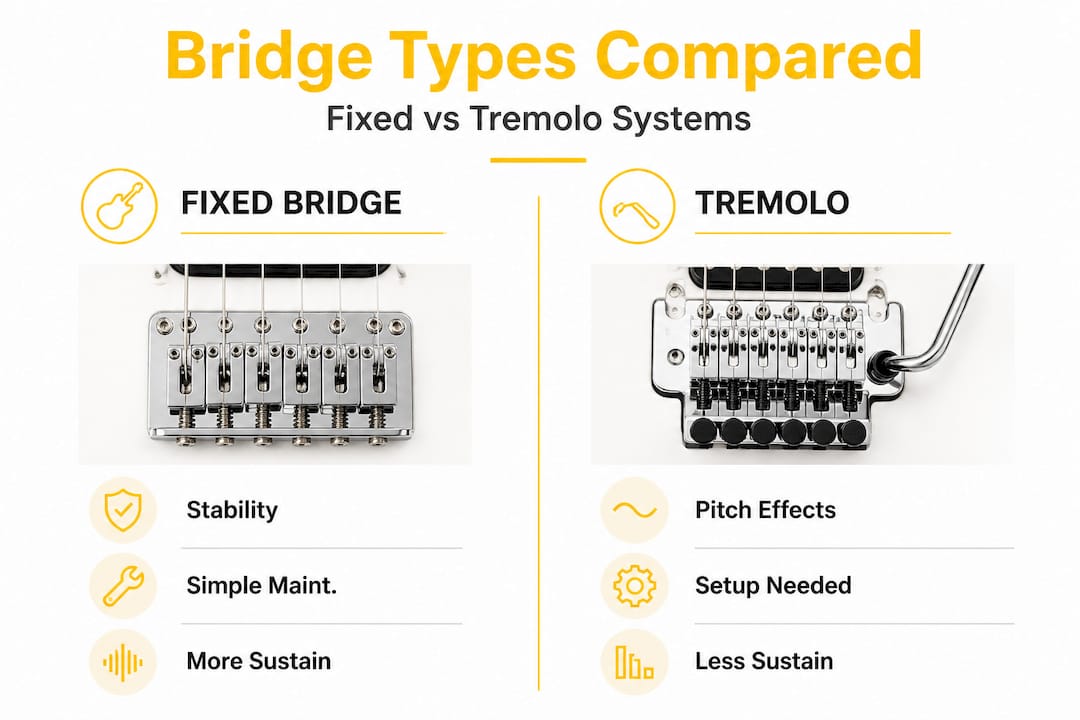
Understanding fixed bridges becomes much clearer when you place them next to their moving counterparts. Tremolo systems, often called vibratos, use a mechanism that allows the bridge to move, changing string tension and producing pitch effects. The classic Fender synchronised tremolo, the Floyd Rose, and the Bigsby are all examples of bridges built around movement.
Mechanically, fixed bridges provide stability because the string-to-bridge connection does not involve springs or pivoting that would alter string tension during playing. There is simply no way for the bridge itself to destabilise your tuning. That single difference has enormous practical consequences.
Here is a straightforward comparison across key performance areas:
| Feature | Fixed bridge | Tremolo/vibrato system |
|---|---|---|
| Tuning stability | Excellent | Variable, depends on setup |
| Setup complexity | Low | Moderate to high |
| String changing ease | Quick and simple | Can be time-consuming |
| Pitch bending range | None via bridge | Moderate to extreme |
| Sustain | Generally high | Can vary |
| Maintenance required | Minimal | More regular attention needed |
| Spring adjustment needed | No | Yes |
Beyond the mechanical comparison, there are real differences in everyday use:
- String changes: On a hardtail or Tune-o-Matic, you feed the string through, tune up, and you are done. With a Floyd Rose, you need to clamp the string, retune, rebalance the spring claw, and repeat for every single string.
- Setting intonation: Fixed bridge saddles are moved with a screwdriver and stay exactly where you leave them. Floating systems require rebalancing the entire bridge after intonation changes.
- Playing in tune after bends: On a poorly set-up floating tremolo, aggressive bends can pull other strings slightly flat. Fixed bridges do not have that issue.
Pro Tip: If you play live regularly and do not rely on vibrato effects, a fixed bridge will give you one less thing to worry about on stage. Less complexity equals fewer technical problems at the worst possible moments.
The trade-off is obvious: you cannot perform dive bombs or the wide pitch swings that a locking tremolo makes possible. But if those techniques are not central to your playing, you are giving up very little and gaining a great deal.
Precision and tone: the technical benefits of fixed bridges
This is where fixed bridges genuinely shine. The mechanical simplicity that makes them easy to use also directly benefits your tone and playability in ways that are measurable and audible.
Intonation accuracy is one of the most important factors in how a guitar sounds across the entire fretboard. Tune-o-Matic designs use individually adjustable saddles for accurate intonation per string, meaning each string can be set so that the 12th fret harmonic matches the fretted 12th fret note precisely. When intonation is right, chords ring true all the way up the neck. When it is wrong, the guitar sounds slightly off even when the open strings are perfectly tuned.
Here is how fixed bridge designs compare on key tonal factors:
| Bridge type | Intonation adjustability | Sustain | Best suited for |
|---|---|---|---|
| Tune-o-Matic | Per string | Excellent | Rock, blues, jazz |
| Hardtail | Per saddle | Very good | Versatile, all styles |
| Wraparound | Limited | Good | Vintage, simple setups |
| Acoustic saddle | Compensated slot | Natural acoustic resonance | Acoustic styles |
Sustain is another area where fixed bridges perform consistently well. Because the strings make firm, direct contact with saddles that are firmly anchored to the body, vibration transfers efficiently. There is no spring system absorbing energy, no floating plate dampening resonance. Understanding how guitar sustain works helps clarify why this matters: longer sustain gives notes more life, more expressiveness, and more room for controlled vibrato from your fretting hand rather than relying on a bridge mechanism.
Pro Tip: To maximise sustain on a fixed bridge guitar, make sure the saddles are making clean, consistent contact with the bridge plate, and that the bridge posts are tight in the body. Even small amounts of looseness drain resonance.
Simplicity as a tonal asset is worth taking seriously. Fewer moving parts means fewer potential points of vibration loss or unwanted buzzing. A well-set-up hardtail Stratocaster or Les Paul is widely considered one of the most tonally consistent platforms available, and that consistency owes a great deal to the fixed bridge design.
Pairing a well-adjusted fixed bridge with quality locking tuners gives you an exceptionally stable and responsive instrument with minimal maintenance overhead. The combination is popular among professional touring musicians for exactly this reason.
Choosing and maintaining a fixed bridge guitar
Knowing the theory is useful, but choosing the right fixed bridge guitar and keeping it in good condition requires a practical approach.
Choosing the right design
Start with how you play. If you favour single-coil tones and play rock, blues, or country, a hardtail Stratocaster-style guitar gives you clarity and snap. If you prefer the warmth of humbuckers and play anything from classic rock to jazz, a Tune-o-Matic equipped guitar will feel right at home. Acoustic players already have fixed bridges by default, but even there, saddle material matters: bone and compensated synthetic saddles improve intonation noticeably over basic plastic.

Setting up your fixed bridge for optimal performance
Follow these steps to get the best out of your instrument:
- Set the action (the string height above the frets) to suit your playing style. Lower action suits fast lead playing; slightly higher action suits heavier strumming and slide.
- Check the neck relief using a capo and a feeler gauge. A small amount of bow in the neck is normal and helps prevent buzzing.
- Adjust intonation by measuring the difference between the open string and the 12th fret note, then moving the saddle forward or back until they match.
- Clean the saddles with a dry cloth or a small brush. Grime in the saddle grooves deadens resonance and causes tuning issues.
- Tighten any loose hardware, including bridge posts and mounting screws. Even a very slight wobble in a bridge post can affect tone.
Common mistakes to avoid
- Over-tightening saddle screws, which can strip threads or crack the bridge plate
- Ignoring intonation after changing to a different string gauge
- Forgetting to clean under the bridge when doing a full guitar clean
- Assuming a new guitar is properly set up out of the box (many are not)
A proper guitar setup guide will walk you through every step in detail, but the core message is this: a fixed bridge rewards careful setup with outstanding stability and tone.
Maintenance is genuinely straightforward
Unlike floating tremolo systems, fixed bridges do not need spring tension adjustments when you change string gauges, and they do not require frequent re-balancing. Beyond the occasional saddle cleaning and intonation check, they are largely self-sufficient. A well-organised guitar accessories guide will cover everything you need in terms of tools and cleaning products for this kind of basic upkeep.
One important nuance worth noting: as many experienced players and forum discussions highlight, tuning stability is not solely about bridge type. Setup quality, string choice, nut condition, and playing technique all contribute. A floating tremolo that is properly set up can be very stable. A fixed bridge with a poorly cut nut or low-quality strings will still drift. Bridge type sets the baseline; everything else builds on it.
Fixed bridges: what most guides don’t tell you
Here is the honest perspective that rarely makes it into bridge comparison articles.
Most players who struggle with tuning stability blame their bridge first. They assume that swapping to a fixed design will solve everything. Sometimes it does. More often, the real culprits are a poorly cut nut, cheap strings being stretched incorrectly during installation, or a neck that has never been properly set up. The bridge gets the blame because it is the most visible piece of hardware.
We have seen this pattern repeatedly at MusicStreet. Players come in convinced they need a different guitar, only to discover that a professional guitar setup on their existing instrument solves the problem entirely. The fixed bridge was fine all along. The rest of the guitar just needed attention.
There is also a tendency among newer players to treat bridge type as a genre marker. Fixed bridge means serious, tremolo means flashy. That thinking is too simplistic. David Gilmour used a tremolo for much of his career and still produced some of the most controlled, singing guitar tones ever recorded. Meanwhile, plenty of shred players use hardtail guitars because they value the raw response and direct attack.
The most important lesson from years of working with players at every level is this: understand what a fixed bridge actually does well, match it to what you actually need, and then invest in a proper setup. That combination will outperform any amount of expensive hardware swapping. Fixed bridges are not magic, but when matched correctly to your playing style and set up with care, they are remarkably effective tools that stay out of your way and let you focus entirely on the music.
Find your ideal fixed bridge guitar and expert support
If this guide has helped you understand what fixed bridges can offer, the natural next step is finding the right instrument to match your playing style and ambitions.

At MusicStreet, our premium guitar shop stocks a carefully selected range of electric, acoustic, and bass guitars, including a strong choice of fixed bridge models from leading brands. Every instrument is professionally inspected before sale, and our team in Huntingdon, Cambridgeshire is on hand to offer expert advice, whether you are browsing online or visiting in store. If you want to go deeper on hardware options before committing, our guide to guitar bridge types is a great place to continue your research. Free UK delivery is available on qualifying orders, and post-sale support is always part of the deal.
Frequently asked questions
What does a fixed bridge do for my guitar?
A fixed bridge anchors strings to the body without any moving vibrato parts, offering straightforward tuning stability and easy day-to-day maintenance.
Is a fixed bridge easier for beginners?
Yes. Fixed bridges provide stability because there are no springs or pivoting mechanisms to manage, making setup and string changes far less intimidating for players just starting out.
Can I play heavy styles or do dive bombs with a fixed bridge?
Fixed bridges excel at sustain and stability across heavy playing styles, but they are not designed for dive bombs or dramatic pitch shifts that vibrato systems produce.
How do I set up a fixed bridge for the best performance?
Adjust string height, check neck relief, and then fine-tune intonation by moving each saddle. Tune-o-Matic designs with individually adjustable saddles make this process particularly precise and straightforward.
Are fixed bridges more stable than tremolo systems?
In general, yes, but as many players acknowledge, stability depends heavily on overall setup quality, strings, and technique rather than bridge type alone.
Recommended
- Understanding neck joints: the guitarist’s guide to construction – MusicStreet
- Guitar Bracing Patterns: 70% Use X-Bracing for Richer Tone – MusicStreet
- Locking tremolos explained: stability, setup and why they matter – MusicStreet
- 7 Essential Types of Guitar Bridges Explained for Players – MusicStreet









Share:
Best Ibanez Guitars for Metal in 2026 — MusicStreet's Definitive Guide
Ibanez RG vs. S Series: Which Iconic Shred Machine is Right for You?