

Table of Contents
- What You'll Need Before You Start
- How to Measure Guitar String Height
- Step-by-Step: How to Adjust Guitar Action for Beginners
- Guitar Truss Rod Adjustment for Beginners
- Common Mistakes to Avoid When Adjusting Guitar Action
- When to Take Your Guitar to a Professional Luthier
- Conclusion
- Frequently Asked Questions
Last Updated: September 29, 2026
What You'll Need Before You Start
Learning how to adjust guitar action for beginners starts with a small toolkit and a clear head. At MusicStreet, we've set up thousands of instruments, and the players who get the best results are the ones who prepare properly before touching a single screw.
Guitar action is the distance between the strings and the fretboard. Lower action makes a guitar easier to play. Higher action gives you more volume and less fret buzz.
Here's what to gather:
- A capo
- A ruler or string action gauge
- The correct hex keys for your bridge and truss rod
- A tuner
- A clean, well-lit work surface
A proper setup kit saves you hunting for the right size key mid-job. The CruzTools Groovetech Guitar Player Tech Kit includes eleven colour-coded hex wrenches, a thickness gauge, a ruler and a capo, plus an Easy Setup Guide that walks you through the process. It costs £49.99 and the tools are pro-grade.

How to Measure Guitar String Height
Measuring guitar string height takes two minutes and tells you exactly where you stand. You measure at two points: the 12th fret and the 1st fret.
Here's the process:
- Tune the guitar to pitch first. Slack strings give false readings.
- Place a capo at the first fret.
- Press the low E string down at the last fret.
- Measure the gap between the string and the 7th or 8th fret. This is your neck relief.
- Remove the capo and measure the gap between each string and the 12th fret. This is your action height.
Write the numbers down. You need a baseline before you change anything.
A common mistake is measuring with the guitar lying flat while you lean over it. Hold the instrument in your normal playing position instead. Gravity shifts the neck slightly, and your reading changes with it.
For accuracy, StewMac's guide to precision string action gauges explains why a dedicated gauge beats a steel ruler for repeatable results.
Step-by-Step: How to Adjust Guitar Action for Beginners
Adjusting guitar action follows a fixed order: relief first, then saddle height, then re-check. Skip a step and you'll undo your own work.
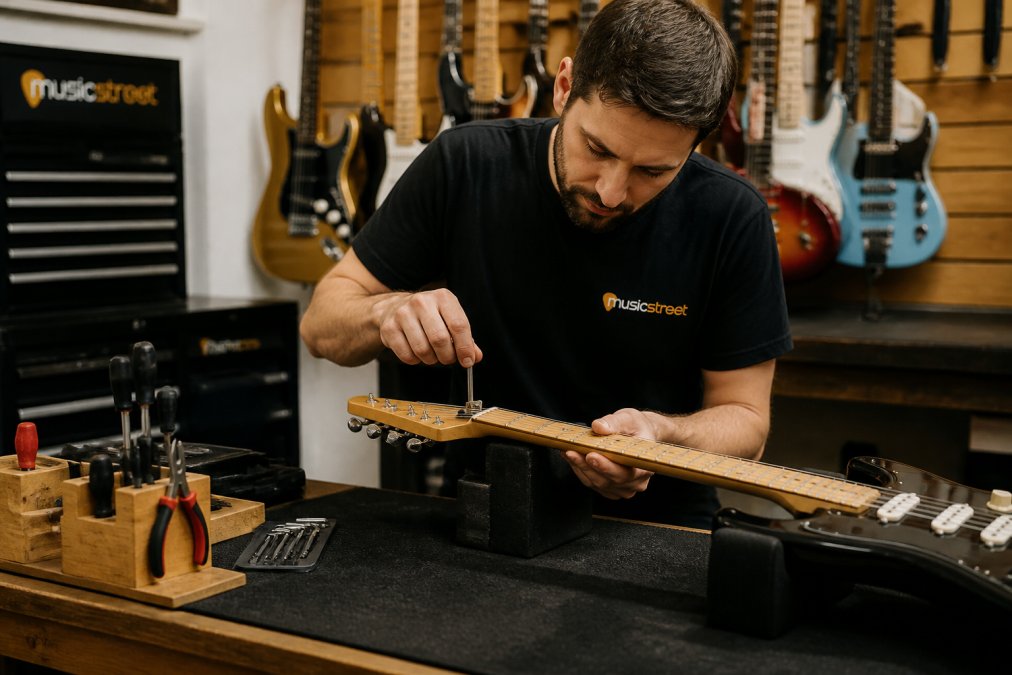
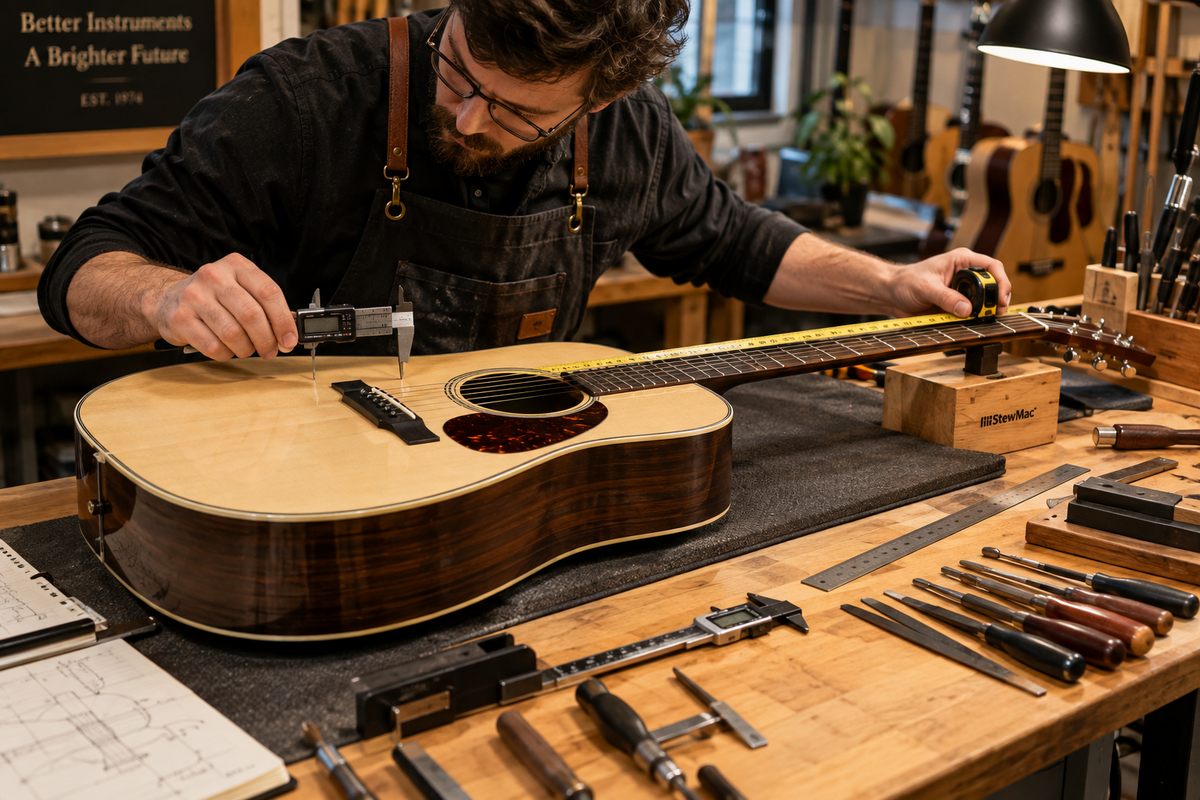
Guitarist using a hex key to adjust a bridge saddle with a ruler and string gauge on a workbench
Here's the full sequence, broken into three stages.
Step 1: Check the Neck Relief First
Neck relief is the slight forward curve in the neck. It needs to be right before anything else.
CruzTools Groovetech Guitar Player Tech →
Capo the first fret. Hold the low E down at the last fret. Look at the gap at the 7th fret. You want a sliver of light, roughly the thickness of a business card.
If the gap is too big, the neck is bowed forward. If the strings sit on the frets, it's back-bowed. Both problems get fixed at the truss rod, which we cover below.
Step 2: Adjust the Bridge Saddles
Bridge saddle height sets your action. Each string usually has its own saddle or height screw.
Turn the screws clockwise to lower a string, anticlockwise to raise it. Go a quarter turn at a time. Small movements add up fast.
On a Strat-style bridge, you'll adjust two screws per saddle. On a Tune-o-matic, you turn the thumbwheels on each side. On an acoustic, you sand the bottom of the saddle, which is a job best left to a professional.
Step 3: Re-Tune and Re-Measure
Changing action pulls the strings out of tune, which changes the neck tension. So tune up again, then re-measure at the 12th fret.
Repeat steps 2 and 3 until the numbers sit where you want them. Expect two or three rounds.
Guitar Truss Rod Adjustment for Beginners
Guitar truss rod adjustment for beginners needs one rule above all: small turns only. The truss rod is a metal rod inside the neck that controls its curve. A quarter turn is a big change.
Turn the nut clockwise to straighten a forward bow. Turn it anticlockwise to add relief. Never force it. If it won't move, stop.
Do this with the strings at pitch so you can watch the relief change as you work. Check the gap after every quarter turn.
This is where most beginners get into trouble. Saddle and truss rod tweaks are reversible. Nut filing is not.
Common Mistakes to Avoid When Adjusting Guitar Action
Most beginner setups fail for the same handful of reasons. Here's what to watch for.
CruzTools Groovetech Guitar Player Tech →
- Adjusting the bridge before the neck. Fix relief first, or your saddle heights mean nothing.
- Turning the truss rod too far. A half turn can snap a rod or crack a neck.
- Measuring on slack strings. Always tune to pitch first.
- Ignoring fret buzz. A little buzz on a hard strum is normal. Buzz on light playing means the action is too low.
- Forgetting to re-tune. Every adjustment changes tension, and tension changes tuning.
- Using the wrong size key. A loose key rounds off the truss rod nut. Then you're stuck.
A proper multi-tool removes the last problem. The CruzTools Groovetech Multi-Tool packs four metric and three fractional hex keys, two Phillips screwdrivers, a slotted screwdriver and a ruler for setting action, all for £19.99. The truss rod sizes are ball-end, so they reach angled nuts easily.

When to Take Your Guitar to a Professional Luthier
Some jobs belong in a workshop, not on your kitchen table. Knowing the difference protects your instrument.
Book a professional when you hit any of these:
- The truss rod won't turn, or turns with a grinding feel
- Frets are uneven, worn flat, or have deep grooves
- The nut needs filing or replacing
- The neck has a twist, not just a curve
- You own a vintage or high-value instrument
- You've adjusted everything and it still plays badly
A trained eye spots problems in minutes that could take you weeks to diagnose. And some fixes, like a fret level or a new nut, need tools most players never own.
MusicStreet runs an in-house repair and setup workshop, so instruments bought from us arrive properly set up rather than straight off a container. Our team includes players, and every guitar is checked before it leaves the shop.
Conclusion
A badly set-up guitar fights you on every chord, and most beginners blame their own hands when the real problem is the instrument. A few careful adjustments fix that, and the tools to do it cost less than a single lesson.
If you'd rather skip the guesswork, MusicStreet hand-selects every guitar and sets it up before it ships. Our range covers electric, acoustic and bass models from brands we're authorised to stock, including Fender, Gibson, PRS and Yamaha. Free delivery applies on orders over £99, and our in-house workshop handles anything beyond a basic tweak.
Get started with MusicStreet and play an instrument that's ready the moment it arrives.
Frequently Asked Questions
Is it safe for a beginner to adjust their own guitar action?
Yes, for most electric guitars with adjustable bridges, beginners can safely lower or raise the action using the correct hex keys. The main risk is over-tightening the truss rod, which can damage the neck. Stick to small quarter-turn adjustments and check your measurements after each change. If the guitar has a fixed acoustic bridge or you're unsure about neck relief, a professional setup is the safer option.
What tools do I need to adjust guitar action?
You need the correct hex keys for your bridge saddles and truss rod, a precision ruler or string action gauge for measuring string height, and a capo for checking neck relief. A string winder and tuner help speed up the process. The CruzTools Groovetech Guitar Player Tech Kit includes colour-coded metric and imperial hex wrenches, a thickness gauge, ruler, capo and string winder, covering everything a beginner needs for a full setup.
How do I know if my guitar action is too high?
If pressing strings down near the 12th fret feels like hard work, or notes sound sharp when you fret them, the action is likely too high. A quick check is to measure the gap between the bottom of the low E string and the top of the 12th fret. On an electric guitar, anything above roughly 2.5mm usually means an adjustment is overdue. High action also makes barre chords and fast playing much harder than they should be.
Does adjusting the truss rod change the action?
Yes, but indirectly. The truss rod controls neck relief, which is the slight forward bow in the neck. Too much relief raises the action in the middle of the fretboard, while too little causes buzzing. Adjusting the truss rod changes the overall string height, so it should be checked before you touch the bridge saddles. Make small quarter-turn adjustments and let the neck settle before re-measuring.






Share:
3 Quick Checks to Tune Your Guitar to Open G With Pro Setup Tips
Read Tablature in a Couple of Weeks, Practice Plan for Beginners