


Open G tuning runs D, G, D, G, B, D from the lowest string to the highest. You get there from standard tuning by dropping the low E string down to D, the A string down to G, and the high E string down to D, each by a whole step. Leave the middle three strings where they are, and strumming all six open strings gives you a full G major chord.
Table of Contents
- Step-by-step: how to tune your guitar to open G
- How do you know your open G tuning is correct?
- String gauges and setup tips for a stable open G
- What can you play in open G right now?
- What most tuning guides get wrong about open G
- Get set up for open G with a professional guitar shop
- Sources
- FAQ
Step-by-step: how to tune your guitar to open G
Start from standard tuning if you can, or at least know roughly where your strings currently sit. Check your strings for obvious wear or rust first: a string that’s already struggling to hold pitch in standard tuning will only get worse under a big retune.
Workflow A: using a chromatic or clip-on tuner
- Tune the 6th string (low E) down until the tuner reads D.
- Tune the 5th string (A) down until the tuner reads G.
- Leave the 4th string (D), 3rd string (G) and 2nd string (B) untouched.
- Tune the 1st string (high E) down until the tuner reads D.
- Strum all six open strings and listen for a clean G major chord.
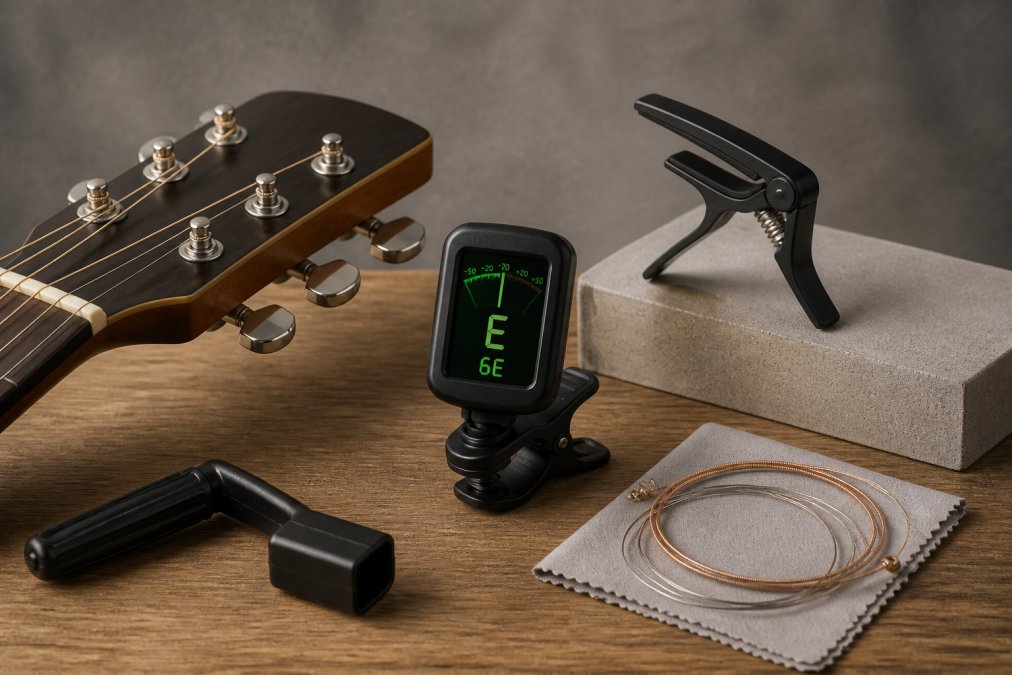
Most clip-on tuners show a note letter and a needle or light that centres when you hit the target pitch. Watch the letter first: it’s easy to drop a string a whole extra step past D or G by accident, especially on the wound low strings.
Workflow B: tuning by ear
If you don’t have a tuner handy, use the strings that aren’t changing as reference points. Loosen the low E string and match it to the open D string (4th string) an octave down, checking by playing them one after another. Do the same with the A string, matching it to the open G-string (3rd string) an octave down. Finally, loosen the high E string until it matches the open D string in pitch, an octave up this time. This comparison method, checking altered strings against the ones that stay put, is a standard approach for players without a tuner to hand, according to OpenTuning.co.uk.
Pro Tip: Always tune down into open G rather than up. Loosening a string is safe; tightening one that’s already near pitch risks snapping it, especially on older or worn strings.
Take your time with the first pass. String tension shifts across the whole neck as you detune three strings, so a string you tuned first may drift slightly by the time you’ve finished the last one. A second pass, adjusting each string a touch, is normal and expected.
How do you know your open G tuning is correct?
Once you’ve worked through both strings, or all six by ear, strum the open strings and listen. A properly tuned open G rings out as a clean G major chord, no clashing or muddy overtones. If something sounds off, it’s usually one string that’s landed a half step away from its target rather than a whole step.
Two fretted checks confirm you’re properly set up for playing chord progressions in the key of G:
- Barre straight across the 5th fret: this should sound like a clean C major chord, the IV in the key of G.
- Barre straight across the 7th fret: this should sound like a clean D major chord, the V in the key of G.
This open-chord-plus-barre method is a fast way to confirm you’ve got a usable I to IV to V without learning new fingerings, a check recommended by OpenTuning.co.uk and echoed in the standard Acoustic Guitar tuning walkthrough.
One string, three whole-step checks: confirming open G takes exactly three quick tests: the open strum, the 5th-fret barre and the 7th-fret barre, according to Acoustic Guitar. If all three sound clean, you’re in tune.
If something’s still not right, work through the usual suspects. A slipping nut slot can let a string creep flat within minutes of tuning up. A loose bridge pin on an acoustic causes a string to buzz or lose tension unpredictably. Old, worn strings simply won’t hold a new tuning reliably, no matter how carefully you retune them.
String gauges and setup tips for a stable open G
Dropping three strings by a whole step each loosens overall string tension across the neck, and that shift can affect how the guitar plays and sounds. Some players switch to a slightly heavier gauge set specifically for open tunings, since the extra tension helps compensate for the drop and can reduce string rattle against the frets.
- Heavier gauge strings can restore some of the tension lost from detuning, useful if you spend a lot of time in open G.
- A guitar that buzzes or feels different in open G may need its action or neck relief checked, since the change in string tension can alter how the neck sits.
- New strings stretch and settle over the first few play sessions, so expect to retune a couple of times after restringing.
Pro Tip: Tune down slowly and in small increments rather than dropping a string straight to pitch in one go. This gives the neck and strings time to settle and reduces the chance of an unexpected snap.
Slide players often go a step further and remove the low sixth string entirely, tuning the remaining five to G, D, G, B, D. This five-string approach, associated with Keith Richards’ rhythm playing, frees up low-end space and simplifies chord shapes to something closer to one-finger barres, according to the MusicRadar lesson on his approach. If your open G tuning regularly drifts or the intonation feels off higher up the neck, that’s usually a sign the guitar would benefit from a proper setup rather than more retuning.
What can you play in open G right now?
Open G rewards players almost immediately because so much of its appeal comes from open strings ringing under simple shapes. It’s a mainstay of blues slide playing, and it underpins a lot of folk fingerpicking, including the alternating-bass style associated with Elizabeth Cotten. Jimmy Page used open tunings on several acoustic Led Zeppelin tracks, and Keith Richards built much of the Rolling Stones’ guitar sound around a five-string open G.
A few things to try straight away:
- Strum a simple I to IV to V progression: open strings for G, barre the 5th fret for C, barre the 7th fret for D.
- Learn a two-finger G chord shape and move it up and down the neck to find other chords quickly.
- Slide a bottleneck or slide bar along the 3rd string while keeping the others muted for a basic blues lick.
If you’re working from a recording, check whether the guitarist used a capo, since that shifts everything up while keeping the same open G shapes. Start slow with a metronome before matching the original tempo.
What most tuning guides get wrong about open G
Most guides treat open G as a party trick: retune, strum a chord, move on. That undersells it. The real value of open G is how much playable material three simple string changes unlock, full chords from one finger, drone textures for free, an entire slide vocabulary that standard tuning makes needlessly awkward.
The advice that wastes people’s time is the insistence that you need a tuner to do this properly. You don’t. The ear-based comparison method, checking altered strings against ones that stay fixed, then confirming with the open strum and two barre checks, is just as reliable and teaches you to actually hear pitch relationships rather than watch a needle.
Where beginners go wrong is skipping the fretted checks. Anyone can strum six open strings and hear “a chord.” Fewer people bother confirming the 5th and 7th fret barres, and that’s exactly where a string sitting a half step off tends to hide. Do the full three-part check every time, not just the easy part.
— Music
Get set up for open G with a professional guitar shop
Switching tunings regularly puts extra demands on your strings, your nut and your neck, and that’s where a proper setup, service or repair earns its keep, particularly if you’re finding your open G drifts within a session or two.

For slide and alternate-tuning players, a good capo is worth having on hand even if you don’t use one on every song. The G7Th Newport Partial5 0218 is built for partial capo work, useful if you want to experiment with altered open-string voicings on top of open G. The G7Th Ultra Light Green suits players who want minimal tuning pull when clamping across all six strings, and the G7Th Newport Classical 0188 is designed for the flat fingerboard radius of classical and Spanish guitars if you’re exploring open tunings on nylon strings.
If your current set is past its best, our guitar strings collection covers a range of gauges suited to open tunings, and our in-store restring service can get you set up correctly the first time. Browse the range online or bring your guitar in for a hands-on look.

Sources
For a full written walkthrough of the standard-to-open-G conversion, see Acoustic Guitar’s tuning guide, which covers the string changes and verification steps in detail. For songs, riffs and further playing ideas once you’re tuned up, Acoustic Guitar’s lesson on playing in open G is a solid next stop. OpenTuning.co.uk also runs through both tuner and ear-based methods for players without equipment handy.
- How to Go from Standard to Open-G Tuning | Acoustic Guitar
- Open G tuning for guitarists | OpenTuning.co.uk
- Keith Richards-style open G tuning lesson | MusicRadar
FAQ
What songs are tuned to open G?
Open G is closely associated with Keith Richards’ rhythm playing on many Rolling Stones tracks, often using his five-string GDGBD approach. It also appears widely in blues slide playing and folk fingerpicking styles, including music associated with Elizabeth Cotten, and on some acoustic Led Zeppelin tracks recorded by Jimmy Page.
How to tune the key of G?
To tune your guitar into open G, lower the 6th string from E to D, the 5th string from A to G, and the 1st string from E to D, leaving the middle three strings unchanged. Strumming all six open strings should then ring out as a full G major chord, ready to play in the key of G.
Is open G tuning easier?
Open G makes full chords easier to play since strumming the open strings already gives you a G major chord, and moving a simple barre shape up the neck covers many other chords. It does mean relearning some fingerings you already know in standard tuning, so it’s a trade rather than a straightforward upgrade.
How to open G?
Detune three strings from standard tuning: the low E string down to D, the A string down to G, and the high E string down to D. Confirm you’ve got it right by strumming the open strings for a G chord, then barring the 5th fret for C and the 7th fret for D.






Share:
How to Test an Electric Guitar in Store: 2026 Guide