


Drop C tuning is C–G–C–F–A–D, with the low string sitting a fourth below standard E. The fastest reliable way to get there is a chromatic or clip-on tuner, or a polyphonic drop pedal, followed by a quick intonation check at the 12th fret. String gauge and a professional setup often make the difference between a guitar that merely reaches Drop C and one that actually plays well there; for more insights on capturing great guitar tones at lower tunings, see How To Properly Record Guitars - Twisby Records.
Table of Contents
- Quick steps: a four-action checklist to tune to Drop C now
- Three reliable methods: by-ear, microphone or phone tuner, and clip-on or pedal
- String gauge and setup advice for Drop C: what to change and when to book a pro
- Troubleshooting: solving buzz, floppy low string and tremolo problems
- How chord shapes and riffs change in Drop C and quick shapes to try
- When to ask a pro: setup and restring services explained
- Our take on tuning down without overthinking it
- Practical kit: quick recommendations for tuning and setup
- FAQ
- Sources
Quick steps: a four-action checklist to tune to Drop C now
If you just need the guitar in tune before a rehearsal or a take, this gets you there in a few minutes.
- Switch on your tuner, or set your phone app to chromatic mode, and play your low E string as a reference.
- Drop the low E string two whole steps to C, then drop the A string one whole step to G, leaving D, G, B and E in their usual relative positions below their new reference points as described in Open G Tuning’s Drop C method.
- Check the 12th-fret harmonic against the fretted note on the low string: if they do not match, the saddle may need adjusting.
- Re-tune once more after stretching the strings by hand, then strum a few power chords to confirm everything holds.
That sequence works whether you are using a clip-on, a pedal or your ears. The real test comes next: does the tuning survive bending, palm muting and a few minutes of playing, or does it drift?
Three reliable methods: by-ear, microphone or phone tuner, and clip-on or pedal

Each method suits a different situation, from a quiet bedroom session to a noisy stage.
By ear, using fret comparisons, works without any gear and sharpens your listening in the process. Drop the low E to C, then check the 9th fret of the low C string against the open G string, the 7th fret of the G string against the open C (fourth string), the 5th fret of that C against the open F, the 4th fret of the F against the open A, and the 5th fret of the A against the open D, following the sequence Open G Tuning sets out.
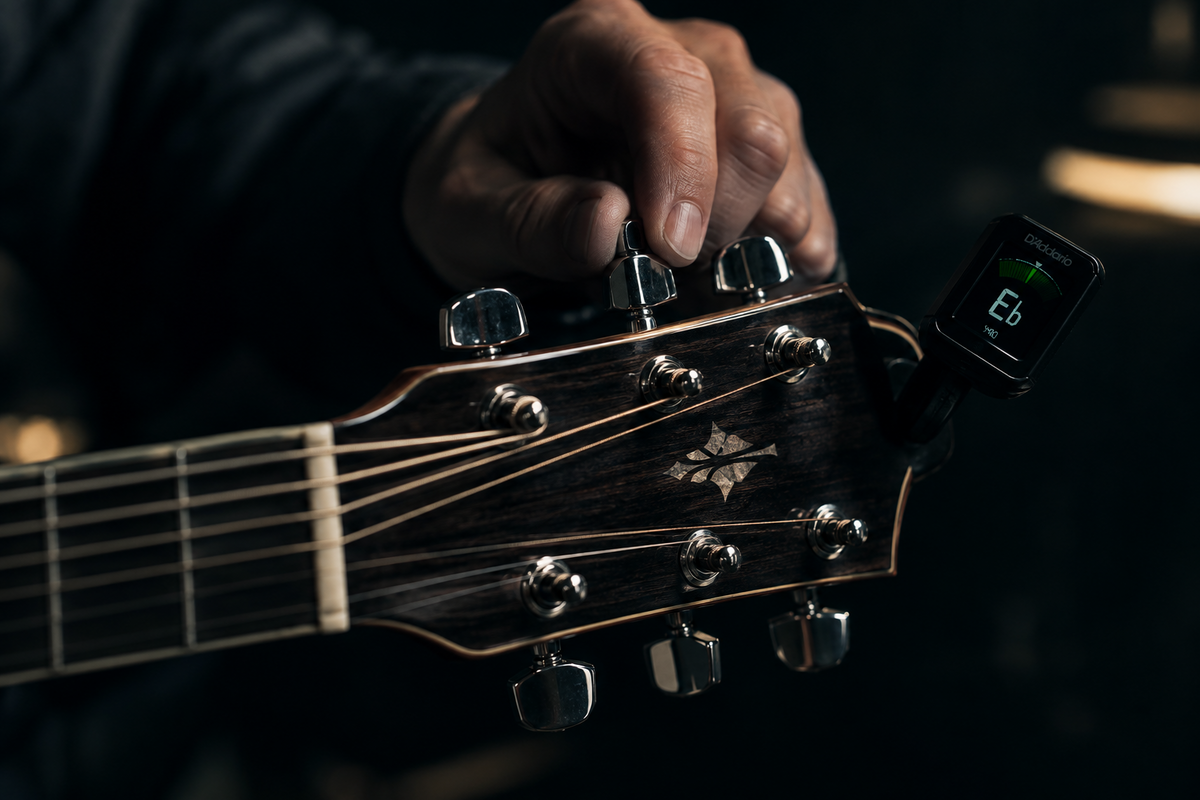
Microphone or phone tuners are the most practical choice for most players. Set the app to chromatic, name each target as you go (C, G, C, F, A, D) and walk each string down slowly, watching for the needle or display to settle rather than jump.
- Peg slippage is the most common fault: if a string keeps sliding flat, check the winding at the tuning post.
- Slow, uneven winding causes false readings, so turn each peg in small, steady movements.
- Fresh strings need stretching by hand a few times before they hold a lower pitch reliably.
Clip-on tuners read vibration through the headstock, which makes them fast and reliable even in a noisy room, while a polyphonic drop pedal such as the DigiTech Drop shifts your whole guitar’s pitch electronically, letting you switch tunings mid-set without touching a single peg.
Pro Tip: Stretch new strings firmly after the first tuning pass. Skipping this step is the single biggest cause of a Drop C guitar going flat within minutes.

String gauge and setup advice for Drop C: what to change and when to book a pro
Tuning the low string down two whole steps removes a meaningful amount of tension, and that slack is what makes a stock set feel floppy and buzz against the frets, as the Yamaha guide to guitar tunings explains. Heavier or mixed gauges restore some of that lost tension and keep the feel closer to what you are used to.
- A traditional light set (.009 to .042) tends to feel loose and buzzy once dropped to C.
- Many players move to a mixed set, keeping standard gauges on the top strings but fitting a heavier wound string, such as a .052 or .056, on the bottom.
- Dedicated Drop C or baritone sets are built with this balance already worked out.
A truss-rod adjustment, saddle intonation and sometimes nut work are what a proper setup covers, and lowering your tuning by two whole steps is exactly the kind of change that justifies booking one, since neck relief that suited standard tuning rarely suits Drop C without a tweak.
As an interim step at home, you can raise the action slightly at the saddle to reduce buzz, but a truss-rod adjustment is not something to guess at: get it wrong and you risk a back-bowed neck or stripped threads, so leave anything beyond a minor tweak to a qualified technician.
Troubleshooting: solving buzz, floppy low string and tremolo problems
Most Drop C problems trace back to tension, relief or intonation, and they usually respond to a specific fix rather than a full setup.
- Buzzing on the low strings often means the neck has too little relief for the new tension; a small truss-rod adjustment or a slightly higher action at the saddle usually clears it.
- A floppy, flubby low string is best solved with a heavier wound gauge rather than more tuner turns, though capoing at the second fret and tuning up from there is a usable short-term fix.
- Floating bridges tend to tip forward when one string drops in tension, pulling every other string sharp; a temporary fix is a block of wood behind the bridge, but a proper setup rebalances the springs for the new tuning.
- Check low-string intonation by comparing the 12th-fret harmonic with the fretted note, and if they disagree, the saddle needs moving, a job the Joshua Humphrey Drop C# guide also recommends after any significant retuning.
How chord shapes and riffs change in Drop C and quick shapes to try
Drop C turns the bottom three strings into a single-finger power chord shape, which is the main reason guitarists reach for it.
- Bar one finger across the low C, G and C strings at any fret to get a full power chord instantly, no second finger needed.
- Standard open chords such as E and A no longer sit where you expect, so most players either transpose shapes up or stick to the barred power-chord approach instead.
- Palm mute the low C string for a tight, percussive chug, then let it ring open underneath a riff for a doubled, bass-like low end.
- Try simple two-fret movements on the bottom strings, since the wide spacing between C and the rest of the tuning makes small shifts sound dramatic.
Drop C shows up often in metal and hard rock for exactly this reason: it delivers a heavier, darker low end and lets guitarists play riffs that sit closer to bass range, a pairing the Yamaha tunings guide also notes. Compared with Drop D, Drop C adds a full extra step of depth, while Drop B pushes further still and usually demands an even heavier string set to stay playable.
When to ask a pro: setup and restring services explained
A tuner gets your guitar to pitch, but it will not fix a neck that was relieved for standard tuning or a saddle set for a different gauge. Our guitar setups, servicing and repairs cover truss-rod adjustment, saddle intonation and restringing, and our in-store restring service handles the gauge change itself if you would rather not do it yourself. If you are hearing persistent buzz, a bridge that tips every time you tune down, or intonation that will not settle no matter how carefully you adjust the saddle, that is the signal to book a setup rather than keep tweaking at home.
Our take on tuning down without overthinking it
Most guides on this topic spend too long on theory and not enough on what actually happens the first time you drop your low E to C: the guitar buzzes, the bridge tips, and the tuning will not hold through a single song. The fix is rarely more patience with the tuner. It is almost always tension, relief or intonation, three things no amount of careful ear-tuning will solve on their own.
Our honest view is that players overvalue the tuning method and undervalue the setup. A clip-on tuner gets you to pitch in thirty seconds either way, so the method barely matters. What matters is whether the instrument was built to hold that pitch in the first place. If you play in Drop C regularly, prioritise a heavier low string and a proper setup before you spend any more time comparing tuning apps. Get the instrument right once, and every tuning session afterwards becomes the quick job it should be.
— Music
Practical kit: quick recommendations for tuning and setup
Getting into Drop C reliably comes down to having the right tool for how you play, then backing it up with a setup if the guitar needs one. For home practice and recording sessions, the D’Addario Eclipse Tuner gives a precise chromatic reading you can trust string by string. For gigging, the DigiTech Drop pedal lets you shift the whole guitar’s pitch instantly between songs without retuning by hand.
- Travelling light or tuning quietly backstage: the Aria Act-01 Clip On Tuner reads string vibration directly, so it works even over a noisy room.
- DIY tuning covers most players most of the time, but once buzz, bridge movement or intonation issues show up, a professional setup sorts the instrument properly rather than papering over it.

If your guitar has never been set up for a lower tuning, that is the next worthwhile step before your next session.
FAQ
What bands tune to Drop C?
Drop C is widely used across metal and hard rock, where the heavier, darker low end suits riff-driven songwriting. The Yamaha tunings guide notes that lower tunings like this also let guitarists play riffs that overlap with a bass’s normal range.
What is BDDDDD tuning?
BDDDDD tuning is not covered by the sources behind this guide, and definitions for unusual tuning names vary between players and forums. If you are after a specific extended-range tuning, it is worth checking with the manufacturer of your instrument’s string gauge recommendations before experimenting.
How do you play in Drop C tuning?
Bar one finger across the lowest three strings at any fret for an instant power chord, since Drop C lines those strings up a fifth and an octave apart. Many standard open-chord shapes need transposing further up the neck, so most players lean on power chords and simple two-fret movements instead.
What is Drop C tuning good for?
Drop C gives a heavier, lower tone that suits riff-based styles like metal and hard rock, and it makes one-finger power chords possible across the bottom three strings. It also lets a guitar reach down into territory closer to a bass, which is why it appears often in genres built around low, heavy riffing.
Does Drop C tuning need heavier strings?
Dropping two whole steps reduces string tension noticeably, and the Yamaha guide recommends heavier or mixed gauges to keep the feel tight rather than floppy. A mixed set with a heavier wound low string is a common starting point, alongside a setup to match the neck relief to the new tension.
Sources
- The beginner’s guide to guitar tunings — Yamaha
- How to tune to Drop C from standard | Open G Tuning
- Joshuahumphrey






Share:
Yamaha Pacifica 112V: Is It the Right Guitar for You?