

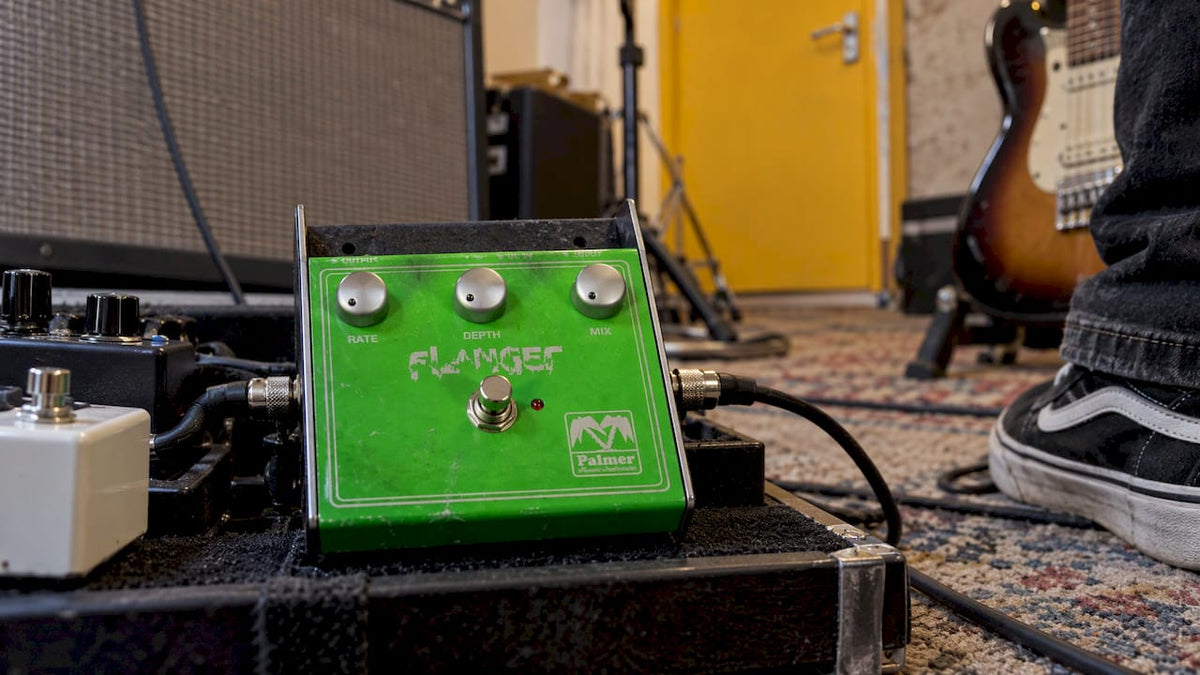
A flanger makes your guitar sound as if it is being swept by a jet engine. It copies your signal, delays the copy by a tiny amount and mixes it back with the original, while that delay is constantly moved up and down. The result is a swirling, metallic whoosh that rises and falls in pitch-like waves. MusicRadar’s guide describes it in the same terms: a delayed copy mixed with the original, with the delay gradually varied to produce the sweep.
Below we explain what is happening to the signal, what each knob changes, how a flanger differs from a phaser and a chorus, where it sits in your pedalboard and how to get usable sounds out of it rather than a permanent seasick wobble.
Table of Contents
- What a flanger actually does to your guitar signal
- What each flanger control changes
- Flanger vs phaser vs chorus
- What a flanger sounds good on
- Should a flanger go before or after distortion?
- How to choose a flanger pedal
- Building it into a pedalboard
- Our view on flangers
- Get your sound sorted with MusicStreet
- FAQ
- Sources
What a flanger actually does to your guitar signal
Think of a flanger as a very short, moving echo that is so close to the original sound that you never hear it as an echo. You hear it as a change in tone.
Here is the process in plain steps:
- Your guitar signal is split into two paths.
- One path stays untouched (the dry signal).
- The other is delayed by a few milliseconds. Native Instruments puts the delay at usually less than 20 milliseconds, while iZotope gives a typical flanger range of 1 to 5 milliseconds.
- The delay time is moved continuously, normally by a low frequency oscillator (LFO).
- The two paths are summed together and sent on to your amp.
Because the copy is so similar to the original, some frequencies line up and get louder while others arrive opposite in phase and cancel. That pattern of boosts and cuts is called comb filtering. Sound On Sound describes it as regularly spaced peaks and dips whose positions depend on the delay time. Change the delay, and the peaks and dips slide up and down the frequency spectrum. That sliding is the sweep you hear.
Why it sounds metallic and resonant
iZotope’s Nick Messitte points out that flanging is more resonant and metallic than chorus, because the delayed copy stays so close to the original that the interference, both constructive and destructive, is strong. A chorus uses a longer delay, so the copy sounds more like a second player. A flanger’s copy is too close to hear separately, so you hear only the tonal colouring.

Where the name comes from
The effect predates pedals. The academic text Physical Audio Signal Processing traces classic flanging to two synchronised tape machines playing the same recording. An engineer would touch the flange of one tape reel to slow it slightly, so the timing between the two machines shifted and the whoosh appeared. Modern pedals do the same job with electronics instead of a thumb on a reel.
What each flanger control changes
Pedals differ in layout, but most flangers share a handful of controls. Learning these four gets you through almost any unit.
| Control | What it changes | What it sounds like |
|---|---|---|
| Rate (or speed) | How quickly the delay time moves | Slow: gentle breathing movement. Fast: an obvious, rapid warble |
| Depth (or width, amount) | How far the delay is modulated | Low: a subtle shimmer. High: a wide, dramatic sweep |
| Manual (or delay) | The starting delay time the sweep centres on | Low: higher, thinner sweeps. High: lower, hollower sweeps |
| Feedback (or resonance, regeneration) | How much of the output is fed back into the input | Low: soft colouring. High: ringing, metallic, almost vocal intensity |
The first two come straight from Native Instruments’ explanation: low rates create subtle, slow movement, faster rates a more obvious warble, and depth controls how far the delay is modulated and so how wide the sweep becomes. Manual and feedback are named differently from pedal to pedal, so check the labels on yours.
A starting point for settings
If you have just plugged one in and the sound is overwhelming, try this:
- Set rate to roughly nine o’clock, so the sweep takes a few seconds.
- Set depth to around half.
- Keep feedback low, then raise it slowly until the effect has character without sounding harsh.
- Set the mix (if your pedal has one) so the flanging sits behind your playing rather than on top of it.
Then move one knob at a time. The point is to learn what each one does to your own guitar and amp, because pickups, gain levels and playing style all change how a flanger behaves.
Flanger vs phaser vs chorus
These three effects are cousins, and they get confused constantly. The difference is in how they build the swirl.
| Effect | How it works | Character |
|---|---|---|
| Flanger | Mixes the signal with a short, modulated delay | Deep, resonant, metallic, jet-like |
| Phaser | Shifts phase using all-pass filters, no delay | Softer, more vocal, gentler swirl |
| Chorus | Mixes with a longer modulated delayed copy | Shimmering, thickened, like two players in unison |
According to Sound On Sound, a flanger produces harmonically related notches, while a phaser typically produces two to six notches that are not harmonically related. Premier Guitar says the same thing from the player’s side: phasing needs no delay, while flanging uses 1 to 5 milliseconds of delay and swept, harmonically spaced notches that cause deeper cancellations. Its writer Tony Miln sums up the central point neatly: chorus and flanging use a modulated delayed signal, while phasing relies on phase-shifting filters without a delay line.
In practice, here is how to choose:
- Want drama and an obvious special effect? Flanger.
- Want a smoother, vintage swirl that stays in the background? Phaser.
- Want width and shimmer on clean or acoustic-style tones? Chorus. If you play bass, a dedicated bass chorus pedal is built for low-end clarity, and a classic analogue chorus is a good reference point for how the two effects differ side by side.
A good flanger can also cover ground beyond the jet sound. With the right settings it can drift into chorus-like thickening or vibrato-style wobble, and some designs offer extras. Sound On Sound’s review of a modulation plug-in suite notes that flangers can offer LFO, manual or envelope-follower modulation, stereo widening and through-zero operation, which makes the sweep more dramatic or more responsive to your playing than a basic cyclic effect.
What is through-zero flanging?
Through-zero flanging is the closest a pedal gets to the original tape trick. Instead of the delayed signal always trailing the dry one, the delay can pass through the point where the two are perfectly aligned, so the sound cancels almost completely for an instant and then swoops back. It gives the biggest, most theatrical sweep. If you hear a player describe a flanger as huge or cinematic, a through-zero design is often behind it.
What a flanger sounds good on
A flanger is a seasoning, not a main course. Used all the time it becomes tiring quickly, which is why it fell out of fashion as an always-on effect. Used deliberately, it is memorable.
Lead lines and solos
A slow flanger behind a sustained lead note gives it motion without changing the notes. Raise feedback a little and the sustain takes on a singing, ringing quality. Premier Guitar suggests, in its guide to flangers and phasers in recording, placing flanging on the reverb or delay return of a solo, so the tails move while the dry note stays solid.
Rhythm parts and chords
Open chords played through a flanger with a slow rate and moderate depth sound wide and animated. Palm-muted riffs through a high-feedback flanger can sound mechanical and tense, a good fit for darker or heavier material.
Short moments, not whole songs
The same Premier Guitar piece recommends using the effect briefly: automating it in selected sections, or using it on a bridge, an interlude or a verse to add movement. On a pedalboard, that translates into a pedal you stamp on for one section and switch off again. That restraint is what stops it sounding like a gimmick.
Bass
Bass can take a flanger well, but low frequencies can thin out. Keep the mix lower than you would for guitar, or use a unit with a blend control so your low end stays intact.
Should a flanger go before or after distortion?
This is one of the most common questions about the effect, and the answer depends on what you want to hear.
- Flanger before distortion: the flanger modulates your clean-ish signal and the drive then reacts to it. The sweep feels more integrated, a bit chewier and less obvious. With very high gain it can lose some clarity.
- Flanger after distortion: the flanger processes an already saturated, harmonically rich signal. The swirl is pronounced and metallic, very clearly audible, and can feel dramatic over heavy distortion.
The usual rule of thumb on pedalboards is that time-based and modulation effects live after gain pedals, which is also the “after distortion” option above. But nothing breaks if you swap them, and the only reliable test is your own ears with your own amp. Try both orders with the same riff, same settings and a few seconds of playing each, then keep the one you like.
If you use a flanger in a recording rather than live, Premier Guitar offers one caution: applying it across a full mix can remove energy when phase interactions add up. Keep it on the guitar track, or on a return, rather than across everything.
How to choose a flanger pedal
The choice comes down to a few practical questions.
- How often will you use it? If it is an occasional colour, a simple unit with rate, depth and feedback is plenty. If you want to experiment, look for extra controls such as a manual knob, through-zero mode or tap tempo.
- Analogue or digital? Analogue units tend to be prized for a warm, slightly rough sweep. Digital units are usually more flexible and often offer more modes and presets. Both can sound excellent.
- Mono or stereo? Stereo outputs let the sweep spread across two amps, which makes the effect sound bigger on stage.
- True bypass or buffered? This affects how the pedal behaves with the rest of your board. If you run a long chain of pedals, ask about it before buying.
- New or pre-owned? Plenty of pedals are built to last for decades, so a carefully inspected used one can be a sensible way into the effect.
If you want to hear a flanger before committing, a pre-owned one is a low-pressure way to try the sound. We currently list a used Palmer flanger, and stock changes regularly, so it is worth checking what has arrived.
If you would rather have a bit of everything in one box, a multi-effects unit puts flanging alongside chorus, delay and more. Our range includes a portable multi-effects processor, a compact multi-effects pedal and a floor-based multi-effects unit. They are a good place to compare how flanging sits against other modulation sounds.
Building it into a pedalboard
Once you have a flanger, think about its neighbours.
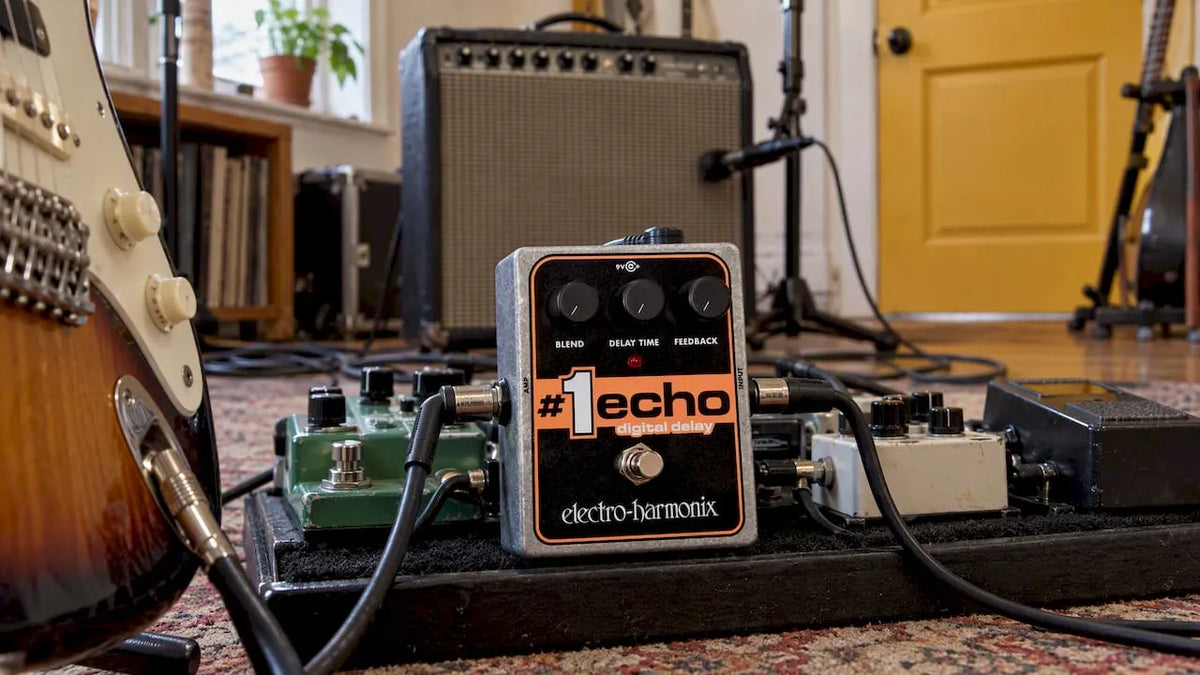
- With delay: a flanger before a delay makes the repeats swirl as well. A flanger after a delay sweeps everything including the repeats. A vintage-style delay pedal is a natural partner for experimenting with both.
- With reverb: put reverb after the flanger for a washed-out, ambient sweep. A reverb pedal after a flanger is a simple, effective pairing.
- With other modulation: running a flanger and a chorus together is possible, but keep one subtle. Two strong sweeps at different speeds can sound messy.
- With a looper: a looper lets you record a rhythm part and play a flanged lead over it, or the reverse. Our listings include a delay and looper pedal if you want to try that approach.
Our view on flangers
We think a flanger is one of the most misunderstood pedals on the board. People hear it once on an old record, decide it is a novelty and never try it again. In fact, the effect rewards a gentle hand: slow rate, modest depth, and a switch you press only when the song needs a lift.
When customers come to us curious about modulation, the most useful thing we can do is let them hear it through a real amp. Pedals interact with pickups, gain and the room, so a flanger that sounds wonderful in a video can feel completely different with your guitar. That is why we put so much weight on trying instruments and gear properly, and why we check and set up each instrument before it goes out.
If you are unsure whether a flanger, a phaser or a chorus suits your playing, tell us what music you play and what amp you use. We would rather help you find the one sound you will reach for every week than sell you three pedals that stay off.
Music
Get your sound sorted with MusicStreet
We are a guitar retailer with an online shop and a physical store in Huntingdon, Cambridgeshire. Our effects range includes new and pre-owned pedals, and our team can talk you through which modulation effect fits your guitar and amp.

Browse our effects and the rest of the shop online, or pop into the store to try pedals through an amp. If you are building a rig around your new effect, take a look at our guitar amps and combos, our electric guitars and our guitar accessories such as cables and straps.
FAQ
What does a flanger pedal do?
A flanger pedal blends your guitar signal with a slightly delayed copy and keeps changing the delay time. This creates a swirling, jet-like sweep as frequencies cancel and reinforce each other. Rate sets the speed of the sweep and depth sets its width.
What is the difference between a flanger and a phaser?
A flanger uses a short modulated delay, which creates evenly spaced notches and a deep, metallic sound. A phaser uses all-pass filters instead of a delay, which gives fewer, unrelated notches and a smoother, softer swirl. Flangers tend to sound more dramatic, phasers more subtle.
Can I use a flanger on bass?
Yes. Bass players use flangers for movement and texture, especially on sustained notes and fills. Keep the mix or depth modest so the low end stays solid, and use a blend control if your pedal has one.
Should a flanger go before or after distortion?
Before distortion gives a more blended, chewier sweep. After distortion gives a more obvious, metallic swoosh. Both work, so try each order with your own amp and keep the one that suits the music.
Sources
- Guitar FX basics: What is a flanger? (MusicRadar)
- What is a flanger? How to use it in music production (Native Instruments)
- Understanding Chorus, Flangers, and Phasers in Audio Production (iZotope)
- How Phasers Work (Sound On Sound)
- Modulation Nation: Chorus, Phasing, and Flanging (Premier Guitar)
- Recording with DAW Flanger & Phaser Plug-Ins Guide (Premier Guitar)
- Flanging (Physical Audio Signal Processing)
- Arturia Modulations review (Sound On Sound)


Share:
TRRS Connector: Pinouts, Uses and Compatibility