

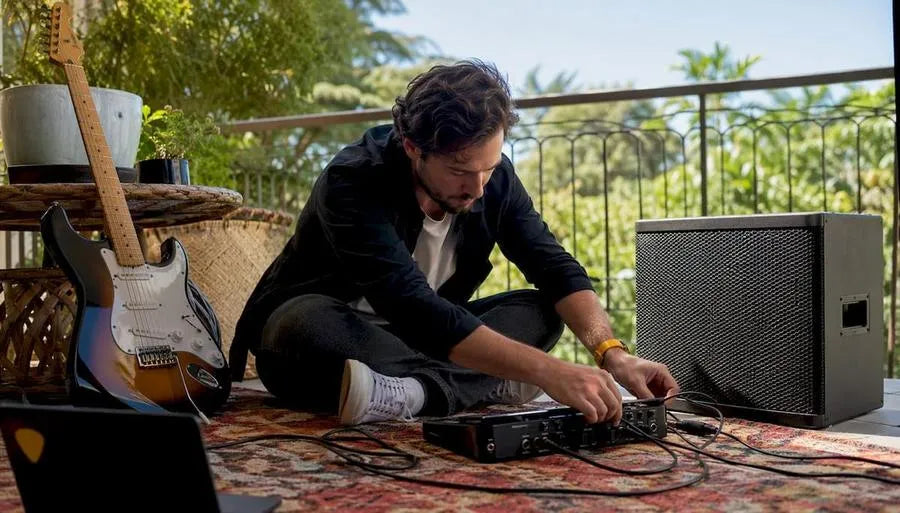
FRFR stands for Full Range, Flat Response. In speaker terms, it describes a cabinet designed to reproduce the entire frequency spectrum as neutrally as possible, without adding the tonal colouration that a traditional guitar cabinet deliberately bakes in. Where a standard 4×12 shapes your sound with a pronounced mid hump and a rolled-off top end, an FRFR speaker acts more like a compact PA or studio monitor: what goes in comes out, faithfully.
For guitarists running digital rigs, that neutrality is the whole point. Key contexts where FRFR speakers are used:
- Digital modelling rigs (Kemper, Line 6 Helix, Neural DSP Quad Cortex)
- Live stage monitoring where you control your own mix
- Home and studio recording for accurate tone playback
- Preset development and tone sculpting sessions
Table of Contents
- What does FRFR mean for your digital rig?
- How to match FRFR specs to your instrument and playing style
- How FRFR speakers differ from traditional guitar cabinets
- Why FRFR speakers work well in live and studio settings
- Musicstreet’s expert guidance on FRFR for UK guitarists
- The FRFR definition in full
- Why modellers need FRFR speakers
- Frequency response and tonal characteristics
- How to integrate an FRFR speaker into your guitar rig
- FRFR versus other amplifier simulation options
- Potential drawbacks of FRFR speakers
- Tips for setting up and calibrating your FRFR speaker
- Common FRFR speaker brands and models
- Musicstreet: guitars and gear for the digital age
- FAQ
- Key takeaways
What does FRFR mean for your digital rig?
If you use a modeller, the cabinet simulation or impulse response (IR) inside the device is already doing the job of a guitar cab. It is mimicking the sound of a mic’d speaker in a room. Feed that signal into a traditional guitar cabinet and you get double filtering: the cab sim colours the tone, then the physical cab colours it again. The result is muddy and undefined, and cab sim double filtering is one of the most common reasons modeller users struggle to get a clean, accurate sound on stage.
An FRFR speaker sidesteps that entirely. It presents the modeller’s output as a finished, mic’d tone at whatever volume you need, which is why it has become the standard pairing for digital modelling rigs. The tonal consistency you hear in the practice room is what the audience hears through the front-of-house system. No surprises, no venue-to-venue guesswork.
How to match FRFR specs to your instrument and playing style
Not all FRFR speakers are built equal, and the spec sheet matters more than the marketing copy. A few things to check before you buy:
- Frequency response floor: Standard guitarists need coverage down to around 80Hz, but bassists and players of 7- or 8-string guitars need response down to 40–50Hz to avoid losing the fundamental of low-tuned notes.
- Flatness rating: A ±3dB variance across the frequency range is the accepted benchmark for tonal accuracy. Wider variance means the speaker is colouring your sound more than it should.
- Power output: Practice-room volumes need far less headroom than a live stage. Higher-powered active FRFR units give you flexibility; lower-powered units may clip at gigging volumes.
- Driver configuration: Coaxial designs (tweeter centred in the woofer) tend to offer better stereo imaging and dispersion than separate driver arrays.
Choosing the right speaker cabinet based on your instrument’s range is not optional — it is the difference between hearing your tone accurately and wondering why your presets sound wrong.
How FRFR speakers differ from traditional guitar cabinets
A traditional guitar cabinet is not trying to be neutral. It is part of the instrument’s voice. A vintage-style 4×12 loaded with Celestion Greenbacks, for example, accentuates the upper midrange, softens the high end, and adds a physical resonance that players have chased for decades. That character is a feature, not a flaw, when you are running an analogue signal chain.
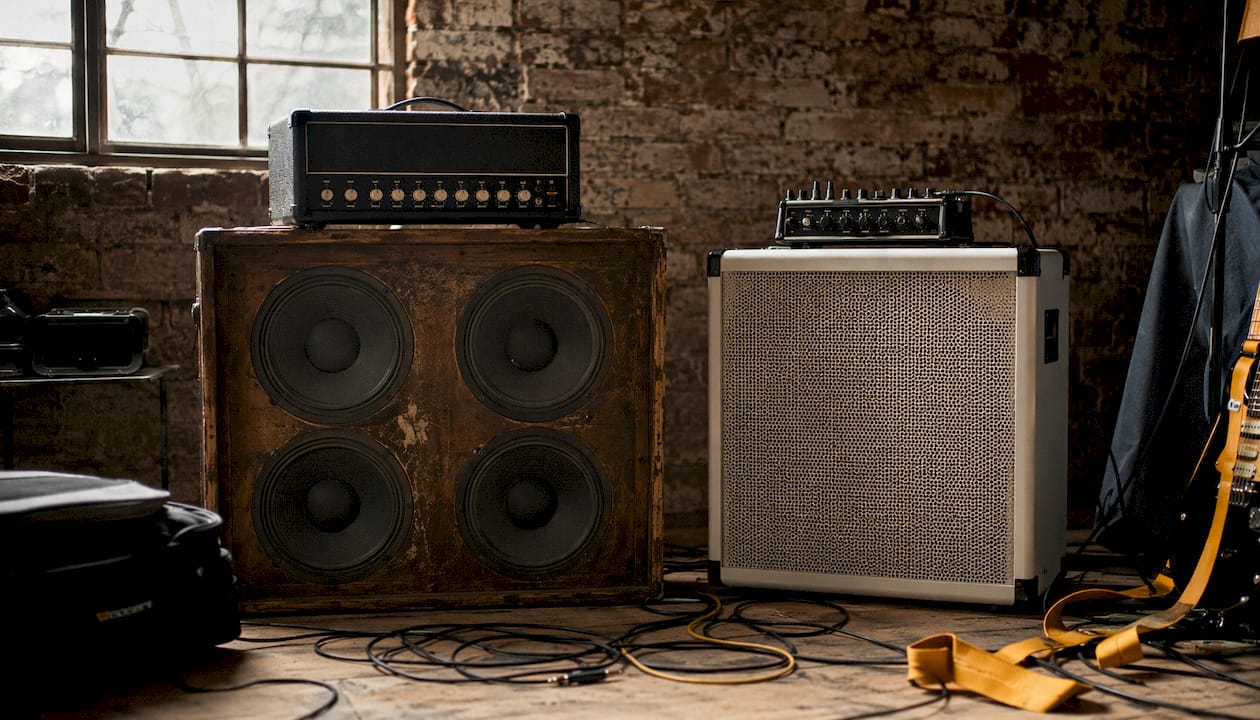
The problem arises when you pair that same cabinet with a digital modeller running cab simulation. The traditional cab’s coloration compounds the modelled cab’s character, and the two fight each other. FRFR speakers, by contrast, use full-bandwidth driver configurations — typically a woofer handling lows and mids alongside a tweeter for the high-frequency content — to cover the full spectrum without imposing a sonic signature. Think of it as the difference between a coloured lens and a clear one.
Analogue rig with a traditional cab: warmth, character, physical feel, but limited flexibility. Digital rig with FRFR: accuracy, portability, preset-to-preset consistency, and a direct signal path to front-of-house.
Why FRFR speakers work well in live and studio settings
On stage, the biggest practical advantage is consistency. Your FRFR speaker reproduces the same tone you dialled in at home, which means sound monitoring accuracy translates directly to performance confidence. You are not compensating for a cab that sounds different in a large room versus a small one.
In the studio or home recording setup, FRFR speakers serve a similar function to studio monitors: they give you a truthful picture of what your modeller is producing. That matters enormously when you are developing presets or mixing, because a flattering speaker hides problems that will surface the moment the track plays back on a different system. FRFR speakers also integrate cleanly with home recording workflows, since the signal going to your audio interface and the signal coming through your monitor are essentially the same thing.
Musicians who control their own stage mix independently from house monitors find FRFR particularly useful, since the speaker acts as a personal reference point that matches what the audience hears.
Musicstreet’s expert guidance on FRFR for UK guitarists
Selecting an FRFR speaker is straightforward once you know what to look for, but setup and integration trip up even experienced players. A few practical points from Musicstreet’s experience working with UK guitarists:
- Disable cab sim when using a traditional cab, enable it with FRFR. This is the single most common misconfiguration.
- Match the FRFR’s frequency floor to your lowest note. Drop-tuned or extended-range players need a speaker that reaches down to a suitably low frequency.
- Start with a flat EQ on the speaker itself. Let the modeller’s output do the tonal work; adding EQ at the speaker stage reintroduces the colouration you bought FRFR to avoid.
- Position matters. On stage, placing the FRFR at ear height (on a stand or tilted back) gives you a far more accurate reference than floor placement.
- Keep your rig maintained. A well-set-up guitar feeds a cleaner signal into your modeller, which means your FRFR speaker has better raw material to work with. The CruzTools Groovetech Guitar Player Tech Kit covers the essential adjustments — intonation, truss rod, saddle height — that keep your instrument performing at its best.
Pro Tip: Presets built on headphones often need EQ adjustment when transferred to an FRFR speaker. The stereo-to-mono fold on stage and the different acoustic environment mean what sounded balanced through headphones can feel harsh or thin through a speaker. Build your presets on the FRFR you will actually use live.
Musicstreet’s team in Huntingdon offers personalised consultation on FRFR setups, whether you are buying your first modeller or upgrading an existing rig. That kind of specific, one-to-one advice is harder to find than the gear itself.
The FRFR definition in full
FRFR: Full Range, Flat Response. A speaker designed to cover the complete audible frequency spectrum without imposing its own EQ curve on the signal. It is the opposite of a traditional guitar cabinet, which is deliberately voiced to complement analogue amplifier circuits.
Why modellers need FRFR speakers
The modeller’s job is to simulate an entire signal chain: amp, cabinet, microphone placement, and room. If you then run that output through a physical guitar cabinet, you are adding a second cabinet to a signal that already contains one. FRFR removes that conflict by acting as a transparent output stage. Guitarists using amp modellers consistently report that switching from a traditional cab to FRFR is the moment their modelled tones finally sound like the reference recordings they were chasing.
Frequency response and tonal characteristics
The frequency response curve of an FRFR speaker is its defining characteristic. A well-designed unit maintains output within ±3dB across its rated range, meaning the speaker adds minimal colouration of its own. Traditional guitar cabs, by comparison, have a pronounced peak in the 1–5kHz midrange and a steep roll-off above 6–8kHz. That is exactly the character cab simulations are designed to replicate — so pairing a cab sim with a traditional cab doubles the effect.
How to integrate an FRFR speaker into your guitar rig
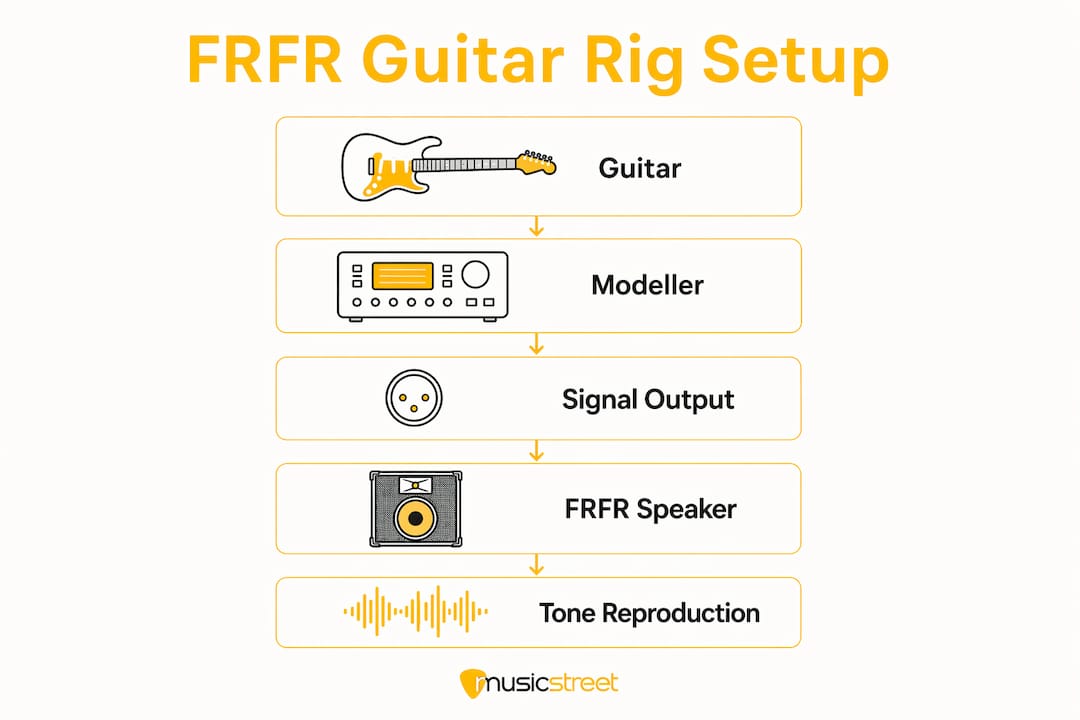
The signal chain is simple: guitar, modeller, FRFR speaker. The modeller’s output (XLR or jack) feeds directly into the FRFR’s input. Cab simulation stays on. The FRFR’s own EQ stays flat. From there, a parallel XLR output from the modeller goes to the front-of-house desk, so your stage sound and the audience’s sound are identical. No amp mic, no bleed, no variables.
FRFR versus other amplifier simulation options
| Option | Best for | Cab sim needed? |
|---|---|---|
| FRFR speaker | Full modeller rigs, live and studio | Yes |
| Traditional guitar cab | Analogue amps, preamp-only modellers | No |
| Studio monitors | Home recording, mixing | Yes |
| In-ear monitors | Silent stage, direct-to-desk rigs | Yes |
| Powered PA speaker | Budget FRFR alternative | Yes |
A powered PA speaker can function as a budget FRFR alternative, though its frequency response is often optimised for vocals rather than guitar, which can produce a harsh top end.
Potential drawbacks of FRFR speakers
FRFR is not the right tool for every situation. A few honest limitations:
- No physical feel. Traditional cabs move air in a way that FRFR speakers do not always replicate, which some players find affects their playing dynamics.
- Harsh with poor presets. A neutral speaker exposes every flaw in a badly dialled tone. There is nowhere to hide.
- Cost. Quality FRFR units are not cheap. Budget options often compromise on frequency flatness, which defeats the purpose.
- Learning curve. Getting the most from FRFR requires understanding cab sims and IR loading, which adds complexity for players new to digital rigs.
Tips for setting up and calibrating your FRFR speaker
Position the speaker at ear level, keep the onboard EQ flat, and disable any built-in voicing or guitar-mode settings the unit may have. Run a known reference track through it before your first session to confirm the speaker sounds neutral. Build and test presets in the environment where you will use them — a preset that works in a bedroom may need adjustment in a live room. Check your modeller’s output level to avoid clipping the FRFR’s input, since digital clipping is unforgiving.
Common FRFR speaker brands and models
Several manufacturers produce well-regarded FRFR units for guitarists. Headrush, Friedman, Laney (the Fresco series), and Powercab (Line 6) are among the most frequently recommended in the UK market. The Line 6 Powercab range is notable for offering both FRFR mode and voiced speaker modes, giving players flexibility depending on the session. For bassists and extended-range players, specialist units from LFSYS address the low-frequency extension that standard guitar-oriented FRFR speakers often lack.
Musicstreet: guitars and gear for the digital age

Musicstreet stocks a carefully chosen range of guitars and accessories suited to players building modern digital rigs. Whether you are pairing a modeller with a new instrument or looking for a pre-owned guitar that delivers the clean signal a digital chain demands, the team in Huntingdon can point you in the right direction. The Yamaha FGC-TA TransAcoustic is a strong example of how onboard processing and acoustic quality can coexist, while the used Ibanez GSR200 bass suits players who need a reliable low-end instrument for extended-range FRFR rigs. Browse the full range at Musicstreet and speak to the team directly for advice on matching your guitar to your rig.
FAQ
What does FRFR stand for in guitar terms?
FRFR stands for Full Range, Flat Response. It describes a speaker designed to reproduce the complete frequency spectrum neutrally, without the tonal colouration of a traditional guitar cabinet.
Do I need cab simulation with an FRFR speaker?
Yes. FRFR speakers are transparent, so you need a cab simulation or impulse response active in your modeller to replicate the sound of a mic’d guitar cabinet.
Can I use a PA speaker instead of an FRFR speaker?
A powered PA speaker can work as a budget alternative, but its frequency response is typically voiced for vocals, which can produce a harsh or unbalanced result with guitar signals.
What frequency response should an FRFR speaker have?
A variance of ±3dB across the rated range is the accepted standard for tonal accuracy. Bassists and extended-range guitarists should look for response down to 40–50Hz.
Where can I get advice on FRFR setups in the UK?
Musicstreet offers personalised consultation on digital rigs and FRFR gear from its store in Huntingdon, Cambridgeshire, with support available online and in person.
Key takeaways
FRFR speakers are the essential output stage for any guitarist running a digital modeller: they reproduce cab simulations accurately, maintain tonal consistency across venues, and eliminate the double-filtering problem that undermines modelled tones through traditional cabinets.
| Point | Details |
|---|---|
| FRFR definition | Full Range, Flat Response: a speaker that reproduces the full frequency spectrum without tonal colouration. |
| Cab sim is required | Always enable cab simulation when using FRFR; disabling it removes the cabinet character your tone depends on. |
| Flatness benchmark | A ±3dB variance rating indicates a speaker accurate enough for serious tone work. |
| Extended-range players | Bassists and 7- or 8-string guitarists need frequency response down to 40–50Hz to hear their lowest notes correctly. |
| Musicstreet | Offers expert consultation, pre-owned guitars, and accessories suited to digital rig builds across the UK. |


Share:
How to read bass guitar tabs: a beginner's guide
Different types of musical scales: a complete guide