


Think multi-effects pedals can’t match analog pedals in tone? Think again. Modern digital technology is redefining guitar sound quality. Today’s units combine dozens of effects, amp simulations, and versatile tone shaping in one compact device. This guide clarifies what multi-effects pedals are, their standout features, and how to choose the right one for your playing style.
Table of Contents
- Understanding Multi-Effects Pedals
- Core Features and Technological Advances
- Advantages of Using Multi-Effects Pedals
- Common Misconceptions and User Challenges
- Suitability for Different Skill Levels
- Choosing and Using Multi-Effects Pedals
- Conclusion: Enhancing Your Sound with Multi-Effects Pedals
- Explore Quality Guitars and Amplifiers at MusicStreet
- FAQ
Key Takeaways
| Point | Details |
|---|---|
| Definition and Function | Multi-effects pedals integrate multiple effects like distortion, delay, and reverb with amp modeling into one digital unit. |
| Setup Efficiency | These units reduce setup time by up to 70% compared to traditional pedalboards with individual stompboxes. |
| Cost and Space Benefits | One multi-effects pedal replaces dozens of individual pedals, saving money and drastically reducing rig size. |
| Skill Level Range | Models range from affordable beginner options around £100 to professional touring units costing £1,500 or more. |
| Key Buying Factors | Prioritize sound quality, interface usability, connectivity options, preset capacity, and price when choosing your pedal. |
Understanding Multi-Effects Pedals
A multi-effects pedal combines multiple guitar effects and amp modeling into one integrated unit. Instead of chaining separate pedals for distortion, delay, reverb, and modulation, you get everything in a single device. This streamlines your setup and opens up vast sonic possibilities.
These pedals typically include popular effects categories:
- Distortion and overdrive for gritty, aggressive tones
- Delay and reverb for spatial depth and atmosphere
- Modulation effects like chorus, phaser, and tremolo
- Compression and EQ for tone shaping and dynamics control
- Wah and filter effects for expressive playing
The core role of multi-effects units is enabling streamlined sound customization. You can quickly dial in complex tones that would require half a dozen individual pedals. Modern units also include amp and cabinet simulations, letting you replicate iconic guitar tones from vintage Fenders to high-gain Marshalls.
For guitarists new to effects, understanding guitar effects types helps you appreciate what these powerful devices offer. A detailed multi-effects overview shows how manufacturers pack studio-quality processing into portable formats.
Core Features and Technological Advances
Amp and cabinet simulations reproduce the characteristics of popular amplifiers and speaker cabinets. You can switch from a clean Fender Twin sound to a high-gain Mesa Boogie tone with a single button press. This eliminates the need to own multiple amps for different styles.
Preset storage is a game changer for live performance. Most multi-effects pedals store dozens or hundreds of complete sound configurations. You recall an entire effects chain instantly, perfect for switching between songs or sections within a song.
Digital signal processing advancements have significantly improved sound quality. Modern processors provide hundreds of realistic effect models and amp simulations rivaling traditional stompboxes. The gap between digital and analog tone quality has narrowed dramatically.
User interfaces vary widely across models:
- Entry-level units feature simple LCD screens with rotary encoders
- Mid-range pedals add colour displays and dedicated effect knobs
- Professional models include touchscreens and extensive footswitch arrays
- Some units integrate smartphone apps for deeper editing
Connectivity options expand your creative possibilities. MIDI support lets you sync with other gear, while expression pedal inputs add real-time control over parameters like wah or volume. USB connectivity enables firmware updates and direct recording to computers.
The evolution of amp modeling technology has made multi-effects pedals viable alternatives to traditional amplifiers. Professional touring musicians now rely on these units for consistent tone night after night.
Pro tip: Start with factory presets to understand available tones before diving into custom programming. This builds familiarity with the unit’s sonic capabilities and interface logic.
Advantages of Using Multi-Effects Pedals
Multi-effects units drastically reduce physical space requirements. A single pedal replaces what might be ten individual stompboxes on a traditional pedalboard. This matters whether you’re gigging in tight venues or practicing in a small bedroom.
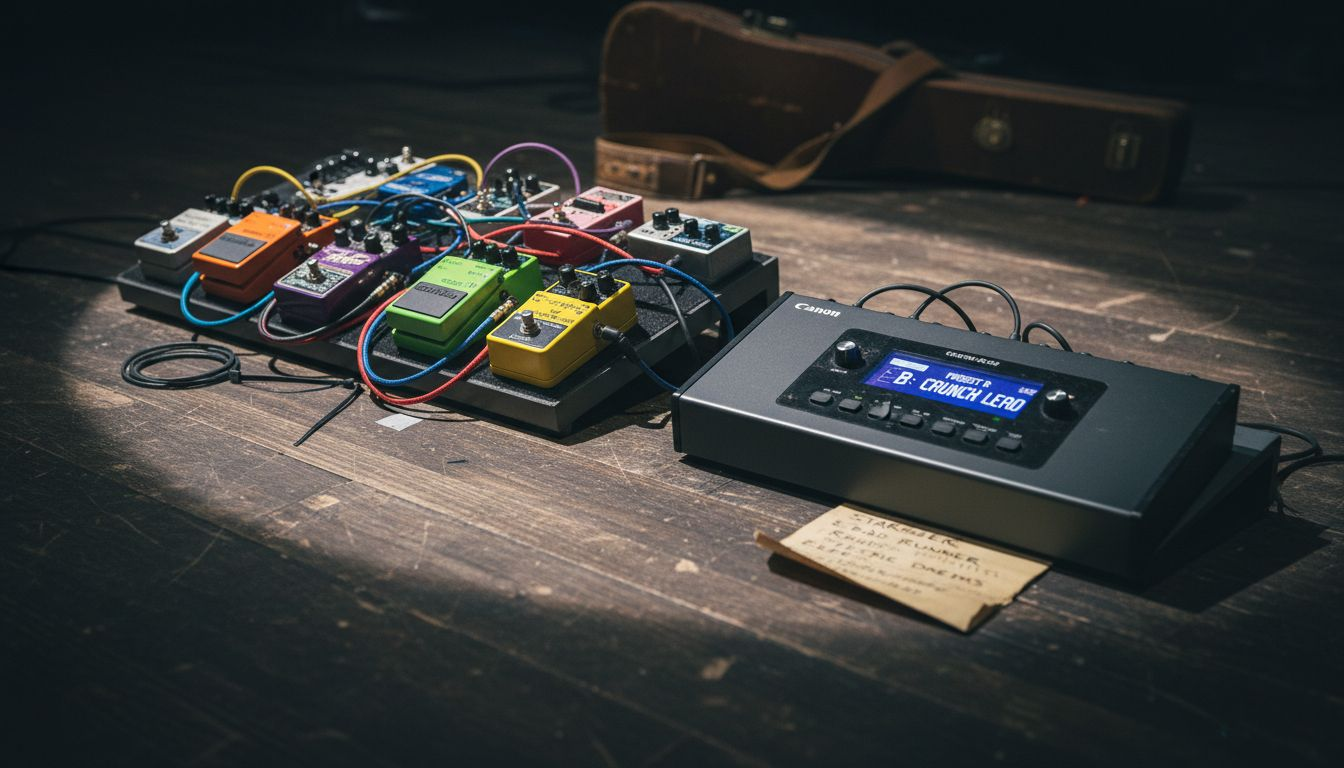
Rig simplification extends beyond space savings. You eliminate the cable spaghetti connecting individual pedals, reducing potential failure points and troubleshooting headaches. One power supply replaces multiple adapters.
Setup time is reduced by up to 70% compared to traditional pedalboards. You spend less time connecting cables and more time playing. For touring musicians, this efficiency translates to faster soundchecks and reduced stress.
The top advantages break down clearly:
- Space saving: One compact unit replaces an entire pedalboard
- Time saving: Quick setup, teardown, and preset recall during performance
- Cost efficiency: Hundreds of effects for the price of three to five individual pedals
- Versatility: Explore new sounds without buying additional hardware
- Portability: Carry your entire effects arsenal in a backpack
Preset access provides instant sound changes during live performances. You switch from a clean rhythm tone to a heavily effected lead sound with one footswitch press. This seamless transition is nearly impossible with multiple individual pedals.
Cost effectiveness becomes clear when you calculate individual pedal prices. Quality stompboxes range from £50 to £200 each. Building a six-pedal board costs £300 to £1,200. A mid-range multi-effects unit delivering equivalent sounds costs £200 to £400.
Understanding pedalboard setup basics reveals the complexity multi-effects pedals eliminate. Traditional setups require careful signal chain planning and power management that digital units handle automatically.
Common Misconceptions and User Challenges
Myth: Multi-effects pedals degrade tone quality. Reality: Modern DSP technologies closely replicate analog sound characteristics. High-end digital processing captures the nuances of vintage circuits with remarkable accuracy. The tonal differences between premium multi-effects and analog pedals are minimal in real-world playing situations.
Myth: These units are intended only for beginners. Reality: Professional musicians use high-end multi-effects pedals as industry standards. Artists touring stadiums rely on units like the Line 6 Helix or Fractal Axe-Fx for consistent, reliable tone. The professional market segment proves these tools serve all skill levels.
Myth: Multi-effects pedals are too complicated to use. Reality: Many units feature user-friendly interfaces with accessible preset systems. Manufacturers design beginner models specifically for ease of use. You can achieve great sounds without understanding every parameter.
User challenges do exist. 27% of new users report challenges with complex user interfaces and overwhelming options. The initial learning curve can feel steep when facing hundreds of effects and parameters.
Menu diving frustrates some players accustomed to the immediate tactile control of individual pedals. Adjusting a single parameter might require navigating through multiple screens. This contrasts with the one-knob-per-function simplicity of analog stompboxes.
The solution lies in gradual exploration. Start with factory presets that demonstrate the unit’s capabilities. Modify one or two parameters to understand how changes affect your tone. Build complexity as your comfort grows.
Resources like effects chain complexity guides and guitar pedals tips help newcomers navigate the learning process. Many manufacturers provide video tutorials demonstrating common programming tasks.
Pro tip: Invest time in manufacturer tutorials and online forums during your first week. This upfront learning investment pays dividends in long-term usability and creative possibilities.
Suitability for Different Skill Levels
Entry-level pedals provide wide sound variety and affordability for beginners. These units typically cost £100 to £200 and include 20 or more amp models with 50 plus effects. They’re perfect for discovering what effects you like without major financial commitment.
Mid-range units balance advanced features with manageable interfaces for progressing players. These pedals cost £300 to £600 and offer improved sound quality, more robust construction, and expanded connectivity. They suit gigging musicians who need reliability and tonal flexibility.
Professional-grade units deliver top-tier sound modeling and extensive control for touring and recording. Units like the Neural DSP Quad Cortex cost £1,500 or more but provide studio-quality processing and comprehensive MIDI integration.
| Model | Skill Level | Key Features | Price Range |
|---|---|---|---|
| Zoom G1X Four | Beginner | 60+ effects, 13 amp models, expression pedal, simple interface | £100-£130 |
| Valeton GP-200 | Intermediate | 100+ effects, 36 amp models, colour screen, dual footswitch modes | £250-£300 |
| Neural DSP Quad Cortex | Professional | Unlimited effects, advanced amp capture, touchscreen, extensive I/O | £1,500-£1,700 |
Each model targets specific user needs. The Zoom G1X Four gives beginners an affordable entry point with enough variety to explore different styles. The Valeton GP-200 provides intermediate players with gig-ready features and improved sound quality. The Neural DSP Quad Cortex offers professionals the ultimate flexibility and tone quality for demanding studio and stage work.
Skill level impacts feature requirements significantly. Beginners benefit from simple interfaces and preset variety. Intermediate players need reliable switching and moderate customization depth. Professionals require extensive routing options, MIDI capability, and pristine sound quality.
Exploring best pedals for all skill levels helps you understand where multi-effects units fit within the broader pedal landscape. Each player’s journey differs, but multi-effects pedals serve valuable roles at every stage.
Choosing and Using Multi-Effects Pedals
Sound quality tops the priority list when selecting a multi-effects pedal. Listen carefully to amp simulations and effects on models you’re considering. The best specifications mean nothing if the tones don’t inspire you. Test units with your own guitar when possible to hear how they respond to your playing style.
Interface usability determines your daily experience. Consider these factors:
- Screen size and clarity for easy parameter viewing
- Knob and button layout for intuitive editing
- Footswitch arrangement for live performance needs
- Menu depth and organization for efficient programming
Connectivity options expand your creative possibilities. MIDI capability enables synchronization with other gear and deep editing via computer software. Expression pedal inputs add real-time control. USB connectivity facilitates firmware updates and direct recording. Balanced outputs provide professional connection quality.
Preset capacity matters for performing musicians. Determine how many different sounds you need quick access to during a typical gig. Most modern units offer ample preset storage, but organization systems vary. Some pedals group presets into banks, while others use setlists.
Price reflects feature sets and build quality. Entry-level units around £100 to £150 offer excellent value for beginners. Mid-range pedals from £250 to £500 provide better sound quality and durability. Professional units above £1,000 deliver studio-grade processing and comprehensive features.
Programming tips streamline your experience. Start with factory presets and make small adjustments rather than building patches from scratch. Save modified presets with descriptive names so you remember their purpose. Organize sounds by song or style for efficient recall.
Integration with existing gear requires planning. Multi-effects pedals work in your amp’s effects loop, in front of the amp, or directly into PA systems and recording interfaces. Each connection method produces different results. The effects loop placement works best when using amp simulations.
Reading user reviews provides real-world insight beyond marketing claims. Focus on reviews from players with similar musical styles and experience levels. Look for consistent comments about specific strengths or weaknesses.
Resources like effects chain tips and best guitar pedals offer guidance on maximizing your multi-effects setup. Understanding signal flow and effect order principles helps you program better-sounding patches.
Pro tip: Prioritize interface simplicity if you’re new to multi-effects pedals. Complex features you never use create frustration rather than value. You can always upgrade to more sophisticated units as your needs grow.
Conclusion: Enhancing Your Sound with Multi-Effects Pedals
Multi-effects pedals combine versatility, convenience, and quality in one compact unit. They’ve evolved from compromised tone solutions into professional-grade tools used by touring musicians worldwide. Modern digital processing delivers authentic amp and effects modeling that rivals traditional gear.
Your choice depends on personal needs and budget. Beginners benefit from affordable exploration of diverse sounds. Intermediate players gain reliable gigging tools with expanded features. Professionals access studio-quality processing in portable formats.
Experiment with different tones and configurations to discover your signature sound. Multi-effects pedals remove technical barriers between your creative vision and sonic reality. They empower you to explore new musical territories without significant financial investment.
Confidence comes through hands-on experience. Start with presets, gradually customize sounds, and trust your ears. Multi-effects pedals elevate your guitar playing by providing the tonal palette your music demands.
Explore Quality Guitars and Amplifiers at MusicStreet
Pairing your multi-effects pedal with the right guitar amplifies your sonic potential. MusicStreet offers an extensive selection of electric guitars suited to every playing style and budget. Our curated collection includes instruments from renowned manufacturers, each professionally inspected and set up for optimal playability.

Discover perfectly matched electric guitar and amp duos that complement your multi-effects setup beautifully. Our experts understand how different gear combinations affect your overall tone. We provide guidance on creating cohesive rigs that inspire creativity.
Complete your setup with essential guitar accessories including quality cables, expression pedals, and power supplies. These supporting elements ensure your multi-effects pedal performs reliably whether you’re practicing at home or performing on stage.
FAQ
What is a multi effects pedal?
A multi-effects pedal is a digital unit combining many guitar effects and amp simulations into one device. It simplifies tone shaping by integrating distortion, delay, reverb, modulation, and more in a single programmable box. This eliminates the need for multiple individual pedals.
How do multi-effects pedals improve guitar tone?
They use advanced digital signal processing to model amps and effects with high realism and accuracy. Presets allow quick switching between complex sounds, facilitating creative expression during live performance. Modern processors rival the tone quality of traditional analog pedals.
Are multi-effects pedals suitable for beginners?
Yes, many models are affordable and come with user-friendly presets designed for easy exploration. Beginners benefit by accessing a wide range of professional sounds without purchasing numerous individual pedals. Entry-level units typically cost between £100 and £200.
What should I consider when buying a multi-effects pedal?
Consider sound quality, ease of interface, effects variety, connectivity options, price, and brand reputation as primary factors. Test units with your guitar when possible and read user reviews from players with similar musical styles. Prioritize features that match your actual playing needs rather than specification lists.




Share:
Vintage Guitars: 50% Value Boost from Original Parts
Best Electric Guitars for Beginners Under £500