

Many guitarists doubt that digital technology can truly capture the warmth and responsiveness of a classic valve amplifier. Modern amp modellers now deliver tones rivaling those legendary amps, offering versatility and portability that traditional gear simply cannot match. This guide explains what amp modeling is, how it works, and its practical benefits for UK musicians at every level.
Table of Contents
- Introduction To Amp Modeling
- How Amp Modeling Works: The Technology Behind The Sound
- Types Of Amp Modeling Equipment And Their Uses
- Benefits And Practical Advantages Of Amp Modeling
- Common Misconceptions About Amp Modeling
- Comparing Amp Modeling And Traditional Valve Amps
- Choosing The Right Amp Modeller For UK Musicians
- Advanced Usage Tips: Upgrading And Integrating Amp Modeling Setups
- Explore Premium Amp Modellers And Gear At MusicStreet
- Frequently Asked Questions About Amp Modeling
Key takeaways
| Point | Details |
|---|---|
| Definition | Amp modeling digitally emulates valve and solid-state amplifier tones using advanced signal processing. |
| Technology | Digital algorithms convert guitar signals, replicate amp characteristics, and output authentic sounds. |
| Benefits | Portability, tonal versatility, cost savings, and integrated effects make modellers practical for any setting. |
| Misconceptions | Modern modellers deliver professional-grade tone that rivals valve amps in warmth and dynamic response. |
| Selection | Choose based on power needs, amp models, connectivity, and user interface for your performance context. |
Introduction to amp modeling
Amp modeling represents digital emulation of valve and solid-state amplifier tones through sophisticated signal processing. Early analogue devices like the SansAmp and digital modelling in the 1990s established the foundation for today’s advanced systems. The technology attracted UK musicians because it offered unprecedented versatility, eliminated heavy gear transport, and reduced costs compared to maintaining multiple valve amplifiers.
Several factors drove the widespread adoption of amp modeling:
- Access to dozens of classic amp sounds in a single, compact unit
- Elimination of costly valve replacements and regular maintenance
- Consistent tone regardless of venue or environmental conditions
- Built-in effects reducing the need for separate pedal collections
- Recording-ready outputs for direct studio integration
The use of amp modellers today spans bedroom practice to stadium performances. Professional touring musicians rely on modelling technology to recreate their entire amp collection without transporting multiple heavy cabinets. Session players appreciate the ability to switch between vintage Fender cleans and high-gain Marshall tones instantly, matching diverse production requirements efficiently.
How amp modeling works: the technology behind the sound
Amp modeling relies on analogue-to-digital conversion and advanced algorithms to capture amplifier characteristics accurately. Your guitar signal first converts from analogue to digital format, allowing sophisticated processors to analyse and manipulate the waveform. Digital signal processing then applies mathematical models that replicate how specific valve circuits respond to input signals, recreating the harmonic distortion, compression, and dynamic response of legendary amplifiers.
The core processes include:
- Analogue-to-digital converters sampling your guitar signal at high rates (typically 44.1kHz to 192kHz)
- DSP algorithms modeling preamp stages, power amp behaviour, and speaker cabinet responses
- Real-time calculations adjusting gain staging, EQ curves, and harmonic content
- Digital-to-analogue conversion outputting the processed signal to speakers or headphones
- User controls and preset management allowing instant tone adjustments
Sampling rates and processor speed directly impact sound quality and responsiveness. Higher sampling rates capture more detail from your playing dynamics, whilst faster processors reduce latency between your note attack and the amp’s response. Modern units achieve latency below 2 milliseconds, making the digital process imperceptible during performance.
The technology behind amp modellers has evolved to include cabinet simulation, microphone placement modeling, and room acoustics. These additions recreate the complete signal chain from guitar to recorded tone. Understanding guitar amplifier types explained helps you appreciate which tonal characteristics modellers aim to replicate.
Types of amp modeling equipment and their uses
Amp modeling equipment comes in several form factors, each serving different performance contexts and player needs. Floorboards combine amp modeling with effects processing and foot-switchable presets, ideal for live performance where hands-free control matters. Rack units offer studio-grade processing with extensive connectivity options, fitting seamlessly into permanent recording setups. Combo amplifiers with integrated modeling provide traditional amp aesthetics whilst housing digital technology, perfect for players wanting familiar operation. Standalone heads deliver modeling through separate speaker cabinets, allowing tone customisation through different speaker combinations.
Power ratings vary based on intended use:
- 15-30 watts suits home practice and small rehearsal spaces
- 50-100 watts handles pub gigs and medium venues comfortably
- 100+ watts provides headroom for larger stages and outdoor performances
- Digital wattage ratings often deliver louder perceived volume than equivalent valve amps
Notable features distinguish different modeling equipment categories. Built-in effects like reverb, delay, and modulation eliminate separate pedal requirements. USB connectivity enables direct recording to computers without additional interfaces. MIDI compatibility allows integration with complex performance rigs and preset management software. Some units include Bluetooth for wireless editing via smartphone apps.
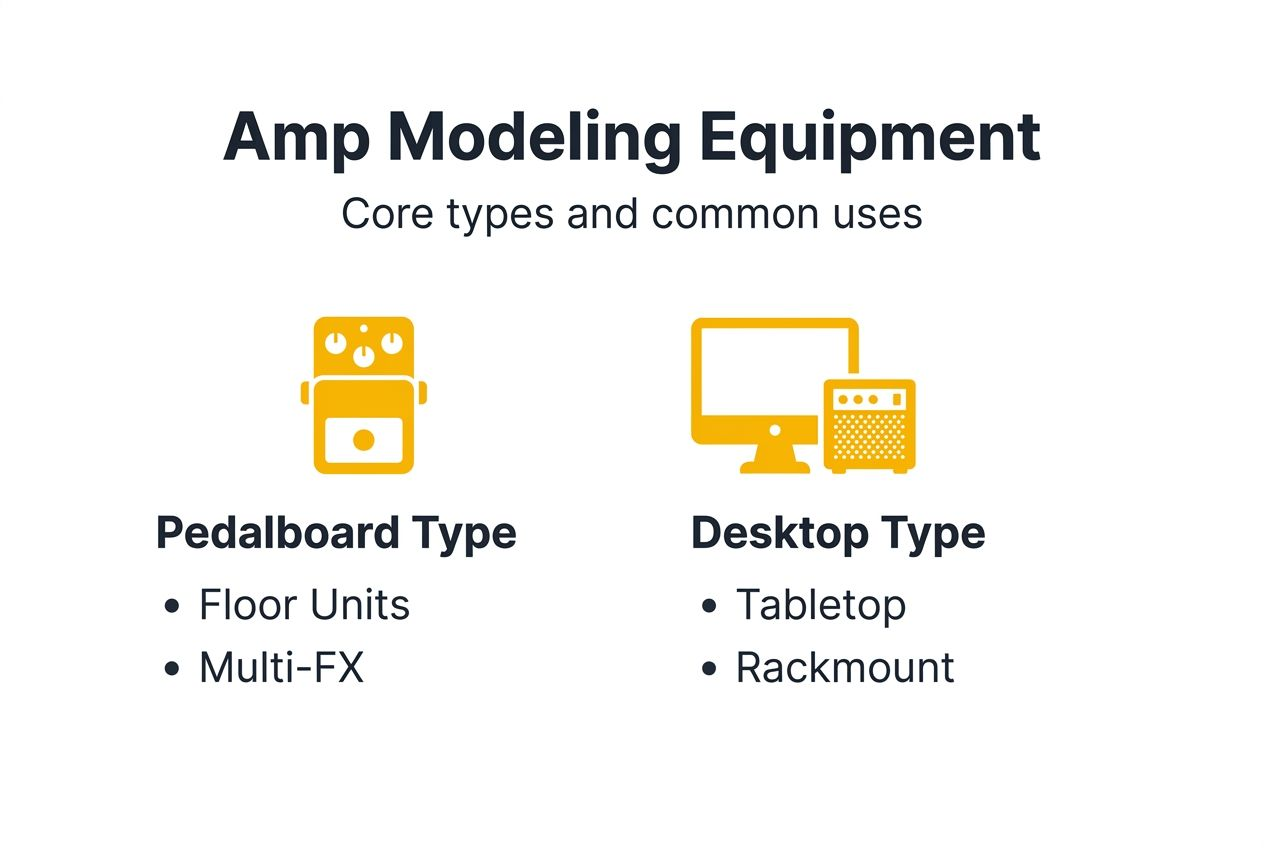
Usage scenarios guide equipment selection effectively. Floorboards suit touring musicians needing reliable, foot-controlled tone changes between songs. Rack units serve session players requiring pristine studio quality and recall of hundreds of saved tones. Combo amps work for traditional players who prefer self-contained solutions for practice and casual gigs. Heads paired with quality cabinets satisfy those seeking modeling flexibility with preferred speaker characteristics.
Compatibility with external speakers and pedal integrations expands creative possibilities. Understanding key guitar amplifier features helps you evaluate which modeling specifications match your performance requirements and budget constraints.
Benefits and practical advantages of amp modeling
Tonal versatility stands as amp modeling’s most compelling advantage, delivering dozens of classic amplifier sounds within a single unit. You access vintage Vox chime, modern high-gain Mesa tones, and everything between without owning multiple expensive amplifiers. This flexibility proves invaluable when playing varied musical styles or covering songs requiring specific amp characteristics.
Practical benefits extend beyond tone variety:
- Portability eliminates transporting heavy valve amps and multiple cabinets to gigs
- Cost savings on purchase price, valve replacements, and amp servicing
- Consistent performance unaffected by valve wear or temperature changes
- Integrated effects reducing pedal board complexity and cable requirements
- Silent practice through headphone outputs without disturbing neighbours
Modeling technology suits diverse environments equally well. Home practice benefits from whisper-quiet volumes whilst maintaining full tonal richness through headphones. Studio sessions leverage direct recording outputs and instant recall of dialled-in tones. Live performances gain reliability and consistent sound regardless of stage volume requirements.
Maintenance demands drop dramatically compared to valve amplifiers. No biasing adjustments, no valve monitoring, no output transformer concerns. Software updates often add new amp models and features to existing hardware, extending the useful life of your investment.
Pro Tip: Create organised preset banks for different songs or styles before gigs. Label them clearly and practise switching between them at home to avoid fumbling through menus during performances.
Common misconceptions about amp modeling
Several persistent myths discourage guitarists from exploring amp modeling despite significant technological advances. The belief that digital modeling cannot replicate valve amp warmth dominated early discussions, yet modern profiling technology captures the exact harmonic content and dynamic response of specific amplifiers. Blind listening tests frequently reveal experienced players cannot reliably distinguish between high-end modellers and the valve amps they emulate.
Prevailing misconceptions include:
- Digital sounds feel artificial and lack organic touch sensitivity
- Modeled tones compress dynamics and lose playing nuance
- Modeling gear targets only beginners or budget-conscious players
- Valve amps always sound superior in live performance contexts
- Professional musicians avoid modeling technology for serious work
Reality contradicts these assumptions. Major touring artists now rely entirely on modeling rigs for consistency across venues and countries. Session guitarists choose modellers to match producer requests for specific vintage amp tones without accessing rare, expensive originals. The technology’s dynamic response has improved so substantially that subtle picking variations translate naturally through digital processing.
Profiling advances challenge remaining scepticism by creating exact digital snapshots of physical amplifiers. These profiles capture not just EQ curves but the complete interaction between preamp, power amp, and speaker, including how the amp responds to volume changes and playing dynamics.
Modern amp modellers deliver professional-grade tones indistinguishable from valve amps in blind tests, proving digital technology has matured beyond early limitations.
Open-mindedness serves guitarists well when evaluating tone solutions. Testing current modeling technology reveals how far the industry has progressed since early digital attempts. Many players discover modellers provide the versatile, reliable tones their musical careers demand.
Comparing amp modeling and traditional valve amps
Understanding the realistic strengths and compromises of each approach enables informed equipment decisions. Valve amps provide organic tone and dynamic response but require maintenance and are heavy, whilst amp modellers offer portability and multiple tones in one unit. Tonal warmth and harmonic complexity remain valve amps’ traditional strengths, though high-end modellers now replicate these characteristics convincingly.
| Feature | Valve Amps | Amp Modellers |
|---|---|---|
| Tone | Organic warmth, natural compression | Accurate emulation, consistent across settings |
| Responsiveness | Dynamic, touch-sensitive | Advanced models match valve response |
| Portability | Heavy, bulky, fragile valves | Lightweight, compact, robust |
| Maintenance | Regular valve replacement, biasing | Minimal, software updates only |
| Versatility | Single amp voice per unit | Dozens of amp models instantly |
| Cost | High initial, ongoing servicing | Lower purchase, negligible upkeep |
| Ease of use | Straightforward controls | Learning curve for digital menus |
Advanced profiling modellers like Kemper and Neural DSP units blur the distinction further by capturing exact amplifier responses. These systems create digital fingerprints of specific amps, preserving their unique characteristics for studio work and live performance. Session players particularly value this capability for matching producer requests without sourcing rare vintage equipment.
Weight and transport considerations matter significantly for working musicians. A typical valve combo weighs 20-30 kilograms, whilst modeling alternatives often weigh under 5 kilograms. Touring schedules and frequent load-ins make this difference substantial over time.
Cost analysis reveals modeling’s economic advantage. Quality valve amps start around £800 and require £100-200 annual maintenance. Comparable modelling units cost £300-1200 with no ongoing expenses. The modelling vs valve amps comparison helps clarify which investment matches your performance context and tonal priorities.
Choosing the right amp modeller for UK musicians
Selecting appropriate modeling equipment requires assessing your specific performance contexts and tonal goals. Power output needs vary dramatically between bedroom practice, studio recording, and live gigs. A 30-watt modeller suffices for home use, whilst 100+ watts ensures adequate stage volume at larger venues. Consider whether you need the amp itself to project sound or if you will run through PA systems where lower wattage works perfectly.
Evaluation criteria should include:
- Number and quality of included amp models matching your preferred tones
- Built-in effects variety and quality reducing external pedal requirements | Connectivity options like USB audio interfaces, MIDI, and balanced outputs
- User interface intuitiveness and ease of preset management
- Build quality and durability for touring versus stationary use
Popular brands available in UK stores include Boss, Line 6, Kemper, Neural DSP, and Fender. Each manufacturer emphasises different strengths. Boss units offer legendary reliability and straightforward operation. Line 6 provides extensive amp libraries and deep editing capabilities. Kemper excels at profiling technology for capturing real amps. Neural DSP delivers cutting-edge algorithms and modern high-gain tones.
Testing gear in person reveals crucial details specifications cannot convey. Physical control layouts affect your workflow significantly. Some players prefer traditional knobs mirroring analogue amps, whilst others appreciate touchscreen interfaces for quick editing. The feel of footswitches, expression pedal compatibility, and preset switching speed all impact live performance confidence.
Research guitar shopping tips 2025 UK for broader purchasing guidance. Understanding key amplifier features for UK players helps you identify which specifications truly matter for your musical applications versus marketing hype.
Pro Tip: Visit shops during quieter hours when staff can demonstrate multiple units thoroughly. Bring your own guitar to hear how different modellers respond to your specific instrument and playing style.
Advanced usage tips: upgrading and integrating amp modeling setups
Optimising your modeling rig involves strategic upgrades that maximise sound quality and performance flexibility. Upgrading setups with FRFR speakers (200W-2600W) improves sound quality and authentic response beyond standard guitar cabinets. FRFR systems reproduce the full frequency range of modelled amp and cabinet combinations without imposing additional tonal colouration, delivering what you hear through headphones to your audience.
Expression pedals and footswitches expand real-time control dramatically:
- Expression pedals control wah effects, volume swells, and parameter sweeps smoothly
- External footswitches enable instant preset changes during performances
- MIDI controllers trigger complex scene changes across multiple parameters simultaneously
- USB connectivity allows computer-based editing and firmware updates
Integrating modelling amps into studio and live rigs requires understanding signal flow and impedance matching. Direct outputs connect to mixing consoles or audio interfaces at line level, bypassing microphone placement uncertainties. Some modellers include analogue speaker outputs for traditional cabinet connection when stage volume matters.
Balancing power output between your modeller and FRFR speakers ensures optimal fidelity and headroom. A 100-watt modeller paired with 200-watt speakers prevents distortion at high volumes whilst maintaining clean headroom for dynamic playing. Mismatched power ratings risk either underpowered sound or potential speaker damage.
Experimentation reveals what works for your specific style and venues. Try different cabinet simulations with FRFR speakers to find combinations that sit well in band mixes. Test various preset organisation systems until you develop efficient workflows for live performance. Study amp modelling setup upgrades for detailed improvement strategies.
Consider how best guitar pedals 2025 integrate with modeling systems. Some players prefer dedicated drive pedals hitting the modeller’s input, whilst others rely entirely on built-in effects. Review amplifier features for integration when planning your complete rig.
Pro Tip: Save multiple versions of your favourite presets with slight variations in gain and EQ. Different venues and guitars often require minor tweaks, and having preset variants saves time during soundcheck.
Explore premium amp modellers and gear at MusicStreet
Ready to experience modern amp modeling yourself? MusicStreet offers a curated selection of premium modelling amplifiers and accessories suitable for players at every level.
Our Huntingdon showroom lets you test and compare popular modelling amps side by side, helping you discover your perfect sound solution. Expert staff provide personalised guidance based on your musical goals, performance contexts, and budget requirements. We stock trusted brands and latest models with convenient UK shipping options, plus professional setup and ongoing support. Whether you are upgrading from your first practice amp or building a professional touring rig, our team understands the practical demands UK musicians face daily.
Frequently asked questions about amp modeling
What is the difference between digital amp modeling and analogue valve amps?
Digital amp modeling uses signal processing algorithms to emulate valve amp behaviour, whilst analogue valve amps generate tone through physical electronic components. Modellers offer multiple amp voices in one unit with minimal maintenance, whereas valve amps provide organic response but require regular servicing and valve replacements.
Can amp modellers be used effectively for live gigs?
Modern amp modellers perform excellently at live gigs, offering consistent tone regardless of venue conditions. Many touring professionals rely entirely on modeling rigs for reliability and ease of transport. Direct outputs to PA systems eliminate microphone placement variables, ensuring your tone translates consistently across different sound systems.
Are amp modellers suitable for beginners and professionals?
Amp modellers serve both beginners and professionals effectively, though for different reasons. Beginners benefit from affordable access to many amp tones whilst learning their preferences. Professionals value the versatility, reliability, and tour-friendly portability that modeling technology provides.
How important are FRFR speaker cabinets with amp modellers?
FRFR speakers reproduce the full frequency range of modelled amps and cabinets without adding tonal colouration. They prove essential for hearing accurate representations of your modelled tones, especially when cabinet simulation is active. Standard guitar cabinets colour the sound unpredictably, undermining the modeling accuracy.
Can I integrate my existing effects pedals with an amp modeller?
Most amp modellers include effects loops and line inputs allowing seamless pedal integration. Many players run favourite drive or modulation pedals into the modeller’s input, whilst others rely entirely on built-in effects. Experiment with both approaches to discover what serves your tonal goals best.

Share:
Best Guitars Under £1000 UK (2026): Expert Picks from MusicStreet
What is a buffer pedal: preserve your guitar tone in 2026