


When you walk into a guitar shop or browse amplifiers online, the term combo amp appears everywhere, yet many guitarists remain confused about what distinguishes it from other amplifier types. A combo amp integrates both amplifier circuitry and speaker into one portable unit, eliminating the need for separate components whilst offering surprising tonal versatility. Whether you’re selecting your first amplifier or considering an upgrade, understanding combo amps unlocks better equipment decisions tailored to your playing environment and musical style. This guide demystifies combo amp design, compares them against alternative setups, explains wattage implications, and provides practical selection advice for 2026.
Table of Contents
- What Is A Combo Amp And How Does It Work?
- Comparing Combo Amps To Head-And-Cabinet Setups: Pros And Cons
- Wattage Ranges And Practical Usage Scenarios For Combo Amps
- Choosing The Right Combo Amp For Your Needs In 2026
- Explore Our Premium Guitar Amps And Combos
- Frequently Asked Questions
Key takeaways
| Point | Details |
|---|---|
| Integrated design | Combo amps house amplifier circuitry and speakers in one portable enclosure, simplifying setup and transport. |
| Wattage determines usage | Lower wattage suits home practice whilst higher wattage handles gigs and rehearsals effectively. |
| Differs from head and cabinet | Unlike separate head/cab systems, combos sacrifice some customisation for convenience and portability. |
| Flexible speaker options | Many combos feature multiple speaker configurations and allow external cabinet connections when needed. |
What is a combo amp and how does it work?
A combo amp is an all-in-one guitar amplifier that integrates the amplifier circuitry and speaker(s) into a single portable enclosure. This integrated design eliminates the need to purchase and connect separate amplifier heads and speaker cabinets, making combos particularly attractive for beginners and gigging musicians who value simplicity. The amplifier section receives your guitar signal, processes it through preamp and power amp stages, then sends the amplified signal directly to the internal speaker without requiring external connections.
Combo amps typically feature speakers ranging from 8 to 12 inches in diameter, with 10-inch and 12-inch configurations being most common. The speaker size influences both tonal characteristics and portability, larger speakers generally produce fuller low-end response whilst smaller speakers emphasise midrange frequencies. Most combo amps weigh between 10 and 30 kilograms, making them manageable for one person to transport between practice spaces, rehearsals, and performances.
Inside a combo amp, you’ll find several key components working together. The input jack receives your guitar signal, which travels through the preamp section where tone shaping occurs via EQ controls. The power amp section then amplifies this shaped signal to speaker-driving levels. The speaker converts electrical signals into acoustic sound waves you hear. Many modern combos also include effects processors, reverb circuits, and digital modelling technology within the same enclosure.
Pro Tip: When comparing combo amps, pay attention to whether they include speaker output jacks for connecting external cabinets, this feature dramatically expands your tonal options without sacrificing the convenience of an integrated design.
Combo amps suit diverse playing situations. Bedroom practice, small venue performances, and studio recording all benefit from the straightforward setup and consistent sound delivery combos provide. For guitarists just starting their journey, an electric guitar and amp for beginners comparison helps identify which combo specifications match your learning environment and musical goals.
Comparing combo amps to head-and-cabinet setups: pros and cons
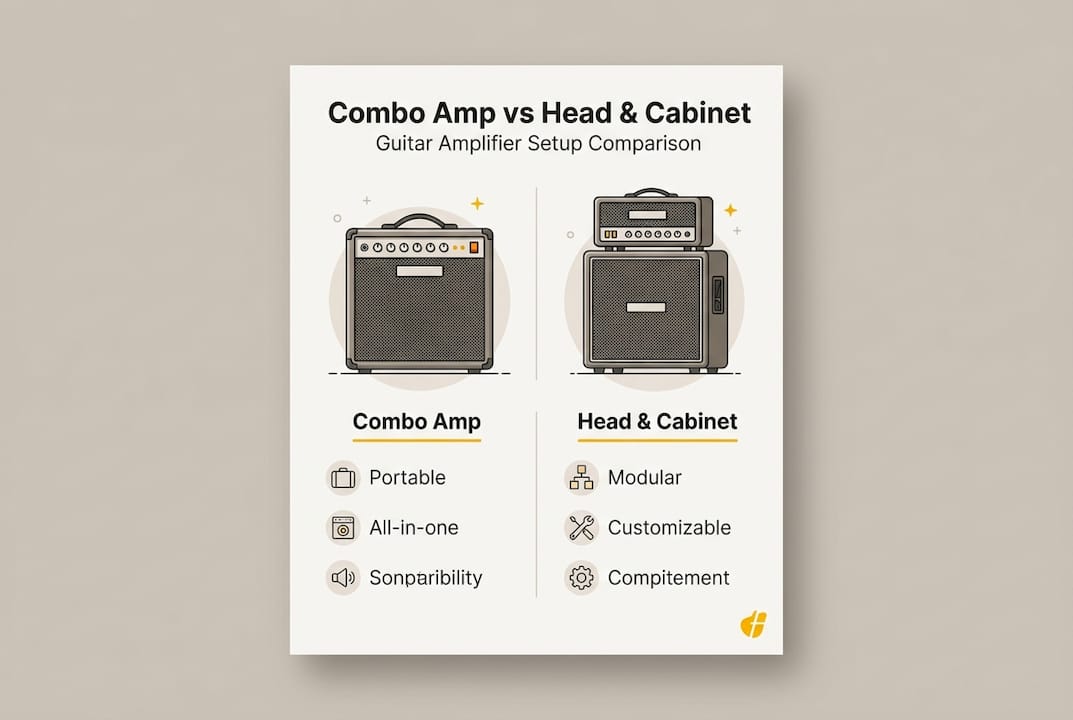
Combos prioritise portability and ease whilst heads offer customisation and more power but require impedance matching and are less portable. Understanding these fundamental trade-offs helps you select the amplifier configuration that aligns with your performance requirements and logistical constraints. Each approach delivers distinct advantages depending on your playing context and tonal preferences.
Combo amplifiers excel in several practical areas. Their single-unit construction means you simply plug in your guitar and play, no cable management between separate components or impedance calculations required. Transport becomes significantly easier when carrying one piece of equipment rather than coordinating multiple components. Setup time at rehearsals and gigs drops dramatically, you arrive, place the combo, connect your guitar, and you’re ready. This simplicity proves invaluable for musicians who frequently move between locations or perform at multiple venues weekly.
Head-and-cabinet systems provide advantages that appeal to tone purists and professional players. Separating the amplifier head from speaker cabinets allows you to mix and match components, pairing a vintage Plexi-style head with modern high-efficiency speakers or combining a high-gain metal head with oversized 4x12 cabinets for maximum stage volume. Power scalability improves as well, upgrading to higher wattage simply requires replacing the head whilst keeping your preferred cabinet. Tonal flexibility expands through speaker swaps, changing from British-voiced Celestion speakers to American-voiced Eminence speakers transforms your amplifier’s character without replacing the entire rig.
However, head/cab systems introduce complexity that combo users avoid. Impedance matching between amplifier output and speaker cabinet input becomes critical, mismatched impedance can damage your amplifier’s output transformer. You’ll need quality speaker cables rated for high current, standard instrument cables won’t suffice. Transport requires careful handling of multiple components, and setup demands more time connecting and positioning separate pieces correctly.
| Feature | Combo Amp | Head and Cabinet |
|---|---|---|
| Portability | Single unit, easier transport | Multiple pieces, requires more effort |
| Setup complexity | Plug and play, minimal connections | Requires impedance matching and speaker cables |
| Customisation | Limited to internal speaker | Mix and match heads with various cabinets |
| Power options | Fixed wattage per model | Easily upgrade head for more power |
| Typical weight | 10-30kg total | Head 10-15kg plus cabinet 20-40kg |
Pro Tip: Many modern combo amps include speaker output jacks, allowing you to disconnect the internal speaker and connect external cabinets when you need more volume, effectively bridging the gap between combo convenience and head/cab flexibility.
For most guitarists, especially those developing their sound and playing in varied environments, combo amps deliver the right balance of quality, convenience, and value. Understanding guitar amplifier types explained further clarifies how different amplifier technologies and configurations serve specific musical applications and playing styles.
Wattage ranges and practical usage scenarios for combo amps
Wattage ratings directly influence how loudly your combo amp can play and which environments suit its capabilities. Wattage examples include 5-15W for home and practice situations such as the Blackstar HT-5R, whilst 30-50W handles gigs effectively like the Vox AC15 and Orange Crush 35RT. Matching wattage to your primary playing context prevents both underpowered performance and excessive volume in inappropriate settings.

Low wattage combo amps, typically 1 to 15 watts, excel for home practice and bedroom recording. These amps reach their sweet spot, where tubes saturate and compression naturally occurs, at manageable volumes that won’t disturb neighbours or household members. A 5-watt tube combo produces surprisingly robust tone whilst remaining quiet enough for apartment living. Solid-state combos in this range cost less and require no tube maintenance, making them practical for beginners exploring amplified guitar playing.
Medium wattage combos, ranging from 20 to 50 watts, serve as versatile workhorses for rehearsals, small to medium venue performances, and studio work. A 30-watt combo typically provides enough headroom to stay clean whilst playing with a full band, yet can be driven into overdrive when needed for saturated lead tones. These amps balance portability with adequate volume, most musicians find 30-40 watts sufficient for pub gigs, church services, and rehearsal spaces without PA support.
High wattage combo amps, 50 watts and above, deliver clean tones at high volumes and suit larger venues or situations requiring substantial low-end presence. A 100-watt solid-state combo can compete with loud drummers and provide pristine clean tones even at performance volumes. However, these amps become heavy, often exceeding 25 kilograms, and their increased volume capability may prove excessive for typical playing situations most guitarists encounter.
| Wattage Range | Typical Usage | Example Models | Volume Capability |
|---|---|---|---|
| 1-15W | Home practice, recording | Blackstar HT-5R, Fender Champion 20 | Bedroom friendly |
| 20-35W | Rehearsals, small gigs | Vox AC15, Orange Crush 35RT | Keeps up with drums |
| 40-65W | Medium venues, versatile use | Fender Blues Deluxe, Marshall DSL40CR | Handles most gig situations |
| 75W+ | Large venues, high headroom | Roland JC-120, Fender Twin Reverb | Extreme clean volume |
Understanding the difference between tube and solid-state wattage proves essential. Tube amplifiers produce more perceived volume per watt than solid-state designs due to harmonic richness and compression characteristics. A 15-watt tube combo often sounds as loud as a 30-watt solid-state amp in practical use. This efficiency means tube combos achieve desirable overdrive tones at lower volumes, whilst solid-state amps require higher wattage for equivalent clean headroom.
Pro Tip: Consider purchasing a combo amp with at least 30 watts if you plan to play with other musicians, even if you currently practice alone at home, this ensures you won’t need to upgrade immediately when joining a band or performing live.
Wattage also affects tonal characteristics beyond pure volume. Higher wattage amps typically exhibit tighter bass response and greater dynamic range, allowing more expressive playing that responds to pick attack variations. Lower wattage amps compress more readily, creating a spongy, saturated feel that some players prefer for blues and rock styles. Selecting appropriate wattage for your musical genre and playing environment ensures your combo amp serves your needs effectively. For specific brand recommendations, explore the best amplifiers for Gibson guitars to understand how amp characteristics complement different guitar types.
Choosing the right combo amp for your needs in 2026
Selecting the ideal combo amp requires evaluating your playing environment, musical style, and budget against available options in 2026. Beginners should start with combo amps for simplicity and portability such as the Fender Frontman, whilst experienced players benefit from combos offering versatility through modelling technology like the Boss Katana or stacks for detailed tone tweaking. Your choice fundamentally shapes your playing experience and determines how well your equipment adapts to evolving musical demands.
Beginners benefit most from straightforward combo amps featuring essential controls without overwhelming complexity. Look for models with clean and overdrive channels, basic three-band EQ, and built-in reverb. Solid-state combos in the 15 to 30-watt range provide reliability, affordability, and sufficient volume for practice and small performances. These amps require minimal maintenance and tolerate the learning curve as you develop your understanding of amplifier controls and tonal preferences.
Intermediate players often seek greater tonal variety and effects integration. Modelling combo amps like the Boss Katana series, Fender Mustang range, and Line 6 Spider models deliver dozens of amp simulations and built-in effects within a single unit. These combos eliminate the need for separate pedals whilst exploring diverse sounds from vintage Fender cleans to modern high-gain metal tones. The versatility proves invaluable when playing varied musical styles or discovering your preferred sonic territory.
Advanced guitarists typically prioritise specific tonal characteristics and build quality. Tube combo amps from manufacturers like Vox, Marshall, and Fender deliver the warmth, dynamic response, and harmonic complexity that experienced players value. These amps reward nuanced playing technique and respond organically to guitar volume and tone control adjustments. Premium combos also feature superior speaker systems, hand-wired construction, and components selected for tonal excellence rather than cost efficiency.
Consider these practical factors when evaluating combo amps:
- Physical size and weight relative to your transport capabilities and storage space
- Speaker configuration, whether single or multiple speakers and their diameter
- Channel switching options for accessing different tones during performance
- Effects loop presence if you plan to use external effects pedals
- Extension speaker outputs for future expansion possibilities
- Power attenuator or master volume for achieving saturated tones at lower volumes
Pro Tip: Before purchasing any combo amp, test it with your own guitar in a similar environment to where you’ll primarily use it, amplifiers sound dramatically different in small shop rooms versus larger spaces, and your guitar’s pickups significantly influence the resulting tone.
Budget considerations matter but shouldn’t compromise essential features for your situation. Entry-level combos start around £100 and provide adequate performance for beginners, whilst professional-grade tube combos range from £500 to £2000 depending on wattage and features. Used combo amps offer excellent value, many vintage models appreciate in value whilst delivering superior tone compared to budget new alternatives.
Tone preferences guide your technology choice between tube, solid-state, and modelling amplifiers. Tube combos excel at dynamic response and natural compression but require periodic maintenance and handle more delicately. Solid-state combos provide reliability and consistent performance across temperature variations and transport conditions. Modelling combos deliver unprecedented versatility and often include recording outputs and practice features like headphone jacks and auxiliary inputs for play-along tracks.
For comprehensive guidance on amplifier selection, review our detailed how to pick a guitar amp guide which explores technical specifications and practical considerations in depth. Additionally, understanding the ongoing debate around modelling vs valve guitar amps helps clarify which technology aligns with your tonal priorities and playing requirements.
Explore our premium guitar amps and combos
Now that you understand combo amp fundamentals, wattage implications, and selection criteria, you’re ready to explore amplifiers that match your specific needs. At MusicStreet, we specialise in curating exceptional guitar equipment for musicians at every level, from beginners selecting their first practice amp to professionals seeking touring-ready combos. Our collection features carefully selected models from renowned manufacturers, each amp professionally inspected and set up to deliver optimal performance from the moment you plug in.

Whether you’re drawn to the vintage warmth of tube technology, the reliability of solid-state designs, or the versatility of modern modelling amps, our range covers diverse tonal preferences and budgets. Visit our Huntingdon showroom to test amplifiers with your own guitar in a proper playing environment, or browse our online catalogue with detailed specifications and expert descriptions. Our team provides ongoing support after your purchase, ensuring your combo amp continues serving your musical journey effectively. Explore our comprehensive guitar amp buying guide for additional insights into matching amplifiers with your playing style and goals.
Frequently asked questions
What makes a combo amp different from other amplifier types?
A combo amp integrates both amplifier circuitry and speakers into one self-contained unit, unlike head-and-cabinet systems that separate these components. This integrated design simplifies setup, improves portability, and eliminates impedance matching concerns that separate systems require.
How much wattage do I need in a combo amp?
For home practice, 5 to 15 watts provides adequate volume without disturbing others, whilst 30 to 50 watts suits rehearsals and small to medium gigs. Larger venues or situations requiring substantial clean headroom benefit from 50 watts or more, though portability decreases with higher wattage models.
Are combo amps suitable for beginners?
Combo amps prove ideal for beginners due to their straightforward operation, affordable entry-level options, and all-in-one convenience. New players can focus on developing technique and musical skills without managing complex equipment configurations or understanding impedance calculations. Explore guitar amplifier types explained to understand how combos fit within the broader amplifier landscape.
Can I connect external speakers to a combo amp?
Many combo amps include speaker output jacks allowing you to disconnect the internal speaker and connect external cabinets when additional volume or different tonal characteristics are desired. Always verify impedance compatibility between your amp’s output and external cabinet before connecting to prevent damage.
Do tube combo amps sound better than solid-state models?
Tube combos deliver warmer tone, natural compression, and dynamic response that many players prefer, particularly for blues, rock, and vintage styles. Solid-state combos offer reliability, consistent performance, and often include more features at lower prices, making them practical for diverse musical applications and gigging situations.







Share:
Essential guitar gig bag tips for optimal protection
Guitar effects pedals list: choose the best for your tone