


Overdrive, in guitar terms, is the soft clipping of your signal by a valve amp or a pedal circuit, producing even-order harmonics, gentle compression and a mid-range emphasis that makes notes feel warm, sustained and alive. Players use overdrive pedals to replicate what a cranked tube amp does naturally at lower, stage-friendly volumes. As Michael Molenda and the team at GuitarPlayer note, the defining quality is touch-sensitivity: back off your pick attack and the tone cleans up; dig in and it blooms. This guide covers the technical causes, the musical effects and how to dial and choose pedals as a UK buyer.
Key takeaways
Overdrive is soft clipping that adds even-order harmonics, gentle compression and mid emphasis, making it the most touch-sensitive and amp-compatible dirt effect available.
| Point | Details |
|---|---|
| Definition | Overdrive = soft clipping that adds even-order harmonics, compression and mid focus. |
| Amp vs pedal | Valve amps clip asymmetrically and time-variably; pedals emulate this via soft-clipping circuits. |
| Dialling basics | Set Level to unity first, then add Drive gradually; use guitar volume to control clean-up. |
| Genre versatility | Suits blues through classic rock; overdrive is often the most-used pedal on a player’s board. |
| Musicstreet | In-store trials and expert consultation in Huntingdon help you find the right pedal for your rig. |
Table of Contents
- What does overdrive actually do to your guitar signal?
- How does overdrive differ from distortion and fuzz?
- How is overdrive produced: tube amps versus pedal circuits
- How to dial in overdrive: step-by-step controls guide
- Where to place overdrive in your signal chain
- Genre starting points and A/B demo ideas
- Overdrive pedal types to try in the UK
- How to choose an overdrive pedal as a UK buyer
- The Musicstreet view on trying overdrive in store
- Musicstreet: hands-on help with overdrive pedals
- What the Musicstreet perspective on overdrive gets right
- Sources
- FAQ
What does overdrive actually do to your guitar signal?
Three things happen the moment overdrive engages: compression, EQ shaping and harmonic enrichment. According to TheGuitarSide’s overdrive explainer, the effect introduces gentle compression, emphasises mid-range frequencies and adds even-order harmonics perceived as tube-like warmth.
Even-order harmonics (2nd, 4th) sit musically close to the original note, so they blend rather than clash. Odd-order harmonics, by contrast, sit further from the fundamental and produce the harsher, more dissonant texture you hear in heavy distortion. Overdrive keeps the even-order content dominant, which is why it sounds musical rather than abrasive.
The practical results for a player:
- Compression: pick attack is softened and sustain is extended, so notes hold longer without feeling forced.
- Mid emphasis: the signal sits forward in a band mix, cutting through without needing extra volume.
- Even-order harmonics: notes gain a warm, slightly fuzzy overtone that thickens single-note lines and chords alike.
Pro Tip: Roll your guitar’s volume knob back to around 6 or 7 while the pedal is engaged. The overdrive cleans up noticeably, giving you a near-clean tone from the same pedal setting. That single knob becomes a real-time gain control.
How does overdrive differ from distortion and fuzz?
Overdrive is the gentlest of the three main dirt types, distortion is more aggressive and less touch-sensitive, and fuzz is a different beast altogether with its own heavily clipped, almost synthetic texture. The BOSS overdrive vs distortion article puts it plainly: overdrive pedals aim to emulate a cranked tube amp and stay dynamic and responsive to playing, whereas many distortion circuits use hard clipping and more heavily colour the source tone.
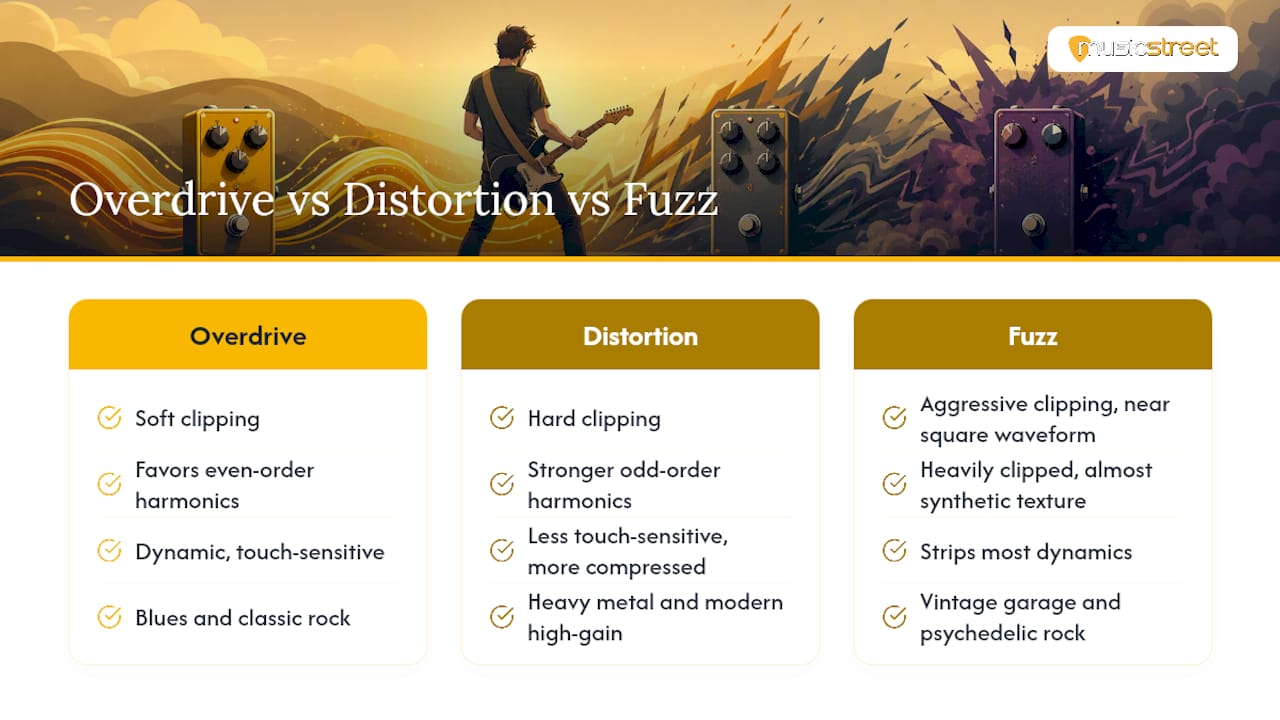
The circuit reason is clipping topology: soft clipping favours even-order harmonics and a more amp-like, dynamic feel, while hard clipping produces stronger odd-order harmonics and a harsher, more compressed character. Fuzz typically clips so aggressively that the waveform approaches a square wave, stripping away most of the original signal’s dynamics entirely.
Genre mapping gives a quick shorthand. Blues and classic rock sit naturally with tube-saturating overdrive. Heavy metal and modern high-gain styles call for hard-clipping distortion. Vintage garage and psychedelic rock lean on fuzz for that woolly, sputtering texture. None of these are rules, but they reflect where each effect’s dynamic behaviour fits most comfortably.
How is overdrive produced: tube amps versus pedal circuits
Tube amp overdrive is soft, asymmetric and time-varying. Rob Robinette’s technical breakdown explains that grid current and bias excursion in valve preamp stages generate this time-varying, asymmetric clipping, producing even-order harmonics and a dynamic sag that many players prize. Small circuit changes, such as grid stopper resistor values or coupling capacitor sizes, alter that time variance and therefore the subjective feel of the breakup.
Pedals recreate or approximate this behaviour through several circuit approaches:
- Op-amp feedback soft clipping: diodes placed in the feedback loop of an op-amp clip gently, favouring even-order harmonics and a smooth, amp-like response.
- Diodes to ground (hard clipping): diodes placed after the gain stage clip more aggressively, pushing the sound toward distortion territory.
- Asymmetric diode pairs: using different diode types on each side of the waveform mimics the asymmetric nature of valve clipping and adds complexity to the harmonic content.
The position of the tone stack relative to the clipping stage also shapes character significantly. Clip first, then tone-shape, and you colour a full-bandwidth signal. Tone-shape before clipping and you change which frequencies get saturated most.
How to dial in overdrive: step-by-step controls guide
Start with your amp set to a familiar clean level, then build the overdrive from there. The common mistake is reaching for Drive first. TheGuitarSide advises that focusing on Level and amp volume often yields a more natural, amp-like response than maxing Drive and compensating with lower output.
- Set your amp to your usual clean volume.
- Set the pedal’s Level control to unity gain (the same volume as your bypassed signal).
- Increase Drive slowly until you hear the first signs of breakup.
- Roll your guitar’s volume back to about 6 to check the clean-up response.
- Adjust Tone or Voice sparingly to tame harsh highs or add mid presence.
Clean breakup starting point: Drive at 9 o’clock, Level at unity, Tone at noon. Suits blues and light crunch.
Lead sustain/boost starting point: Drive at 11–12 o’clock, Level slightly above unity, Tone at 10 o’clock. Adds sustain and pushes the amp harder for solos.
Pro Tip: Maxing Drive first is the fastest way to lose the amp-like feel. A moderate Drive setting with the amp’s own volume doing some of the work almost always sounds more three-dimensional.
Where to place overdrive in your signal chain
Placement matters more than most players expect. A mild overdrive placed early in the chain, before modulation and time-based effects, preserves the dynamics of your picking and lets the amp respond naturally. TheGuitarSide confirms that putting a mild overdrive before a high-gain distortion tightens the overall sound, while placing it after tends to act primarily as a level boost without improving distortion quality.
Two practical stacking examples:
Mild OD into distortion: the overdrive compresses and tightens the input signal before it hits the distortion, producing a focused, punchy high-gain tone with less flub in the low end. This is a common approach for players who want clarity at high gain.
OD after distortion: the distortion handles all the saturation; the overdrive acts as a clean volume boost for solos. Useful, but you gain nothing tonally from the overdrive’s clipping circuit.
A/B swapping placement during a shop trial takes about thirty seconds and immediately reveals which order suits your rig. Try it before committing to a position on your board.
Genre starting points and A/B demo ideas
Overdrive is often the most-used pedal on a player’s board because it blends with an amp’s tone and responds to playing dynamics across a wide range of styles. The Fender effects guide notes that overdrive is cleaner at lower levels and driven at higher ones, which makes it naturally expressive.
| Genre | Drive/Gain | Level | Character note |
|---|---|---|---|
| Blues | Low (9 o’clock) | Unity | Warm, clean-up responsive |
| Classic rock | Medium (10–12 o’clock) | Slightly above unity | Mid-forward, sustained |
| Modern rock rhythm | Medium-high | Unity | Tight, punchy |
| Lead boost | Low | Above unity | Transparent push |
A/B demo ideas: play the same riff with your guitar volume at 10, then at 6. The BOSS practical guide recommends exactly this test to judge a pedal’s dynamic feel. Also try the pedal before and after a distortion box to hear the tightening effect described above.
Single-coil pickups tend to emphasise the mid-hump of an overdrive and can sound glassy or bright; hum buckers add warmth and body. A high-headroom solid-state amp may need more Drive to respond similarly to a valve amp at the same setting.
Overdrive pedal types to try in the UK
Try these broad overdrive characters to hear the range before settling on one type. A comprehensive pedal guide can help you map these categories to specific models.
- Transparent boost/overdrive: adds minimal colour; pushes the amp’s own character harder. Suits players who love their amp tone and want more of it.
- Mid-hump soft-clip: the classic tube-screamer style circuit that emphasises upper mids and compresses gently. Cuts through a band mix and stacks well before other dirt.
- Asymmetric bloom: mimics valve asymmetry closely; notes swell and breathe. Works well for blues and classic rock where feel matters as much as gain.
- Op-amp hard-edge: sits between overdrive and distortion; more compressed and aggressive but still touch-sensitive at lower Drive settings.
Budget pedals (under £80) cover the basics well. Mid-range (£80–£180) typically offers better build quality and more nuanced tone controls. Premium options (above £180) often add true bypass, high-quality components and more complex clipping options. You can also find well-maintained used overdrive pedals, such as the Rothwell Heartbreaker, which offer premium performance at a lower price point.
Pro Tip: Always try a pedal through your own amp at your usual clean setting, not through a shop demo rig. A pedal that sounds great through a high-wattage valve combo may feel flat through a solid-state practice amp, and vice versa.
How to choose an overdrive pedal as a UK buyer
Prioritise how the pedal interacts with your amp and responds to your guitar’s volume and pick attack. A single impressive demo tone tells you very little; Fender’s effects guide recommends trying pedals with your own guitar and a familiar amp setting.
Checklist for selection:
- Transparency vs colour: do you want the pedal to enhance your existing tone or reshape it?
- Clipping topology: soft clip for amp-like feel; hard clip for more aggressive saturation.
- Dynamic response: roll your guitar volume back. Does it clean up smoothly?
- EQ/tone control: is there enough range to suit your amp and pickup combination?
- Build quality: metal enclosure, quality jacks and a solid footswitch matter for gigging.
- Warranty and returns: check the retailer’s return policy before buying online.
Ask in store: “Can I try this through my own amp?” and “What is your returns window?” A retailer who encourages that kind of trial is one worth buying from.
The Musicstreet view on trying overdrive in store
The most common mistake we see is players choosing a pedal based on a YouTube demo recorded through a completely different rig. Bring your guitar, plug into an amp close to your own, and spend ten minutes with the Drive at a moderate setting rather than maxed. That alone eliminates most buyer’s remorse. At Musicstreet’s store in Huntingdon, Cambridgeshire, you can trial pedals properly, get expert setup advice and leave with a pedal that actually works in your rig. If you are undecided, book a consultation and we will walk you through the options.
Musicstreet: hands-on help with overdrive pedals
Musicstreet gives you something a streaming demo cannot: a real amp, your own guitar and someone who knows the stock.
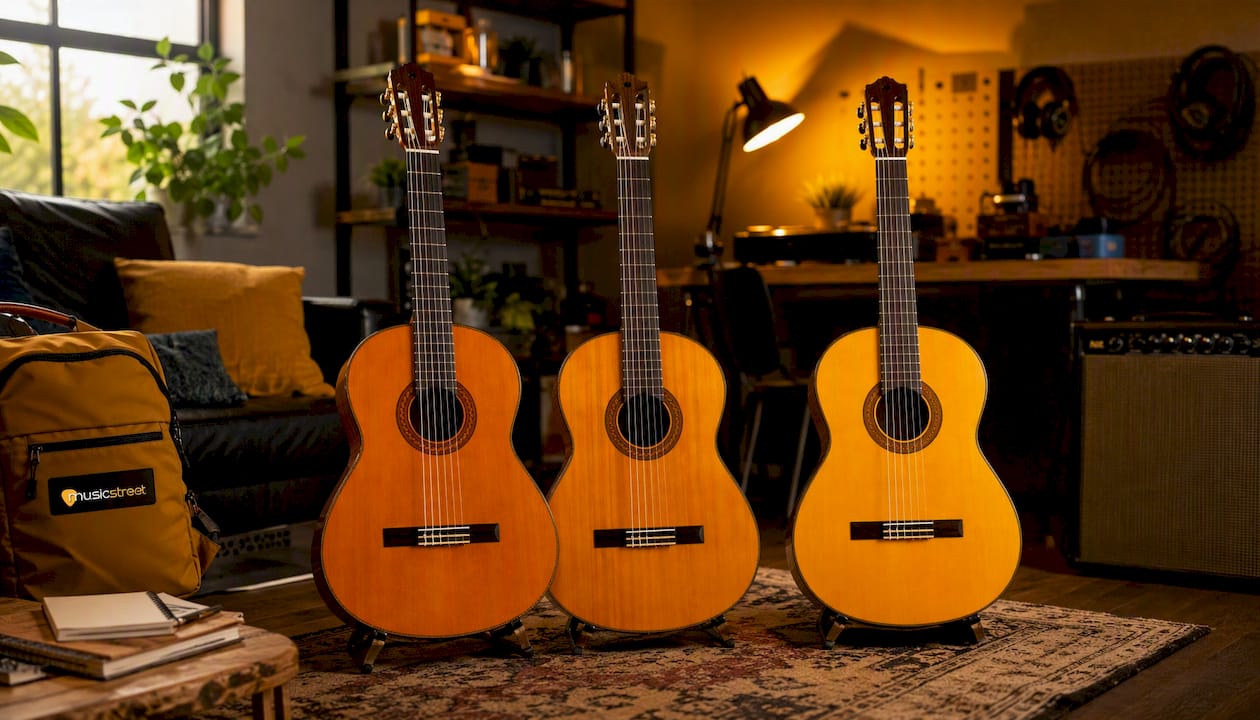
Whether you want to explore guitar effects pedals or browse the full catalogue including the Yamaha CG192C, Yamaha CG122MC and Yamaha CG122MS, Musicstreet’s team is ready to help. Services include in-store trials, personalised tone consultations, expert setup and free UK delivery on qualifying orders. Visit Musicstreet or come into the Huntingdon store to try before you buy.
What the Musicstreet perspective on overdrive gets right
The best overdrive tone is not found in a pedal alone. Dave Hunter’s observation, cited in GuitarPlayer, holds up in practice: the pedal and amp must work together. Players who treat overdrive as a standalone solution often end up chasing a sound they could reach simply by raising their amp’s volume slightly and letting the pedal push it. That partnership is what separates a convincing overdriven tone from a processed one.
Sources
- What’s the Difference Between Overdrive and Distortion? - BOSS Articles
- Overdrive pedal explained - TheGuitarSide
- How clipping works in overdrive and distortion pedals · Guitar Gear
- Tube guitar amp overdrive - Rob Robinette
- All about fuzz, overdrive, distortion and boost pedals | GuitarPlayer
- Effects Guide: An Overview of Overdrive, Distortion and Fuzz | Fender Guitars
FAQ
What is overdrive in guitar terms?
Overdrive is soft clipping of your guitar signal, producing even-order harmonics, gentle compression and a mid-range emphasis that mimics a cranked valve amp. It is the most touch-sensitive of the main dirt effects.
How does overdrive differ from distortion?
Overdrive uses soft clipping and stays responsive to pick attack and guitar volume; distortion uses harder clipping, produces more odd-order harmonics and is less dynamic by design.
Where should an overdrive pedal sit in the signal chain?
Place it early in the chain, before modulation and time effects. Before a distortion pedal it tightens the gain; after a distortion pedal it acts mainly as a volume boost.
How do I dial in overdrive without losing amp character?
Set Level to unity gain first, then raise Drive gradually. Keep Drive moderate and let your amp’s own volume contribute to the saturation for a more natural, amp-like result.
Can I try overdrive pedals in store in the UK?
Yes. Musicstreet’s store in Huntingdon, Cambridgeshire offers in-store trials where you can test pedals through a suitable amp with your own guitar before buying.





Share:
PRS Guitars UK: Explore the Collection at MusicStreet
The complete Ibanez guitar models list: series, specs and UK buying guide