

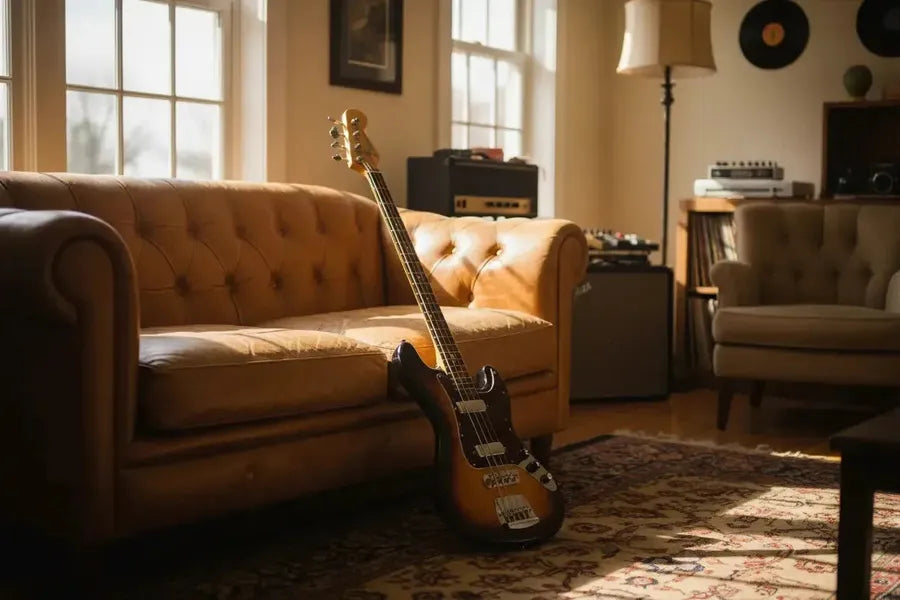
The Fender Bass VI (often called the Fender VI) is one of the most unusual instruments Fender ever built. Introduced in 1961, it combined the familiar feel of a guitar with the deep register of a bass. Fender advertised it simply as a “new six‑string bass guitar” and tuned it E‑A‑D‑G‑B‑E just like a guitar, but an octave lower. Players could therefore use familiar chord shapes while exploring lower frequencies that a standard guitar cannot reach.
For players in the UK looking to explore Fender’s full range of instruments, the Fender guitars UK collection showcases everything from classic bass designs to modern reissues. Though its original production run lasted only fourteen years (1961-1975), the Bass VI developed a cult following and has been reissued several times by Fender and Squier. Today it appeals to guitarists and bassists who want a hybrid instrument for surf rock, post‑punk, and cinematic soundscapes. In this article, we’ll explore the history, design, and appeal of the Bass VI and show you how Music Street can help you find the right model.
Fender VI Electric Bass Guitar History
The Bass VI was designed as Fender’s response to Danelectro’s UB‑2 six‑string bass, which was popular with session musicians. Fender launched its six‑string bass in 1961, styling it after the then‑new Jaguar guitar. The instrument featured an offset body, three single‑coil pickups with chrome mounting rings and a floating tremolo bridge. It was marketed as a bass, but its narrow neck (30-inch scale) and guitar‑like tuning meant it catered more to guitarists than bassists.
Fender quickly modified the design, adding a strangle (high‑pass) switch and foamy string mutes in 1963, then binding the fingerboard and replacing nitrocellulose lacquer with polyester finishes in 1968. Despite these improvements, many players considered it “too bass” for guitarists and “too guitar” for bassists, so production ceased in 1975.
Renewed interest in the 1990s and 2000s prompted Fender Japan and the Fender Custom Shop to offer vintage‑style reissues. In 2013, Fender released the Pawn Shop Bass VI with a humbucking bridge pickup and a five‑position switch, and Squier introduced an affordable Vintage Modified Bass VI. Today, the Bass VI remains in production through Fender’s Vintera series and Squier’s Classic Vibe models.
Fender VI Electric Bass Guitar Design & Specifications
Tuning and Range
The Bass VI looks like a guitar but behaves like a bass. It has six strings tuned E‑A‑D‑G‑B‑E, an octave below a standard guitar. This tuning allows guitarists to transfer their chord knowledge directly; you can strum open chords or play melodic lines that would sit an octave lower than your guitar parts. Unlike baritone guitars (often tuned A-A or B-B), the Bass VI provides a full octave of range below the guitar.
Scale Length and Playability
Traditional bass guitars use a 34‑inch scale, but the Bass VI has a 30‑inch scale. This shorter scale gives it a looser feel and tighter string spacing, making it easier for guitarists to adjust. The American Guitar Academy notes that the instrument “feels like a hybrid in your hands, it’s not as unwieldy as a bass but still provides that satisfying low‑end punch”. Many models use a 7.25″ or 9.5″ fingerboard radius with 21 frets, while modern versions feature comfortable “C”‑shaped necks.
Electronics and Hardware
Original Bass VI models used three Jaguar‑style single‑coil pickups controlled by three on/off slider switches and a tone circuit. Later models added a fourth slider switch for a low‑frequency cut, while the Fender Vintera II ’60s Bass VI uses vintage‑style early‑’60s pickups with a floating tremolo and vintage‑style tuning machines. Squier’s Classic Vibe Bass VI employs a poplar body with three single‑coil pickups and on/off slide switches.
Construction
Most original Bass VI instruments were built with an alder body, maple neck, and rosewood fingerboard. Modern variations sometimes substitute poplar (Squier Classic Vibe) or other woods, but the fundamental design remains. Standard string gauges for the Bass VI are heavy (typically .024 - .100 inch) to maintain proper tension with the lower tuning.
How Is the Fender Bass VI Electric Bass Guitar Played?
Bass Techniques
Because the Bass VI is tuned like a bass, you can play it using fingerstyle or pick techniques common to four‑string bass guitars. The American Guitar Academy notes that players can “lock into a rhythm section, delivering that low‑end punch, while the six‑string layout offers more melodic flexibility”. The instrument’s narrow string spacing makes it ideal for quick riffs and single‑note runs.
Guitar Techniques
For guitarists, the Bass VI opens up new sonic possibilities. The same chord shapes you use on guitar create deep, resonant harmonies when played an octave lower. Guitarists such as Robert Smith of The Cure and Joe Perry of Aerosmith have used the Bass VI to strum dreamy chords or riff‑driven grooves.
The ability to combine bass and guitar roles makes it perfect for genres like surf rock, post‑punk, and progressive rock, where musicians push beyond traditional instrument roles.
Blending Roles and Creative Use
The Bass VI’s greatest asset is its versatility. It can serve as both a bass and a baritone guitar in the same arrangement. As the American Guitar Academy explains, the Bass VI lets musicians “blend both bass and guitar roles,” ideal for solo performers or minimalist bands who need to cover multiple sonic ranges.
Famous Bass VI Players
Although the Bass VI never achieved mainstream popularity, it has been used by an eclectic mix of artists. Early adopters included Jet Harris (The Shadows), who recorded hits like “Besame Mucho” and “Main Title Theme (From The Man with the Golden Arm)”. Jack Bruce used a psychedelic‑painted Bass VI on Cream’s debut album Fresh Cream.
John Lennon and George Harrison employed the instrument on several Beatles songs when Paul McCartney switched to piano or guitar. Later players include Robert Smith of The Cure, Peter Holmström of The Dandy Warhols and Brian Molko of Placebo, all of whom exploited the Bass VI’s ability to occupy the mid‑range and add atmospheric chords.
Modern rock and jazz musicians such as John Frusciante, Dan Auerbach, and Sergio Vega also champion the instrument.
Why Choose a Fender Bass VI?
- Unique Sound and Versatility - With six strings and guitar‑like tuning an octave lower, the Bass VI bridges the gap between guitar and bass. It can lay down deep bass lines, fill the mid‑range with chords, or even take melodic leads. For players seeking something different from standard four‑ or five‑string basses, this instrument offers endless creative possibilities.
- Familiar Feel for Guitarists - The shorter 30‑inch scale and familiar tuning mean guitarists can quickly adapt. The narrow neck allows comfortable chording and soloing without the bulk of a traditional bass.
- Vintage Fender Aesthetics - The Bass VI features the classic Fender offset body, chrome hardware, and floating tremolo. Modern reissues retain these vintage styling cues while improving tuning stability and electronics.
- Niche Appeal - Because the Bass VI is relatively rare, owning one can set you apart. It’s ideal for surf rock, post‑punk, progressive rock, and cinematic scoring, and its distinctive tone turns heads in studio sessions or live performances.
- Musical Heritage - The list of influential artists who have used the Bass VI, spanning from the 1960s rock to modern alt‑rock, demonstrates its enduring relevance.
Buying Options at Music Street
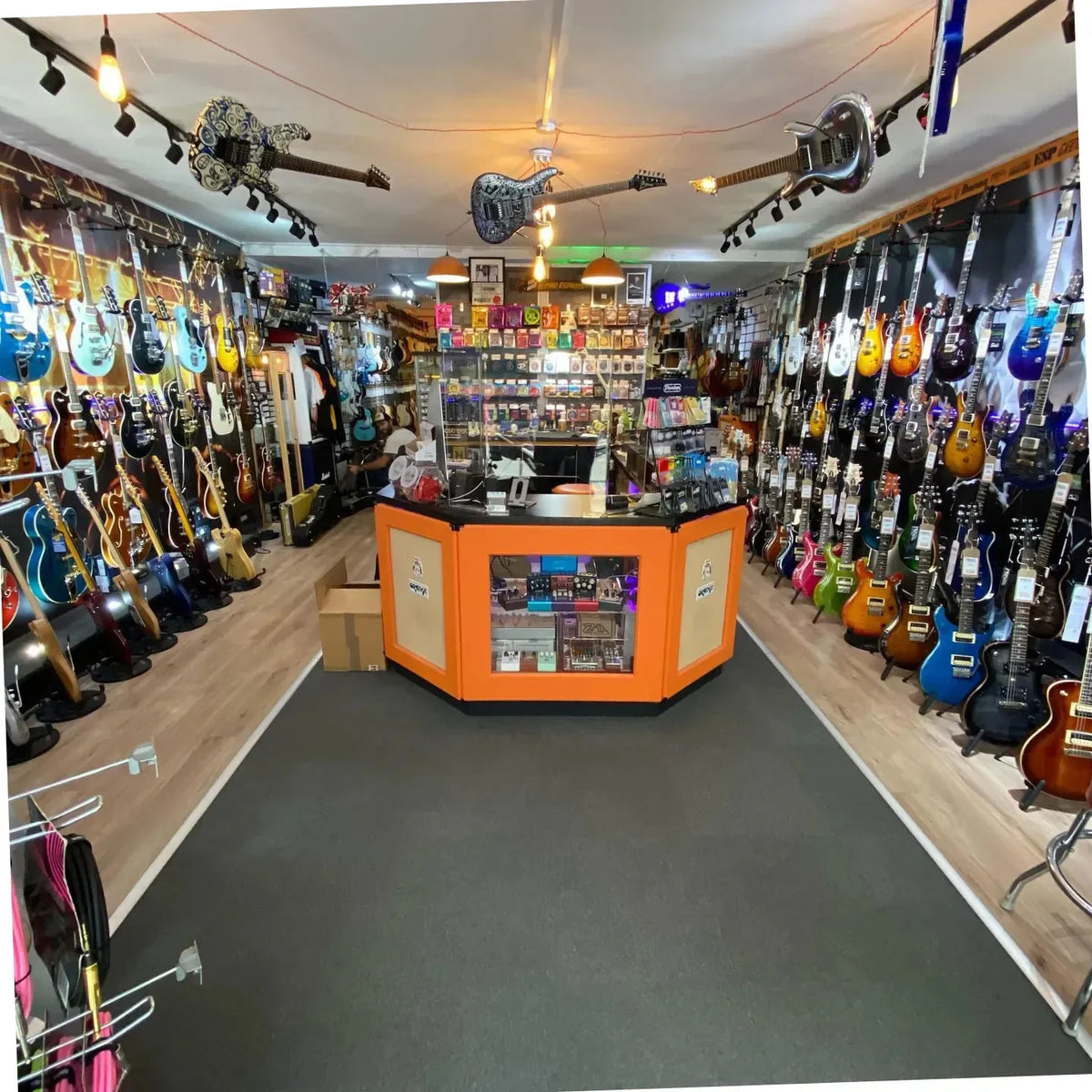
At Music Street, our mission is to provide a carefully curated selection of instruments with exceptional customer service. We operate a family‑run store and online shop, stocking hundreds of electric and acoustic guitars, basses, amplifiers, and accessories. Every instrument is professionally set up before shipping, and our team of musicians offers expert advice.
Below are some recommended Bass VI models and related products available from Music Street. Each link opens a page on our site and is unique; we don’t repeat URLs across the article.
| Point | Details |
|---|---|
| Fender Vintera II ’60s Bass VI | A modern reissue with an alder body, maple neck, vintage-style early-’60s pickups, and floating tremolo; delivers punchy, classic Fender tone. Ideal for players wanting an authentic 1960s sound with modern reliability. Fender Vintera II ’60s Bass VI |
| Squier Classic Vibe Bass VI | A budget-friendly alternative featuring a poplar body, maple neck and three single-coil pickups with on/off slide switches. Perfect for guitarists exploring the Bass VI concept without breaking the bank. Squier Classic Vibe Bass VI |
| D’Addario EXL156 Bass VI Strings | Nickel-wound string set (.024-.084) designed specifically for the Bass VI to ensure proper tension and intonation. A must-have for maintaining optimum tone. Bass VI Strings |
| Bass Guitars Collection | Explore our broader selection of four-, five-, and six-string basses, including traditional Fender models and boutique brands. Perfect if you’re comparing the Bass VI to other bass types. Bass Guitars Collection |
| Fender Guitars Collection | Our curated range of Fender electric guitars includes Stratocasters, Telecasters, and other offsets. Browse these instruments to complement your Bass VI or to diversify your sonic palette. Fender Guitars Collection |
| Types of Bass Guitars Guide | This blog post compares 4-, 5- and 6-string basses, highlighting why a six-string instrument like the Bass VI suits jazz fusion and solo work. Different Types of Bass Guitars |
| Beginner’s Guide to Fender Guitars | Learn how Fender’s history and innovations influence different models. Helpful if you’re deciding between a Bass VI and other Fender instruments. Beginner’s Guide to Fender Guitars |
| Iconic Musicians & Their Fenders | Discover famous players who chose Fender instruments and how those guitars shaped their sound. A great read for understanding the cultural impact of Fender. Iconic Musicians & Fenders |
| Fender vs. Gibson Comparison | A detailed comparison of Fender and Gibson guitars. Useful if you’re exploring the Bass VI’s tonal family and considering other brands. Fender vs Gibson Comparison |
| About Us | Learn about Music Street’s philosophy, our bricks-and-mortar store, and commitment to offering the finest selection of guitars, basses and effects. About Music Street |
Tips for Choosing and Using a Bass VI
- Define Your Role - Decide whether you’ll primarily use the Bass VI as a bass, baritone, or both. If you need deep bass lines with occasional chord voicings, choose models with vintage‑style pickups for warmth. If you plan to play melodic solos, look for comfortable neck profiles and modern pickup options.
- Consider Scale Length and Neck Profile - All Bass VI models feature a 30″ scale, but neck shapes vary (vintage “C” vs modern “C”). Try both to see which feels comfortable for your hands.
- Experiment with Strings and Tunings - The Bass VI uses heavier gauge strings to maintain tension. If you prefer a looser feel, consider flatwound strings for a smoother tone or adjust tuning (e.g., A-A) for baritone use. Always ensure your strings are designed for the Bass VI to avoid intonation issues.
- Use Effects Creatively - Because the Bass VI covers both bass and guitar frequencies, it responds well to effects. Try reverb, delay, and tremolo for surf and post‑punk textures, or fuzz and overdrive for aggressive riffs. The floating tremolo adds expressive vibrato, so don’t hesitate to dive‑bomb chords.
- Record and Layer - The Bass VI shines in studio settings where its unique tonal range can be layered. Record clean lines for definition, then re‑amp through guitar and bass amplifiers to blend tones. Its ability to straddle roles reduces the need for multiple instruments on a track.
Conclusion
The Fender Bass VI remains one of the most intriguing instruments in Fender’s history. With its six‑string, guitar‑like tuning and bass‑guitar depth, it offers a sonic palette unavailable on standard basses or baritones. Whether you’re a guitarist seeking new textures or a bassist looking to expand your range, the Bass VI delivers exceptional versatility, vintage aesthetics, and a rich legacy.
At Music Street, we’re proud to stock both Fender and Squier versions of this instrument alongside a wide range of basses, guitars, and accessories. Explore our collections, read our in‑depth guides, and let us help you find the Bass VI that inspires your next musical adventure.



Share:
Why Vintage Guitar Reissues Captivate UK Musicians
Why Upgrade Guitar Pickups – Transform Your Tone