


Acoustic guitars produce sound through natural resonance in a hollow body, while electric guitars rely on magnetic pickups and amplification.
Beginners find electric guitars easier to play due to lighter strings and lower action, but acoustic guitars cost less and require no extra equipment.
Acoustic and electric guitars are the two dominant guitar types, and the difference between them goes far beyond looks. An acoustic guitar produces sound through the vibration of its strings resonating inside a hollow wooden body. An electric guitar relies on magnetic pickups to convert string vibration into an electrical signal, which an amplifier then projects as sound. That single distinction shapes everything: how the guitar feels to play, what it costs to get started, which genres it suits, and how practical it is for home practice. Understanding the acoustic vs electric divide is the most important decision any first-time buyer will make.
How do acoustic and electric guitars differ in sound and playability?
The physical construction of each guitar type directly determines its sound and feel. Acoustic guitars use a hollow body, typically built from tonewoods like spruce, mahogany, or rosewood, to amplify string vibration naturally. Brands like Martin and Taylor have refined this construction over more than a century. Electric guitars, made by brands such as Fender and Gibson, use a solid or semi-hollow body paired with magnetic pickups that send the signal to an amplifier.

String material and gauge affect both tone and physical feel significantly. Acoustic guitars typically use bronze or phosphor bronze strings, which are thicker and under higher tension. Electric guitars use nickel or nickel-wound strings, which are lighter and easier to press down. That difference in tension is felt immediately in the fretting hand.
Action height, which is the distance between the strings and the fretboard, also differs between the two types. Acoustics tend to have higher action, which requires more finger pressure to produce a clean note. Electrics are set up with lower action as standard, making chord shapes and single-note runs physically easier to execute.
| Attribute | Acoustic guitar | Electric guitar |
|---|---|---|
| Sound source | Hollow body resonance | Magnetic pickups and amplifier |
| String material | Bronze, phosphor bronze | Nickel, nickel-wound |
| String tension | Higher | Lower |
| Action height | Generally higher | Generally lower |
| Neck width | Wider | Narrower |
| Portability | No amp required | Requires amp and cable |
Pro Tip: If you pick up an acoustic and find it uncomfortable to press the strings down, ask the retailer to check the action. A professional setup can make a significant difference to playability without changing the instrument itself.
What genres suit acoustic and electric guitars?
Acoustic guitars produce a natural, warm, resonant sound that suits folk, country, blues, and singer-songwriter styles. The sound is immediate and organic, with no equipment between the player and the listener. Artists from Ed Sheeran to Bob Dylan have built careers around the acoustic guitar’s directness. Fingerpicking styles, open tunings, and strummed chord progressions all sit naturally on an acoustic.
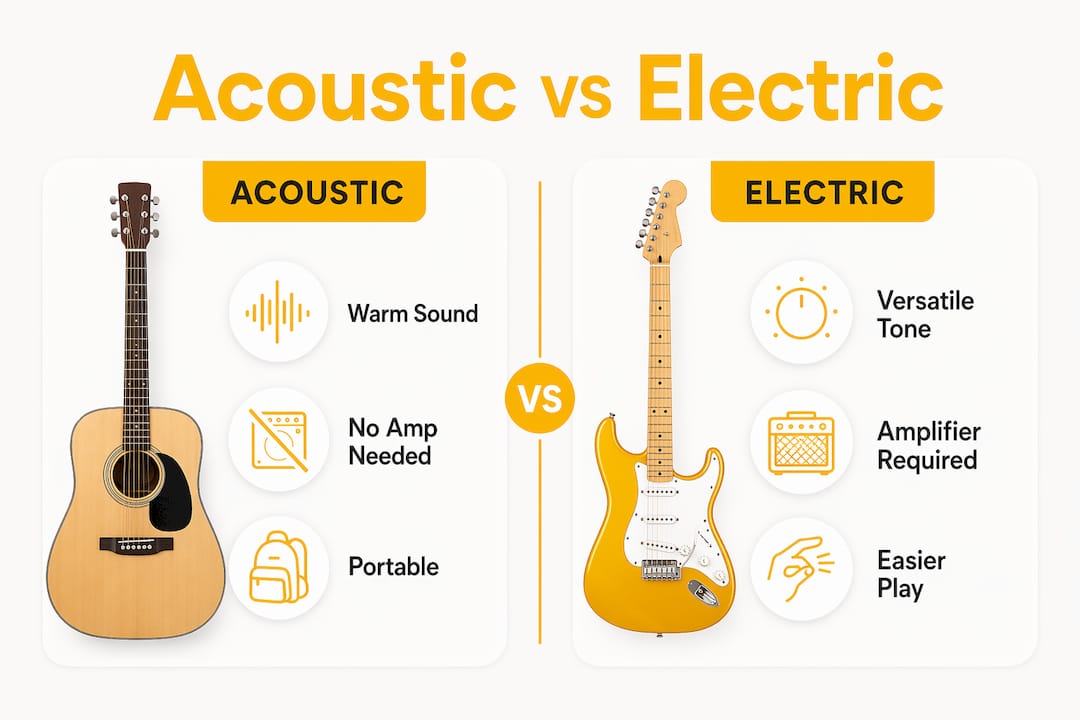
Electric guitars offer a much wider tonal range. Through pickups, amplifiers, and effects pedals, a single electric guitar can produce clean jazz tones, crunchy rock rhythms, or high-gain metal distortion. Electric guitar tone is shaped by the combination of pickup type, amplifier settings, and effects, giving players far greater control over their sound. That versatility is why the electric guitar dominates rock, blues, jazz, funk, and metal.
Genre suitability by guitar type:
- Folk, country, singer-songwriter: Acoustic guitar is the natural choice. The warm, resonant tone suits open chords and fingerpicking.
- Rock and pop: Electric guitars deliver the driven, sustained tones associated with bands from The Rolling Stones to Arctic Monkeys.
- Blues: Both types work well. Acoustic blues has a raw, intimate quality; electric blues, as played by artists like B.B. King, uses amplification and vibrato for expressive lead playing.
- Jazz: The electric guitar, particularly semi-hollow models, produces the warm, rounded tone that defines jazz.
- Metal: Electric guitars with high-output humbucking pickups and high-gain amplifiers are the only practical choice.
- Classical and fingerstyle: Nylon-string acoustic guitars, sometimes called classical guitars, are purpose-built for this style.
Coated strings preserve brightness and extend string life on both guitar types. This is worth knowing if you play regularly, as fresh-sounding strings make a noticeable difference to tone.
Which guitar is easier to learn as a beginner?
Electric guitars are generally easier to play physically. Lighter strings, lower action, and narrower necks reduce the finger pressure required to fret notes cleanly. Beginners on acoustic guitars often experience sore fingertips and struggle with barre chords in the early weeks, because the higher string tension demands more grip strength. That physical challenge is real, but it is not permanent. Calluses develop within a few weeks of regular practice, and many players find that starting on acoustic builds stronger technique.
There is a counterintuitive argument for starting on electric, though. Amplification exposes every buzz, muted note, and sloppy transition immediately. That immediate feedback encourages cleaner technique from the start. Players who practise on acoustic can sometimes develop habits that only become apparent when they plug into an amp later.
Factors that affect the beginner’s choice:
- Physical comfort. Electric guitars are easier on the fingers initially. If discomfort causes a beginner to stop practising, the easier instrument is the better choice.
- Genre motivation. A beginner who wants to play Oasis songs will stay motivated on acoustic. One who wants to play Metallica needs an electric. Motivation is the single biggest predictor of progress.
- Budget. Acoustic beginner guitars typically cost between £120 and £250. Electric starter kits including an amplifier typically cost £200 to £380. The additional equipment cost for electric is real and worth planning for.
- Practice environment. An acoustic can be played anywhere. An electric requires an amplifier or headphone practice solution.
- Long-term goals. A player who wants to perform acoustically at open mic nights needs an acoustic. A player aiming for a band setting will almost certainly need an electric.
Pro Tip: Try both types in a shop before buying. Fifteen minutes of playing each will tell you more about comfort and feel than any online comparison. Musicstreet’s store in Huntingdon, Cambridgeshire offers exactly this kind of hands-on experience.
How do portability and practice environment affect your choice?
Acoustic guitars win on portability without question. They require no additional equipment, no power source, and no cables. You can pick one up and play in a garden, a bedroom, or a campsite. That simplicity makes acoustics the default choice for players who want to practise casually or travel with their instrument.
Electric guitars require an amplifier, a cable, and a power source. That adds cost, weight, and complexity to every practice session. The good news is that modern practice amplifiers solve most of these problems. The Marshall MG15GR is a 15W practice amplifier with a headphone output that enables completely silent practice at home. It also includes an MP3 input, clean and overdrive channels, and adjustable reverb, making it a capable home practice tool in a compact format.
The Marshall MG15GR’s emulated headphone output allows electric guitar players to practise at any hour without disturbing others. This is a practical solution for players in flats, shared houses, or homes with young children. Silent practice amplifiers have removed one of the most common practical objections to starting on electric guitar.
| Factor | Acoustic guitar | Electric guitar |
|---|---|---|
| Equipment needed | Guitar only | Guitar, amp, cable |
| Portability | High | Moderate |
| Silent practice | Not possible unamplified | Possible with headphone amp |
| Noise level | Moderate (natural volume) | Controllable via amp volume |
| Setup time | None | Minimal (plug in and play) |
For players in noise-sensitive environments, an electric guitar with a headphone-capable amplifier can actually be quieter than an acoustic. That is a fact that surprises most beginners and is worth weighing seriously.
Key takeaways
The right guitar type is determined by the music you want to play, your practice environment, and your physical comfort, not by any universal rule about which is better.
| Point | Details |
|---|---|
| Sound production differs fundamentally | Acoustics use hollow body resonance; electrics use pickups and amplification. |
| Genre should guide your choice | Acoustic suits folk and country; electric suits rock, blues, jazz, and metal. |
| Electric is physically easier to play | Lower action and lighter strings reduce finger strain for beginners. |
| Acoustic costs less to start | No amplifier needed; entry-level acoustic setups are simpler and cheaper. |
| Silent practice favours electric | A headphone-capable amp like the Marshall MG15GR makes electric viable in any home. |
What I’ve learned from watching beginners choose the wrong guitar
The most common mistake I see is beginners choosing a guitar based on what looks cool rather than what they actually want to play. Someone buys a Stratocaster-style electric because they love the look, then never touches it because they have no amp and no interest in rock music. Someone else buys an acoustic because it seems like the sensible starting point, then gives up after three weeks because barre chords are painful and they really wanted to play blues.
The honest truth is that neither type is universally better. The first-time buyer’s guide question is always the same: what music do you actually want to make? Start there and work backwards. If the answer is folk or singer-songwriter, buy an acoustic. If the answer is anything amplified, buy an electric and budget for a small practice amp.
One thing beginners consistently underestimate is the impact of string gauge and material on playability. A lighter gauge set of strings on an acoustic can make the instrument significantly more comfortable without compromising tone for a beginner. That single change has kept more than a few new players from quitting.
My final observation: try before you buy whenever possible. Reading comparisons is useful, but twenty minutes in a shop will settle the question faster than any article.
— Music
Guitars for every style at Musicstreet
Musicstreet stocks a carefully chosen range of acoustic and electric guitars from brands including Fender, Gibson, Martin, and PRS, covering everything from beginner-friendly models to professional-grade instruments.

Whether you are drawn to the natural warmth of an acoustic or the tonal range of an electric, the team at Musicstreet offers expert advice and hands-on support to help you find the right fit. Every guitar is professionally inspected before sale, and free UK delivery is available on qualifying orders. Visit Musicstreet’s guitar shop to browse the full range, or come into the Huntingdon store to try instruments in person before committing.
FAQ
Is acoustic or electric guitar better for beginners?
Electric guitars are physically easier to play due to lighter strings and lower action, but acoustic guitars require no additional equipment. The better choice depends on the music you want to play and your practice environment.
Do I need an amplifier to play electric guitar?
An amplifier is required to hear an electric guitar at full volume, but headphone-capable practice amps like the Marshall MG15GR allow completely silent practice. This makes electric guitar practical even in noise-sensitive homes.
Can I learn guitar on acoustic and then switch to electric?
Yes. The core skills transfer directly between both types. Many players start on acoustic to build finger strength and technique, then move to electric once they are comfortable with the fundamentals.
Which guitar type suits rock music better?
Electric guitars suit rock music. The combination of pickups, amplifiers, and effects pedals produces the driven, sustained tones that define rock, from classic bands like The Rolling Stones to modern artists.
How much does a beginner electric guitar setup cost compared to acoustic?
A beginner acoustic guitar typically costs between £120 and £250. An electric starter setup including a guitar and practice amplifier typically costs between £200 and £380, reflecting the additional equipment required.






Share:
Acoustic vs electric guitar: which type is right for you?
How are guitar strings made: materials, winding and craft