


Struggling to make your notes sing or leave a lasting impression onstage often comes down to one crucial element many players overlook: sustain. For intermediate guitarists across the UK, understanding guitar sustain transforms not just your sound but your control over every phrase you play. Whether you crave long, expressive solos or crisp rhythmic lines, mastering how sustain shapes your tone empowers you to craft a signature style others will notice.
Table of Contents
- What Is Guitar Sustain And Why It Matters
- Types Of Sustain On Different Guitars
- Electric Guitars: Maximum Sustain Potential
- Acoustic Guitars: Natural Decay
- Artificial Sustain Solutions
- Sustain Across Guitar Styles
- Key Factors Impacting Sustain Duration
- Wood Selection And Body Mass
- Hardware And Bridge Design
- Pickup Height And Positioning
- Amplifier And Effects Chain
- Setup And Maintenance Impact
- Playing Technique
- Techniques For Improving Your Guitar Sustain
- Adjust Your Pickup Height
- Amplifier And Gain Optimisation
- EQ And Tone Shaping
- String And Setup Maintenance
- Playing Technique Refinement
- Avoiding Common Mistakes
- Choosing Guitars And Gear For Better Sustain
- Guitar Body Type Matters Most
- Pickup Selection And Adjustability
- Hardware Specifications
- Amplifier And Effects Choice
- Pedals And Sustain Gear
- String Selection And Gauge
- Making Your Purchase Decision
Key Takeaways
| Point | Details |
|---|---|
| Understanding Sustain | Sustain is the duration a note rings out after being played, fundamentally affecting tone and playability. |
| Impact on Playing Styles | Long sustain is beneficial for lead playing with expressive bends, while shorter sustain suits rhythm playing, maintaining note clarity. |
| Choosing the Right Guitar | Solid-body electric guitars typically offer the best sustain compared to acoustic and hollow-body designs, influencing tonal choices for genres. |
| Enhancing Sustain | Factors such as pickup height, amplifier settings, and string quality can be optimised to significantly improve sustain performance. |
What Is Guitar Sustain And Why It Matters
Guitar sustain is simply how long a note rings out after you strike it. When you pluck a string, the note doesn’t immediately disappear; instead, it gradually fades away. That fade time is sustain.
Sustain refers to the continuation of a musical tone after it has been played. Think of it like the difference between clapping and holding a note on a microphone. With a clap, the sound vanishes instantly. With sustain, the sound lingers, giving you time to shape the note with bends, vibrato, or effects.
Why should you care about sustain? It changes how your guitar feels to play and fundamentally shapes your tone.
Why Sustain Shapes Your Sound
Long sustain lets you create expressive, singing notes that ring for seconds. Short sustain forces you to play more percussively, which suits certain styles perfectly. Neither is “better”—they’re simply different tools.
Consider these practical impacts:
- Lead playing: Long sustain makes bends and vibrato shine. Your note continues ringing whilst you manipulate it with your hand.
- Rhythm work: Shorter sustain keeps notes tight and defined, preventing muddy overlap between chords.
- Soloing: Extended sustain lets you hold dramatic notes, building tension before moving to the next phrase.
- Effects processing: Sustain interacts with reverb, delay, and distortion, creating layered textures.
Solid-body electric guitars naturally provide more sustain than acoustic guitars because the body doesn’t absorb as much vibrational energy. Materials like heavier woods in the guitar neck also influence how long notes ring.
Sustain isn’t random. It’s determined by your instrument’s construction, your setup, and how you play.
Long sustain unlocks expressive playing possibilities, whilst proper setup ensures you actually achieve the sustain your guitar is capable of delivering.
How Sustain Connects to Tone
Sustain directly affects tone because a note that fades quickly sounds different from one that rings for seconds. A held note allows harmonics to develop naturally, creating richness and depth. That’s why sustain matters beyond mere longevity; it changes what listeners actually hear.

Your playing technique influences sustain too. Harder picking attacks and proper finger pressure on the fretboard extend sustain. Muting strings accidentally cuts it short instantly.
Pro tip: Check your guitar’s current sustain by playing a fretted note and timing how many seconds it takes to fade to silence. Compare different positions on the neck. This baseline helps you hear whether your setup needs adjustment.
Types Of Sustain On Different Guitars
Not all guitars sustain equally. The differences are dramatic. A solid-body electric guitar can hold a note for 10 seconds or more, whilst an acoustic might fade in 3 to 5 seconds. Understanding these variations helps you choose the right instrument for your playing style.
Here’s how sustain varies across major guitar types:
| Guitar Type | Typical Sustain Duration | Tonal Character | Ideal Genres |
|---|---|---|---|
| Solid-body Electric | 8–12 seconds | Bright and focused | Rock, metal, fusion |
| Semi-hollow Electric | 5–8 seconds | Warm and resonant | Jazz, blues, indie |
| Hollow-body Electric | 3–6 seconds | Mellow and round | Jazz, vintage pop |
| Acoustic | 2–5 seconds | Natural and woody | Folk, singer-songwriter |
Electric Guitars: Maximum Sustain Potential
Solid-body electric guitars dominate the sustain game. Their dense wood bodies transfer energy directly to the strings without absorption, allowing notes to ring indefinitely under the right conditions.
Here’s what gives electrics their advantage:
- Solid construction: No hollow cavities to dampen vibrations.
- Direct pickup response: Electronics amplify the string vibration before it naturally decays.
- Hardware efficiency: Guitar bridges and tuning machines transfer energy with minimal loss.
- Amplification factor: Your amp sustains the note well beyond what the guitar alone could achieve.
Semi-hollow and hollow-body electrics offer less sustain because their cavities absorb some vibrational energy. However, they compensate with warm, resonant tone that many players prefer for jazz and blues.
Acoustic Guitars: Natural Decay
Acoustic guitars sacrifice sustain for volume and resonance. The hollow body is designed to amplify string vibrations acoustically, not to hold them indefinitely. Sound radiates outward through the soundhole, so energy dissipates quickly.
Acoustics simply fade faster. This isn’t a defect; it’s by design. The trade-off is part of their character.
Artificial Sustain Solutions
If you want extended sustain without changing guitars, technology offers options. Natural and artificial sustain mechanisms exist for different playing needs.
Sustainer pickups like the Sustainiac electromagnetically excite your strings, creating infinite sustain. They’re especially popular in rock and metal. The pickup senses the string’s vibration and feeds energy back to keep it resonating indefinitely.
The EBow (Energy Bow) is a handheld device that works similarly, using electromagnetic oscillation. You glide it over strings to create sustain effects without plugging into your guitar permanently.
Effects-based sustain uses compression and reverb through your amplifier. These won’t create true infinite sustain, but they extend the natural decay significantly.
Different sustain types suit different genres. Rock thrives on sustainer pickups, whilst blues prefers natural acoustic decay combined with amp compression.
Sustain Across Guitar Styles
Your playing style determines which sustain type matters most. Lead players benefit from long sustain for bending and expressive techniques. Rhythm players often prefer shorter sustain to keep notes tight and separated.
Heavy woods in the neck also influence sustain duration, as do bridge materials and string gauge.
Pro tip: Try solid-body and semi-hollow electric guitars side by side at a shop, playing the same fretted note on each. Listen for the sustain difference. Your ear will immediately recognise which instrument matches your playing needs.
Key Factors Impacting Sustain Duration
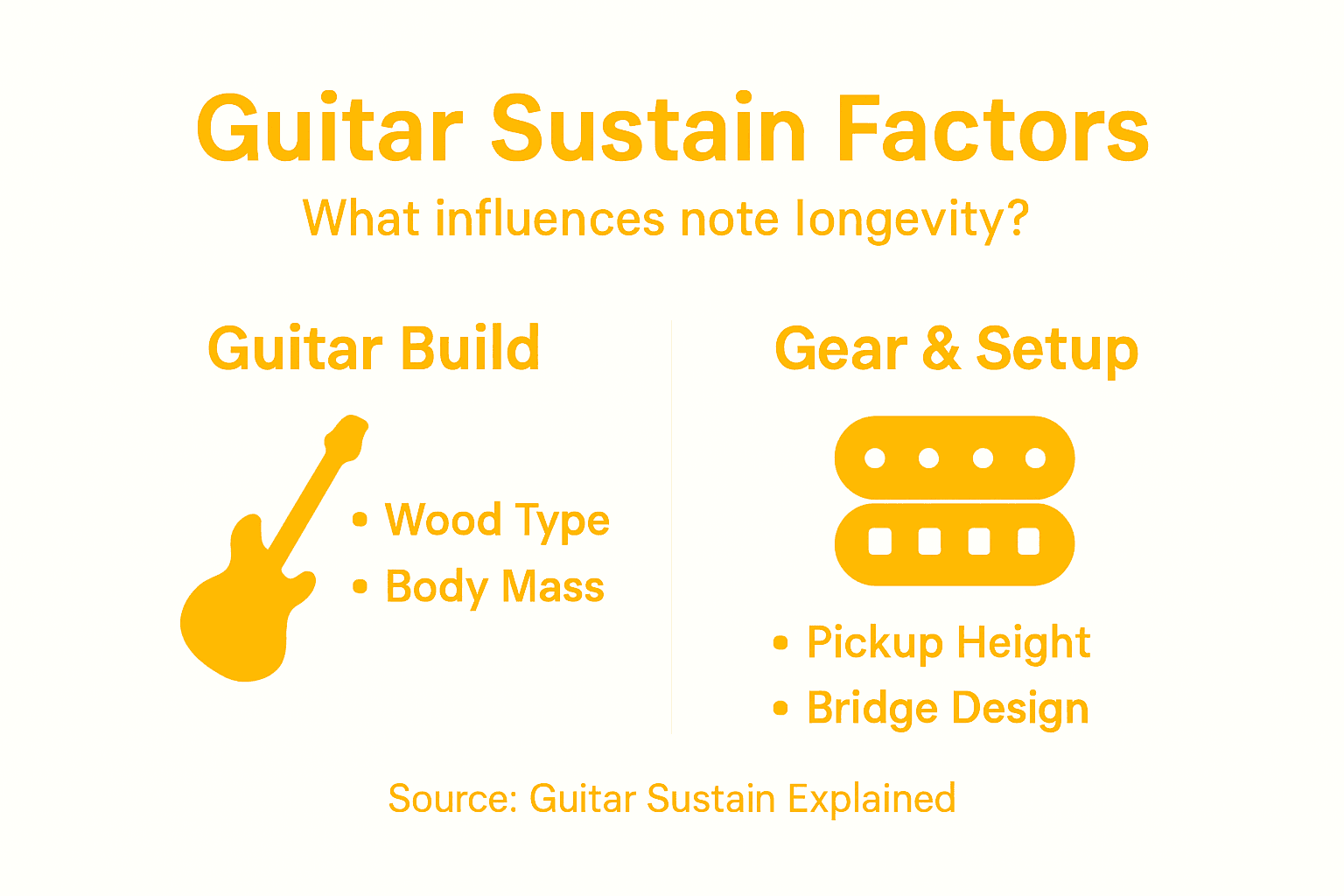
Sustain doesn’t happen by accident. Multiple factors work together to determine how long your notes ring out. Master these, and you’ll unlock your guitar’s full potential.
Wood Selection and Body Mass
The wood you choose directly affects sustain. Denser, heavier woods hold vibrations longer than lighter timber. Mahogany, maple, and ash are sustain-friendly choices. Each wood species resonates differently, so your guitar’s tone and sustain are inseparable.
Body mass matters too. A heavier instrument transfers string vibrations more efficiently than a light one. This is why solid-body electrics outperform hollow designs in sheer sustain duration.
Hardware and Bridge Design
Your bridge connects strings to the body. A poorly designed or loose bridge bleeds energy. Quality bridges lock vibrations in place, preventing energy loss at the connection point.
Tuning machine stability also counts. Slack or worn tuners allow strings to slip fractionally, cutting sustain short. Upgrade to quality hardware and you’ll hear the difference immediately.
Consider these sustain-critical components:
- Bridge type: Hardtail designs sustain longer than tremolo systems.
- Nut material: Bone nuts transfer energy better than plastic.
- String gauge: Thicker strings sustain longer but feel stiffer.
- Fretboard contact: Proper setup ensures strings vibrate freely.
Pickup Height and Positioning
Pickup height seems minor, but it’s surprisingly powerful. Optimising pickup height directly influences sustain quality and note decay characteristics. Moving pickups further from strings reduces the initial transient, allowing smoother sustain.
A few millimetres make measurable differences. Too close, and pickups suppress sustain. Too far, and output drops. Finding the sweet spot transforms your tone.
Amplifier and Effects Chain
Your amp sustains notes beyond what the guitar alone can achieve. Compression extends decay time significantly. Reverb and delay create the illusion of infinite sustain by repeating the note.
Distortion actually enhances sustain because it maintains signal strength longer than clean tone. Overdrive and fuzz are sustain-boosting tools. Use them intentionally, not just for aggression.
Setup and Maintenance Impact
Construction materials and design elements create the foundation for sustain, but only if your guitar is properly set up. A warped neck kills sustain instantly. High action reduces vibration efficiency. Dead frets dampen tone.
Regular maintenance keeps everything working. Dirty pots, oxidised connectors, and worn strings all reduce sustain gradually.
To quickly reference core factors influencing guitar sustain:
| Factor | Effect on Sustain | Optimisation Tip |
|---|---|---|
| Body Wood Density | Higher density increases sustain | Choose mahogany or maple |
| Bridge Quality | Stable bridges retain vibration | Fit a hardtail or fixed bridge |
| String Gauge | Thicker strings sustain longer | Use .010–.046 or heavier gauges |
| Pickup Height | Too high can choke sustain | Lower pickups slightly for clarity |
| Amplifier Settings | Compression and gain extend notes | Add light compression, moderate gain |
Sustain lives in the details. One loose screw or worn component cascades into noticeable decay loss across your entire guitar.
Playing Technique
Your hands matter as much as hardware. Firm finger pressure on frets maximises vibration transfer. Light touch reduces sustain. Muting accidentally kills notes instantly.
Picking attack influences sustain too. Harder strikes excite the string more thoroughly, creating longer decay.
Pro tip: Adjust your pickup height in tiny increments—half a millimetre at a time—whilst playing the same fretted note. Listen for the point where sustain peaks without sacrificing output clarity. Mark that position so you can return to it after servicing.
Techniques For Improving Your Guitar Sustain
You don’t need new gear to unlock better sustain. Smart adjustments to your current setup yield dramatic results. These techniques work whether you’re playing a budget model or a premium instrument.
Adjust Your Pickup Height
Pickup position is your fastest sustain win. Moving pickups further from the strings reduces harsh transients and creates smoother decay. Optimising pickup height typically means loosening the screws holding pickups in place and moving them down a few millimetres.
The sweet spot varies by guitar, but start with about 2-3 millimetres of clearance between pickup and string. Play test notes and listen for peak sustain without losing output. Mark the position once you find it.
Amplifier and Gain Optimisation
Your amp shapes sustain as much as your guitar does. Increasing gain extends note duration significantly. Use either your amplifier’s gain channel or a dedicated gain pedal to boost signal strength.
Avoid stacking multiple gain sources simultaneously. This creates unwanted noise and muddy tone. Pick one or two and dial them carefully.
Compression pedals are sustain game-changers. They maintain signal level as notes decay, making sustain seem infinite. Set compression moderately to avoid squashing your tone.
EQ and Tone Shaping
Your amplifier’s EQ controls interact with sustain. Boosting midrange frequencies enhances note definition and perceived sustain. Cut excess bass to prevent boom from masking decay.
Experiment with these settings:
- Treble: Modest boost (1-2 o’clock) adds clarity without harshness.
- Midrange: Boost here for sustain perception and note presence.
- Bass: Keep it moderate to maintain definition and sustain clarity.
- Presence: A small boost adds sparkle without sacrificing sustain.
String and Setup Maintenance
Worn strings die before new ones. Replace them every 2-3 months if you play regularly. New strings vibrate more freely, extending sustain noticeably.
Proper setup matters too. High action reduces sustain by restricting string vibration. Low action risks fret buzz. Aim for 2mm at the 12th fret on the bass side, 1.5mm on treble.
Fretboard cleanliness affects sustain indirectly. Clean frets vibrate more efficiently than grimy ones.
Playing Technique Refinement
Understanding perfect tone includes mastering technique that maximises sustain. Press strings firmly against frets without excessive pressure. Hard muting accidentally kills sustain instantly.
Picking attack matters too. Solid strikes excite strings fully. Soft touches reduce initial vibration and shorten decay.
Sustain improvement compounds. Combine pickup adjustment, gain optimisation, EQ tweaking, and fresh strings for transformative results.
Avoiding Common Mistakes
Some approaches backfire. Cranking all EQ controls boosts unwanted frequencies and creates mud. Using heavy distortion masks sustain rather than extending it.
Too much compression kills dynamics. Your notes should breathe naturally, not sound squashed throughout their decay.
Pro tip: Make one adjustment at a time and play the same passage repeatedly before changing anything else. This trains your ear to recognise subtle sustain improvements and prevents you from accidentally reverting good changes whilst chasing bad ones.
Choosing Guitars And Gear For Better Sustain
Not all guitars are created equal when it comes to sustain. The right choice depends on your budget, playing style, and tone goals. Smart purchasing decisions pay dividends in sustain performance.
Guitar Body Type Matters Most
Solid-body electric guitars deliver maximum sustain. Their dense construction transfers string vibrations efficiently, with minimal energy loss. Semi-hollow and hollow-body models sacrifice some sustain for warmth and resonance, making them better suited to jazz and blues.
Solid body guitars usually provide better sustain than chambered designs because their solid wood resists energy dissipation. This advantage compounds when paired with quality hardware and electronics.
Budget solid-bodies outperform expensive hollow guitars if sustain is your priority. Choose based on your actual playing needs.
Pickup Selection and Adjustability
Pickups shape sustain dramatically. Look for guitars with adjustable pickup height. This single feature lets you customise sustain to match your preferences without expensive modifications.
Passive pickups offer different sustain characteristics than active ones. Active pickups maintain stronger signal throughout decay, extending perceived sustain naturally. Consider this when comparing instruments.
High-output pickups boost sustain by maintaining signal strength longer. They’re particularly effective for lead playing and heavier genres.
Hardware Specifications
Quality hardware directly impacts sustain. Consider these components:
- Bridge type: Hardtail fixed bridges sustain longer than tremolo systems.
- Tuning machines: Quality tuners prevent string slippage and energy loss.
- Nut material: Bone and brass nuts transfer vibrations better than plastic.
- Body-to-neck joint: Neck-through designs sustain longer than bolt-on necks.
Amplifier and Effects Choice
Tube amplifiers configured with appropriate EQ settings increase sustain significantly. Valve amps compress naturally, extending note decay compared to solid-state designs.
Gain staging matters too. A 50-watt tube amp sustains better than a 100-watt solid-state unit at moderate volumes. The valve response characteristics favour sustain.
Pedals and Sustain Gear
Distortion and overdrive pedals extend sustain measurably. Stack them carefully to avoid excessive noise. One quality overdrive pedal outperforms layering multiple drives simultaneously.
Compression pedals smooth sustain and create more consistent decay across your playing range. Use them subtly for best results.
Sustain gear works best when matched to your guitar and playing style. A cheap guitar through premium gear won’t outperform a quality instrument through modest equipment.
String Selection and Gauge
Thicker strings sustain longer but feel stiffer. Most intermediate players find 0.046-0.010 gauge optimal for balance. Experiment across the range to find your preference.
Quality string brands hold tension better than budget options, extending sustain duration naturally over weeks of playing.
Making Your Purchase Decision
Test multiple guitars side by side before buying. Play identical passages on solid-body, semi-hollow, and hollow models. Your ears tell you which sustain character matches your needs.
Pro tip: Visit a shop where you can try different guitar and amplifier combinations. Play lead passages that showcase sustain, not just strumming. Ask the shop to adjust pickup height on a test guitar so you hear the sustain difference firsthand.
Unlock The Full Potential Of Your Guitar Sustain
Understanding guitar sustain is key to transforming your tone and playing experience. Whether you seek longer ringing notes for expressive solos or tighter note decay for crystal-clear rhythm parts, your instrument and setup make all the difference. At MusicStreet, we specialise in providing both electric and acoustic guitars expertly selected and set up to maximise sustain and tone, tailored for your style and goals.

Discover a curated range of guitars crafted from premium woods with hardware designed to enhance sustain. Benefit from professional setup services including precise pickup height adjustment and string installation that breathe new life into your sound. Don’t settle for struggles with note decay or muddy tone anymore. Visit MusicStreet now to explore our collection, learn more about achieving optimal sustain, and experience personalised support from our expert team dedicated to helping you unlock your ideal guitar voice.
Frequently Asked Questions
What is guitar sustain and how does it affect playing?
Guitar sustain is the duration a note rings out after being played. It affects playing by allowing expressive techniques like bends and vibrato, or keeping notes tight and defined depending on sustain length.
How does the type of guitar influence sustain?
Different guitar types have varying sustain capabilities. Solid-body electrics typically provide the most sustain due to their dense construction, while acoustics tend to have shorter sustain, sacrificing it for volume and resonance.
What factors can improve my guitar’s sustain?
Factors that can improve sustain include using denser woods, optimising pickup height, ensuring quality hardware like bridges and tuning machines, and maintaining a good setup. Additionally, using effects like compression and reverb can enhance sustain.
Can I extend sustain artificially without changing my guitar?
Yes, you can use technologies like sustainer pickups or an EBow, which energises strings electromagnetically for extended sustain. Compression pedals can also help prolong the note decay, enhancing the overall sustain effect.


Share:
The "MusicStreet Standard": Why a Pro Setup Beats a Factory Box
How to Evaluate Guitar Value for Resale or Collection