

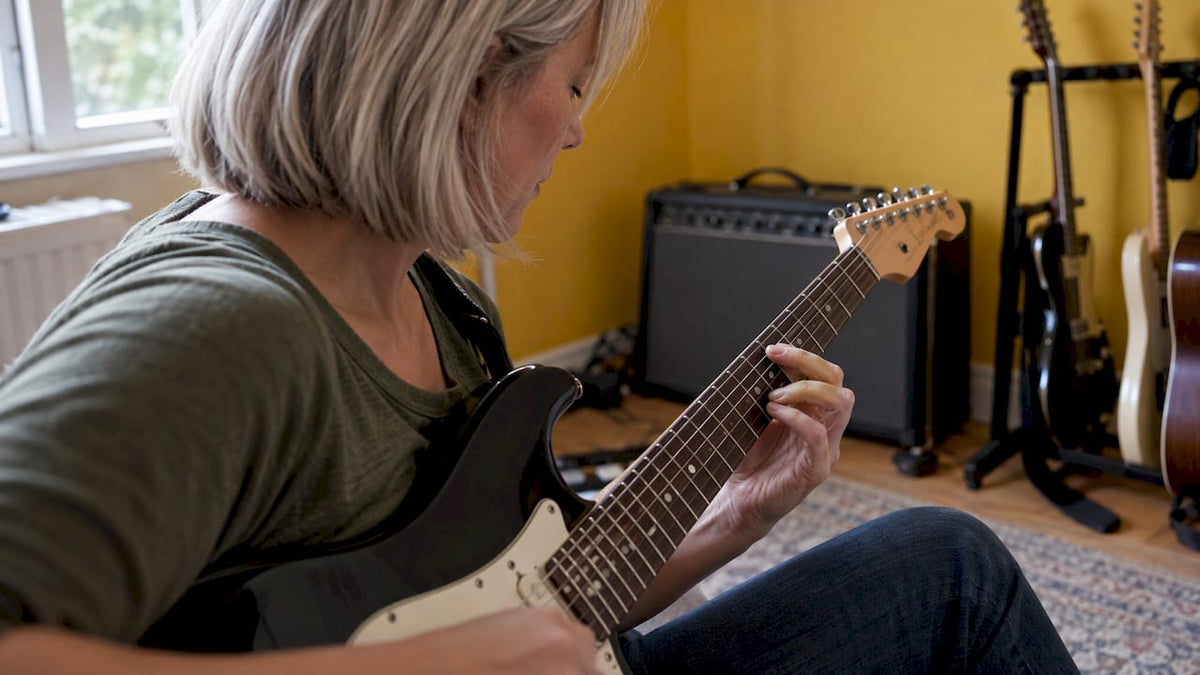
A Dorian is the scale A, B, C, D, E, F♯, G, played over an A minor sound. It is A natural minor with one note changed: the F becomes F♯. That single raised sixth gives you a minor scale that sounds brighter and more open, which is why Dorian turns up in funk, soul, blues-rock and jazz. This guide covers the notes, the sound, where to find it on the fretboard, the chords that bring it out and how to keep your ear hearing A as home.
Table of Contents
- What the A Dorian mode is
- A Dorian versus A minor: one note apart
- How A Dorian sounds, and why the F♯ matters
- Playing A Dorian on the fretboard
- Chords and progressions in A Dorian
- Keeping A as home: Dorian versus G major
- Songs that use Dorian
- Our view: learn the mode on an instrument you love playing
- Find the right guitar for modal playing
- FAQ
- Sources
What the A Dorian mode is
A Dorian contains the notes A, B, C, D, E, F♯ and G. It is a minor mode with a major sixth, and it is the second mode of a major scale. In practice that means it uses exactly the same notes as G major, but you treat A as the root instead of G.
As a formula, A Dorian is 1, 2, ♭3, 4, 5, 6, ♭7. The step pattern from A is whole, half, whole, whole, whole, half, whole, so the half steps fall between the 2nd and 3rd degrees (B to C) and between the 6th and 7th (F♯ to G).
| Degree | 1 | 2 | ♭3 | 4 | 5 | 6 | ♭7 |
|---|---|---|---|---|---|---|---|
| Note | A | B | C | D | E | F♯ | G |
| Steps from the previous note | root | W | H | W | W | W | H |
The step table above is simply the note list read as intervals. If you want to see how Dorian sits alongside the other six modes of the major scale, our guide to the seven modes of the major scale lays out the whole family.
A Dorian versus A minor: one note apart
The question most players ask first is how Dorian differs from the ordinary minor scale. Compared with Aeolian (natural minor), Dorian has its 6th degree a half step higher, and that is what makes it sound brighter.
On the same root the two scales line up like this:
| Scale | Notes |
|---|---|
| A natural minor (Aeolian) | A, B, C, D, E, F, G |
| A Dorian | A, B, C, D, E, F♯, G |
One way to hold it in your head is that Dorian is a minor scale with one altered note: raise the 6th by a half step, and A natural minor becomes A Dorian as F becomes F♯.
The practical consequence is that you do not need to learn Dorian from scratch. If you already know your minor scale shapes, you know six of the seven notes. Find the 6th, push it up one fret, and you are playing Dorian.
How A Dorian sounds, and why the F♯ matters
The character comes from the pairing of a minor 3rd and a major 6th. Natural minor has a minor 3rd and a minor 6th, which gives its darker sound, while the mix of minor and major in Dorian is what lifts it. Players often describe the result as bittersweet: still minor, but never fully gloomy.
The F♯ does something useful in a chord progression too. It is not in the Am chord, but it is the major 3rd of D major, so playing it just before the move from Am to D creates a moment of tension that resolves into a chord tone. That small “outside, then inside” movement is a big part of the Dorian sound.
Two practical habits help you hear it:
- Play an A drone or a sustained Am chord and slowly play the scale up and down, pausing on F♯ each time.
- Alternate F and F♯ over the same Am backing. The F sounds like standard minor; the F♯ is the Dorian colour.
Because the flat 3rd and flat 7th are also essential, without them it simply will not sound like Dorian. Landing on C and G against an A root matters as much as the F♯ does.
Playing A Dorian on the fretboard
In standard tuning, A Dorian is easy to reach because several notes fall on open strings. The open-position version, sometimes called Box 1, runs from fret 0 to fret 3 and contains 16 notes across six strings. Here is how it lays out, from the low E string up:
| String | Notes (fret) |
|---|---|
| Low E | E (0), F♯ (2), G (3) |
| A | A (0), B (2), C (3) |
| D | D (0), E (2) |
| G | G (0), A (2) |
| B | B (0), C (1), D (3) |
| High E | E (0), F♯ (2), G (3) |
The root A appears on the open A string and on the 2nd fret of the G string. Try this pattern slowly, one note per beat, over a backing track or a looped Am chord.
Moving beyond the open position
Open strings are handy but limiting, so the next step is to learn A Dorian higher up the neck. A simple route is the following:
- Learn the A root on the low E string at the 5th fret and on the A string at the 12th.
- Take the minor scale or minor pentatonic shape you already use around that root.
- Add the F♯ (the 6th) by pushing the F up one fret wherever it appears.
- Repeat with each of the five CAGED-style positions so the scale covers the whole neck.
If you play pentatonic boxes, our guide to pentatonic scale theory for improvising shows how to turn those boxes into fuller melodic ideas. Adding the 2nd, 4th and 6th to a minor pentatonic is the quickest way to arrive at Dorian.
Practice routine
Ten focused minutes beat an hour of aimless scale running. Try this:
- Two minutes: play the scale up and down in one position to a metronome.
- Three minutes: play only the notes A, C, E and F♯ (a chord-tone-plus-colour set) over a looping Am chord.
- Three minutes: make up four-note phrases that always finish on A.
- Two minutes: switch to a different position and repeat.
If the notes on a worn set of strings sound dull or tuning drifts, that quickly gets in the way of hearing modal colour. Fresh strings make a real difference, and we offer an in-store restring service at our Huntingdon shop.
Chords and progressions in A Dorian
Stacking thirds on each note gives the diatonic triads of A Dorian:
| Degree | Chord | Notes |
|---|---|---|
| i | Am | A, C, E |
| ii | Bm | B, D, F♯ |
| III | C | C, E, G |
| IV | D | D, F♯, A |
| v | Em | E, G, B |
| vi° | F♯dim | F♯, A, C |
| VII | G | G, B, D |
These triads are the same set listed for A Dorian and they are, of course, the same chords as in G major, just in a different order of importance. The chords that carry the F♯ are the most Dorian: D major (IV), B minor (ii) and F♯ diminished. Add a seventh or sixth for richer colour. The characteristic chords are the m6 and m13, both of which contain the raised sixth, so playing natural minor over them clashes on exactly the note that makes Dorian what it is.
The i to IV vamp
The classic Dorian move is minor i to major IV. Modal harmony of this type uses a mode as the tonal centre rather than V7 to I resolution, and the textbook example is i to IV. In A Dorian that is Am to D, and D major contains the F♯. Try a two-bar loop of Am for two beats and D for two beats, then solo over it with the A Dorian shape.
Other progressions to try, all using only notes from the scale:
- Am to Bm and back
- Am, G, C, D, Am
- Am to D to Am
- Am, C, D, Am
Keeping A as home: Dorian versus G major
Because A Dorian and G major share the same seven notes, it is easy to drift into G major without noticing. The notes are not what decide the mode; the harmony is. A simple test is where the progression feels finished. A sequence like Am, G, C, D, Am sounds resolved when it ends on Am, whereas the same chords ending on G would confirm G major.
Music that really sounds like A Dorian tends to avoid reinforcing G as the tonic. It centres on Am and leans on B minor or D major, both of which contain the F♯.
A few ways to keep the centre firm:
- Start and end phrases on A, C or E.
- Keep a drone or open A string ringing underneath.
- Use a bass note of A under most of the loop.
- Avoid lingering on G chords, which pull the ear toward G major.
That last point applies to bass players as well. If you play low end, our 5-string bass scale guide covers the interval formulas that make modes like Dorian easy to transfer to bass.
Songs that use Dorian
Listening to Dorian in context is the fastest way to internalise it. Examples that players commonly cite include Cream’s “Crossroads” and AC/DC’s “Hells Bells” in A Dorian, along with Pink Floyd’s “Another Brick in the Wall” in D Dorian. Other well-known examples are Santana’s “Oye Como Va” in A Dorian, Simon and Garfunkel’s “Scarborough Fair” and Miles Davis’s “So What”.
That last tune is a good reminder that Dorian is as much a jazz sound as a rock one. Dorian overlaps heavily with the sound of the blues, which is part of why it works so naturally under a blues-influenced player’s fingers.
Try learning the main riff of one of these in A Dorian, then improvise over a backing loop in the same key. Transposing is easy: since the pattern is the same in every key, a D Dorian shape is just the A Dorian shape moved across to start on D.
Our view: learn the mode on an instrument you love playing
We see the same thing at our counter in Huntingdon again and again: players learn modes fastest on a guitar that is set up properly and feels good under the fingers. Dorian is a subtle sound, one raised note against a minor chord, and you only hear it clearly when the instrument is in tune, the action is comfortable and the strings are fresh.
That is why every instrument we sell is inspected and set up by us, and why we offer setups, servicing and repairs alongside new and pre-owned guitars. A guitar that fights you makes theory feel harder than it is.
Our advice for anyone starting with Dorian is simple. Pick one position, one loop and one riff, and live with them for a week. Then try the same ideas on a different guitar, perhaps a bright single-coil electric against a warmer acoustic, and notice how the F♯ speaks differently. Come in and try a few in the shop if you can; it is the quickest way to find the instrument that makes you want to practise.
Music
Find the right guitar for modal playing
Dorian suits almost any instrument, but clean, articulate tones show the raised sixth best. Browse our electric guitars or acoustic guitars if you want a new one, and look through our pre-owned stock for good-value options. We back instruments with expert setup and post-sale support, and UK delivery is free above a minimum order value.

Want a hand with a setup, a restring or advice on a first guitar? Visit the shop in Huntingdon, Cambridgeshire, or start with our full range at MusicStreet.
FAQ
What is the difference between the Dorian mode and the minor scale?
Dorian differs from natural minor in one note: the 6th degree is raised by a half step. In A, that means F♯ instead of F. The change makes Dorian sound brighter than natural minor, while the minor 3rd and flat 7th keep it clearly minor.
What notes are in A Dorian?
A Dorian contains A, B, C, D, E, F♯ and G. These are the same notes as G major, but with A as the tonal centre. Phrases that start and end on A, supported by an Am chord, make the mode sound like itself.
What are some famous songs in Dorian mode?
Commonly cited examples include “Oye Como Va” by Santana, “Scarborough Fair” and “So What” by Miles Davis, plus “Crossroads” and “Hells Bells” in A Dorian. Learn the riff, then solo over a loop in the same key.
Which chord progression works best for A Dorian?
The i to IV move, Am to D, is the standard choice, because D major contains the F♯ that defines the mode. Keep a drone or bass note on A and finish phrases on Am so the ear hears A, not G, as home.
Sources
- A Dorian mode
- Employing chromatic passing tones to connect phrases
- A Dorian scale: notes, chords and fingerings
- Music modes: major and minor modal scales
- A practical explanation of Dorian mode, part 1
- Dorian mode: learn the guitar scale that’s great for solos
- Ultimate guide to the Dorian mode on guitar
- A Dorian scale on guitar: notes and positions
- A Dorian scale: notes, chords and how to play it
- Modal chord progressions
- The Dorian mode
- G major vs A Dorian: same notes, different music
- Examples of modes in songs and rock music
- Dorian mode, The Ethan Hein Blog

Share:
Overdrive: What It Is and How It Shapes Guitar Tone