


Guitar strings are made of a metal core wrapped with a thin metal ribbon, which shapes their tone, feel, and durability. Different materials, winding types, and core shapes influence the sound and playability, with manufacturing precision ensuring consistent quality and performance. Understanding construction helps players choose strings that match their tonal preferences and playing style more effectively.
Guitar strings are defined by a single core wire wrapped tightly with a thinner metal ribbon, assembled through a precise manufacturing process that determines every aspect of tone, feel, and durability. Understanding how guitar strings are made reveals why brands like D’Addario and SIT Strings invest so heavily in material science and tension control. The process spans wire drawing, ball end attachment, controlled winding, polishing, and quality inspection. Each stage shapes the final sound you hear when you strike a chord.
What are guitar strings made of?
The raw materials for guitar strings define their tonal character before a single note is played. Steel strings use a high-carbon steel core, which provides the tensile strength needed to hold pitch under playing tension. The wrap wire varies widely depending on the intended application.
Common wrap materials include:
- Nickel-plated steel: the standard for electric guitars, offering a balanced tone with moderate brightness
- Pure nickel: warmer and darker than nickel-plated steel, favoured for vintage-style tones
- 80/20 bronze (80% copper, 20% zinc): bright and articulate, common on acoustic guitars
- Phosphor bronze: warmer than 80/20 bronze with extended treble response, widely used on acoustic instruments
- Stainless steel: highly corrosion-resistant with a bright, cutting tone
- Nylon: used on classical guitars for treble strings, producing a warm, mellow sound
Material density directly affects how a string vibrates. Denser wrap materials damp high frequencies more quickly, producing a warmer sound. Lighter, stiffer materials sustain brightness longer. String performance differences arise mainly from materials chosen and winding technique rather than basic process steps. That means two strings built on the same machine can sound completely different if the wrap wire changes.
Corrosion is a practical concern for every player. Phosphor bronze resists oxidation better than plain bronze, which is why it dominates the acoustic market. Coated strings from brands like Elixir add a polymer layer over the wrap wire to extend lifespan further, though the coating slightly softens the initial brightness.
How are guitar strings made, step by step?
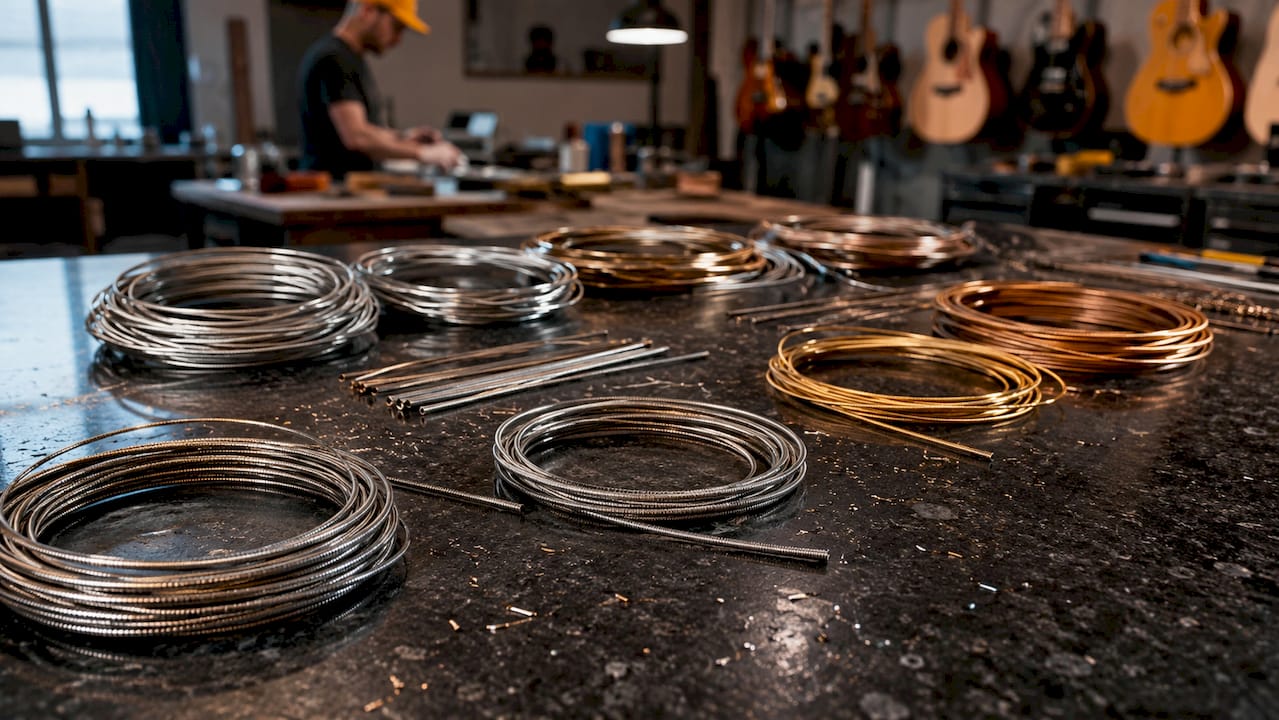
The guitar string manufacturing process follows a clear sequence. Each step builds on the last, and a flaw at any stage carries through to the finished string.
-
Wire drawing: Raw steel rod is pulled through progressively smaller dies to reach the exact core diameter. This process work-hardens the steel, increasing tensile strength. Wire drawing reduces rod diameter progressively, and the final thickness determines the string’s gauge and pitch range.
-
Core wire cutting: The drawn wire is cut to the correct length for the string set being produced. Tolerances at this stage are tight, as length affects how the string seats in the instrument.
-
Ball end attachment: A small brass or steel ball is secured to one end of the core wire before winding begins. The ball end is attached early to stabilise the core during winding and provide a reliable anchor for string tension when played. Without this anchor, the winding process would be inconsistent.
-
Controlled winding: The core wire is loaded onto a lathe-like machine, and a thin metal wrap wire is wound uniformly around it under precise tension. Modern wound guitar strings are made by winding a thin metal ribbon around a core with a secured ball end, followed by polishing and thread wrapping on the ends. The machine controls both the angle of the wrap and the feed rate.
-
Polishing: After winding, the string surface is polished to remove burrs and smooth the texture. This step affects both feel and the rate at which the string collects dirt.
-
Thread wrapping: Silk or nylon thread is wrapped around the ends of the string to protect the core wire at the tuning peg and bridge contact points.
-
Quality inspection: Finished strings are tested for diameter consistency, tensile strength, and tonal uniformity before packaging.
Pro Tip: If you ever notice a string that goes out of tune immediately after installation, the ball end attachment or the winding tension at that point is likely inconsistent. A quality-controlled string from a reputable manufacturer will hold pitch far more reliably from the first stretch.
Roundwound vs flatwound: which winding method suits you?
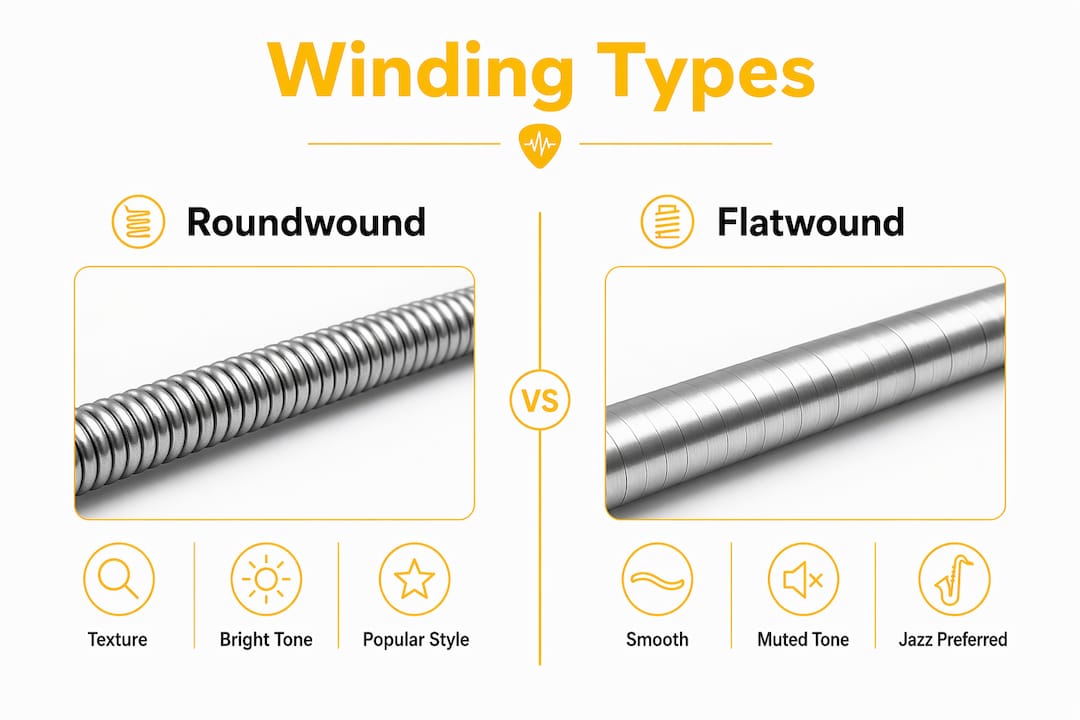
Winding geometry is baked into the string during manufacture and cannot be changed afterward. The choice between roundwound, flatwound, and halfwound strings shapes both the sound and the physical experience of playing.
| Winding type | Surface texture | Tone character | Best suited for |
|---|---|---|---|
| Roundwound | Ridged, textured | Bright, articulate, sustaining | Electric, acoustic, bass |
| Flatwound | Smooth, flat | Dark, warm, compressed | Jazz, vintage electric, bass |
| Halfwound | Semi-smooth | Between bright and dark | Players wanting a compromise |
Core shape adds another layer of complexity. Hex core wires provide brighter tone and stability by gripping the wrap wire tightly, whereas round cores allow more flexibility and a warmer tone. Hex cores became the industry standard from the 1970s onward because they produce more consistent results at scale. Round cores require more careful handling during winding but reward the player with a more organic feel.
Winding geometry and core type dictate the physical seating of the wrap wire and the surface texture, influencing both tone and player feel. This is why switching from a roundwound to a flatwound set on the same guitar produces a dramatically different result, even at the same gauge. For players curious about different string types, understanding winding method is the single most useful piece of knowledge before buying.
Steel strings vs nylon strings: how does construction differ?
Steel and nylon strings are built on fundamentally different principles. The differences begin at the core and extend through every stage of manufacture.
Nylon treble strings on classical guitars are single monofilaments. There is no wrap wire. The nylon is extruded to a precise diameter and cut to length. Classical nylon strings use monofilament or multifilament nylon cores for treble strings and nylon, silk, or steel-wrapped cores for bass strings, with mechanical winding and shaping to exact thickness. The bass strings on a classical set are wound in the same way as steel strings, but the core is softer and the wrap wire is typically silver-plated copper.
Key differences between steel and nylon string construction:
- Steel strings use a rigid metal core; nylon strings use a flexible polymer or fibre core
- Steel string ball ends are made from brass or steel; nylon strings often tie directly to the bridge
- Nylon cores stretch considerably when first fitted, requiring a longer settling period
- Synthetic cores resist humidity changes far better than gut, which nylon replaced historically
- Synthetic cores may stretch but resist humidity better than natural materials, making them more stable in varying climates
The shift from gut to nylon in the mid-20th century was driven by supply and consistency. Gut strings varied significantly from batch to batch. Nylon offered manufacturers the ability to produce strings to tight tolerances at scale. For players interested in the tonal differences between acoustic string materials, the gut-to-nylon transition is one of the most significant moments in the history of guitar string making.
Pro Tip: New nylon strings need stretching before they hold pitch reliably. Pull each string gently away from the fretboard several times after fitting, then retune. Repeat this three or four times and the string will settle far more quickly.
How do manufacturers control quality in guitar string production?
Uniform mass and geometry along the string length is as important as material choice. Even minor fluctuations in geometry or mass during winding affect string intonation and harmonics, making controlled winding tension and uniform feed critical to manufacturing quality.
Modern manufacturers use closed-loop digital tension systems rather than open-loop tensioning. Controlled tension during winding is critical; variations can alter diameter, intonation, and harmonics. Load cells measure the tension applied to the wrap wire in real time and feed corrections back to the winding machine. A string wound with inconsistent tension will intonate poorly, meaning the note at the 12th fret will not be a perfect octave above the open string.
| Quality factor | What is measured | Why it matters |
|---|---|---|
| Diameter consistency | Measured along the full string length | Uneven diameter causes intonation errors |
| Tensile strength | Load at which the string breaks | Determines reliability under playing tension |
| Winding uniformity | Gap and angle between wrap wire coils | Affects tone and surface texture |
| Mass distribution | Weight per unit length | Influences harmonic content and sustain |
Finished strings are also tested for tonal consistency. A string that measures correctly in diameter but has an uneven mass distribution will produce weak or false harmonics. Uniform mass and geometry along the string length is as important as material, to avoid poor intonation and harmonic distortion. This is why budget strings from less controlled manufacturing environments often feel and sound inconsistent across a set.
Key takeaways
Guitar strings are made by combining a precisely drawn metal core with a tightly wound wrap wire, and every material and process decision shapes the final tone, feel, and lifespan of the string.
| Point | Details |
|---|---|
| Core and wrap wire define tone | Material choice determines brightness, warmth, and how quickly a string loses its sound. |
| Ball end comes first | Attaching the ball end before winding stabilises the core and anchors tension reliably. |
| Winding method is permanent | Roundwound, flatwound, or halfwound character is set during manufacture and cannot be changed. |
| Core shape affects feel | Hex cores produce brighter, more stable strings; round cores give a warmer, more flexible feel. |
| Tension control ensures quality | Closed-loop digital systems prevent the diameter and intonation errors that ruin a string’s performance. |
Why understanding string construction changed how I choose strings
Most players pick strings by gauge and brand habit. That is understandable, but it misses the real story. Once you understand that the difference between a warm, vintage-feeling string and a bright, cutting one comes down to core shape and wrap material, the choice becomes much clearer.
I have seen players spend significant money on a new guitar and then fit the cheapest strings available. The irony is that strings are the only part of the instrument that directly touches both the player and the vibrating body. Their construction matters enormously. A hex-core roundwound string in phosphor bronze will sound completely different from a round-core flatwound in pure nickel, even on the same guitar at the same gauge.
The other misconception I encounter regularly is that coated strings are always a compromise. The coating does soften the initial attack slightly, but for players who sweat heavily or live in humid climates, the extended lifespan more than compensates. Knowing how the coating is applied over the wrap wire helps you understand exactly what you are trading and whether that trade suits your playing.
My honest advice is to treat string selection as a genuine part of your tone-shaping toolkit. Try a roundwound set, then a halfwound set on the same guitar. The difference will be immediate and instructive. Curiosity about construction leads directly to better decisions at the point of purchase.
— Music
Premium guitars and strings at Musicstreet
Musicstreet stocks a carefully selected range of guitars from brands including PRS, Gibson, Fender, and Martin, alongside the strings and accessories that bring them to life.

Whether you are fitting a new set of phosphor bronze acoustics or exploring flatwound strings for a jazz tone, Musicstreet’s team can point you toward the right choice for your instrument and playing style. The physical store in Huntingdon, Cambridgeshire, lets you try strings on real instruments before you buy. Visit Musicstreet to browse the full range of guitars and accessories, with free UK delivery available and expert support before and after your purchase.
FAQ
What is the core wire in a guitar string?
The core wire is the central metal strand around which the wrap wire is wound. It is typically made from high-carbon steel and drawn to a precise diameter that determines the string’s gauge and pitch range.
Why do guitar strings have a ball end?
The ball end is a small brass or steel ring attached to one end of the core wire before winding begins. It anchors the string at the bridge and stabilises the core during the winding process.
What is the difference between roundwound and flatwound strings?
Roundwound strings use a round wrap wire, producing a textured surface and bright tone. Flatwound strings use a flat ribbon wire, giving a smooth surface and a darker, warmer sound favoured in jazz and vintage styles.
How do nylon strings differ from steel strings in construction?
Nylon treble strings are single monofilaments with no wrap wire. Bass strings in a nylon set use a nylon or silk core wrapped with silver-plated copper wire, making them fundamentally different from steel-core wound strings.
Does string quality affect intonation?
Yes. Inconsistent winding tension or uneven mass distribution along the string length causes intonation errors, meaning fretted notes will not be in tune relative to open strings. Quality-controlled manufacturing is the primary safeguard against this.








Share:
Acoustic vs electric guitar: which should you buy?
Acoustic vs acoustic-electric guitar: key differences explained