


Think you need heavy strings or a special guitar to play slide? That’s the number one myth holding UK guitarists back. Slide guitar simply uses a smooth tool to glide over strings, creating vocal-like tones that work on any guitar. This guide covers history, gear choices, tunings, techniques, and practical steps to get you playing slide confidently.
Table of Contents
- Introduction To Slide Guitar: What And Why
- History And Origins Of Slide Guitar
- Types And Materials Of Guitar Slides
- Tunings And Guitar Setup For Slide Playing
- Slide Guitar Playing Techniques And Best Practices
- Common Misconceptions About Slide Guitar
- Influential Slide Guitarists And Styles To Learn From
- Bringing Slide Guitar To Your Playing: Getting Started And Beyond
- Explore The Right Guitar And Accessories For Slide Playing
- Frequently Asked Questions About Slide Guitar
Key Takeaways
| Point | Details |
|---|---|
| Slide guitar technique | Uses a smooth slide worn on the finger to produce expressive glissandos and vocal-like tones. |
| Slide materials matter | Glass offers warmth, metal provides brightness, and ceramic balances both for different playing styles. |
| Tuning flexibility | Open tunings simplify chord shapes but standard tuning works with proper technique. |
| Light touch essential | Minimal pressure and muting techniques prevent fret buzz and produce clean sound. |
| Gear myths debunked | No special guitars or heavy strings required; standard gear works perfectly. |
Introduction to Slide Guitar: What and Why
Slide guitar involves wearing a smooth object on your finger and gliding it over the strings without pressing down. The slide produces smooth, vocal-like glissandos and expressive tone colors that set this technique apart from standard fretting. The slide is most commonly worn on the ring finger for optimal control, leaving your other fingers free for muting and chord work.
Many beginners stumble because they apply too much pressure or believe they need specialized equipment. The truth? Proper slide guitar technique basics emphasize a feather-light touch. Press too hard and you’ll choke the strings against the frets, creating buzzing and unwanted noise.
Here are the fundamental elements that make slide guitar work:
- Slide positioned directly over the fretwire, not between frets
- Ring finger placement for balance and finger independence
- Light contact with strings to let them vibrate freely
- Muting techniques to eliminate unwanted string noise
- Smooth gliding motion for seamless transitions
Pro Tip: Start by practicing on a single string. Hover the slide just above the string, then gradually lower it until you hear a clear tone without buzz. This teaches you exactly how much pressure you need.
The misconception that slide guitar requires special gear stops many UK players from experimenting. Your existing guitar and essential guitar skills provide everything needed to start. Focus on developing the correct touch and muting habits instead of shopping for new equipment.
History and Origins of Slide Guitar
Slide guitar originated from African stringed instrument traditions and Hawaiian slack-key guitar in the late 19th century. These early players used knives, bones, and glass bottles to create sliding tones on their instruments. The technique traveled to the American South where it became integral to blues music.
Sylvester Weaver made the earliest recorded slide guitar tracks in 1923, documenting this emerging style for the first time. His recordings captured the haunting, expressive quality that would define slide guitar for generations. The Delta blues tradition popularized slide guitar through the early 20th century, with players using the technique to mimic the human voice.
Historic players shaped the sound we associate with slide today:
- Robert Johnson created iconic Delta blues recordings using slide techniques
- Muddy Waters brought slide guitar to Chicago blues and electric amplification
- Elmore James developed the electric slide style that influenced rock music
- Duane Allman pioneered slide guitar in Southern rock during the 1970s
- Ry Cooder explored slide guitar across multiple genres and world music traditions
The influence spread globally, affecting blues, rock, country, and experimental music. British musicians embraced slide guitar during the blues revival of the 1960s, integrating it into their own musical vocabulary. Understanding this guitar history and origins helps you appreciate how slide technique connects to British guitar heritage.
The technique evolved from acoustic Delta blues to electric rock and beyond. Each generation of players added their own innovations while maintaining the core principle of sliding smoothly across strings to create expressive, vocal-like tones.
Types and Materials of Guitar Slides
Glass slides produce warm, smooth tone; metal slides provide a brighter, cutting tone; ceramic slides offer a balanced tone between the two extremes. Your choice affects not just sound but playing feel and technique.
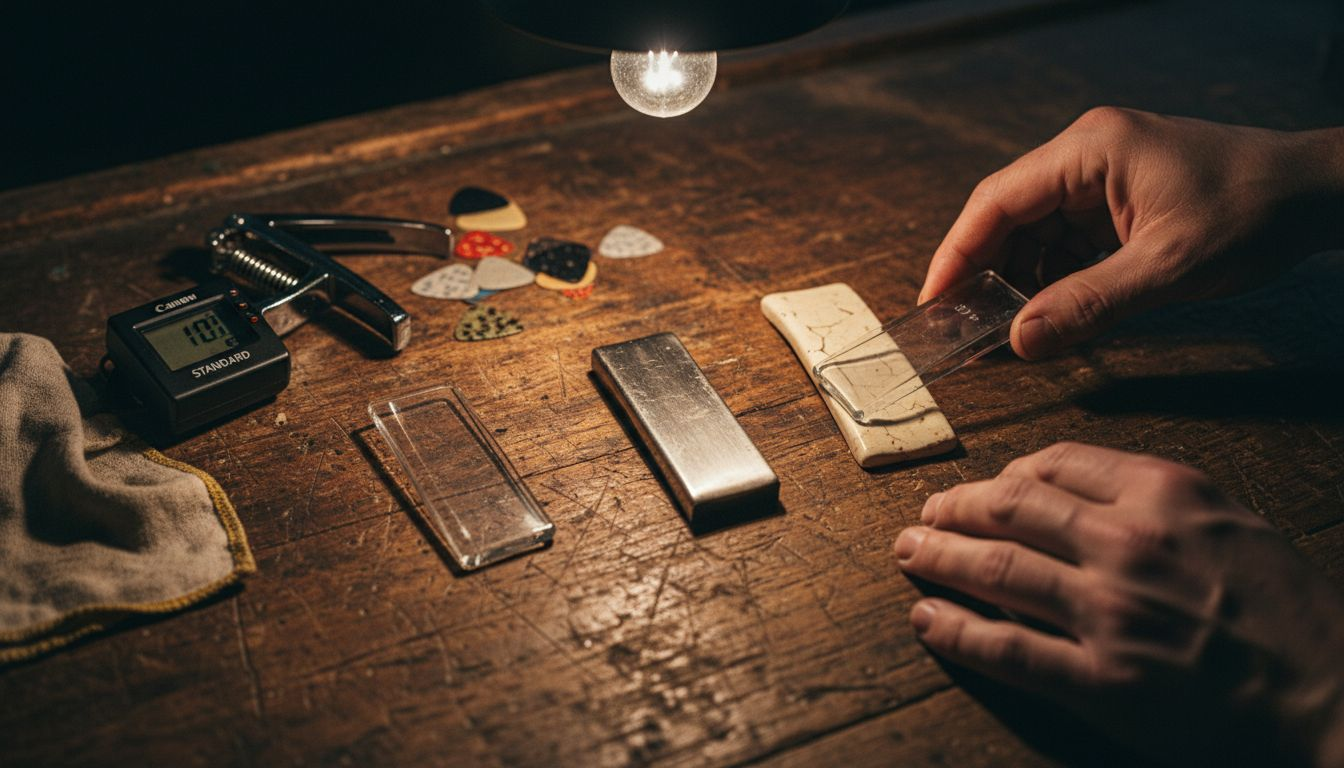
Glass slides deliver warmth and smoothness ideal for beginners and softer playing styles. The material glides easily over strings without excessive friction. Many blues players prefer glass for its rounded, mellow character that sits well in acoustic and low-gain electric settings.
Metal slides create bright, cutting tones favored in electric blues and rock. Steel and brass variants offer slightly different tonal qualities, with brass adding warmth compared to stainless steel’s sharper attack. The heavier weight provides more sustain and presence through amplification. Options like brass and chrome guitar slides showcase these tonal differences.
Ceramic slides split the difference, combining glass warmth with metal brightness. They’re less common but worth exploring if you want versatility across playing styles.
| Material | Tone Quality | Weight | Best For |
|---|---|---|---|
| Glass | Warm, smooth | Light | Beginners, acoustic, mellow styles |
| Brass | Bright, warm sustain | Medium-heavy | Electric blues, rock |
| Stainless Steel | Sharp, cutting | Heavy | Aggressive electric playing |
| Ceramic | Balanced | Medium | Versatile genre crossing |
Slide size and finger fit dramatically affect control. Too loose and the slide wobbles, killing your accuracy. Too tight and your finger swells, causing discomfort during extended playing. Measure your ring finger and try different internal diameters before committing.
Pro Tip: Buy two slides in different materials. Practice the same passage with each to hear how material choice shapes your tone. This trains your ear and helps you select the right slide for different songs.
Wall thickness matters too. Thicker walls add weight and sustain but reduce tactile feedback. Thinner walls let you feel string contact more directly, improving control for beginners.
Tunings and Guitar Setup for Slide Playing
Open tunings such as Open G and Open D facilitate playing chords and melodies with slides by creating major chords across all strings when barred at any fret. This simplifies chord shapes dramatically compared to standard tuning.
Open G tuning (D-G-D-G-B-D) ranks as the most popular slide tuning. Strum all open strings and you hear a G major chord. Slide to the 5th fret for C major, 7th fret for D major. This layout makes blues progressions intuitive and accessible.
Open D tuning (D-A-D-F#-A-D) offers similar benefits with a deeper root note. Some players prefer this for heavier, more resonant tones. The principle remains identical: open strings form a major chord that shifts up and down the neck.
Standard tuning absolutely works for slide guitar but requires more technique and fretboard knowledge. You need to understand chord shapes and intervals to find harmonious positions. Many modern players use standard tuning to integrate slide passages into conventional playing without retuning.
Common open tunings for slide guitar:
- Open G: D-G-D-G-B-D (most popular)
- Open D: D-A-D-F#-A-D (deeper sound)
- Open E: E-B-E-G#-B-E (higher tension)
- Open A: E-A-E-A-C#-E (alternative root)
String action height influences playability but isn’t mandatory to change. Higher action reduces fret buzz when the slide contacts strings, but proper light touch minimizes buzz even on standard setup. Don’t rush to modify your guitar before developing correct technique.
Many players raise action slightly at the nut and bridge for dedicated slide guitars. If you’re starting out, try slide on your current setup first. You might find it works perfectly. Having proper guitar setup tools helps if you decide adjustments would benefit your playing.
Slide Guitar Playing Techniques and Best Practices
Proper slide finger placement on fretwire and muting techniques produce clear tone and avoid unwanted noise. Position your slide directly over the fretwire, not in the space between frets where you’d normally press. This placement puts you exactly in tune.
The ring finger provides optimal control and leaves your index and middle fingers available for muting. Some players use the pinky, but this limits muting options and reduces stability. Wearing the slide on your ring finger gives you the best balance of control and finger availability.
Muting separates clean slide playing from noisy chaos. Your palm and unused fretting fingers must dampen strings you’re not playing. Rest your palm lightly on the bridge side of the strings to control sympathetic vibrations. Use your index and middle fingers to touch strings on either side of the note you’re playing.
Follow these steps for clean slide technique:
- Position slide perpendicular to the fretboard, not tilted
- Apply minimal downward pressure, just enough for clear contact
- Place slide directly over the fretwire for accurate pitch
- Rest palm on bridge side of strings for bass string muting
- Use free fingers to dampen adjacent strings
- Move slide smoothly without jerky motions or heavy landings
Common muting approaches:
- Palm muting controls overall string resonance and feedback
- Index finger wraps behind slide to mute lower strings
- Middle finger reaches ahead to mute higher strings
- Light finger touches dampen without stopping desired notes
Pro Tip: Practice moving the slide between two frets while maintaining consistent pressure and smooth motion. Listen for any bumps, scrapes, or pitch wobbles. Your goal is a seamless glide that sounds like one continuous note shifting pitch.
Vibrato adds expression to sustained notes. Rock the slide gently back and forth along the length of the string, not across it. This creates pitch variation similar to vocal vibrato. Expert slide guitar tips emphasize controlled vibrato as a key expressive tool.
Avoid pressing the slide down into the frets. This chokes the strings and creates buzz. The slide should float just above the fretboard, making contact with strings only. Think of it as painting the strings lightly rather than pressing them.
Common Misconceptions About Slide Guitar
The myth that heavy strings or special guitars are required for slide guitar stops many UK players from experimenting. Standard guitars work perfectly with correct technique. No specialized instrument needed.
Heavy gauge strings aren’t mandatory. While some players prefer them for tone and sustain, light strings work well for slide playing. Your touch and muting technique matter far more than string thickness. Many iconic slide guitarists used standard light or medium gauge strings throughout their careers.
Open tunings simplify slide playing but aren’t required. You can absolutely play slide in standard tuning by understanding chord shapes and intervals. Open tunings just make it easier to find harmonic positions quickly. Starting in open G or D makes sense for beginners, but don’t feel locked into these tunings forever.
Common myths that limit players:
- Special slide guitars with raised action are necessary (standard guitars work fine)
- You must use heavy gauge strings for proper tone (light strings perform well)
- Open tunings are mandatory for slide playing (standard tuning works too)
- Glass slides are only for beginners (professional players use glass regularly)
- Slide guitar requires different amplification (standard setups work perfectly)
Many famous slide guitarists achieved iconic sounds using standard gear and techniques. They focused on developing touch, muting, and musical expression rather than collecting specialized equipment.
The belief that you need to modify your guitar before starting prevents experimentation. Try slide on your current instrument first. Develop proper technique with what you have. You’ll discover whether setup changes would genuinely benefit your playing style.
These misconceptions create artificial barriers. Slide guitar welcomes players at all levels using whatever gear they currently own. Focus on learning proper hand position, light touch, and effective muting instead of shopping for special equipment.
Influential Slide Guitarists and Styles to Learn From
Notable slide guitarists span early blues legends like Robert Johnson and Muddy Waters to modern players such as Derek Trucks. Each brought unique approaches that expanded slide guitar’s expressive range.
Robert Johnson defined Delta blues slide playing in the 1930s. His recordings demonstrate how slide guitar can convey emotion and tell stories through pure tone. Muddy Waters electrified this tradition, bringing slide guitar into the modern blues era with amplification and urban sensibility.
Derek Trucks represents contemporary slide mastery, blending blues, rock, jazz, and world music influences. His fluid technique and melodic sensibility show how slide guitar continues evolving. Ian Thornley applies slide techniques to alternative rock contexts, proving the approach works across genres.
Key players to study:
- Duane Allman: Southern rock slide pioneer with soaring melodic lines
- Bonnie Raitt: Blues and roots slide with sophisticated phrasing
- Sonny Landreth: Behind-the-slide fretting techniques and innovative approaches
- Joe Walsh: Rock slide guitar integrated into songwriting and solos
- Rory Gallagher: Irish blues rock with aggressive slide work
Stylistic range extends from traditional Delta blues through rock, country, Hawaiian slack key, and experimental genres. Studying diverse styles helps UK players find their own slide voice rather than copying one approach. Famous slide guitar players demonstrate countless ways to apply this technique creatively.
British blues players during the 1960s revival integrated slide techniques into their own musical vocabulary. This cross-pollination between American blues traditions and British rock sensibilities created new slide guitar approaches. Understanding these slide guitar influences provides context for your own exploration.
Listen to how different players approach vibrato, note choice, and rhythmic phrasing. Some favor sustained notes with wide vibrato while others use quick, percussive slides between chord tones. These stylistic choices shape each player’s distinctive voice.
Bringing Slide Guitar to Your Playing: Getting Started and Beyond
Beginner slide players benefit from starting with open G tuning and a glass slide for a warm tone. This combination offers the most forgiving entry point while you develop proper technique.
Follow these steps to begin your slide guitar journey:
- Choose a glass slide matching your ring finger diameter for comfort and control
- Tune your guitar to Open G (D-G-D-G-B-D) to simplify chord shapes
- Check your action height but focus on light touch before making adjustments
- Wear the slide on your ring finger, leaving other fingers free for muting
- Practice sliding between the 5th and 7th frets while muting unused strings
- Work on smooth glides without bumps, buzzes, or pitch wobbles
Practice exercises to build fundamental skills:
- Single-string melodies on the third string to develop clean tone
- Sliding between chord positions on beats 1 and 3 of a blues progression
- Sustaining notes with controlled vibrato by rocking the slide gently
- Combining slide notes with regular fretted notes on different strings
Adjust string action only if you consistently struggle with fret buzz despite using proper light touch. Many players succeed on standard setups by developing correct technique first. If adjustment helps, raise the action at the nut and bridge gradually, testing playability after small changes.
Pro Tip: Record yourself playing simple slide phrases. Listen back to identify buzzes, uneven glides, or unwanted string noise. This feedback loop accelerates your progress by making technical issues obvious.
Experiment with different slide materials once you’re comfortable with basic technique. Try a metal slide on the same passages you practiced with glass. Notice how the tonal difference affects your playing style and note choices. Starting slide guitar involves discovering your personal preferences through hands-on experience.
Alternate between slide passages and regular fretting in the same song. This integration makes slide guitar a versatile tool rather than a specialized technique requiring dedicated instruments. Many modern players move fluidly between slide and conventional playing.
Explore the Right Guitar and Accessories for Slide Playing
Ready to take your slide guitar playing further? Finding the right instrument makes a real difference in your sound and comfort. Whether you’re drawn to the warmth of acoustic slide or the power of electric blues, having gear that responds to your touch matters.

MusicStreet offers carefully selected electric and acoustic guitars suited for slide technique, from classic models to modern designs. Browse best electric guitars for slide playing featuring guitars with excellent sustain and tone clarity. Explore quality slides in glass, metal, and ceramic materials alongside essential guitar accessories like setup tools and maintenance supplies.
Our team provides expert advice on choosing slide guitar accessories that match your playing style and musical goals. Visit our Huntingdon showroom to try different slides and guitars, or shop online with confidence knowing every instrument receives professional setup before shipping.
Frequently Asked Questions about Slide Guitar
What is the best slide material for beginners?
Glass slides are recommended for beginners because they produce warm, smooth tones and glide easily over strings. The lighter weight makes it easier to control pressure and develop proper touch. Start with glass, then experiment with metal or ceramic once you’re comfortable.
Can I use my standard guitar for slide playing?
Yes, standard guitars work perfectly for slide playing with proper technique. No special modifications or dedicated slide guitar is required. Focus on developing light touch and effective muting rather than buying new equipment. Many professional players use standard guitars for slide work.
Is open tuning necessary for slide guitar?
Open tuning helps by simplifying chord shapes and making harmonic positions easier to find, but it’s not mandatory. Standard tuning works for slide playing if you understand chord shapes and intervals. Beginners benefit from starting with Open G or Open D, but you’re not limited to these tunings.
How do I prevent fret buzz when using a slide?
Use a light touch and position the slide directly over the fretwire rather than pressing down. Proper muting technique with your palm and unused fingers also reduces unwanted noise. If buzz persists despite correct technique, consider slightly raising your string action at the nut and bridge.
Which finger should I wear the slide on?
The ring finger is most common because it provides optimal control and balance while leaving your index and middle fingers free for muting. Some players use the pinky, but this limits muting options and reduces stability. The ring finger offers the best combination of control and finger independence.





Share:
Best Electric Guitars for Beginners Under £500
Guitar Bracing Patterns: 70% Use X-Bracing for Richer Tone