


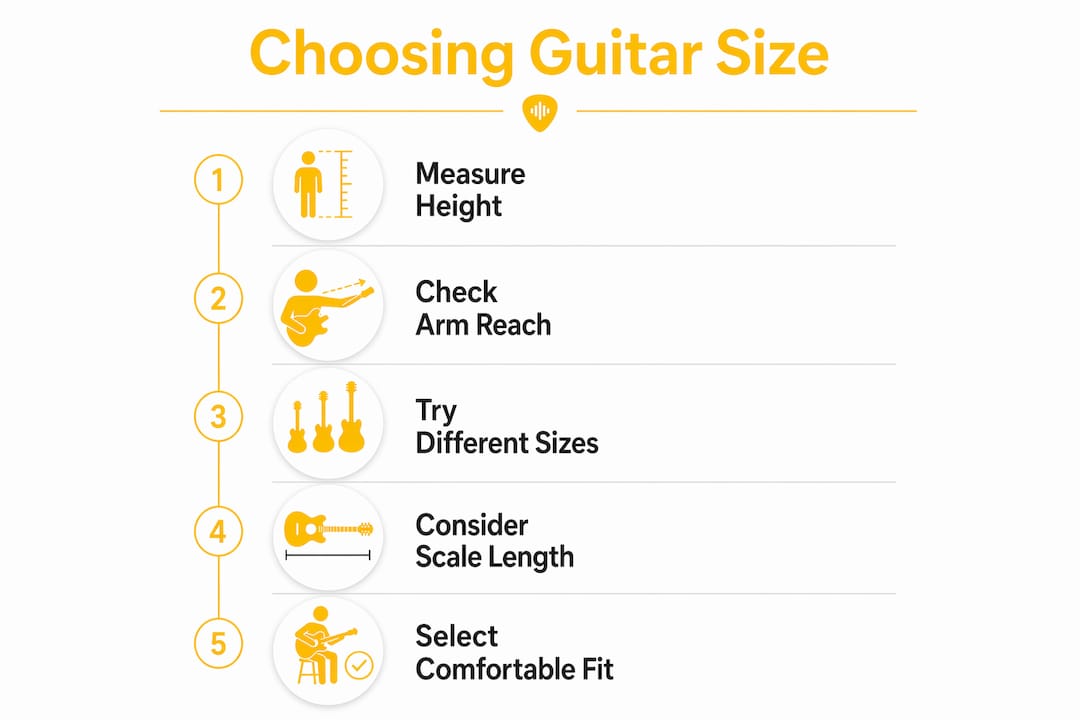
Choosing the right guitar size depends on a player’s height and arm reach, not age alone.
Scale length and neck profile are more important for comfort than body size, especially for beginners.
Choosing the right guitar size is the single most important decision a new player makes before touching a string. Get it wrong and the instrument fights you at every turn. Get it right and learning feels natural from the first chord. The standard approach to guitar sizing uses a player’s height and arm reach as the primary measurements, not age alone. This guide covers the full guitar size guide from quarter-size instruments to full-size models, explains how scale length and neck profile affect comfort, and gives you practical tests to confirm the best guitar size for you or your child before buying.
How to choose a guitar size using height and arm reach
Height is the most reliable starting point for selecting guitar size. Standard size categories link directly to a player’s height, giving you a clear framework before you even pick up an instrument. Age is a useful rough guide, but two children of the same age can differ by 15 centimetres in height, which puts them in entirely different size categories.
Arm reach matters just as much as height. A player needs to wrap their fretting hand comfortably around the neck and reach the lower frets without straining their shoulder. If your child’s arm looks stretched or their elbow locks out, the guitar is too large.
The five standard guitar sizes are:
| Guitar size | Player height | Approximate age |
|---|---|---|
| 1/4 size | Up to 130 cm | 4–6 years |
| 1/2 size | 120–140 cm | 6–8 years |
| 3/4 size | 130–150 cm | 8–11 years |
| 7/8 size | 140–160 cm | 11–15 years |
| Full size | 160 cm and above | 12+ and adults |
The height ranges overlap deliberately. A child at 135 cm might suit either a 1/2 or a 3/4 depending on their arm length and hand size. Always use the table as a starting point, then confirm with a physical test.
Pro Tip: Prioritise arm reach over age when choosing size. A tall nine-year-old with long arms will often play a 3/4 guitar more comfortably than a 1/2, regardless of what an age chart suggests.
Why scale length and neck profile matter more than body size
Scale length is the distance between the nut and the saddle, and it directly controls how much tension sits in the strings. Shorter scale lengths reduce string tension, which means less finger pressure is needed to fret a note cleanly. A 24.75-inch scale requires noticeably less effort than a standard 25.5-inch scale. For a beginner whose fingertips are not yet toughened, that difference is significant.
Neck profile describes the shape of the back of the neck in cross-section. A slimmer, shallower profile allows smaller hands to wrap around the neck without overstretching the thumb. Slimmer necks and narrower body waists reduce hand fatigue and make chord shapes easier to form, which keeps beginners motivated rather than frustrated.
Key points on scale length and neck profile:
- A 24.75-inch scale guitar produces less string tension than a 25.5-inch model, making fretting easier for small hands.
- Shorter scale lengths also reduce the physical stretch between frets, which helps players with shorter fingers reach chord shapes more easily.
- A C-shaped neck profile suits most beginners; a V-shape tends to suit players with larger hands.
- Nut width affects how spread out the strings feel. A narrower nut, around 42–43 mm, suits smaller hands better than a wider 45 mm nut.
- Body depth also affects comfort. A thinner body sits more naturally against a smaller torso.
Pro Tip: Try guitars with different scale lengths side by side if you can. The difference in feel between a 24.75-inch and a 25.5-inch scale is immediately obvious, even to a complete beginner.
Acoustic, electric, or classical: which type fits a beginner best?
Guitar type interacts directly with sizing decisions. The body shape, string material, and neck dimensions all vary by type, and each affects how comfortable the instrument feels for a smaller or less experienced player.

Electric guitars have lower string tension, slimmer necks, and thinner bodies, which makes them physically easier to play than many acoustic models. The lower action typical on a well-set-up electric means less finger pressure is needed to produce a clean note. This is a genuine advantage for younger players or adults with smaller hands, and it challenges the common assumption that acoustic is always the better starting point.
Classical guitars use nylon strings rather than steel. Nylon strings are softer on fingertips and produce less tension than steel strings, which suits younger players aged 6–11 particularly well. The neck on a classical guitar is wider and flatter than on a steel-string acoustic, which some players find comfortable and others find awkward.
| Guitar type | String tension | Neck profile | Body size | Best suited to |
|---|---|---|---|---|
| Acoustic (steel string) | High | Medium to wide | Medium to large | Older beginners, teens, adults |
| Electric | Low | Slim | Thin | Beginners of all ages, smaller hands |
| Classical (nylon string) | Low to medium | Wide and flat | Medium | Young children, fingerstyle learners |
Acoustic body shapes also vary considerably. Smaller body styles such as parlour and 00 shapes suit fingerstyle playing and smaller players, while dreadnoughts deliver more bass and projection but are physically larger and harder to hold for a child. For a beginner, a parlour or 000-size acoustic often provides a better fit than a full dreadnought.
For a detailed comparison of acoustic and electric options, Musicstreet’s guide on acoustic vs electric for beginners covers the comfort and playability differences in full.
How to test guitar fit before you buy
Physical testing confirms what measurements suggest. Comfort testing involves checking reach to the 12th fret, assessing arm and elbow positioning, and evaluating how naturally the guitar sits against the body while seated. A player who cannot reach the 12th fret without their shoulder rising or their elbow locking should try a smaller scale or a different body shape.
Seated comfort is the most telling test. Sit with the guitar resting on your leg in the classical position or the standard position. The body of the guitar should sit naturally without you needing to hunch forward or crane your neck to see the fretboard. Your strumming arm should drape over the body without tension.
Buying checklist before committing to a guitar:
- Can you reach the 12th fret with your fretting hand without straining your shoulder?
- Does your elbow bend naturally at roughly 90 degrees when your hand rests on the first fret?
- Does the guitar body sit comfortably against your torso without feeling unwieldy?
- Can you form a basic open chord shape without your thumb cramping?
- Does the guitar stay in tune after a few minutes of playing?
One common mistake is buying based on age alone or choosing an ultra-cheap starter pack. Beginner guitars priced below £80 for acoustic or £120 for electric frequently suffer from high string action and tuning instability, both of which make learning harder regardless of size. Spending slightly more on a quality instrument pays back in motivation and faster progress.
Professional setup makes a measurable difference. Lowering the string action on a well-chosen guitar can transform its feel entirely. A full-size guitar with a professional setup often plays more easily than a smaller guitar left in factory condition.
Pro Tip: Ask for a professional setup when you buy. Lowering the action by even a millimetre reduces the effort needed to fret every single note, which matters enormously for a beginner building finger strength.
For more detail on size recommendations by height, Musicstreet’s guitar size guide covers every category in depth.
Key takeaways
Choosing the right guitar size comes down to matching the instrument’s scale length, neck profile, and body dimensions to the player’s height and arm reach, then confirming the fit with a hands-on test.
| Point | Details |
|---|---|
| Height over age | Use the player’s height and arm reach, not age, to select the correct size category. |
| Scale length matters | A 24.75-inch scale reduces string tension and finger stretch compared to a 25.5-inch scale. |
| Type affects comfort | Electric guitars have lower action and slimmer necks, making them physically easier for smaller hands. |
| Test before buying | Check reach to the 12th fret, elbow angle, and seated comfort before committing to any guitar. |
| Setup changes everything | A professional setup lowering string action can improve playability more than switching to a smaller size. |
What I’ve learned from watching beginners choose the wrong size
The most common mistake I see is parents buying a guitar based on what looks right rather than what fits. A full-size dreadnought acoustic looks impressive hanging on a wall. On a nine-year-old with a 130-centimetre frame, it is a physical obstacle. The child spends their first weeks fighting the instrument rather than learning music, and motivation collapses fast.
Arm length is the key comfort indicator, not age or what the packaging suggests. I always recommend trying at least two or three different sizes before deciding. The difference in feel between a 3/4 and a 7/8 guitar is immediately obvious when you hold them back to back.
The other thing I would stress is that a properly set-up guitar changes the experience completely. I have seen beginners give up on instruments that were actually the right size, simply because the factory action was too high. Before you conclude that a guitar is wrong for your child, get it set up by a professional. The result is often transformative.
If you are buying for a child who is still growing, consider sizing up slightly rather than down. A 3/4 guitar that fits perfectly today may feel cramped in six months. A 7/8 with a short scale length gives room to grow without sacrificing comfort.
— Music
Guitars for every size at Musicstreet
Musicstreet stocks guitars across all standard sizes and types, from 1/4-size models for young beginners to full-size acoustics, electrics, and classical instruments for adults.

Every guitar sold through Musicstreet is professionally inspected before dispatch, and the team at the Huntingdon store offers hands-on advice to help you find the right fit. Whether you are buying your child’s first instrument or selecting your own, expert guidance is part of the service. Browse the full range at the Musicstreet guitar shop and find a guitar that fits from day one.
FAQ
What size guitar does a 10-year-old need?
Most 10-year-olds suit a 3/4 or 7/8 guitar, depending on their height. A child between 130 and 150 centimetres typically fits a 3/4 size; taller children approaching 160 centimetres may be ready for a 7/8 or even a full-size model.
Is a 3/4 guitar good for adults?
A 3/4 guitar suits adults with smaller frames or shorter arms, and many players find the shorter scale length more comfortable for fingerstyle playing. Full-size guitars are the standard for adults, but a 3/4 is a legitimate choice if comfort is the priority.
Does scale length matter more than guitar body size?
Scale length has a more direct effect on playability than body size alone. A shorter scale reduces string tension and the physical stretch between frets, which matters more for daily comfort than whether the body is a dreadnought or a parlour shape.
Should a beginner start on acoustic or electric?
Electric guitars are physically easier for most beginners due to lower string tension and slimmer necks. Acoustic guitars build finger strength faster but require more effort initially. The best choice depends on the music the player wants to make.
How much should a beginner spend on a first guitar?
A playable beginner acoustic costs from around £80–£150. A beginner electric with an amplifier typically starts at £120–£250. Spending below these ranges usually means high action and poor tuning stability, both of which make learning significantly harder.






Share:
Acoustic vs acoustic-electric guitar: key differences explained
Best guitar shop guide: what to look for in 2026