

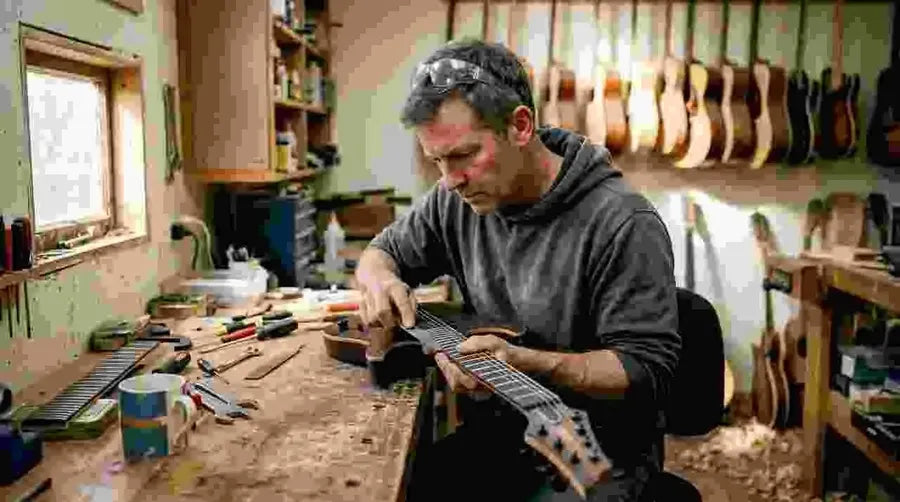
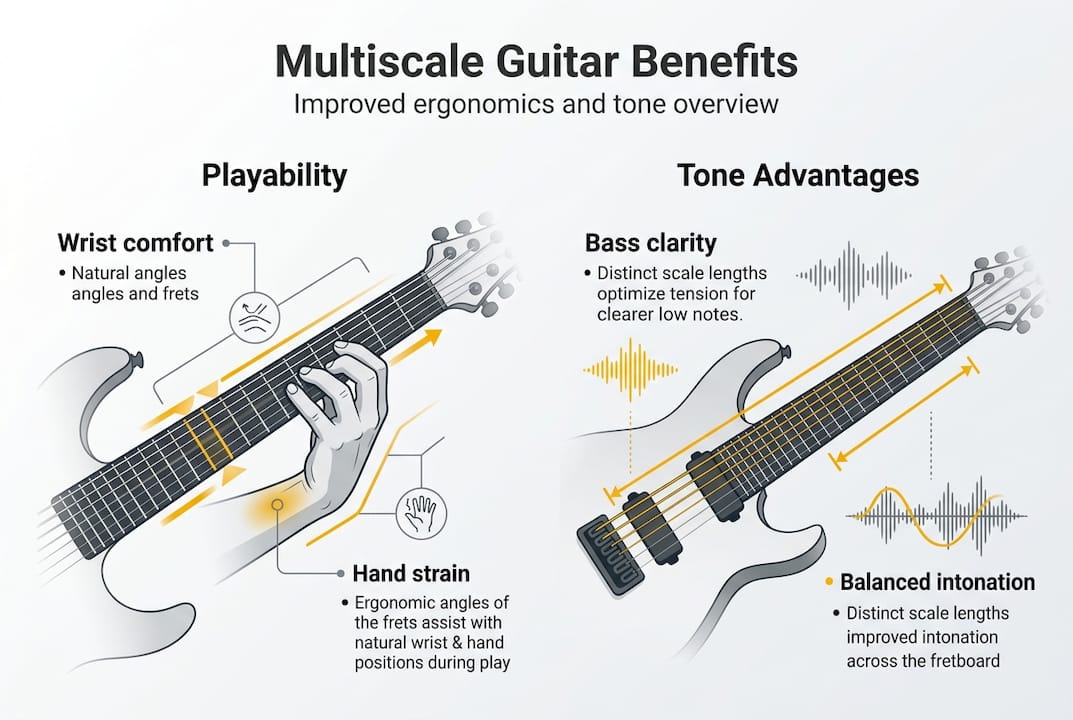
- Multiscale guitars have variable string lengths, improving tone, intonation, and ergonomic comfort.
- They provide balanced tension, especially beneficial for extended tunings and lower string clarity.
- Suitable for all skill levels and genres, with a short adaptation period for new users.
If you’ve ever spotted a guitar with oddly angled frets and wondered whether it was a gimmick or a genuine innovation, you’re not alone. Multiscale guitars confuse a lot of players at first glance. Some assume they’re purely for prog-metal virtuosos or that the unusual fret layout makes them harder to play. Neither is true. This guide cuts through the noise and gives you a clear, practical understanding of what multiscale guitars actually are, how they affect your tone and comfort, and whether one might belong in your hands.
Table of Contents
- What is a multiscale guitar?
- How does multiscale design alter string tension and sound?
- Multiscale vs traditional guitars: What’s the difference?
- Who should consider a multiscale guitar?
- Common myths and questions about multiscale guitars
- A fresh perspective: Why the future of guitars might be multiscale
- Explore multiscale guitars with MusicStreet
- Frequently asked questions
Key Takeaways
| Point | Details |
|---|---|
| What multiscale means | A multiscale guitar uses angled frets to give each string an optimal length for tone and playability. |
| Player benefits | Balanced string tension improves intonation, makes bends easier, and helps reduce hand strain. |
| Sound improvements | Low notes sound tighter and high notes stay clear, especially in alternate or drop tunings. |
| Who should try | Any guitarist seeking comfort, clear tone, or innovative gear will find value in a multiscale guitar. |
What is a multiscale guitar?
A multiscale guitar is an instrument where each string has its own individual scale length (the distance from the nut to the bridge). On a standard guitar, every string shares the same scale length. A multiscale design changes this by gradually shifting from a longer scale on the bass strings to a shorter scale on the treble strings. This creates the distinctive angled, or “fanned,” fret pattern you’ve likely noticed.
You’ll often hear these instruments called fan fret guitars, which is simply an alternative term describing the same design. The frets fan outwards from a fixed pivot point, giving the instrument its signature look.
Here’s what sets a multiscale guitar apart from a standard model:
- Variable scale length: Bass strings benefit from a longer scale for tighter tension; treble strings use a shorter scale for comfortable bending.
- Angled frets: The fanned layout feels surprisingly natural once your hands adapt.
- Improved intonation: Each string is optimised for its pitch range, making the instrument more accurate across the full neck.
- Ergonomic wrist positioning: The angled frets naturally align with the natural angle of the human wrist.
- Enhanced tonal clarity: Particularly noticeable on the lower strings, where notes bloom with more definition.
“Balanced string tension provides better intonation and ergonomic benefits,” which is precisely why so many players who switch to multiscale rarely go back.
Understanding why multiscale guitars matter for modern players goes beyond aesthetics. The design addresses real mechanical limitations that every fixed-scale instrument carries.
How does multiscale design alter string tension and sound?
String tension is everything in guitar playing. Too loose, and your low strings sound flabby and undefined. Too tight, and bending becomes a chore. Standard guitars compromise by choosing a single scale length that works reasonably well across all strings. Multiscale guitars reject this compromise entirely.
By giving each string its ideal scale length, a multiscale guitar achieves something standard instruments simply cannot: genuinely balanced tension from string to string. The result is that balanced string tension leads to better intonation, tighter low-end in drop tunings, and easier bends on the higher strings.
Here’s a comparison to make this concrete:
| Property | Standard guitar | Multiscale guitar |
|---|---|---|
| Scale length | Fixed (e.g. 25.5") | Variable (e.g. 25.5" to 27") |
| Bass string tension | Often too loose in low tunings | Tight and well-defined |
| Treble string tension | Consistent but not optimised | Comfortable and responsive |
| Intonation accuracy | Good across mid-range | Excellent across all ranges |
| Down-tuning suitability | Moderate | Excellent |
This matters enormously if you play in drop C, drop B, or any extended-range tuning. Standard guitars in these tunings often produce a muddy, indistinct low-end. A multiscale instrument keeps everything tight and articulate, even at extreme tunings.
When you decide to restring for optimal sound, string selection on a multiscale becomes especially important.
Pro Tip: On a multiscale guitar, don’t automatically use the same string gauge you’re comfortable with on a standard instrument. The longer bass-side scale means you can often go slightly lighter on the lower strings without losing tension. Experiment with mixed or custom gauge sets to find your sweet spot.
Multiscale vs traditional guitars: What’s the difference?
Let’s get practical. How do multiscale and standard guitars actually stack up side by side?
| Feature | Standard guitar | Multiscale guitar |
|---|---|---|
| Ergonomics | Neutral wrist angle | Natural wrist alignment |
| Intonation | Good across middle positions | Excellent across entire range |
| Tone clarity | Consistent, familiar | Enhanced, especially on bass strings |
| Tuning stability | Standard | Improved in alternate tunings |
| Learning curve | Minimal | Short adaptation period |
| Availability | Widely available | Growing selection |
A standard guitar is an outstanding instrument. Decades of refinement have made it incredibly versatile. But it does carry inherent compromises that most players simply accept because they don’t know an alternative exists.
Here are the real-world scenarios where each design excels:
- Multiscale wins when you play extended-range instruments (7, 8, or 9-string guitars).
- Multiscale wins when you experience wrist or hand strain after long sessions.
- Multiscale wins when you need consistent intonation in alternate or drop tunings.
- Standard wins when you play exclusively in standard tuning and prefer familiar fret spacing.
- Standard wins when you’re shopping on a tight budget, as multiscale options typically cost more at entry level.
- Standard wins when you need maximum availability for gigging, repairs, or replacements.
It’s worth acknowledging that ergonomic hand positioning and reduced player strain are genuine, notable advantages rather than marketing talk. Players with smaller hands or those managing repetitive strain conditions often find multiscale designs genuinely transformative.

For a thorough look at how neck dimensions affect feel, the scale length comparison guide covers the fundamentals well.
Who should consider a multiscale guitar?
Multiscale guitars suit a wider range of players than most people assume. Here are the player types who benefit most:
- Metal and progressive rock players: Extended tunings, complex chord voicings, and the need for tight low-end definition make multiscale an obvious fit.
- Jazz players: Cleaner intonation and natural wrist angles suit the more intricate, finger-intensive demands of jazz playing.
- Players managing hand or wrist pain: The angled frets reduce strain, particularly in the lower positions.
- Extended-range players: Anyone on a 7-string or higher will notice an immediate improvement in string-to-string balance.
- Producers and session players: Those who need precise intonation across a wide tonal range benefit from the enhanced accuracy.
- Curious intermediate players: You don’t need to be at an advanced level to appreciate what a multiscale guitar offers.
Multi-scale guitars reduce hand strain and suit players needing ergonomic support or versatility, which makes them far more universally applicable than their niche reputation suggests.
Beginners can absolutely play multiscale guitars. The adjustment period is typically short, often just a few sessions. Many players find the natural wrist angle actually makes certain techniques easier to learn from scratch. Exploring the benefits of custom guitars can also help you understand how instrument choices shape your development over time.
Pro Tip: If you’re nervous about the transition, try before you commit. The fanned frets look more dramatic than they feel. Most players who try a multiscale guitar in person are surprised by how quickly their hands adapt, sometimes within the first ten minutes.
For those already thinking about personalising guitars for playability, multiscale instruments open up even more possibilities for customisation.
Common myths and questions about multiscale guitars
Let’s clear up the persistent misconceptions that stop players from even trying these instruments.
“Multi-scale guitars are not just for advanced players but offer genuine benefits for all skill levels.”
Here are the most common myths, each worth addressing directly:
- “Fan frets are only for metal or extreme genres.” False. The ergonomic and tonal benefits apply equally to blues, jazz, folk, and pop. The design is genre-agnostic.
- “They’re harder to tune.” Not true. Standard tuning processes apply. Using a decent chromatic tuner (or a tuning guide for reference) works perfectly fine on a multiscale instrument.
- “The fanned frets make chord shapes unplayable.” The pivot point on most multiscale guitars sits around the 7th to 12th fret, meaning standard open chord shapes feel almost identical to a regular guitar.
- “You need specially made strings.” Standard string sets fit most multiscale guitars without modification.
- “They’re a passing trend.” Major manufacturers including Ibanez, Strandberg, and Kiesel have committed to multiscale lines, and player demand continues to grow year on year.
The ergonomic and tonal benefits of multiscale guitars are backed by consistent player feedback, not just clever marketing copy. Once you sit down with one and play it properly, the appeal becomes immediately clear.
A fresh perspective: Why the future of guitars might be multiscale
There’s a tendency in the guitar world to treat tradition as a virtue in itself. Conventional thinking says: if the fixed-scale guitar worked for Hendrix and Garcia, why change it? It’s a fair point, but it misses something important.
Instruments evolve. The classical guitars that preceded modern electrics would be unrecognisable to today’s players. Each evolution happened because player needs changed. Multiscale design is no different.
What we observe at MusicStreet is that younger players, those who haven’t spent twenty years reinforcing habits on a standard neck, often take to multiscale guitars with remarkable ease. For them, the angled frets aren’t a hurdle. They’re simply how the guitar works.
Our expert insights on multiscale point to a consistent pattern: players who spend two weeks with a multiscale instrument frequently struggle to return to standard guitars without noticing the difference. That’s not marketing. That’s preference formed through genuine experience. The adaptation period is real but short, and what follows is often a permanent shift in expectations.
Explore multiscale guitars with MusicStreet
If this guide has sparked your curiosity, the natural next step is getting one in your hands. Reading about fan frets only takes you so far.

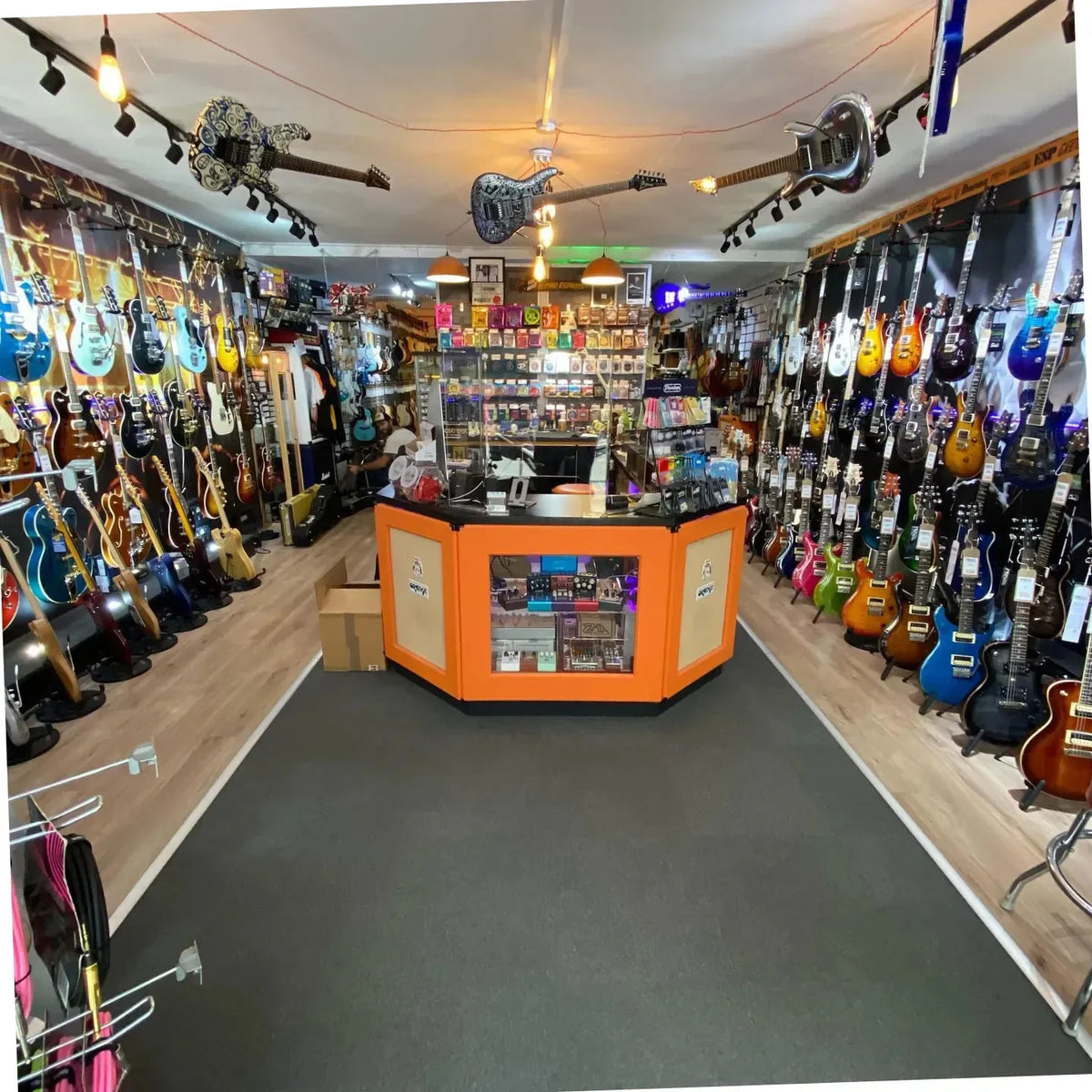
At MusicStreet, we stock a carefully chosen selection of innovative guitars, including multiscale models suited to a wide range of players and budgets. Whether you’re exploring from home or want to visit us in Huntingdon, Cambridgeshire for a hands-on try, our team is ready to point you in the right direction. We offer expert setup, genuine post-sale support, and the kind of honest, no-pressure guidance you’d expect from people who actually play. Shop multiscale guitars and find the instrument that genuinely fits the way you play.
Frequently asked questions
What is the main advantage of a multiscale guitar?
The main advantage is balanced string tension, which delivers better intonation, clearer bass response, and a noticeably more comfortable playing experience across all string ranges.
Are multiscale guitars harder to play?
Most players adjust within a few sessions and frequently discover the ergonomic hand positioning reduces strain on their hands and wrists compared to standard guitars.
Can I use regular guitar strings on a multiscale guitar?
Standard strings fit most multiscale guitars without issue, but selecting the right gauge for each scale length optimises both playability and tone for the best results.
Do multiscale guitars work for genres other than metal?
Absolutely. Their tonal clarity for all genres and ergonomic advantages make them a strong choice across jazz, rock, pop, blues, and beyond.



Share:
Master guitar tuning methods for better sound quality
Understanding plectrums: a guide for guitarists