


Choosing the right instrument can mean the difference between creative frustration and pure musical enjoyment. Many British guitarists have found that multi-scale guitars offer definite ergonomic benefits by reducing hand strain and offering improved string balance, as shown by recent biomechanical research. Whether you are tackling complex techniques or searching for greater tonal clarity, understanding how multi-scale designs enhance both comfort and sound quality could help you unlock a more rewarding playing experience.
Table of Contents
- Multi-scale Guitars Explained And Common Myths
- Types Of Multi-scale Guitars And Variations
- Ergonomics And Playability Improvements
- Tonal Benefits And String Tension Explained
- Comparing Multi-scale With Traditional Designs
- Costs, Setup, And Potential Drawbacks
Key Takeaways
| Point | Details |
|---|---|
| Multi-Scale Design Benefits | Multi-scale guitars enhance playability, reduce strain, and offer improved tonal characteristics. |
| Versatility Across Genres | These instruments are suitable for various playing styles, from blues to progressive metal. |
| Ergonomic Advantages | The design improves hand positioning and reduces the risk of repetitive stress injuries. |
| Investment and Maintenance Considerations | Higher initial cost and specialised setup are crucial factors when considering a purchase. |
Multi-scale guitars explained and common myths
Multi-scale guitars represent an innovative approach to guitar design that challenges traditional single-scale instrument construction. Unlike conventional guitars with a uniform scale length, multi-scale instruments feature multiple scale lengths across the fretboard, typically ranging from around 25.5" to 27" - creating a sophisticated solution for enhanced playability and tonal characteristics.
The core concept behind multi-scale design involves creating fanned frets that accommodate different string tensions and improve harmonic performance. Players who explore scale length variations quickly discover several critical advantages:
- More comfortable playing position for both hands
- Improved string tension across different registers
- Enhanced note definition and clarity
- Reduced hand and wrist strain during extended playing sessions
One common myth surrounding multi-scale guitars is that they are overly complex or difficult to play. In reality, most guitarists adapt remarkably quickly to the unique fretboard geometry. The ergonomic benefits often outweigh any initial adjustment period, making these instruments increasingly popular among progressive musicians seeking advanced playing experiences.
Another prevalent misconception is that multi-scale guitars are exclusively designed for specific genres like progressive metal or technical jazz. While these musical styles certainly appreciate the instrument’s nuanced capabilities, multi-scale guitars offer benefits across virtually all playing styles - from blues and rock to classical and acoustic performances.
Fanned fret geometry enables musicians to optimise string tension and improve overall intonation, which means each string can have its ideal scale length. This engineering approach addresses fundamental limitations in traditional guitar design, providing musicians with a more responsive and versatile instrument.
Pro tip: When transitioning to a multi-scale guitar, spend time practising chord shapes and scale patterns to develop muscle memory around the unique fretboard geometry.
Types of multi-scale guitars and variations
Multi-scale guitars come in several distinctive variations, each designed to address specific playing styles and musical requirements. Scale length differences play a crucial role in defining these instrument configurations, with manufacturers developing innovative approaches to fretboard design.
The primary types of multi-scale guitars include:
- Extended Range Guitars: Typically featuring 7 or 8 strings
- Progressive Metal Guitars: Optimised for heavy, technical playing styles
- Jazz and Fusion Models: Designed for complex harmonic exploration
- Acoustic Multi-Scale Instruments: Offering enhanced resonance and tonal complexity
Each variation brings unique characteristics to the instrument. Extended range guitars often utilise wider fret spacing and more pronounced fanned fret geometries, allowing musicians to explore lower tunings with exceptional clarity. Fanned fret configuration enables each string to have its optimal scale length, dramatically improving intonation and string tension across the entire fretboard.
Progressive musicians and technically-minded players particularly appreciate multi-scale designs that challenge traditional guitar construction. The asymmetrical fretboard allows for more ergonomic hand positioning, reducing strain during complex playing techniques and extended performance sessions.
Interestingly, multi-scale guitars are not limited to electric instruments. Acoustic players are increasingly adopting these innovative designs, with luthiers creating instruments that offer improved harmonic response and more balanced string tension across different registers.
Pro tip: When selecting a multi-scale guitar, prioritise personal comfort and playing style over technical specifications.
Ergonomics and playability improvements
Multi-scale guitars offer remarkable ergonomic advantages that transform playing comfort and technique. Biomechanical research highlights significant improvements in hand positioning and muscular stress reduction, making these instruments particularly appealing for professional and amateur musicians alike.
The key ergonomic benefits include:
- Reduced left-hand strain during complex playing techniques
- More natural wrist and finger alignment
- Improved string tension distribution
- Minimised risk of repetitive stress injuries
- Enhanced playing speed and precision
The fanned fret geometry fundamentally reimagines how guitarists interact with their instrument. By allowing each string to have an individually optimised scale length, musicians experience less physical tension and can maintain more relaxed hand positions during extended playing sessions.

Professional musicians frequently report significant improvements in technical performance. The asymmetrical fretboard design enables more intuitive finger placement, particularly when navigating complex chord progressions or executing intricate lead techniques. This ergonomic approach means players can maintain better hand health while simultaneously expanding their technical capabilities.
Interestingly, the ergonomic benefits extend beyond immediate playing comfort. By reducing muscular strain and promoting more natural hand movements, multi-scale guitars can potentially help prevent long-term repetitive strain injuries that often plague professional musicians.
Pro tip: Gradually introduce multi-scale guitars into your practice routine to allow your muscles to adapt to the new playing geometry.
Tonal benefits and string tension explained
Multi-scale guitars represent a sophisticated approach to addressing the fundamental challenges of string tension and tonal quality. String tension research reveals that individual string optimisation can dramatically transform a guitar’s sonic characteristics, offering musicians unprecedented control over their instrument’s voice.
The key tonal advantages of multi-scale designs include:
- Enhanced low-end clarity and definition
- Reduced fret buzz across different registers
- More balanced string response
- Improved overall harmonic complexity
- Greater sustain and note articulation
The fanned fret geometry allows each string to have its optimal scale length, which means lower strings can have longer scales for improved tension and resonance, while higher strings benefit from shorter scales that facilitate easier playability. This approach fundamentally challenges traditional guitar design by recognising that not all strings perform identically under standard configuration.
Professional musicians appreciate how multi-scale guitars provide nuanced tonal control. The varied scale lengths enable more precise intonation, particularly in genres requiring complex harmonic structures like jazz, progressive rock, and experimental music. By distributing string tension more effectively, these instruments produce a more consistent sound across different playing techniques and register ranges.
Unlike conventional guitars, multi-scale instruments offer a more sophisticated approach to managing acoustic properties. The individually optimised string lengths mean that players can achieve greater tonal depth, with each string responding more naturally to different playing styles and techniques.
Pro tip: Experiment with different playing techniques to fully explore the unique tonal characteristics of your multi-scale guitar.
Comparing multi-scale with traditional designs
Multi-scale guitars represent a significant departure from traditional fixed-scale instrument designs, offering musicians a fundamentally different approach to string tension and playability. Instrument design research reveals nuanced differences that challenge conventional guitar construction principles.
Key differences between multi-scale and traditional guitars include:
- Fret Geometry: Angled versus parallel frets
- String Tension: Individually optimised versus uniform tension
- Tonal Characteristics: Complex harmonic response versus standard resonance
- Playing Comfort: Ergonomic design versus conventional layout
- Intonation: Improved precision versus standard configuration
Traditional guitars have long been the standard, offering familiarity and a well-established tonal palette. Fixed scale lengths provide musicians with a consistent playing experience that generations of players have mastered. However, multi-scale designs challenge this paradigm by recognising that different strings inherently require different mechanical properties to perform optimally.
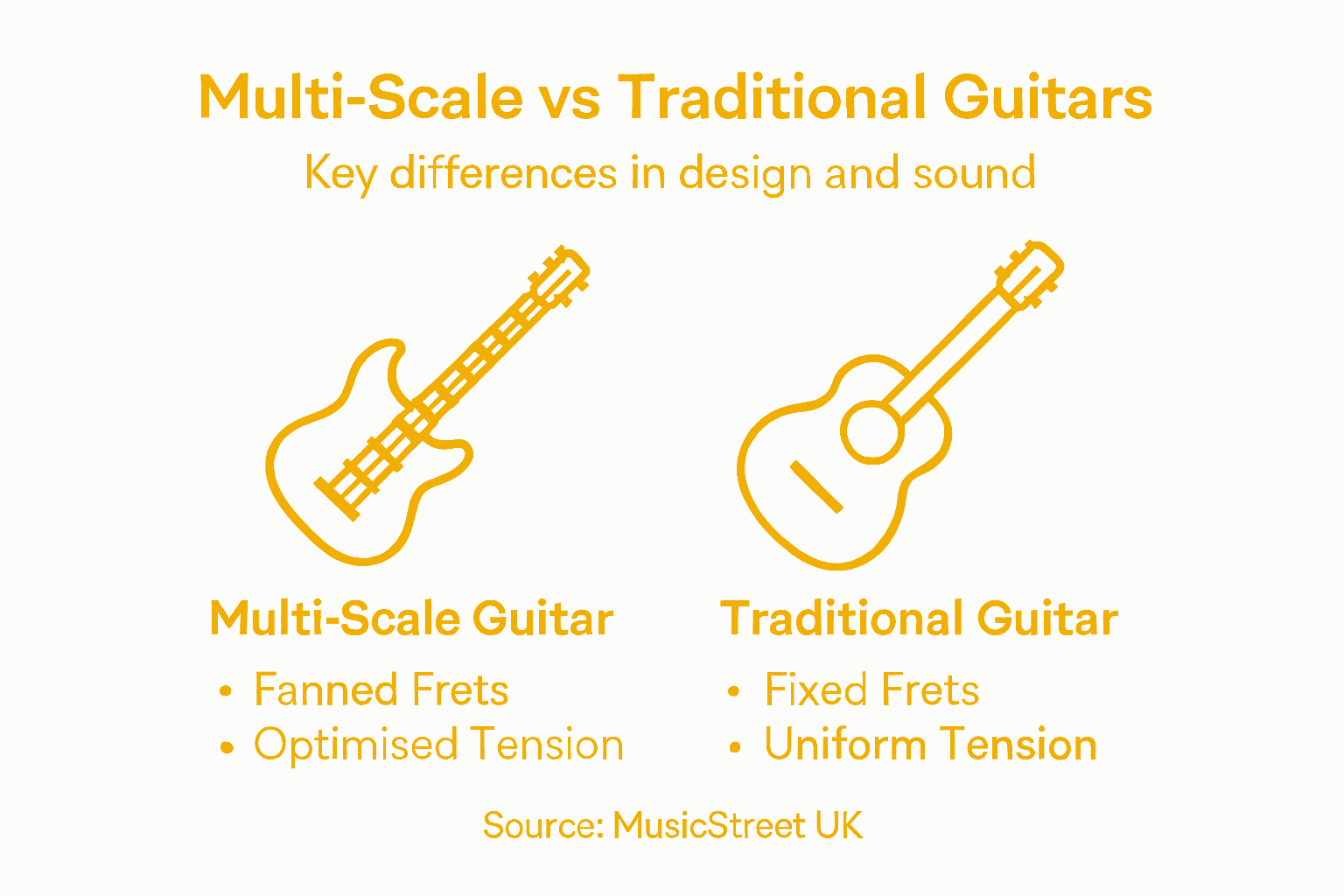
The fanned fret configuration allows lower strings to have longer scale lengths, which improves low-end clarity and reduces fret buzz, while higher strings benefit from shorter scales that enhance playability. This approach represents a more sophisticated understanding of string physics compared to traditional single-scale designs.
While traditional guitars remain popular, multi-scale instruments are gaining traction among progressive musicians who seek enhanced tonal complexity and improved ergonomic performance. The ability to optimise each string’s characteristics provides a level of nuance that fixed-scale guitars cannot match.
To clarify how multi-scale and traditional guitars differ, see this comparison:
| Aspect | Multi-scale Guitar | Traditional Guitar |
|---|---|---|
| Fretboard Geometry | Angled, fanned frets | Parallel, straight frets |
| String Tension | Customised per string | Uniform across all strings |
| Tonal Range | Enhanced with distinct clarity | Standard resonance profile |
| Playability | More ergonomic for complex passages | Familiar, traditional layout |
| Adjustable Intonation | More precise, per string | Less flexible, fixed scale |
Pro tip: Test both traditional and multi-scale guitars to understand the unique advantages of each design approach.
Costs, setup, and potential drawbacks
Multi-scale guitars represent a sophisticated technological investment that comes with unique financial and technical considerations. Guitar design research reveals the complex manufacturing processes that contribute to their higher price point and more intricate setup requirements.
Key cost and technical considerations include:
- Higher initial purchase price
- More specialised setup requirements
- Limited replacement part availability
- Extended learning curve for musicians
- Potentially higher maintenance costs
The manufacturing complexity of multi-scale guitars directly impacts their pricing. Unlike traditional guitars, these instruments require precision engineering to create the unique fanned fret geometry, which involves more sophisticated tooling and craftsmanship. This translates to a higher cost for musicians seeking these advanced instruments.
Professional musicians and serious enthusiasts must consider the technical setup challenges associated with multi-scale guitars. Finding a luthier experienced in multi-scale instrument configuration can be more difficult, and initial setup may require more specialised knowledge compared to conventional guitars. The asymmetrical fretboard demands a more nuanced approach to neck adjustments, intonation, and string action.
While the benefits of multi-scale guitars are substantial, potential buyers should be aware of some potential drawbacks. The learning curve can be steeper, with musicians requiring time to adapt to the unique fretboard geometry. Additionally, accessories and replacement parts might be less readily available compared to traditional guitar designs.
Here is a summary of the main cost and maintenance considerations for multi-scale guitars:
| Factor | Multi-scale Guitar | Traditional Guitar |
|---|---|---|
| Purchase Price | Generally higher | Wider price range |
| Setup Complexity | Requires specialised knowledge | Standard maintenance |
| Parts Availability | Sometimes limited | Common and accessible |
| Learning Curve | More adjustment needed | Typically easier |
| Maintenance Costs | Potentially increased | Usually predictable |
Pro tip: Consult with experienced multi-scale guitar technicians before making your purchase to understand the specific setup requirements.
Discover the Advantages of Multi-Scale Guitars with MusicStreet
If you are seeking to overcome common challenges like hand strain, complex setup, or tonal limitations discussed in the article, MusicStreet is here to support your journey with multi-scale guitars. Whether you are exploring ergonomic benefits, improved string tension, or enhanced playability, our expertly inspected range of electric and acoustic guitars offers the perfect blend of innovation and quality. We understand how crucial comfort and precision are to your performance and provide personalised service to help you find your ideal instrument.

Take advantage of MusicStreet’s free UK delivery and expert setup support to experience the full potential of multi-scale designs. Visit our main store to browse featured and latest instruments, or come in for an in-store tryout in Huntingdon, Cambridgeshire. Embrace the future of guitar playing today and see why musicians across the UK trust MusicStreet for their boutique guitar needs.
Frequently Asked Questions
What are the advantages of using a multi-scale guitar?
Multi-scale guitars offer several advantages, including a more comfortable playing position, improved string tension across registers, enhanced note definition, and reduced hand and wrist strain during extended playing.
Are multi-scale guitars difficult to play?
While some may perceive them as complex, most guitarists adapt quickly to the unique fretboard geometry. The ergonomic benefits often make them easier to play in the long run.
How do multi-scale guitars compare to traditional guitars?
Multi-scale guitars feature fanned fret geometry, allowing each string to have an optimal scale length, which improves intonation and string tension. In contrast, traditional guitars have a uniform scale length which may not cater to the needs of each string equally.
Can multi-scale guitars be used for all music genres?
Yes, multi-scale guitars are versatile and can benefit a wide range of music styles, from blues and rock to progressive metal and jazz. They provide improved tonal clarity and playability, making them suitable for various genres.








Share:
Your Ultimate Guitar Buying Guide for Beginners
The Ultimate Guitar Pedal Guide: Setup Your Pedalboard Today