

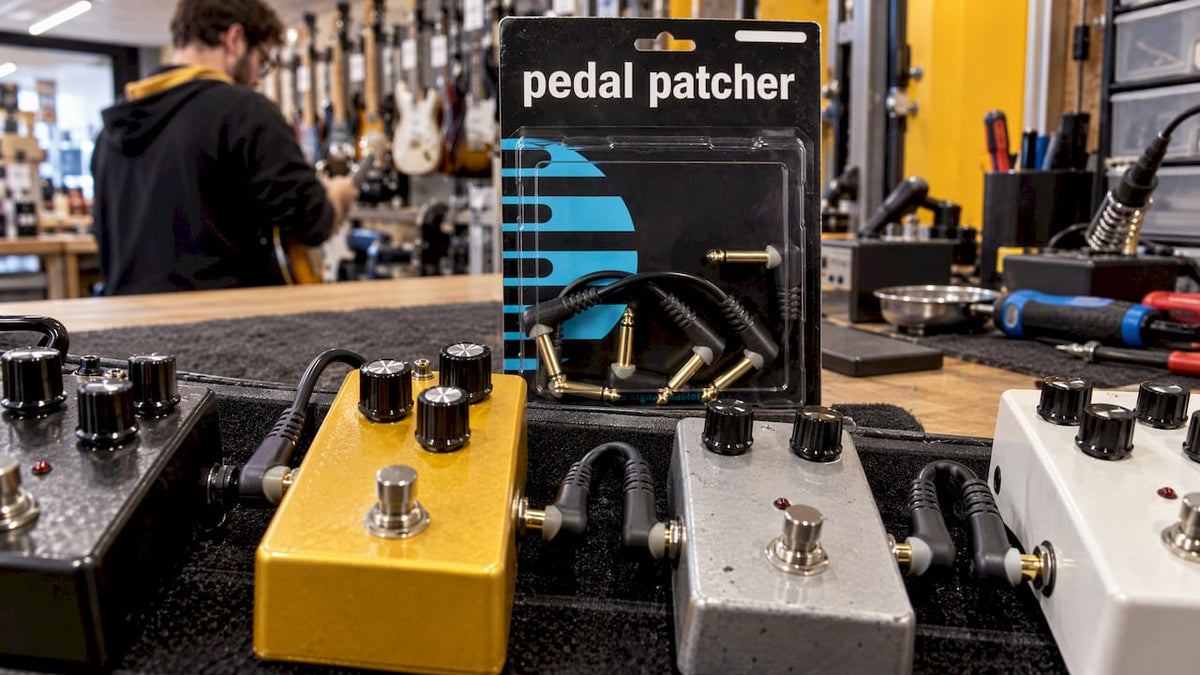
A patch lead is a short instrument cable that links one pedal to the next on a pedalboard, or a pedal to a switcher or amp. “Lead”, “cable” and “cord” all mean the same thing, so you will also see the same item sold as a patch cable. Most are only a few inches to a metre long, which is the whole point: a normal guitar lead is far too long to wire between pedals. If you are building or tidying a board, our Klotz patch cables come in short and longer lengths, and the rest of this guide shows you how to choose between them.
One note on the search results: many pages for this phrase are about network cabling, where a patch lead joins computers, switches and routers. This article is about the guitar kind.
Table of Contents
- What a patch lead does on a pedalboard
- Patch lead, instrument lead or speaker cable?
- Plugs and connectors: what to look at
- Choosing the right length
- Do patch leads change your tone?
- Wiring and noise: what to check when something sounds wrong
- Keeping the board tidy
- Our view: why we pair patch leads with a proper setup
- Getting your leads from us
- FAQ
- Sources
What a patch lead does on a pedalboard
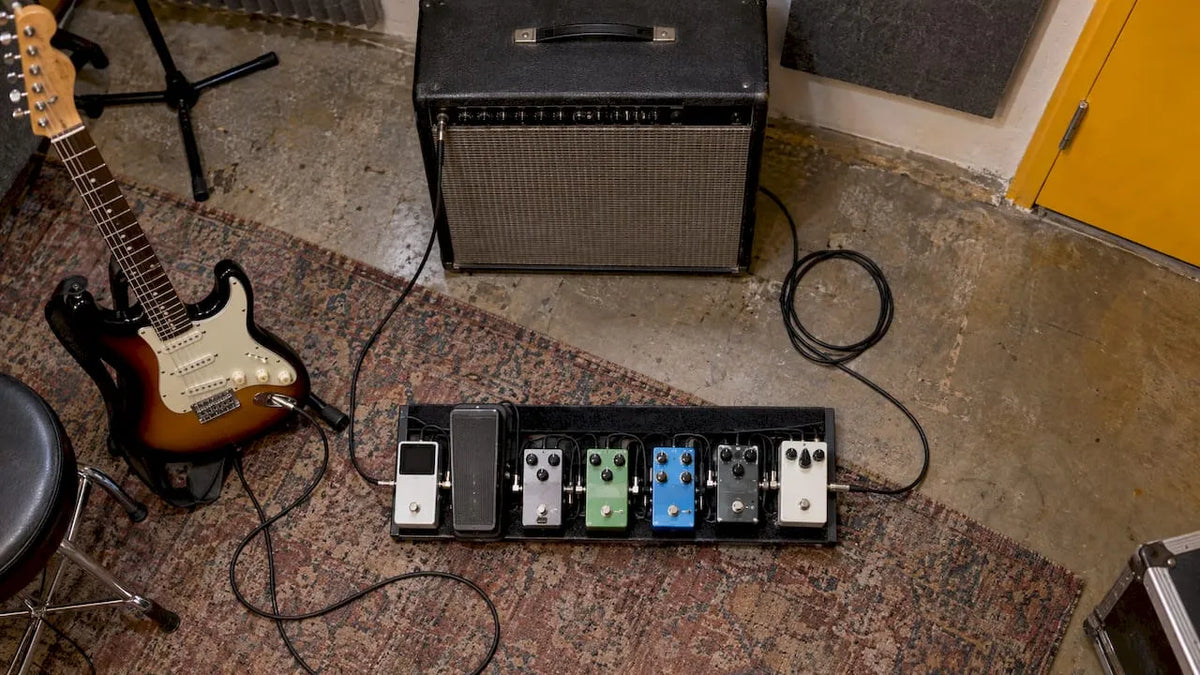
Your guitar plugs into the first pedal with a full-length lead. After that, every pedal needs its own link to the next one in the chain, and each of those links is a patch lead. The signal travels from the guitar into the first pedal’s input, out of its output, along a patch lead into the next pedal, and so on until the last pedal feeds the amp.
Guitar World explains that patch cables exist to avoid long lengths of cable between pedals, which would add capacitance (a property of cable that can dull the highs) and create clutter. Gear News makes the practical point in its pedalboard build: regular guitar jack cables are far too long for a board, which is where patch cables come in.
That is really all a patch lead is. What makes one good or bad is the plug design, the cable quality and the length.
Patch lead, instrument lead or speaker cable?
Three cables look similar to a beginner and do different jobs.
| Cable | Job | Typical length |
|---|---|---|
| Patch lead | Connects pedals to each other on a board | A few inches to about a metre |
| Instrument lead | Connects guitar to first pedal or amp | Several metres |
| Speaker cable | Connects an amp head to a speaker cabinet | Varies with the rig |
A patch lead is built like an instrument lead, only shorter. Guitar World describes a guitar cable as carrying the weak, low-current signal from passive pickups so it can be amplified. That is why shielding matters: a weak signal is easily polluted.
A speaker cable is a different animal. According to Guitar World, an instrument cable has one core conductor with braided copper shielding, while a speaker cable has two equal-sized conductors. A speaker cable used between pedals will pass the signal but, being unshielded, can pick up interference from fluorescent lighting and amp power supplies. Never plug a lead meant for an instrument into a speaker output, either: that output carries far more power than a pedal connection is designed for. Keep each cable to its own job.
Plugs and connectors: what to look at
Most patch leads for guitar pedals use quarter-inch (6.35mm) jack plugs. Three details decide whether a lead suits your board.
TS and TRS
A TS plug (tip and sleeve) carries a single unbalanced signal, which is what a guitar pedal normally uses. A TRS plug adds a ring, giving three contacts. Sound On Sound’s Hugh Robjohns explains that TS plugs have one plastic band and TRS plugs two, and that TRS carries unbalanced stereo or balanced mono. On a standard mono pedalboard you want TS-to-TS leads. If you use an expression pedal, a stereo pedal or a switcher with special sockets, TRS may come into it. Our guides to the TRS connector and the 4-pole TRRS jack explain those cases in more detail.
Straight, right-angle and flat plugs
The shape of the plug matters more on a board than on a stage lead, because pedals sit close together. MusicRadar’s review of a flat ribbon patch cable notes that its angled ends help move pedals closer together on stacked boards, and it lists lengths from 3 inches to 12 inches. Guitar World also suggests flat “pancake” plugs when space is at a premium.
As a rule:
- Right-angle plugs suit pedals whose jacks sit side by side on the left and right edges, with a gap of a few centimetres between them.
- Straight plugs suit jacks on the top of a pedal, or pedals with a wider gap between them.
- Flat or low-profile plugs help when pedals are almost touching.
Build quality
MusicRadar recommends connectors from makers such as Neutrik and Switchcraft because they are tough, reliable and easy to re-solder, and says braided shielding is generally better than spiral shielding at rejecting noise. A patch lead takes plenty of stress, since pedals get plugged and unplugged, bumped in transit and stamped on. Flexible cable also helps by easing the strain on the jacks.
Choosing the right length
Length is the question most beginners get wrong. Too long and the board looks like spaghetti; too short and the lead is pulled tight, stressing both jacks.
Guitar World’s advice is to place your pedals on the board first, measure the distances between the jacks and draw the signal path by hand. Because pedals have side jacks and top jacks, you will probably need a mix of lengths. It also says to add extra length if you route cables underneath the board.
A simple method:
- Lay out the pedals in the order you want them. If you are unsure of the order, read our guide to the pedal signal chain.
- Mark each connection: output of pedal A to input of pedal B.
- Measure each gap from jack centre to jack centre, then add a little slack so the lead is not under tension.
- Count how many short leads and how many longer ones you need. Longer ones are for runs that cross the board, go under it, or reach a switcher or the amp.
- Check which edge each jack is on. Most pedals have inputs on one side and outputs on the other, so side-by-side neighbours usually need only a very short lead.
For typical side-by-side pedals, the shortest lead that does not strain is the right one. Our 0.15m Klotz patch cables suit neighbouring pedals, while the 0.9m Klotz patch cables cover the longer runs: across a larger board, under it, or out to an amp or switcher.
A worked example
Say you have a five-pedal board: tuner, overdrive, modulation, delay and reverb, with a guitar lead in at one end and a lead to the amp at the other. That needs four patch leads between the pedals, since five pedals have four gaps. If the pedals sit in a row with side jacks, four very short leads do the job. If you decide to mount the tuner on a second tier above the others, its link may need a longer lead. And if you later add a switcher, you will need more leads again, because it connects to each pedal separately. Counting the connections before you buy saves a second order.

Do patch leads change your tone?
They can, though far less than a long instrument lead. Two things are going on.
Noise. Guitar World’s patch cable round-up says cheap patch cables can add noise. Good shielding and well-made plugs keep hiss, crackle and dropouts out of the signal, which matters most on stage, where a faulty lead can end a gig. Gear News advises buying the best you can afford for exactly that reason.
Treble loss. Capacitance builds up along a cable, so longer runs can dull the top end. Guitar World says players can start hearing a subtle treble loss around 15 to 18 feet with a good-quality instrument lead. A large board with many leads adds up too, and Guitar World says stacking many cables can cause high-end loss that a buffer pedal can counter. Short patch leads keep that total low.
For your main lead from the guitar, MusicRadar suggests 10 to 15 feet if you stand fairly still and up to 20 feet if you pace, and puts a solid mid-range cable at around £20 to £40 for most players, a price from its 2026 update. Patch leads are priced by the pack, and the same principle applies: spend on shielding and plugs, not on length.
Wiring and noise: what to check when something sounds wrong
If a board starts to hiss, crackle or cut out, a patch lead is a likely cause, since there are so many of them. Work through it in this order:
- Wiggle each lead at the jack while playing. A crackle or dropout points at a worn plug or a loose connection.
- Swap a suspect lead for a spare. This is why it pays to keep an extra one in your gig bag.
- Check the order of your pedals. Gain-heavy pedals amplify noise; our guide on what a noise gate does covers taming it.
- Check the power. Sharing a single supply the wrong way can hum; our guide to daisy chaining effects pedals safely and quietly shows how.
- Confirm every plug is fully seated and the cable runs away from power supplies.
If the noise is in the guitar rather than the board, a setup check is the sensible next step, covered below.
Keeping the board tidy
Tidy routing protects your leads. Run them neatly, avoid tight bends right at the plug, and where a lead has to cross the board, give it a gentle curve. Gear News recommends routing cables neatly underneath the board where you can, and Guitar World’s advice to allow extra length for that route is why a few longer leads belong in any set. Cable ties and a board with space underneath make the job easier, and labelling the leads that go to a switcher saves time at a soundcheck.
If you use delay and reverb at a gig, signal order matters as much as the leads that connect it all. Our guide to a five-pedal stage chain shows a layout that keeps delays clear.
Our view: why we pair patch leads with a proper setup
We see a patch lead as part of the instrument, not an afterthought. A pedalboard is only as reliable as its weakest connection, and short leads are the cheapest place to build in reliability.
At MusicStreet we inspect and set up every instrument we sell, and we think the same care belongs on the board. Before you buy, measure your gaps, count your connections and choose the shortest lead that does not strain a jack. Pick plugs that fit your pedal layout, and keep a spare in your gig bag.
If a guitar sounds noisy or crackly, the lead is not always the cause. A setup, a jack check or a repair at our Huntingdon shop can find what a cable swap will not. Our guitar setups, servicing and repairs are there for exactly that, and you can try gear in store before you commit.
Music
Getting your leads from us
We stock Klotz patch cables in packs, in short lengths for neighbouring pedals and in longer lengths for runs that cross the board: 0.15m in a pack of two, 0.15m in a pack of three, 0.9m in a pack of two and 0.9m in a pack of three. You can order online or visit our shop in Huntingdon, Cambridgeshire, where you can lay your pedals out and see which lengths work. For pedals, amps and everything else for the board, browse our accessories and guitar amps and combos, or start at musicstreet.co.uk.

If you are also adding a switcher, we sometimes have used Boss MS-3 multi effects switchers in stock. Remember that a switcher adds several leads of its own to your count.
FAQ
Are patch leads the same as guitar leads?
They are built on the same principle: a shielded cable with jack plugs that carries your guitar signal. The difference is length and purpose. A guitar lead runs from your guitar to a pedal or amp, while a patch lead is short and links pedals to each other.
Can I use a normal guitar lead between pedals?
You can, but it is a poor fit. A long lead has to be coiled or looped on the board, which is untidy and adds extra cable length to the signal path. Short patch leads keep the board compact and the signal path short.
What length of patch lead do I need?
It depends on your layout. Measure from jack to jack with your pedals in their final positions and add a little slack. Very short leads suit neighbouring pedals, and longer ones suit runs across or under the board. Guitar World’s advice is to plan the layout first and then buy.
Do I need right-angle plugs?
Often yes, when pedals sit close together with their side jacks facing each other. Right-angle or flat plugs let the pedals sit closer. Straight plugs are fine where there is a gap or the jack is on top of the pedal.
What is the difference between TS and TRS leads?
A TS lead carries a single mono signal and is the usual choice for guitar pedals. A TRS lead has an extra contact for stereo signals, expression pedals or balanced connections. Check your pedal’s manual before buying, and use TS unless the pedal calls for TRS.
Sources
- Guitar cables: everything you need to know
- Instrument cable vs speaker cable: what’s the difference?
- Best patch cables 2026
- Best guitar cables 2026
- Building My First Pedal Board: Gear, Signals & Surprises
- The Low-down On Analogue Interfacing




Share:
What Does a DI Box Do? A Plain Guide for Guitarists