


- Choosing the right guitar tuner depends on your playing environment and budget, with options ranging from clip-on to rack-mounted models. Clip-on tuners are portable and suitable for quiet settings, while pedal tuners excel in noisy live performances, offering silent muting and fast tuning. For professional accuracy, rack-mounted and strobe tuners provide the highest precision, but most casual players will find chromatic pedal tuners more than adequate for their needs.
Choosing the right tuner might seem straightforward, but the sheer variety available makes it genuinely confusing. There are four primary types of guitar tuners most players will encounter: clip-on, pedal, rack-mounted, and mobile app. Each suits a different playing environment, budget, and skill level. Whether you are a complete beginner tuning up in your bedroom or a seasoned gigging musician who needs reliable pitch accuracy under stage lights, understanding the key guitar tuner types will help you make a smarter choice.
Table of Contents
- Key takeaways
- 1. What to consider before you buy: key selection criteria
- 2. Clip-on guitar tuners
- 3. Pedal guitar tuners: the gigging musician’s best friend
- 4. Rack-mounted and app-based tuners: specialist and mobile options
- 5. Guitar tuner comparison: choosing the right type for you
- My honest take on picking a guitar tuner
- Find the right guitar tuner at Musicstreet
- FAQ
Key takeaways
| Point | Details |
|---|---|
| Four main tuner types | Clip-on, pedal, rack-mounted, and app tuners each serve different playing scenarios. |
| Environment drives choice | Your playing setting matters more than brand or price when selecting a tuner. |
| Accuracy measured in cents | Casual players need roughly ±1 cent accuracy; professionals benefit from tighter precision. |
| Pedal tuners suit live gigs | Stompbox tuners handle noisy stages well and integrate cleanly into a pedalboard. |
| Apps work for casual use | Smartphone tuners are convenient but struggle in noisy environments. |
1. What to consider before you buy: key selection criteria
Before you get into the individual tuner categories, it helps to build a clear picture of what you actually need. The best tuner for one guitarist can be completely wrong for another. Tuner choice should be driven by playing environment above all else, so start there.
Here are the main factors worth thinking through:
- Accuracy. Tuner precision is measured in cents. A cent is one hundredth of a semitone. For casual practice, ±1 cent is perfectly fine. For studio recording or setting intonation, you want something tighter.
- Tuning modes. Chromatic tuners detect all 12 notes in the musical scale, making them ideal for alternate tunings. Polyphonic tuners let you strum all strings at once and see which need adjustment. Strobe tuners offer the highest precision, sometimes exceeding ±0.01 cent accuracy.
- Playing environment. Are you gigging in loud venues? Practising quietly at home? Recording in a studio? Each scenario demands a different tuner type.
- Form factor. Pedal tuners live on pedalboards. Clip-ons attach to your headstock. Rack tuners mount in studio gear racks. Apps live on your phone.
- Ease of use. Some tuners have large, bright displays that are easy to read under stage lighting. Others have small screens suited to quiet, well-lit rooms.
- Budget. Prices range from free (apps) to well over £100 for professional pedal or strobe tuners.
- Instrument compatibility. Some tuners work better with acoustic guitars, others with electric. Nylon string guitars can sometimes confuse cheaper tuners due to their complex harmonic content.
Pro Tip: If you play in more than one setting regularly, consider owning two tuners. A clip-on for home practice and a pedal tuner for gigs is a combination many working musicians swear by.
2. Clip-on guitar tuners
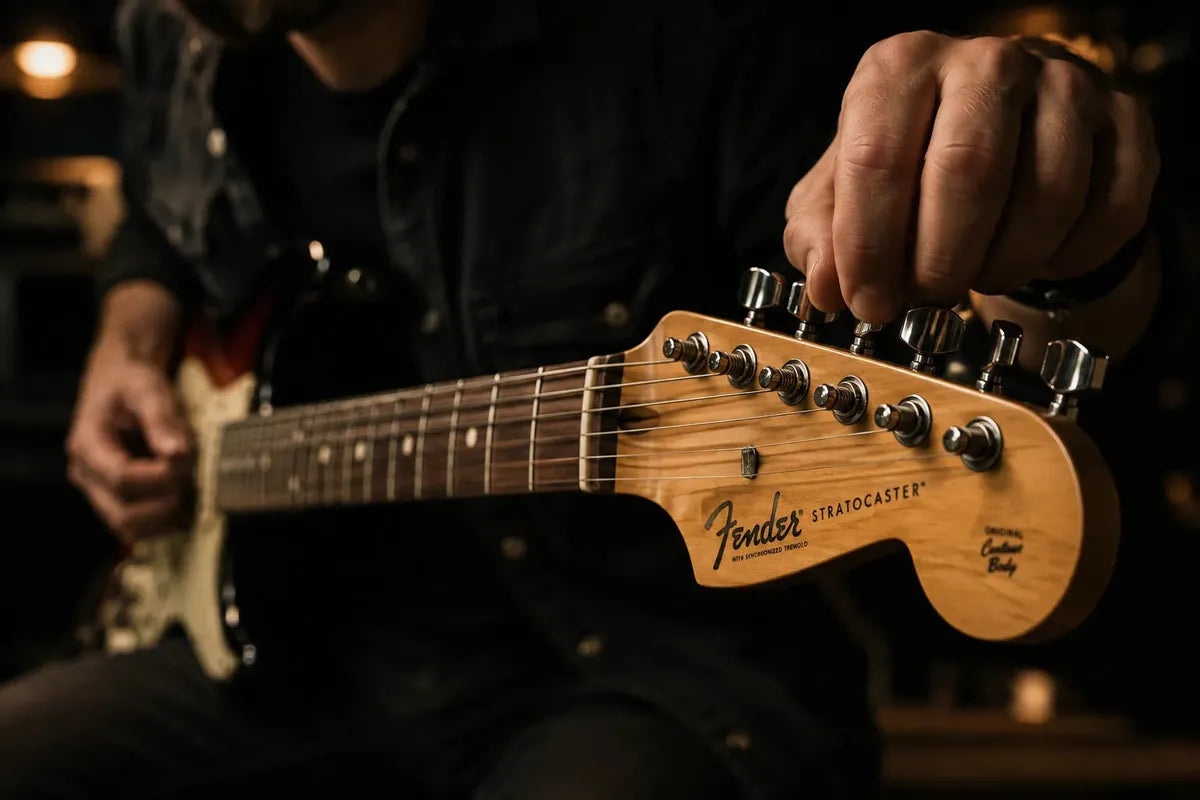
Clip-on guitar tuners are the most popular choice for beginners and acoustic players, and it is easy to see why. They attach directly to your headstock and detect pitch through vibration sensing rather than through a microphone. That means ambient sound does not interfere with the reading, at least in reasonably quiet environments.
The main advantages are portability and simplicity. A clip-on tuner weighs almost nothing, fits in your gig bag pocket, and takes seconds to attach. Most have a rotating display so you can read the screen at any angle, which is genuinely useful when the tuner is sitting on the back of a headstock at an odd angle.
That said, clip-on tuners are vulnerable to ambient noise and strong external vibrations. On a loud stage with bass frequencies bouncing around the room, the vibration sensor can pick up interference that throws off the reading. They are not reliable tools for live gigging unless you are playing in a very quiet acoustic setting.
Pricing for clip-on digital guitar tuners sits in an accessible range. Entry-level options cost around £15 to £20, while better-featured models with rechargeable batteries, colour displays, and wider tuning ranges nudge toward £30 to £40.
Key strengths of clip-on tuners at a glance:
- Extremely portable and lightweight
- No cables required
- Suitable for acoustic, classical, and ukulele players
- Easy for beginners to use without setup
Pro Tip: When using a clip-on on an electric guitar, the solid body can sometimes produce weak vibrations that cause inconsistent readings. Try plucking the string more firmly or using the tuner closer to the nut for a cleaner signal.
3. Pedal guitar tuners: the gigging musician’s best friend
If you play live regularly, a pedal tuner earns its place on your pedalboard faster than almost any other accessory. The stompbox format means you can mute your signal, tune silently, and be back in pitch within seconds without the audience hearing a thing.
Pedal tuners are built to handle noise. Because they receive signal directly from your guitar via a cable, ambient sound is irrelevant. That directness also means you get a stable, reliable reading even in the chaos of a festival stage.
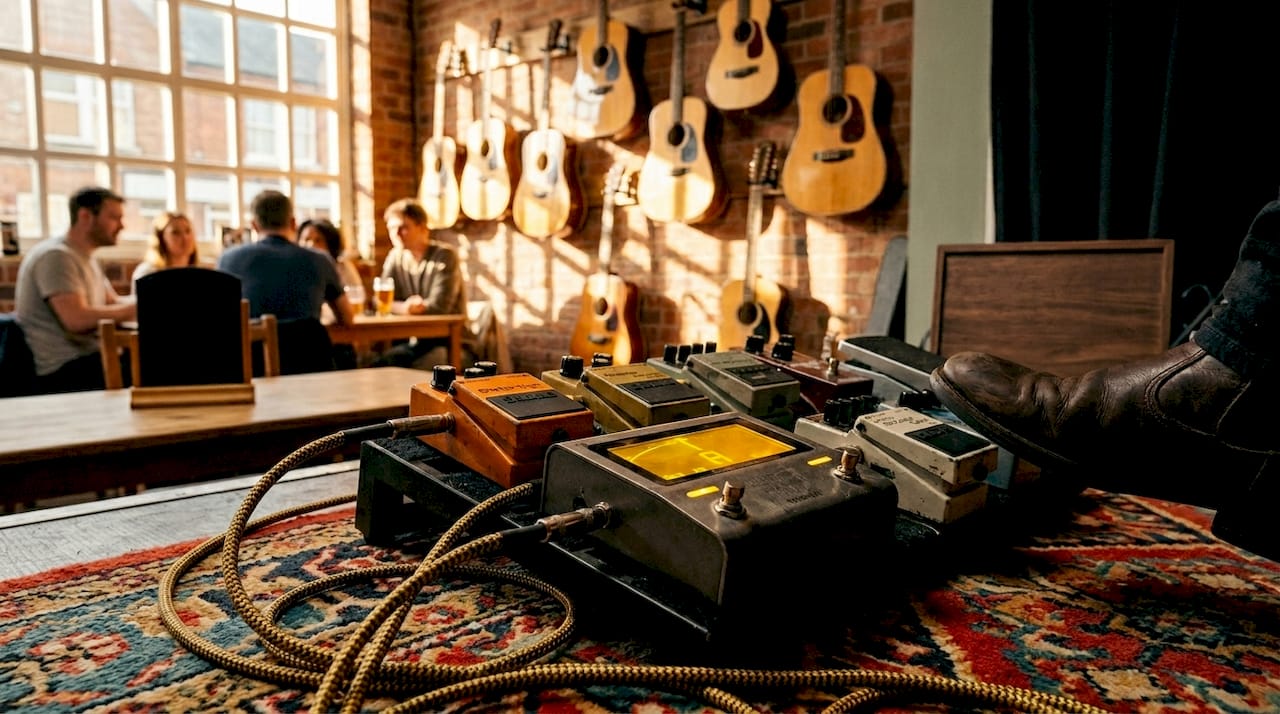
Most pedal tuners offer chromatic tuning as standard, and many of the better models add polyphonic and strobe modes. Polyphonic tuning is particularly useful live. You strum all six strings open, and the display shows you which strings are flat or sharp simultaneously. Polyphonic tuners let you check all strings at once, which cuts your tuning time significantly between songs.
The other practical benefit is pedalboard integration. Pedal tuners with true bypass switching prevent tone loss when the tuner is disengaged. Many also support daisy-chain power, meaning you can run them off the same power supply as the rest of your pedals.
Pricing reflects the professional focus. Mid-range models typically cost between £60 and £90, while premium options with advanced strobe accuracy or polyphonic detection sit closer to £100 to £150.
Things pedal tuners do particularly well:
- Accurate tuning in noisy, loud environments
- Silent muting during live performances
- Polyphonic and strobe mode availability on better models
- Clean integration with existing pedalboard power supplies
- Large displays legible under stage lighting
Pro Tip: Position your pedal tuner at the very start of your signal chain, before any other effects. This gives it the cleanest possible signal and the most accurate reading.
4. Rack-mounted and app-based tuners: specialist and mobile options
Rack-mounted tuners
Rack tuners occupy a specialist corner of the market. They are designed for studio environments and professional touring rigs where precision and integration with other rack gear matter more than portability. Rack-mounted tuners often include strobe mode options and can be integrated with rack effects units, offering superior visual feedback and a level of tuning precision that most players never actually need but professionals genuinely rely on.
The accuracy of strobe tuners can reach ±0.01 cent, which is genuinely extraordinary. That level of precision matters when you are setting the intonation on a guitar that will be recorded and heard through high-end speakers. For recording sessions or professional studio work, a rack tuner paired with a quality interface or a tool like SoundBridge DAW creates a precision-focused environment that is hard to match.
Rack tuners are not a casual purchase. They cost significantly more than clip-on or pedal options, often running from £150 upward. They also require rack housing and are not portable in any practical sense.
App-based tuners
App tuners sit at the opposite end of the spectrum. They are free or nearly free, always with you, and perfectly adequate for quiet home practice. Mobile app tuners are generally less reliable in noisy environments because they depend on your phone’s microphone to pick up sound, and that microphone picks up everything around it.
The quality of app tuner accuracy depends heavily on your device’s microphone and the algorithm the app uses. A quiet room with a good phone can yield surprisingly solid results. A busy rehearsal room? Not so much.
App tuners are best thought of as a convenience tool or a backup. They are genuinely useful when you have forgotten your tuner, are practising in a quiet space, or need to check tuning quickly without digging through your bag.
5. Guitar tuner comparison: choosing the right type for you
Here is a clear side-by-side view of all four main types to help you make your decision:
| Tuner type | Accuracy | Best environment | Price range | Best suited for |
|---|---|---|---|---|
| Clip-on | ±1 cent | Home, quiet studio | £15 to £40 | Beginners, acoustic players |
| Pedal | ±0.5 to ±1 cent | Live stage, rehearsal | £60 to £150+ | Gigging musicians, electric players |
| Rack-mounted | ±0.01 cent | Studio, pro touring | £150 and above | Studio engineers, touring professionals |
| App-based | Variable | Quiet practice only | Free to £5 | Casual players, backup use |
Choosing between them comes down to a few practical questions:
- Are you a beginner? A clip-on digital guitar tuner is the obvious starting point. It is affordable, simple, and does everything you need for home practice.
- Do you gig regularly? Invest in a pedal tuner. The reliability, silent muting, and stage-ready display will pay for themselves quickly.
- Are you recording professionally? A rack tuner or a high-end strobe pedal tuner will give you the accuracy required for precise intonation work. Many players find that precise intonation adjustments make a bigger difference to recorded tone than they expected.
- Are you a casual hobbyist? An app tuner or a budget clip-on is perfectly sufficient. There is no need to overcomplicate it.
Many beginners mistakenly assume all tuners are equally accurate. The truth is that for most casual use, the difference between a £20 clip-on and a £100 pedal tuner in terms of tuning accuracy is minimal. Where the pedal tuner earns its price is in environment suitability, speed, and reliability, not in basic pitch detection.
My honest take on picking a guitar tuner
I have used every type of tuner described in this article over many years working with guitarists at every level, and my honest view is this: most people overcomplicate the decision by focusing on features they will never use.
If you are buying your first tuner, spend £20 on a decent clip-on. Full stop. The difference between a £20 and a £80 tuner will not make your playing sound better in your living room. Save the money for strings or lessons.
Where I see players genuinely underserve themselves is at the gigging stage. Too many intermediate players turn up to live gigs with a clip-on tuner, clip it to the headstock under bright stage lights, and spend thirty seconds squinting at a tiny display in between songs. A pedal tuner solves all of that, and the cost is not as prohibitive as people think.
The other misconception I encounter regularly is around strobe tuners. Players read that strobe accuracy exceeds ±0.01 cent precision and assume they need one. Unless you are doing professional intonation work or recording at a high level, you do not. A good chromatic pedal tuner is accurate enough for 99% of playing situations. Chasing extreme precision without the listening environment or recording chain to benefit from it is genuinely a waste of money.
Finally, do not overlook the step that comes after tuning. Learning to tune a guitar properly and maintain tuning stability through proper string stretching and nut maintenance will do more for your pitch accuracy than any tuner upgrade.
— Musicstreet
Find the right guitar tuner at Musicstreet
At Musicstreet, we stock a carefully selected range of guitar tuners to suit every playing style and budget, from compact clip-on digital guitar tuners for home practice to professional-grade pedal tuners for the stage.

Whether you are just starting out or putting together a serious pedalboard, our team understands that the right tuner is the one that fits your actual playing life. We offer expert advice alongside every purchase, and our physical store in Huntingdon, Cambridgeshire gives you the chance to see products in person before you commit. Browse our full selection and get personalised guidance on finding the right guitar tuner for your setup. Free UK delivery is available on qualifying orders, and our post-sale support means you are never left without help after you buy.
FAQ
What are the main types of guitar tuners?
The four main types of guitar tuners are clip-on, pedal, rack-mounted, and mobile app tuners. Each is suited to different playing environments, from home practice to professional studio recording.
Are clip-on guitar tuners accurate enough for live use?
Clip-on tuners are generally not reliable for live stage use because ambient noise and vibrations can interfere with their sensors. They are best suited to quiet practice environments such as home or acoustic studio settings.
What is the most accurate type of guitar tuner?
Strobe tuners offer the highest accuracy, measuring pitch to within ±0.01 cent compared to the ±1 cent typical of standard chromatic tuners. They are primarily used in professional studio contexts for precise intonation work.
Do I need a polyphonic tuner?
A polyphonic tuner is useful for live gigs where you need to check all six strings simultaneously and retune quickly between songs. For home practice or casual use, a standard chromatic tuner is more than adequate.
Can I use a smartphone app instead of a physical tuner?
App-based tuners work well for quiet home practice and are a useful backup option. However, their accuracy depends on your device’s microphone quality, and they become unreliable in noisy environments.





Share:
Guitar storage tips to protect your instrument
Acoustic electric bass vs electric bass: which suits you?