


A loop pedal is a stompbox that records a phrase you play, then repeats it instantly so you can add more layers on top. Beginners use them to practise against a live backing track, write songs on the spot, or build a full band’s worth of sound alone on stage. The next sections cover exactly how the recording works and how to make your first loop tonight.
TL;DR:
- Beginners should prioritize simple loop pedals with dedicated stop switches over complex models with multiple features, to ensure reliable performance in live settings.
- Recording capacity varies widely, with basic models offering around 12 minutes of total memory, which may be insufficient for longer or multiple layered loops.
- Proper pedal placement at the end of the effects chain and consistent finger timing are essential to achieving clean, professional-sounding loops.
- Practicing with a metronome and mastering tap timing are crucial for preventing amateurish timing mistakes in live or recorded loops.
- Using loop pedals for solo practice, songwriting, or live performance can significantly enhance creativity and arrangement building with minimal gear.
Table of Contents
- What are loop pedals? Form, connections and recording capacity
- How loop pedals work: recording, overdubbing and playback
- What loop pedals are good for: practical uses and artists worth studying
- Key features to look for in a first loop pedal
- Five practical steps to start looping tonight
- Common beginner mistakes and how to fix them
- So, what exactly is a loop pedal?
- Musicstreet’s take on buying your first loop pedal
- Ready to build your looping setup?
- Sources
- FAQ
What are loop pedals? Form, connections and recording capacity
What are loop pedals, mechanically speaking? At the simplest level, they’re a small footswitch box sitting between your guitar and amp, built to survive being stamped on mid song. You tap once to start recording, tap again to close the loop, and it plays back on repeat while your hands stay free to keep playing.
Most units connect the same way a standard pedal does: a quarter inch instrument cable in from your guitar, another out to your amp or the next pedal in the chain. Some higher end loop stations add XLR inputs for microphones or line-level gear, which matters if you’re layering vocals or a keyboard alongside guitar. Everything you record gets stored as WAV audio, either in onboard memory or on a removable card, and it plays back the moment you release the switch, according to MasterClass’s breakdown of looper mechanics.
Recording capacity is where units genuinely separate. A basic model like the BOSS RC-1 gives you around 12 minutes of loop time, which sounds generous until you realise that’s total memory, not per loop. Pricier loop stations offer multiple independent tracks and far deeper storage.
What to check before you buy:
- Input type: quarter inch only, or quarter inch plus XLR for mic and line sources
- Total recording memory versus memory per individual loop
- Whether loops save after power off or reset every time
- Mono or stereo output, which matters if you run stereo effects
- Physical footprint on your pedalboard
How loop pedals work: recording, overdubbing and playback
The core cycle behind every loop pedal is short: record, play, overdub, stop, clear. You press the switch to start recording a phrase, press again to close the loop and start playback, then press a third time to layer a new part over what’s already playing. That third step, overdubbing, is genuinely the reason loop pedals exist. Recording a phrase that repeats is a neat trick; recording new parts on top of it while it keeps looping is what turns a stompbox into a one-person arranging tool. Overdubbing is the core capability that gives loop pedals their creative power, according to Roland’s beginner’s guide to looping, and it’s genuinely what separates a looper from a simple delay pedal.
Here’s the typical sequence you’ll follow on almost any unit:
- Tap once to begin recording your first phrase (a chord progression, a riff, a rhythm)
- Tap again the moment the phrase ends to close the loop, which switches automatically into playback
- Tap a third time to start overdubbing a new part while the original loop keeps cycling
- Tap again to stop overdubbing without stopping playback
- Hold or double tap (depending on the model) to stop everything, and again to clear the loop entirely
Beyond that core loop, most pedals from entry level upwards add a few extras worth knowing about:
- Undo/redo: lets you strip back the last overdub if it clashed, without wiping the whole loop
- Reverse: plays your recorded loop backwards, a favourite trick for atmospheric intros
- Tempo or rhythm tracks: a built in metronome or drum pattern you can loop against before you’ve played a note
Pro Tip: Record your first pass slightly generously rather than cutting it razor tight. A loop with a fraction of a second of silence at the start is far easier to play along with than one that starts mid beat.
What loop pedals are good for: practical uses and artists worth studying
Looping earns its keep in four fairly distinct situations, and knowing which one you’re solving for changes how you set the pedal up; for more on performing live with such gear, see our guide on what is a live music show.
- Practice: loop a chord progression and solo over it for as long as you like, without needing a backing track or a patient friend
- Songwriting: capture an idea the second it happens, then build the arrangement in real time to hear how a bridge or bass line actually sits
- Live solo performance: build up rhythm, harmony and lead in front of an audience, effectively performing as a one-person band
- Percussion and texture: tap or slap the guitar body for a rhythm loop, then layer chords and melody over the top
Ed Sheeran and Tash Sultana are the two names most beginners have already half-noticed doing this on stage, using loop pedals to build layered, studio-quality arrangements live, according to BOSS’s guide to loop pedals for beginners. Watch either of them and you’ll see percussion, harmony and rhythmic texture built from nothing, one footswitch tap at a time. It also changes how you practise even if you never play a gig. A loop turns solitary scales and chord drills into an actual arrangement exercise, because you’re reacting to something rather than playing into silence.
Key features to look for in a first loop pedal
The temptation with any first pedal purchase is to chase the spec sheet. Resist it. Industry guides consistently advise beginners to favour a simple interface and a dedicated stop footswitch over hunting for the biggest numbers on the box, a point MusicRadar makes repeatedly in its own buyer’s guide, and it holds up in practice.
Footswitch layout matters more than almost anything else on this list. A single footswitch pedal handles record, overdub and stop with different tap patterns (single tap, double tap, hold), which works fine in a bedroom but gets risky live when your foot is half a second late. Professionals generally prefer loopers with separate play/record and stop switches, since a single switch increases the odds of a mistimed tap mid song, according to Acoustic Guitar’s guide to loopers.
Beyond the footswitches, weigh up:
- Recording length and memory: enough for your longest song idea, with headroom for false starts
- Stereo input/output: only worth paying for if you already run stereo effects or a stereo rig
- Audio quality (the analogue to digital to analogue conversion): better converters mean your loop sounds as close to the live signal as possible
- Undo/redo and multiple memory slots: useful once you’re saving loops between songs, unnecessary for a first pedal
- Drum or rhythm patterns: handy for solo practice, but not essential for live looping
Simple loopers suit most beginners best; the more elaborate loop stations add rhythm tracks, multiple tracks and deeper memory but often bring complexity you don’t need yet, a view echoed by MusicConstructed’s looping overview. Price tends to track exactly these features: entry-level stompboxes cover the essentials, while advanced models add 32-bit audio, dozens of memory slots and multi-track recording, which is why the cost gap between loop pedals is so wide.
Pro Tip: Buy the simplest pedal that does everything on your must-have list, not the one with the most features overall. You will use a reliable stop switch every single time you play; you may never touch reverse mode.
Five practical steps to start looping tonight
You don’t need a rehearsal room or a band to get useful practice from a loop pedal. Twenty minutes and a metronome will do it.
- Set up your signal chain properly. Guitar into your other pedals, looper last, then into the amp. Placing the looper at the very end of the chain captures your final tone, including any drive or modulation, rather than a dry, unprocessed signal, a point TrueFire’s looper guide makes specifically for this reason. Check your input and output levels aren’t clipping before you record anything.
- Lock your timing with a metronome or built-in rhythm track. Loop pedals are unforgiving about tempo drift; a click track trains your foot taps to land consistently.
- Record a simple four-chord progression first. Nothing fancy. Close the loop cleanly, then overdub a bass note or a simple lead line on top while it plays back.
- Balance your loop volume against your direct signal. If the looped playback sits louder than what you’re playing live, the overdub will sound buried; adjust until both sit at a similar level.
- Practise stopping and clearing safely. Know exactly which tap pattern stops playback without wiping your loop, and which one clears it completely, before you ever play this in front of anyone.
Repeat this five or six times in a session and the footwork stops being something you think about.
Common beginner mistakes and how to fix them
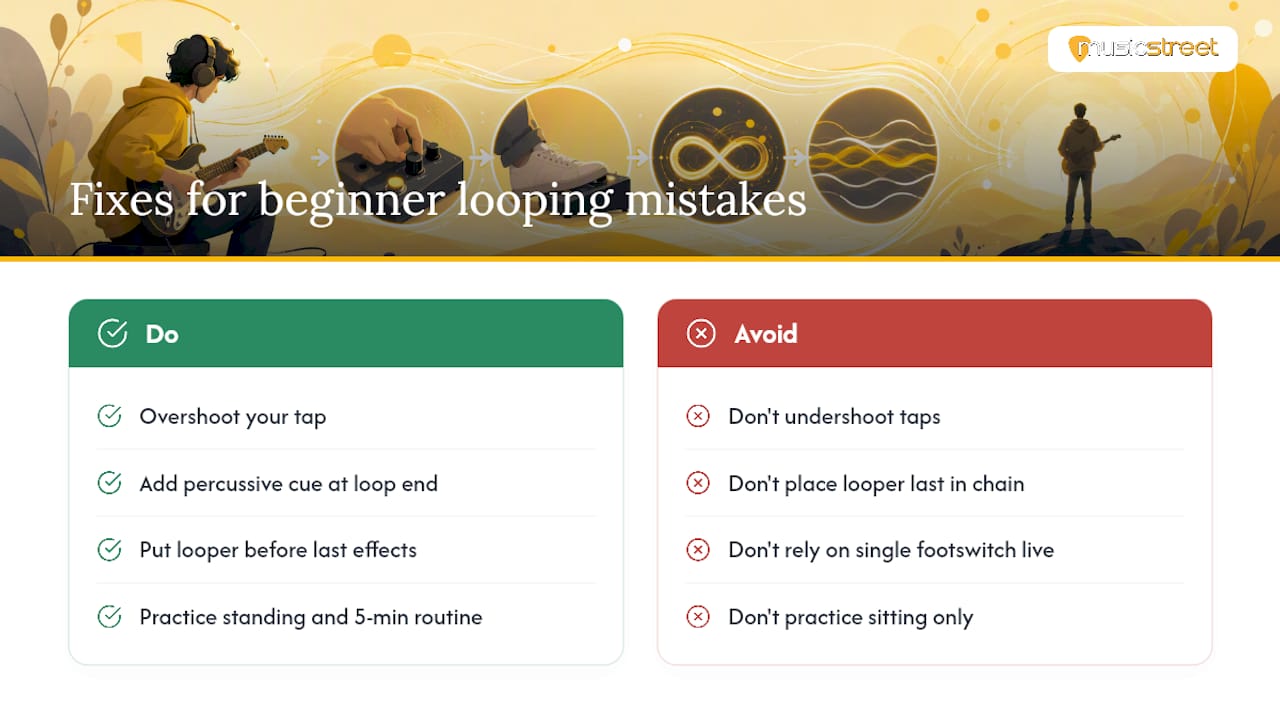
Timing mistakes are the single biggest cause of loops that sound amateurish, and almost every player makes them for the first few weeks. The fix isn’t perfect timing straight away, it’s a technique: slightly overshoot your tap rather than under shooting it, since a loop that’s a touch long is far less noticeable than one that clips the start of a note. A small percussive accent or hit right at the loop’s end also gives your foot a clear cue to land the next tap on, according to [TrueFire’s practical looping advice](https://truefire.com/learn/how-to-use-a looper-pedal).
Second mistake: pedal placement. Put the looper anywhere except last in your effects chain and you’ll capture a dry, thin version of your tone rather than the one you actually hear.
Third: outgrowing a single footswitch pedal. They’re genuinely fine for bedroom practice, but once you’re doing more than record, overdub, stop, you’ll find yourself missing taps live. That’s the point to look at a two or three switch unit.
Pro Tip: Practise your loop routine standing up, exactly as you would on stage. Foot coordination changes completely between sitting and standing, and stage nerves make hesitant footwork worse, not better.
Build a short daily routine, even five minutes, and the physical side of looping stops being the thing you worry about.
So, what exactly is a loop pedal?
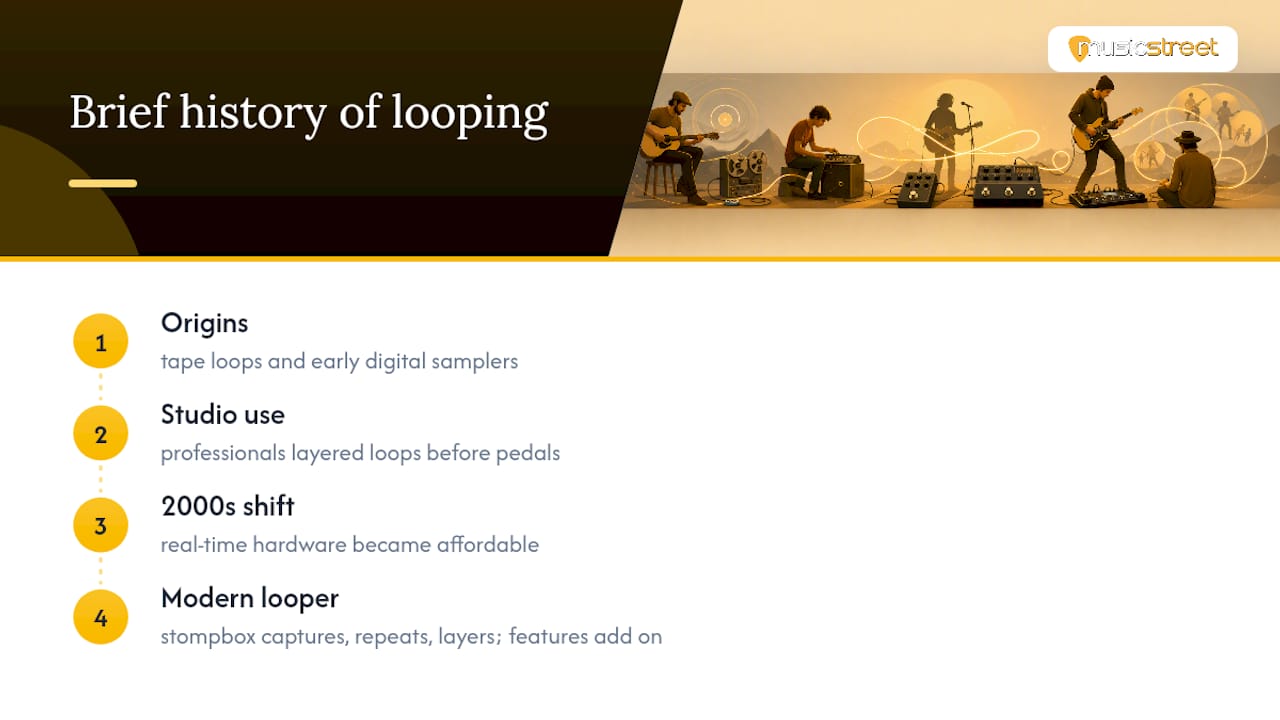
Strip away the features and the marketing, and a loop pedal is an electronic stompbox that records whatever you play in real time and repeats it on a continuous cycle, freeing your hands to play something new against it. That’s the whole definition. Everything else, undo/redo, rhythm tracks, multiple memory slots, stereo I/O, is a feature built on top of that one core function.
It’s worth being precise about the terminology here, because “loop pedal” and “looper pedal” get used interchangeably, and both refer to the same device: a phrase sampler in a footswitch enclosure. Industry manufacturers like BOSS and Roland tend to call their larger, multi-track units “loop stations” rather than pedals, reserving “pedal” for the simpler, single or dual footswitch stompboxes most beginners start with. The distinction is mostly about complexity rather than function. A basic pedal and an elaborate loop station both do the same fundamental job: capture, repeat, layer.
Live looping as a technique actually predates the compact stompbox by decades, with musicians using tape loops and early digital samplers to achieve the same layered effect long before it fit on a pedalboard, and live looping’s history stretches back further than most players assume. What changed in the early 2000s was affordability. Real-time hardware loopers became cheap enough for bedroom musicians, not just studio professionals, and that’s largely why the technique is now a standard part of learning guitar rather than a specialist studio trick.
Musicstreet’s take on buying your first loop pedal
Most beginners don’t need the biggest loop station on the shelf, they need honest advice about what they’ll actually use. That’s the gap Musicstreet tries to close: staff who’ll talk you through footswitch layout and recording memory before you spend a penny, and a physical Huntingdon store where you can stand with a pedal at your feet and feel whether the footswitch spacing suits you, rather than guessing from a spec sheet online.
Every pedal Musicstreet sells gets expert setup before it reaches you, and pre-owned kit is inspected properly rather than shipped as-is. Warranty and aftercare support carry on after the sale too, which matters more with a looper than most pedals, since you’re relying on it to behave consistently on stage. Pair one with the right bass pickups or guitar electronics and the whole rig starts working as one instrument rather than a pile of separate gear.
— Music
Ready to build your looping setup?
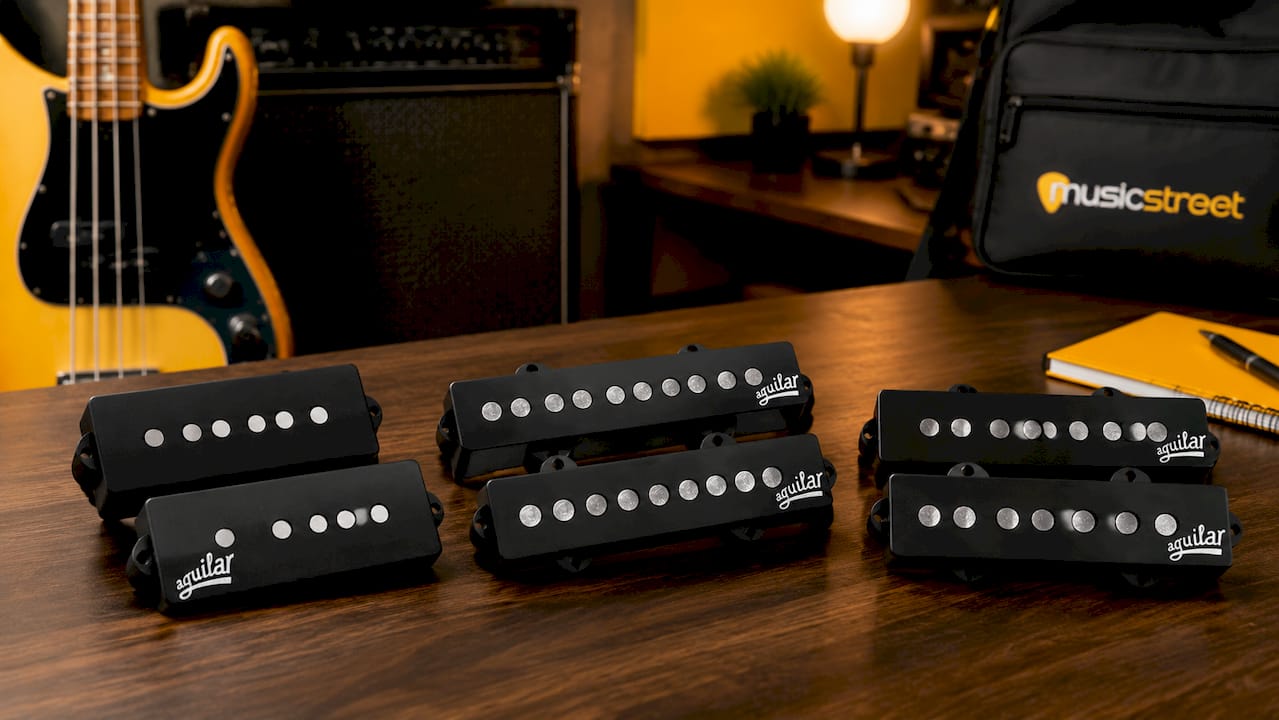
If you’re putting together a rig around your new pedal, the pickups you run through it matter just as much as the pedal itself, since a muddy or thin signal going in comes out just as muddy once it’s looped and layered three times over. For bass players building a fuller live sound, the Aguilar 60S Series 5 String Precision Bass Set gives a classic, well-defined tone that holds up under overdubbing, while the Aguilar Hot-J Series 5 String Jazz Bass Set suits players who want more output driving into their loop. Players after a vintage-leaning jazz voice should look at the Aguilar 60S Series 5 String Jazz Bass Set instead.
Every order over the free delivery threshold ships free across the UK, and every guitar or bass leaves Musicstreet properly set up, not just boxed and sent. If you’re still deciding how a looper fits your pedalboard, the guide to building your own pedalboard system is worth a read first. Come into the Huntingdon store to try pickups and pedals together before you commit, or get in touch online for advice tailored to your current setup.
Sources
- The complete guide to loop pedals for beginners (BOSS article)
- A beginner’s guide to looper pedals | MusicRadar
- The definitive beginner’s guide to looping (Roland blog)
- How to use a loop pedal (MasterClass article)
FAQ
What are loop pedals good for?
Loop pedals are good for solo practice, songwriting, live one-person arrangements, and building percussion or harmony layers on the spot without needing other musicians present.
Why are loop pedals so expensive?
Price scales with storage capacity, footswitch count, audio conversion quality and extras like drum patterns or multiple memory slots; a basic stompbox costs far less than a multi-track loop station with 32-bit audio and dozens of memory slots.
What does Ed Sheeran use for looping?
Ed Sheeran is widely known for using a loop pedal live to layer rhythm, chords and vocal parts into full arrangements built entirely from his own performance, a technique detailed in BOSS’s beginner looping guide.
What artists use loop pedals?
Ed Sheeran and Tash Sultana are the most widely cited examples of solo artists using loop pedals live to build percussion, harmony and rhythmic textures on stage.
Should a beginner buy a single or multi-footswitch loop pedal?
A single footswitch pedal is fine for practice, but a multi-footswitch unit is more reliable for live performance since it separates record, play and stop into distinct, less error-prone taps.

Share:
How to read guitar sheet music: a beginner's method
Read PDF Guitar Tabs Without Guessing Rhythm, UK practice routine