


- Choosing the correct string gauge significantly impacts your acoustic guitar’s tone and playability, depending on factors like playing style and instrument size. Heavier strings deliver fuller sound but require more tension and finger strength, while lighter strings are easier to play and better suited for fingerstyle; selecting the right gauge involves balancing tone, comfort, and guitar structure. Professional setup adjustments are essential after gauge changes to ensure optimal action and avoid damage, making gradual experimentation and expert advice key to finding your ideal strings.
Choosing the right string gauge is one of the most consequential decisions you can make for your acoustic guitar, yet it’s also one of the most misunderstood. Many players assume heavier strings automatically deliver better tone, while others grab whatever came on their guitar and never question it. The truth is that what gauge strings are best for acoustic guitar depends on a combination of factors: your playing style, your guitar’s body size, your finger strength, and how your instrument is set up. Get it right and your guitar comes alive. Get it wrong and you may be fighting your instrument on every chord.
Table of Contents
- Key takeaways
- What string gauge means for your acoustic guitar
- How your playing style should guide your gauge choice
- How guitar body size affects the right gauge
- Practical steps for finding your ideal gauge
- Common myths about string gauge
- My take on the gauge question
- Find your perfect strings at Musicstreet
- FAQ
Key takeaways
| Point | Details |
|---|---|
| Gauge affects tone and tension | Heavier strings produce fuller sound but demand more finger strength and increase neck tension significantly. |
| Match gauge to playing style | Fingerstyle players generally favour lighter gauges; strummers and flatpickers often benefit from medium gauges. |
| Body size matters | Small-bodied guitars are more vulnerable to the structural stress of heavier strings than dreadnoughts. |
| Setup changes are often necessary | Switching gauge, especially by more than one size, typically requires a professional guitar setup to maintain proper action and intonation. |
| Experiment with purpose | Start lighter if you are a beginner or returning player, then move up incrementally based on tone preference and comfort. |
What string gauge means for your acoustic guitar
String gauge refers to the thickness of a string, measured in thousandths of an inch. When you see a set labelled “light” or “12s,” the first number refers to the thinnest string in the set, your high E, at .012 inches. The remaining strings in the set scale up accordingly, and the combination of all six strings working together creates the total tension your guitar bears at any given time.
Acoustic guitar string gauges typically fall into the following categories:
- Extra light: .010–.047
- Custom light: .011–.052
- Light: .012–.054
- Medium: .013–.056
- Heavy: .014–.059
String gauge effects on tone are significant and immediate. Lighter strings are easier to press, bend, and play for extended periods, making them popular with beginners and fingerstyle players. They also produce a brighter, thinner tone with less volume projection. Heavier strings, by contrast, push more air and drive the guitar’s top harder, resulting in richer low-end response, more sustain, and stronger overall volume.
The relationship between gauge and tension is non-negotiable. Higher gauge strings increase tension and require higher finger strength, which directly translates into fatigue during long playing sessions. That extra tension also travels through the bridge, saddle, and into the neck, influencing how the guitar responds over time.
Scale length adds another layer of complexity. Longer scale length guitars require more tension to reach pitch at any given gauge, making strings feel noticeably stiffer compared to shorter scale instruments strung with the same set. A .012 set on a guitar with a 650mm scale length will feel meaningfully tighter than the same set on a 628mm parlour guitar.
Pro Tip: If your guitar feels unusually stiff or difficult to play and you are not sure why, check the scale length before assuming you simply need lighter strings. You may already be on a lighter gauge than you realise.
How your playing style should guide your gauge choice
There is no single ideal string gauge for acoustic guitar. The best choice is the one that suits how you actually play, not what a famous player uses or what came factory-fitted.
Fingerstyle players typically benefit most from lighter gauges, in the .011–.012 range. When you are picking individual notes and relying on clarity, articulation, and left-hand independence, ease of fretting matters enormously. Lighter strings respond to a softer touch, which suits the nuanced dynamics of fingerstyle technique. What string gauge for fingerstyle comes down to this: you want enough tension to keep the string from flapping against the frets under your right hand, but not so much that your fretting hand tires before you reach the bridge section of a piece.

Strummers and flatpickers sit on the other end of the spectrum. If you are driving through full chords with a plectrum, heavier strings reward your attack. Medium gauge strings (.013–.056) provide richer, fuller tone and increased sustain, but they do require more finger strength and exert higher tension on the neck. Folk singers who strum hard, bluegrass pickers, and players who perform without amplification often gravitate toward mediums for this reason.
Here is a quick reference for playing style versus gauge:
- Fingerstyle and classical-influenced: Extra light (.010) to light (.012)
- Fingerstyle with occasional strumming: Light (.012) to custom light (.011)
- Singer-songwriter strumming: Light (.012) to medium (.013)
- Bluegrass or aggressive flatpicking: Medium (.013) or heavier
- Open tunings or slide: Medium (.013) or heavier for added tension at lower tunings
Pro Tip: Do not let genre conventions override your own comfort. If you play country but your hands fatigue badly on .013s, try a .012 set first. Tone differences between adjacent gauges are subtler than most players expect when they first make the switch.
How guitar body size affects the right gauge
Your guitar is a physical object with tolerances built into its design. Choosing an incompatible gauge can cause real structural harm over months and years, and this is a point that gets far too little attention in casual conversations about strings.
Small-bodied guitars with lighter bracing are more sensitive to heavy string tension. Using heavier gauge strings on these instruments can cause bridge lifting or neck bowing over time, two problems that are both expensive to repair and entirely avoidable. A parlour guitar, 000, or small-bodied travel guitar simply was not built to handle the sustained pull of .013s indefinitely.
Dreadnoughts and jumbo-bodied guitars are braced more heavily and can tolerate medium gauges comfortably. In fact, many dreadnoughts sound somewhat thin or lacking in authority when strung with extra lights, because the top needs a certain amount of tension to vibrate properly and project.
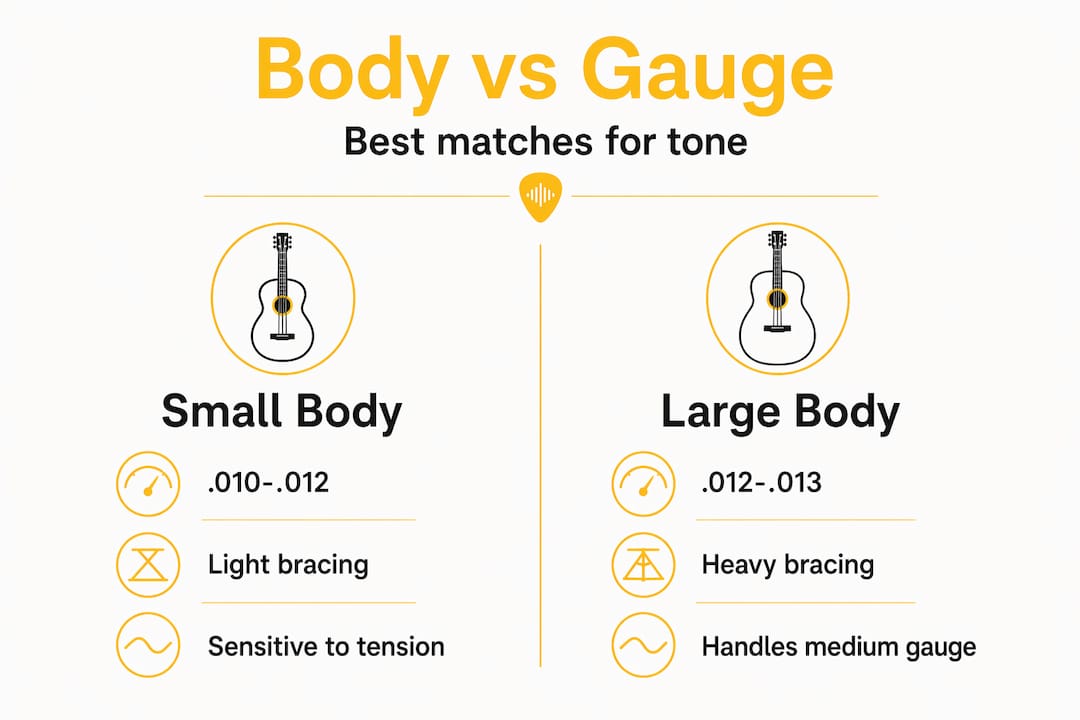
| Guitar body type | Recommended gauge | Notes |
|---|---|---|
| Parlour / travel | Extra light (.010) to light (.012) | Light bracing; heavy strings risk structural stress |
| Concert / 000 | Light (.012) to custom light (.011) | Moderate bracing; medium strings used with caution |
| Orchestra Model (OM) | Light (.012) to medium (.013) | Versatile body; suits fingerstyle and strumming |
| Dreadnought | Light (.012) to medium (.013) | Heavy bracing; thrives with medium strings |
| Jumbo | Medium (.013) or heavier | Built for maximum projection and volume |
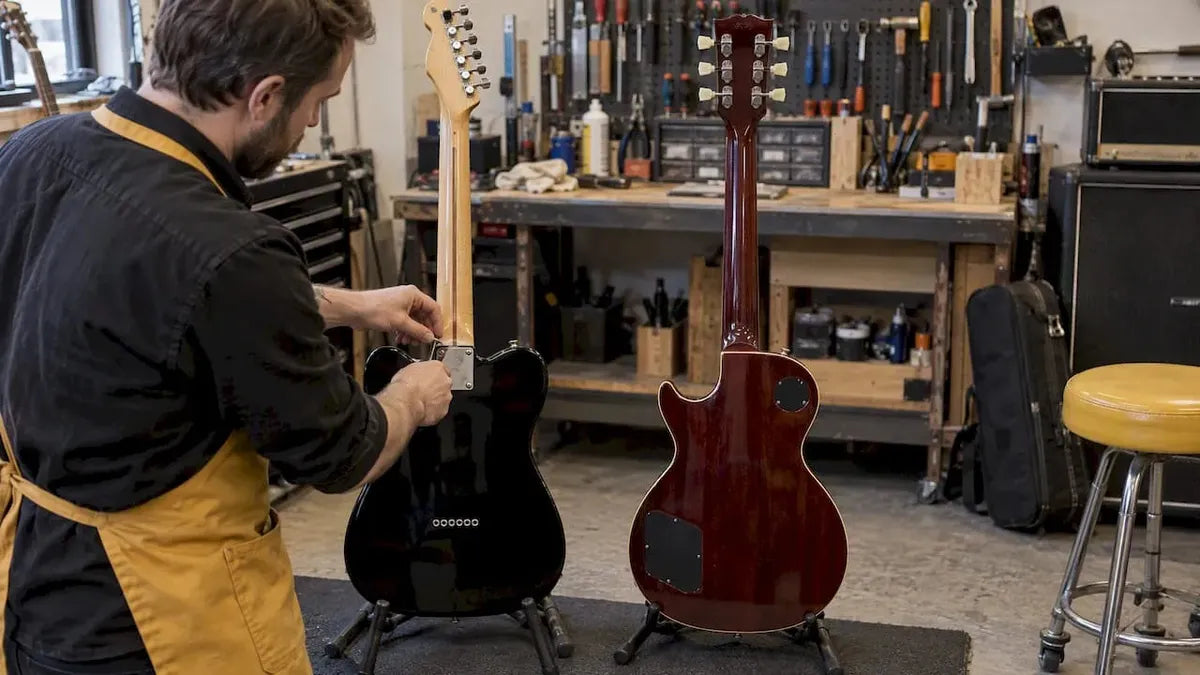
Setup is the other critical variable here. Significant gauge changes require professional guitar setup including truss rod adjustment to maintain proper action and intonation. When you go up in gauge, the increased tension pulls the neck forward; when you go down, the neck may straighten excessively or even back-bow. Neither state is ideal for playability or intonation accuracy.
Professional setup work after a significant gauge change is not optional. It is how you protect your instrument and unlock the full potential of your new strings. The team at Musicstreet offers expert guitar setup and maintenance to help players make these transitions safely, whether you are moving up from lights to mediums or dropping down to extra lights for the first time.
Pro Tip: If you change from light (.012) to medium (.013) strings and your guitar starts buzzing or the action suddenly feels very high, do not keep playing and hope it settles. Take it for a setup straight away. Those symptoms indicate the truss rod needs adjustment.
Practical steps for finding your ideal gauge
The process of finding the right acoustic guitar string thickness does not need to be complicated, but it does benefit from a structured approach rather than random experimentation.
- Start lighter than you think you need. Beginners are well advised to start on lighter gauges like .010–.047 or .011–.052 sets to reduce finger fatigue and ease the learning process. Even experienced players returning after a break benefit from this approach.
- Play the new strings for at least two weeks. Your fingers adapt, your technique adjusts, and your ears calibrate. Give yourself enough time to genuinely assess whether a gauge is working before declaring it wrong.
- Watch for warning signs after a gauge change. Fret buzz that was not there before, unusually high or low action, tuning instability, or a neck that feels visibly different when you sight down it are all signs that a setup adjustment is needed.
- Move up incrementally. Rather than jumping from .010s to .013s in one change, move one gauge size at a time. This protects your guitar and gives you accurate feedback about how tone and feel are changing.
- Consider your tuning. If you play in open or drop tunings regularly, factor that into your gauge choice. Dropping to open D reduces string tension significantly, which makes heavier strings more appropriate as a starting point to maintain feel and tone at lower pitches.
The balance between tone and comfort is genuinely personal. Some players will happily accept finger fatigue in exchange for the richer tone of medium strings. Others prioritise hours of comfortable playing above all else. Neither preference is wrong.
Common myths about string gauge
A few persistent misconceptions keep cropping up in guitar communities, and they are worth addressing directly because acting on them can lead to frustration or worse.
- “Heavier strings always sound better.” Tone is a system, not just a string property. Heavier strings on a guitar not set up for them, or played with a technique that does not suit them, will not sound better. They may actually sound worse.
- “My favourite guitarist uses .013s, so I should too.” Professional players spend considerable time with luthiers optimising their guitars for specific gauges. Copying a gauge without copying the full setup context gives you half the picture.
- “If it fits, it’s fine.” Strings will physically fit on virtually any guitar. That says nothing about whether the tension is appropriate for the bracing and construction. The ideal gauge depends on instrument design and player goals to avoid frustration or instrument damage.
- “String changes don’t need a setup.” Changing strings impacts the guitar as a system. Setup adjustments are often overlooked by players focused only on string preference, but they are frequently necessary after gauge changes.
“There is no universally best gauge. The right choice must account for the guitar’s design, the player’s technique, and their long-term playing goals.”
Ignoring hand size and physical strength is also a common error. A player with smaller hands or less grip strength will not benefit from struggling through medium strings. The discomfort actively hinders technique development and can contribute to repetitive strain issues over time.
My take on the gauge question
I have seen players buy expensive guitars and then immediately string them with whatever gauge they found in a drawer, which is a bit like fitting premium tyres to a car and then never checking the tyre pressure. The gauge choice is part of the instrument’s overall voice, and it deserves the same attention as the guitar itself.
What I have noticed over many years of working with guitarists of all levels is that most players under-string rather than over-string when left to their own devices. They default to lighter gauges because they are easier to play, but they never quite love the tone they are getting. The sweet spot for most acoustic players sits at custom light or light gauges, particularly on well-made dreadnoughts and OM-sized guitars. That range gives you enough tension and mass for a satisfying acoustic sound without the fatigue of mediums.
The setup conversation is the one I find myself having most often. Players will swap gauges several times trying to chase a tone, never realising that without a corresponding setup adjustment, they are comparing apples with broken apples. The strings are doing their job. The guitar is compensating poorly. A proper setup after each significant gauge change resets the system and gives you an honest read on what those strings actually sound like on your specific instrument.
My genuine advice: treat gauge selection as an ongoing refinement rather than a one-time decision. Start with lights, play them properly set up, and decide from there whether you want more warmth, volume, or ease of playing. The answer will be yours alone.
— Musicstreet
Find your perfect strings at Musicstreet
Whether you are making your first gauge change or refining a setup you have been chasing for years, having the right strings in hand is where it starts. At Musicstreet, we stock acoustic guitar strings across the full gauge spectrum, from extra lights suited to fingerstyle players and smaller-bodied guitars through to medium sets that bring dreadnoughts and jumbos to life.

Our team understands that selecting the best acoustic guitar string gauge is rarely straightforward, which is why we pair our product range with expert guidance. You can also read our detailed breakdown of why string gauge matters to go deeper on setup implications and tone choices. Browse the full range at Musicstreet and find strings matched to the way you play.
FAQ
What is the most commonly recommended gauge for acoustic guitar?
Light gauge strings (.012–.054) are the most widely recommended starting point for acoustic guitarists, as they balance playability and tone across most body sizes and playing styles.
Are lighter strings better for beginners?
Yes. Lighter gauges reduce finger fatigue and make fretting easier, which helps beginners build technique without unnecessary strain. Sets in the .010–.047 or .011–.052 range are ideal.
Do I need a setup when I change string gauge?
If you change by more than one gauge size, a professional setup is strongly advised. Truss rod adjustment is typically needed to correct neck relief and maintain proper action and intonation after a significant gauge change.
What string gauge is best for fingerstyle playing?
Custom light (.011–.052) or light (.012–.054) gauges are generally best for fingerstyle, offering the articulation and ease of fretting that intricate picking patterns require without sacrificing too much tonal body.
Can heavy strings damage my acoustic guitar?
On small-bodied guitars with lighter bracing, heavy strings can cause structural problems including bridge lifting and neck bowing over time. Always check your guitar’s specifications or consult a luthier before moving up to medium or heavy gauge strings.






Share:
Acoustic guitars that play like electric
Different types of guitar strings: a complete guide