


Choosing a comfortable guitar neck often comes down to more than just its shape or finish. For many British players, especially those just starting or moving beyond the basics, understanding guitar nut width makes all the difference in playability and ease. The nut’s width, usually ranging from 41mm to 52mm depending on guitar type (classical, acoustic, or electric), directly affects finger spacing and how your hand interacts with every chord. This introduction helps demystify nut width, highlights common misunderstandings, and points you toward a better, more enjoyable fit.
Table of Contents
- Defining Guitar Nut Width And Common Misconceptions
- Standard Nut Width Variations Across Guitar Types
- How Nut Width Affects Fretting Hand Comfort
- Choosing Optimal Nut Width For Different Players
- Mistakes To Avoid When Selecting Nut Width
Key Takeaways
| Point | Details |
|---|---|
| Nut Width Significance | Nut width directly influences string spacing and hand comfort, impacting overall playability. Wider nuts suit fingerstyle playing, while narrower nuts facilitate speed and technique. |
| Testing Before Purchase | Always try different nut widths in person to determine what feels comfortable for your hand size and playing style. Specifications alone cannot account for individual preferences. |
| Common Misconceptions | Many players confuse nut width with neck thickness; they are distinct measurements affecting different aspects of playability. Additionally, nut width varies significantly across guitar types. |
| Long-Term Considerations | Selecting the right nut width should consider future hand growth and evolving playing techniques to ensure continued comfort and ease of play. |
Defining guitar nut width and common misconceptions
The nut sits at the headstock end of your fretboard, acting as the first string guide. It’s a small but crucial component that directly shapes how comfortable your guitar feels when playing.
Guitar nut width refers to the measurement of the nut’s width at the top edge of the fretboard near the headstock. This measurement determines string spacing, hand positioning, and overall neck feel. Most guitars fall between 41mm and 52mm, depending on the guitar type and design.
Why does this matter? Wider nuts space strings further apart, whilst narrower nuts bring them closer together. This directly affects how your fingers interact with the strings and how comfortably you can fret notes.
What nut width actually controls
Nut width influences several key playability factors:
- String spacing – the distance between individual strings
- Hand comfort – how naturally your fingers land on the strings
- Fingerstyle ease – spacing affects picking accuracy, particularly for fingerstyle players
- Barre chord difficulty – wider nuts require more finger stretch
- Overall grip feel – contributes to how the neck feels in your hand
Common misconceptions debunked
Many players confuse nut width with neck thickness, but they’re completely different measurements. Neck thickness runs front-to-back, whilst nut width runs side-to-side. You can have a thick neck with a narrow nut, or a thin neck with a wide nut.
Another myth: nut width doesn’t matter much. Wrong. It significantly impacts comfort, particularly for players with smaller or larger hands. Guitar neck shapes interact with nut width to create your overall playing experience.
Some assume all guitars within a category have identical nut widths. Classical guitars typically range 48mm to 52mm, whilst electrics vary from 41mm to 48mm. Acoustic guitars sit somewhere between, often around 44mm to 47mm.
Nut width directly affects string spacing and hand comfort—it’s not merely aesthetic. The right width for your hands transforms playability.
Many beginners underestimate how much nut width impacts their learning experience. Starting on a guitar with the wrong nut width for your hand size creates unnecessary frustration and slows progress.
Pro tip: Visit a music shop where you can hold different guitars with varying nut widths. Spend five minutes with each, playing simple chords and scales. Your hands will tell you what feels right—trust that feedback more than specifications on paper.
Standard nut width variations across guitar types
Nut width varies considerably depending on the guitar type you choose. This isn’t random—each design reflects how the instrument is typically played and what string spacing works best for that playing style.
Classical guitars: wider for fingerstyle
Classical guitars feature the widest nuts of all guitar types. Standard nut widths for classical guitars typically range from 48mm to 52mm, sometimes even reaching 52mm on premium instruments.
Why so wide? Classical players use fingerstyle exclusively, plucking individual strings with their fingers rather than picks. Wider spacing prevents accidental string contact and allows for precise finger placement on each string. The classical repertoire demands this accuracy.
Thicker nylon strings also require more physical space between them. This generous spacing accommodates the larger diameter of classical strings whilst maintaining playability.
Acoustic guitars: the middle ground
Acoustic guitars strike a balance between fingerstyle and strumming. Nut widths typically fall between 42.9mm and 44.5mm, giving players reasonable comfort for both playing styles.
This moderate width works well because acoustic players switch between techniques. You might fingerpick a verse, then strum the chorus on the same song. The compromise width supports both approaches without excelling at either one exclusively.
Electric guitars: narrower for speed
Electric guitars feature the narrowest nut widths, generally ranging from 41mm to 44.5mm. Many modern electrics sit closer to 41mm to 43mm.
Why tighter spacing? Electric players favour speed and quick fretboard movement. Narrower string spacing means less finger travel between strings. This suits lead playing, rapid position changes, and modern playing techniques like tapping and shredding.
Electric strings are thinner than acoustic or classical strings, so they don’t require as much physical separation to avoid unwanted contact.
Comparison at a glance
| Guitar Type | Typical Nut Width | Best For |
|---|---|---|
| Classical | 48mm–52mm | Fingerstyle precision |
| Acoustic | 42.9mm–44.5mm | Fingerstyle and strumming |
| Electric | 41mm–44.5mm | Speed and lead playing |
Wider nuts suit fingerstyle accuracy; narrower nuts enable faster playing. Your intended style should guide your nut width choice.
Specialised guitars may differ
Some guitars break these conventions. Vintage electric models sometimes have wider nuts. Certain acoustic designs cater to fingerstyle players with slightly wider spacing. Travel guitars and short-scale instruments may have different proportions entirely.
Pro tip: When trying guitars, compare at least one from each category. Play the same simple progression on a classical, acoustic, and electric. You’ll feel the spacing differences immediately and understand which width suits your fingers and playing style best.
How nut width affects fretting hand comfort
Your fretting hand spends hours gripping the neck and pressing strings. Nut width directly shapes how comfortable that experience feels. The wrong width can lead to finger fatigue, cramping, and frustration during practice sessions.
String spacing and finger placement
String spacing created by nut width influences both comfort and precision for your fretting hand. Wider nuts position strings further apart, giving your fingers more room to land accurately without accidentally touching adjacent strings.
Narrower nuts bring strings closer together. This feels cramped for some players, particularly those with larger hands. Fingers can struggle to find space between strings without muting the ones you’re trying to avoid.
Hand size matters more than you think
Players with larger hands typically prefer wider nuts to reduce finger fatigue. A 52mm classical guitar nut feels spacious and comfortable for someone with big hands. That same width might feel excessive for a smaller player.

Conversely, someone with smaller hands might prefer the tighter spacing of a 41mm electric guitar nut. The closer strings require less finger stretch and less overall hand movement.
How nut width affects common playing tasks
Different playing techniques feel different depending on nut width:
- Barre chords – wider nuts require more finger stretch across strings
- Fingerstyle playing – wider spacing prevents accidental muting of adjacent strings
- Rapid chord changes – narrower nuts enable faster transitions between positions
- Single-note lines – narrow nuts reduce lateral finger movement between strings
- Sustained comfort – proper width prevents cramping during long practice sessions
The fatigue factor
When nut width doesn’t match your hand, you compensate with tension. Your forearm works harder. Your fingers grip tighter to control strings that feel either too spread or too bunched. This creates fatigue that builds throughout your practice session.
Over time, playing with the wrong nut width can contribute to repetitive strain issues. Your hands tell you when something’s not right—listen to them.
The right nut width reduces hand fatigue and improves control. Comfort translates directly into more consistent practice and faster progress.
Finding your ideal width
There’s no universal “best” width. Your ideal nut width depends on your hand size, finger length, and playing style. A beginner with small hands might struggle on a 50mm classical guitar but thrive on a 44mm acoustic.
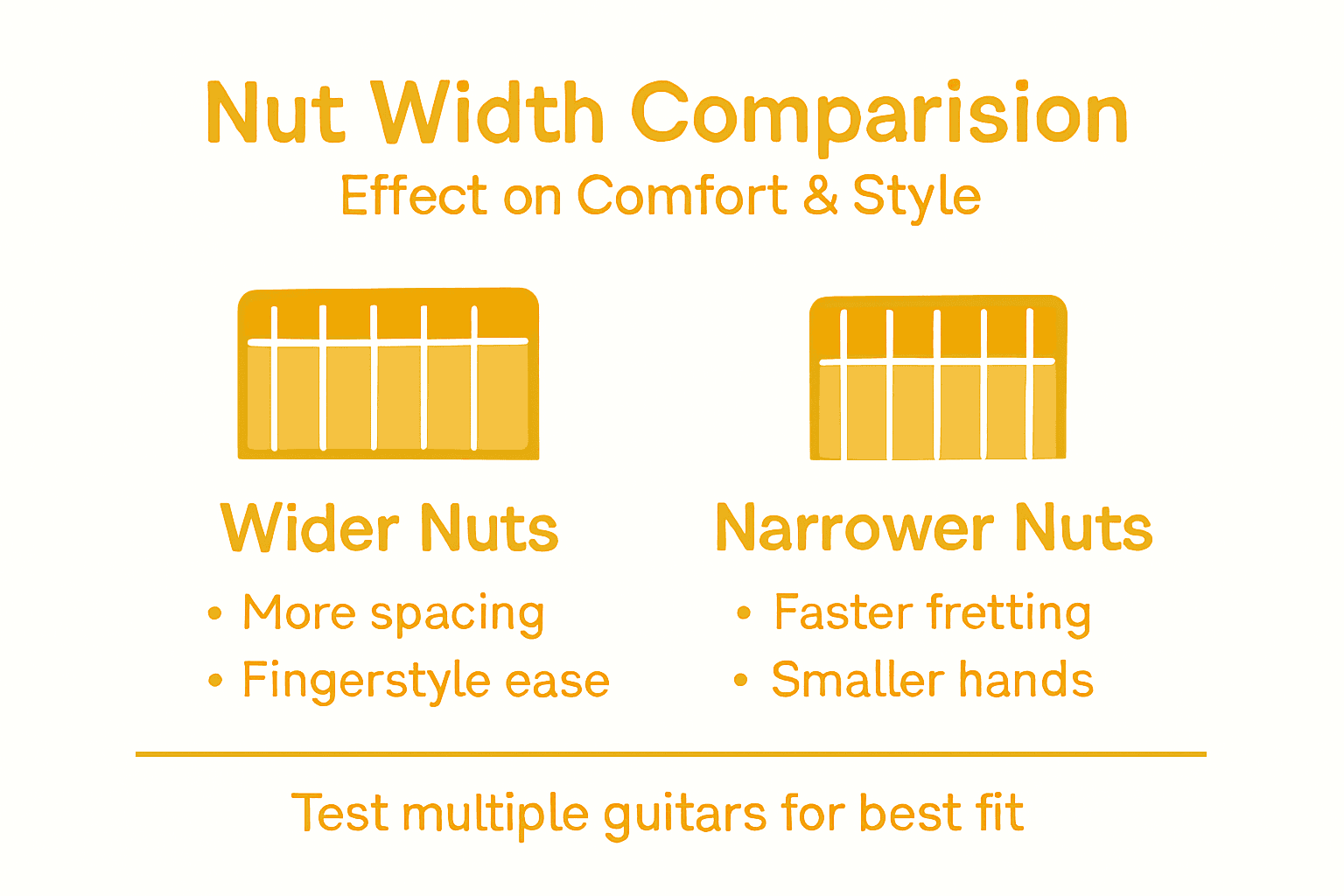
Pro tip: Hold guitars with different nut widths and play the same chord progression on each. If your fingers feel cramped or you’re muting adjacent strings unintentionally, the nut is likely too narrow. If you’re stretching excessively or tiring quickly, it’s probably too wide. Your comfort zone becomes obvious within minutes.
Choosing optimal nut width for different players
Selecting the right nut width isn’t about finding an industry standard that works for everyone. It’s about matching the instrument to your specific hands, playing style, and musical goals. The perfect width for one player might feel awkward for another.
Small-handed players and younger guitarists
If you have smaller hands or are learning as a young player, narrower nuts feel more manageable. A 41mm to 43mm width reduces the stretch required between strings and across the fretboard.
Smaller spacing also speeds up chord transitions. Your fingers travel less distance laterally, making position changes feel quicker and less exhausting. This builds confidence during the learning phase.
Players emphasising speed and technique
Musicians focused on lead playing, shredding, or fast-paced styles benefit from optimal nut width for speed-focused playing. Narrower nuts around 41mm to 43mm enable rapid fretboard movement and closer string spacing.
This matters when you’re playing single-note lines, tapping, or switching positions frequently. Less lateral movement means faster, more accurate playing without excessive hand fatigue.
Large-handed players and fingerstyle musicians
If you have larger hands or favour fingerstyle playing, wider nuts ranging from 46mm to 52mm provide essential fingeroom. Wider spacing prevents accidental string muting and allows cleaner note articulation.
This is particularly important for classical and fingerstyle acoustic players who need precision with individual strings. Wider spacing lets your fingers move independently without touching adjacent strings unintentionally.
Matching nut width to your playing style
Consider what you actually play most:
- Lead and fast playing – choose narrower (41mm–43mm)
- Fingerstyle and classical – choose wider (48mm–52mm)
- Mixed styles and strumming – choose moderate (44mm–46mm)
- Chording focus – choose narrower for faster transitions
- Clean articulation priority – choose wider for finger spacing
The test before you buy rule
Never purchase a guitar without trying different nut widths first. What feels right on paper might feel wrong in your hands. Spend time with guitars featuring 41mm, 44mm, 48mm, and 52mm nuts.
Play chord changes, single-note passages, and fingerstyle patterns on each. Notice where your fingers feel comfortable and where they strain. Your hands provide honest feedback that specifications cannot.
Here’s how hand size, playing style, and nut width preference relate for guitarists:
| Player Attribute | Preferred Nut Width | Reason |
|---|---|---|
| Small hands | 41mm–43mm | Less finger stretch required |
| Large hands | 46mm–52mm | More space, increased comfort |
| Speed-focused | 41mm–43mm | Faster position changes |
| Fingerstyle | 48mm–52mm | Accurate string separation |
| Mixed styles | 44mm–46mm | Balanced for technique versatility |
Test guitars with different nut widths before buying. Your hands know the right width better than any chart or recommendation ever could.
Account for your long-term goals
Are you learning rock and blues? Narrower might suit you. Transitioning toward classical? Consider wider. Your nut width choice should support where you’re heading, not just where you are now.
Pro tip: Visit a music shop with several guitars in stock and ask to play instruments with nut widths differing by 3mm to 4mm. Play the same piece on each—something you know well. The right width becomes obvious within minutes because your fingers feel relaxed rather than stretched or cramped.
Mistakes to avoid when selecting nut width
Choosing a guitar nut width involves real decisions that affect your playing experience for years. Common mistakes cost players money, frustration, and sometimes abandoned guitars gathering dust in the corner. Learn what to avoid before making your purchase.
Mistake 1: Buying based on specs alone
Never select a guitar purely by reading the nut width specification online. A 44mm nut might feel perfect to one person and cramped to another. Numbers don’t account for your individual hand shape, finger length, or muscle memory.
The only way to know if a width works is to hold the guitar and play it. Spend real time with it, not just a quick five-minute trial. Play passages you actually perform regularly.
Mistake 2: Assuming all guitars in a category match
You might think all electric guitars have similar nut widths. They don’t. Vintage Fender electrics often feature wider nuts than modern shredder-focused designs. Acoustic guitars vary too—some builders prioritise fingerstyle, others favour strumming comfort.
Always verify the exact measurement before buying. Don’t assume category means consistency.
Mistake 3: Ignoring long-term playing comfort
You might fall in love with a guitar’s appearance, sound, or price and overlook nut width issues. “I’ll get used to it,” you tell yourself. You probably won’t. Playing the wrong width creates constant micro-adjustments and tension in your hands.
Over months of practice, this discomfort compounds. What felt “manageable” becomes frustrating and limiting.
Common mistakes to watch for
Avoid these pitfalls:
- Choosing based on brand reputation alone – even excellent builders use varying widths
- Assuming your first guitar’s width is ideal – you might outgrow it as your hands develop
- Ignoring finger fatigue during trials – play for at least 15 minutes, not 2 minutes
- Buying online without trying first – return policies exist for a reason; use them
- Following someone else’s recommendation blindly – their hands aren’t your hands
- Prioritising price over comfort – a cheaper guitar with the wrong nut width costs more in wasted time
Mistake 4: Not considering your growth trajectory
Young players’ hands grow. A 41mm nut might feel spacious at age 12 but cramped at 16. Consider where your hands will be, not just where they are now.
Similarly, as your technique improves, your preference might shift. What felt perfect for basic chords might feel limiting for complex fingerstyle patterns.
The right nut width feels invisible—you focus on playing, not on finger positioning. If you’re constantly thinking about string spacing, it’s wrong.
Mistake 5: Settling without proper comparison
You find a guitar you like and don’t bother trying alternatives. This is how players end up with instruments that don’t quite fit. Spend time comparing at least three different nut widths side by side.
The contrast makes your preference obvious. You’ll notice comfort differences you’d miss trying guitars days apart.
Pro tip: Ask the staff at a music shop to bring out guitars with 41mm, 44mm, and 48mm nuts on the same day. Play the exact same song on each one without stopping to discuss or overthink. Your fingers will tell you which width feels most natural and which causes compensatory tension.
The following table summarises common errors when choosing nut width and their impact:
| Mistake | Consequence | Best Practice |
|---|---|---|
| Buying online without testing | Greater risk of discomfort | Test in person or use returns |
| Ignoring hand growth | Instrument becomes cramped | Anticipate future needs |
| Relying on specs alone | Poor individual fit | Trust physical feel |
| Not comparing widths | Unnoticed tension | Try multiple guitars side-by-side |
| Following others blindly | Unsuitable playability | Match to your own hands |
Find Your Perfect Guitar Nut Width for Ultimate Comfort and Playability
Choosing the right guitar nut width is a crucial step to ensure your playing experience is comfortable and frustration-free. Whether you have small hands seeking narrower string spacing or prefer wider nuts for fingerstyle precision, understanding your needs will transform your guitar journey. The article clearly highlights how nut width affects string spacing, hand comfort, and performance, making it essential to try instruments with varied widths before making a decision.

At MusicStreet, we specialise in offering a wide selection of electric, acoustic, and bass guitars tailored to your hand size and playing style. With expert setup and personalised advice available both online and in our Huntingdon store, you can explore guitars with different nut widths and find the best fit for your unique preferences. Start your search today by visiting MusicStreet and discover detailed listings and helpful buying guides that will support your choice. Don’t let the wrong nut width hold back your progress – act now to play with confidence and comfort.
Frequently Asked Questions
What is guitar nut width and why is it important?
Guitar nut width is the measurement of the nut’s width at the top edge of the fretboard near the headstock. It is crucial because it directly influences string spacing, hand comfort, and overall playability.
How does nut width affect my playing style?
Nut width affects string spacing and finger placement, which can influence techniques such as fingerstyle playing, barre chords, and rapid chord changes. Wider nuts may benefit fingerstyle players, while narrower nuts support quicker playing styles.
What nut width is best for beginners?
Beginners often find narrower nut widths (41mm–43mm) more manageable as they require less finger stretch, making transitions between chords easier and helping to build confidence while learning.
Can nut width lead to playing-related discomfort?
Yes, using a guitar with an unsuitable nut width can lead to finger fatigue, cramping, and frustration. The right nut width for your hand size enhances comfort, control, and overall practice experience.
Recommended
- 7 Best Guitar Strap Options for Comfortable Playing – MusicStreet
- How to Select Guitar Straps for Ultimate Comfort and Fit – MusicStreet
- What Is Guitar Scale Length? Complete Breakdown | MusicStreet
- Guitar Neck Shapes Explained: Playability Matters – MusicStreet
- Cricket Bat Handle Types: Impact on Grip and Play – Cricket Bats Com








Share:
What Is Guitar Binding and Its Impact
How to Pick Luxury Guitar Accessories for the Perfect Sound