

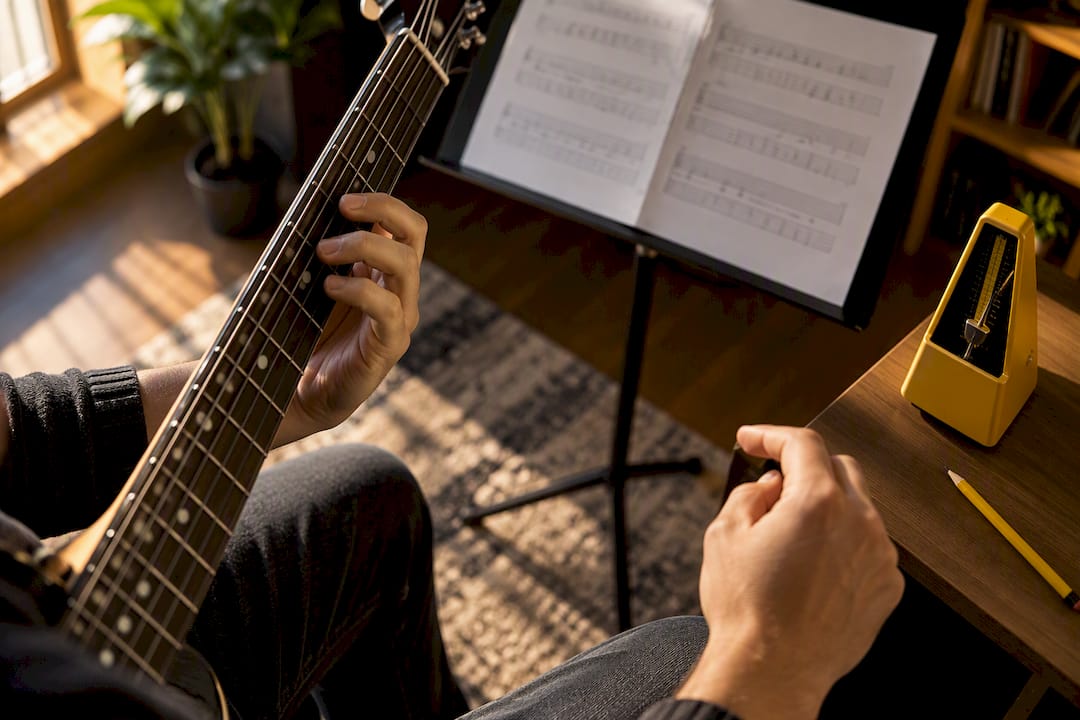
Guitar tablature shows which string and fret to play. Learn the six lines, work out what the fret numbers mean, and then listen to the recording to place the rhythm. Start by identifying which line matches which string, play the numbered frets slowly, and let your ears fill in the timing gaps that the page leaves out.
Table of Contents
- Tab basics: how the six lines, fret numbers and stacked chords work
- Common symbols and how to play them: slides, hammer-ons, pull-offs, bends and muted notes
- Rhythm and timing: why TAB often omits duration and how to learn the timing
- Reading chord and fretboard diagrams alongside TAB
- A simple practice plan: step-by-step to get fluent reading TAB
- Why MusicStreet recommends this approach and where to find beginner resources
- Using TAB for rhythm indication with software or combined notation
- How to interpret repeat signs, codas, and other structural markers in TAB
- A short first-person perspective on TAB as a learning tool
- Optional next steps: useful MusicStreet products and services
- Sources
- FAQ
Tab basics: how the six lines, fret numbers and stacked chords work
A standard guitar tab uses six horizontal lines, one for each string. The top line represents the high E string and the bottom line represents the thick, low E string, an orientation confirmed by Berklee Online’s guide to guitar notation. Most tabs assume standard tuning unless a note at the top tells you otherwise, so always check the header before you start playing.
Numbers written on the lines tell you which fret to press. A single number sitting on one line means one note on one string, while several numbers stacked vertically mean you strike those strings together as a chord. A “0” always means an open string, played with no finger pressing any fret.
A few points make the system click:
- Single notes: one number on one line, read left to right in the order you play them.
- Chords: numbers stacked directly above each other, played at the same time.
- Open strings: marked “0”, meaning no fret is pressed.
- Tuning notes: alternate tunings or a capo position are usually written above the first bar, not buried in the tab itself.
Picture a simple riff written as single numbers moving across the low strings, one at a time. Compare that with an open chord shape, where you might see several numbers lined up in a single column, some of them zeros. Once you can tell those two patterns apart at a glance, you have the mechanical core of tab reading sorted.
Common symbols and how to play them: slides, hammer-ons, pull-offs, bends and muted notes
Beyond plain numbers, tab uses a short set of letters and marks to show technique. These conventions are not universally standardised, and research on tablature formats notes that symbols and textual instructions vary between transcribers.
The most common markings you will meet are:
- h: hammer-on, played by tapping a higher fret without picking again.
- p: pull-off, played by releasing a fretted finger to sound a lower note.
- / or ****: a slide up or down between two frets.
- b: a bend, pushing the string to raise its pitch.
- r: a release, letting a bend return to its original pitch.
- x: a muted or dead note, usually a percussive scratch rather than a clear pitch.
- PM: palm muting, damping the strings lightly with your picking hand.
- ~: vibrato, a slight wavering of pitch after the note sounds.
Stacked symbols can look confusing at first. A slide inside a chord line, for example, might show one number sliding into position while the others stay fixed, meaning only that one string moves. Because notation habits differ from one tab to another, an unfamiliar mark is worth checking against a trusted method book or the original recording before you commit it to muscle memory.
Pro Tip: When a symbol looks unfamiliar, listen to a short section of the recording on repeat. Your ear will usually confirm what the page is trying to show.
Rhythm and timing: why TAB often omits duration and how to learn the timing
Tab is built to show fingering, not timing. Standard notation carries that job instead, using note shapes such as semibreves, minims, crotchets and quavers to fix exact durations, a distinction explained in BBC Bitesize’s rhythm guides. Exam guidance from Pearson Edexcel’s teaching materials makes the same point directly: basic tab often leaves rhythm out entirely, so learners are advised to combine it with staff notation or a recording.
Some transcribers add rhythm marks above the tab stave, using stems or note symbols borrowed from standard notation, but this is not guaranteed on every sheet you find. Tuplets and dotted values, when they do appear, are usually written as small numbers or dots layered over the fret numbers rather than built into the tab itself.
Basic tablature typically omits precise rhythmic notation, according to Pearson Edexcel’s guidance for GCSE music, which is why pairing it with listening habits matters so much.
Practical fixes that work well:
- Slow the recording down using playback software so you can hear each note separately.
- Practise with a metronome to build a steady internal pulse before adding speed.
- Find a version with standard notation when the song matters enough to get exactly right.
Reading chord and fretboard diagrams alongside TAB
Chord diagrams work differently from linear tab, and Berklee Online describes them as a separate, static format. Vertical lines represent the six strings, horizontal lines represent frets, and dots show where your fingers land. An “O” above a string means play it open, while an “X” means mute or skip that string entirely.
These grids are useful for learning finger numbers, working out barre shapes, and planning smooth transitions between chords, since you can see the whole shape at once rather than piecing it together note by note.
- Vertical lines: the six strings, usually with low E on the left.
- Dots: finger positions, sometimes numbered to show which finger to use.
- O and X: open string and muted string respectively.
When the same note is available in more than one place on the neck, the choice comes down to comfort and tone. Guidance from the London College of Music’s rock guitar handbook notes that open strings often suit beginners for ease of play, while higher fretted positions give more sustain and tonal control as skills develop.
A simple practice plan: step-by-step to get fluent reading TAB
Fluency comes from steady repetition, not from reading theory alone. A workable order looks like this:
- Start with single-note riffs so you get used to matching numbers to strings without the added complexity of chords.
- Move to open chords, checking each stacked number against a chord diagram until the shape feels familiar.
- Add technique symbols one at a time, slides first, then hammer-ons and pull-offs.
- Slow the recording down and loop short sections until timing feels natural rather than guessed.
- Practise with a metronome, isolating and repeating any bar that keeps tripping you up.
- Bring in a lead sheet or standard notation where one is available, so rhythm stops being a guessing game.
- Get a teacher or a setup check if your hands are fighting the guitar rather than the music, since poor action or intonation can undo good practice.
Why MusicStreet recommends this approach and where to find beginner resources
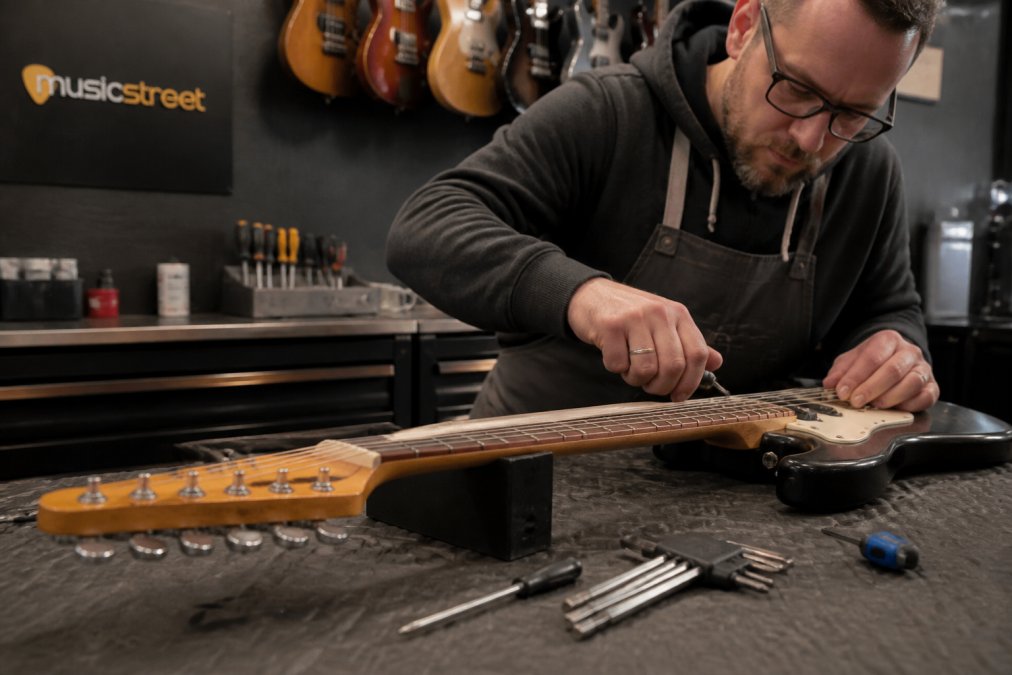
We see plenty of beginners get stuck less on reading tab and more on fighting an instrument that is not set up properly. Every guitar available gets a proper inspection and setup, and there is an option to get hands-on help for technique checks in person.
For theory alongside tab, the Vaieology music theory book for guitar players is a solid companion, and the CruzTools Groovetech guitar player tech kit covers basic maintenance so your instrument stays playable between lessons. Bass players starting out might look at something like the Aria TAB Classic as an example of the kind of instrument that suits early practice.

Using TAB for rhythm indication with software or combined notation
Because plain tab rarely fixes duration, many players turn to software that overlays rhythm onto the fret numbers. Notation programs can display a tab stave and a standard notation stave together, so the fret numbers sit below note stems and beams that show exact timing. This combined view lets you read fingering from the tab line while checking rhythm against the notation above it, rather than guessing from feel alone.

Some tools also let you slow playback without changing pitch, loop a single bar, or highlight the beat as it passes, which is useful when a rhythm figure is too fast to catch by ear at full speed. Guidance in the Pearson Edexcel GCSE music specification treats a tab lacking rhythm as an incomplete score for exam purposes, and expects staff notation or a lead sheet to fill the gap.
If you cannot find a combined score, a workaround is to write in rhythm by hand: mark a slash or a note value above tricky bars once you have worked out the timing by ear. It is not elegant, but it turns a one-off listening session into something you can return to later without relearning the timing from scratch. Over time, many players find they need this crutch less often, since repeated exposure to common rhythmic patterns, such as a steady eighth-note strum or a syncopated riff, builds a kind of internal library you can draw on when a new tab gives you no rhythm information at all.
How to interpret repeat signs, codas, and other structural markers in TAB
Tab sheets borrow several structural markers from standard notation to avoid rewriting the same bars over and over. A repeat sign, usually two dots before a double bar line, tells you to go back to the matching opening repeat sign, or to the start of the piece if none is marked, and play that section again.
Codas and first or second endings show up too, usually as small labelled boxes or bracketed numbers above the stave. A “1.” bracket marks a bar you play only the first time through a repeat, while a “2.” bracket replaces it on the repeat itself. A coda marking, often a small circle with a cross through it, tells you to jump ahead to a matching coda section, usually near the end of the piece, skipping whatever lies between.
These markers matter because skipping them changes the song’s structure entirely, turning a verse-chorus-verse arrangement into something that no longer matches the recording. When a tab looks unusually short for a song you know well, check for repeat signs or a coda jump before assuming the transcription is incomplete. Method books and teaching resources, such as those referenced in the TES beginner guitar method, often introduce these markers gradually alongside basic chord charts, which is a sensible order to learn them in.
A short first-person perspective on TAB as a learning tool
Tab is a shortcut, not a shortcut around listening. It gets you playing real songs fast, which keeps beginners motivated, but it will not teach your ear to hear rhythm or your eye to read standard notation. Use it to learn quickly, pair it with listening and simple rhythm exercises, and set small weekly goals rather than trying to absorb every symbol at once.
— Music
Optional next steps: useful MusicStreet products and services

Reading tab is only half the job. If your guitar fights you every time you try a slide or a bend, no amount of practice will feel rewarding, and that is where a proper setup makes a real difference to how quickly you improve.
- Theory grounding: the Vaieology music theory book for guitar players explains the ideas behind the tab symbols you are learning.
- Basic maintenance: the CruzTools Groovetech guitar player tech kit keeps your instrument playable between visits to a technician.
- Better playability: our guitar setups, servicing and repairs sort out action, intonation and general feel so your practice time counts for something.
- Fresh strings: our in-store restring service is a quick way to reset a tired-sounding instrument before a practice session.
Browse the shop online or drop into our Huntingdon store to talk through what your guitar needs.
Sources
- Guitar notation basics | Berklee Online TakeNote
- Pearson Edexcel GCSE music teaching materials (tabs and notation guidance)
- From lutetab to frettab | Transforming Musicology (TM, Oxford)
- BBC Bitesize: Notation and rhythm (starter guides)
FAQ
What is the 3 fret rule on guitar?
The “3 fret rule” is not a formal notation term, so definitions vary between players. A common version refers to keeping your fretting hand within a three or four fret span for a given scale pattern, which reduces unnecessary hand movement while playing.
How do you know which tab to play on guitar?
Match each fret number to its line, remembering that the top line is the high E string and the bottom line is the low E string, as set out in Berklee Online’s notation guide. Play through slowly at first, checking each number against the recording until the fingering feels natural.
What is the forbidden chord on guitar?
There is no single, universally recognised “forbidden chord” in standard guitar teaching material, and the phrase is mostly folklore rather than an established musical term. It is best treated as informal guitar culture rather than a fact worth building technique around.
Is it easier to read tabs or chords?
Tab is generally easier for beginners because it shows exactly which string and fret to press, while chord diagrams require you to translate a shape into individual finger placements. Many learners use both together, reading chord diagrams for hand shapes and tab for the surrounding single-note lines, as suggested by teaching resources combining tab and chord charts.




Share:
Tune Your Guitar Fast, By Ear or Tuner, Starter Kit for UK Guitarists
Guitar Tuning: A Step-by-Step Guide for Beginners