

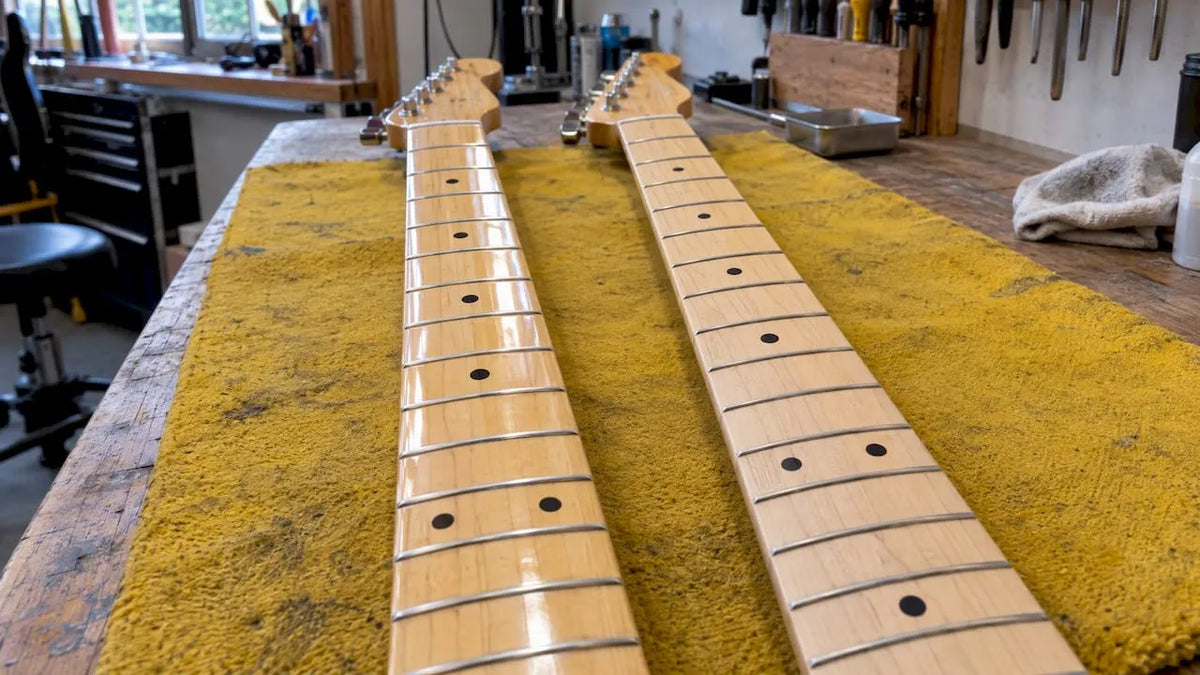
For sealed maple, wipe with a slightly damp microfibre cloth and a mild guitar cleaner, working along the grain. For unfinished or oil-finished maple, clean first with a manufacturer-approved product, then apply conditioning oil sparingly. Avoid household solvents, acidic lemon formulations on raw wood, and WD-40 in every case. Read on for the full step-by-step method for each finish type.
Table of Contents
- Finished vs unfinished maple: which one do you have and why it matters
- Tools and products that actually work for maple fretboards
- Step-by-step cleaning for finished (sealed) maple fretboards
- Step-by-step cleaning and conditioning for unfinished or oil-finished maple
- Removing stubborn grime and stains between frets: safe techniques
- Aftercare: maintenance schedule, expected time and low-cost supplies
- MusicStreet: what our technicians see and how we help
- Our take on caring for a maple neck properly
- Get the right fretboard care products or book a professional clean
- FAQ
- Sources
- Further reading and manufacturer guidance
Finished vs unfinished maple: which one do you have and why it matters
Most maple necks you will see on electric guitars carry a lacquer or polyurethane finish that seals the wood completely. This sealed surface feels smooth and slightly glassy under your fingers, and it resists moisture and dirt because the grain is sealed, not exposed. Trade guidance explains that finished maple generally only needs cleaning, never conditioning, because there is no open grain for oil to penetrate.
Unfinished or oil-finished maple is different. The surface feels slightly more porous, often shows a matte or satin look rather than a shine, and some manufacturers leave it raw or treat it with a light oil finish at the factory. Open-pore wood like this absorbs moisture, sweat and dirt more readily, which is why it occasionally benefits from sparing conditioning once clean.
A quick checklist helps you confirm which type you have:
- Run a fingertip along the wood: a glassy, sealed feel means finished maple, a slightly textured feel suggests unfinished or oil-finished.
- Check the manufacturer’s specification sheet or owner’s manual, since many brands state the fretboard finish explicitly.
- Look at the colour under strong light: sealed maple often shows a deeper gloss, unfinished maple looks paler and more matte.
Pro Tip: When in doubt, treat the board as sealed and clean only. You can always condition later once you have confirmed the finish, but you cannot easily undo oil applied to the wrong surface.
Tools and products that actually work for maple fretboards
A small, well-chosen kit covers nearly every maple fretboard job you will face at home. You need a soft microfibre cloth for general wiping, a second lint-free cotton cloth kept dry for buffing, a soft nylon brush for dust in the grain, cotton swabs for tight spots around frets, and a small bottle of mild guitar cleaner.
For finished maple, a standard guitar cleaner and microfibre cloth combination handles almost everything. For unfinished or oil-finished boards, you want a manufacturer-approved conditioner rather than a generic household oil, since raw maple absorbs substances readily and reacts badly to acidic formulations.
We stock three products that cover this exact distinction: the Re-Fret (maple fingerboard inc spray) & setup service for boards needing more than a home clean, Music Nomad Fretboard F One Oil for conditioning unfinished boards, and Jim Dunlop Fretboard 65 Ultimate Lemon Oil For Guitars as a lighter-touch option where the manufacturer confirms it is suitable.
Keep these off your fretboard entirely:
- Household solvents containing acids, bleach, or ammonia, which can strip finish or discolour wood.
- WD-40 and similar penetrating lubricants, which are not designed for wood and can leave residue in the grain.
- Abrasive pads or scouring pastes, which scratch both finished lacquer and raw wood fibres.
One widely cited piece of guidance: manufacturer advice recommends specific cleaners and conditioners for unfinished wood rather than generic household oils, precisely because open-pore maple reacts unpredictably to the wrong product. Patch test any new product on a small, hidden area first.
Step-by-step cleaning for finished (sealed) maple fretboards
Sealed maple is the easier of the two to clean safely, provided you work methodically and avoid oils altogether.
- Lay the guitar flat on a padded surface and cover the pickups and bridge with a cloth to protect them from drips.
- Loosen the strings slightly if you want easier access to the fret edges, though full removal is optional for a light clean.
- Brush away loose dust and debris with a soft nylon brush, working from the headstock towards the body.
- Dampen a microfibre cloth lightly with water or a small amount of mild guitar cleaner, never soaking it.
- Wipe along the grain in short strokes, re-folding the cloth as it picks up grime.
- Use a cotton swab dipped lightly in cleaner to reach the tight areas directly around each fret.
- Dry the board thoroughly with a clean, dry cloth before retuning or restringing.
- Apply a light polish only if the finish is specifically rated for it, buffing gently with a dry cloth.
- Bring the strings back to pitch and check that the action and intonation feel normal before you play.
Pro Tip: A barely damp cloth does more good than a wet one. Excess moisture can creep under fret edges even on sealed boards, so wring the cloth out until it feels almost dry.
If you restring after cleaning, it is worth confirming the guitar holds tune properly; our guide on tuning a guitar quickly and accurately covers that final check.
Step-by-step cleaning and conditioning for unfinished or oil-finished maple
Before you touch an oil or conditioner, confirm the board is genuinely unfinished or oil-finished using the checklist earlier in this guide. Treating a sealed board with oil can leave a sticky film that attracts more dirt than it removes.
- Remove the strings fully for better access to the entire board.
- Brush away loose dust with a soft nylon brush, paying attention to the area around each fret.
- Apply a small amount of a quick-evaporating cleaner designed for guitar fretboards to a cloth, then wipe along the grain to lift grime.
- Let the board dry completely before moving to conditioning.
- Apply a manufacturer-approved conditioner sparingly, roughly a drop or two per three or four frets.
- Spread the conditioner thinly with a clean cloth or your fingertip, covering the wood evenly.
- Leave it to sit for a few minutes, following the product’s recommended wait time.
- Wipe away all excess with a dry cloth, since any oil left sitting on the surface attracts dust.
- Restring and bring the guitar back to pitch once the board feels dry to the touch.
We carry Music Nomad Fretboard F One Oil and Jim Dunlop Fretboard 65 Ultimate Lemon Oil For Guitars for exactly this step, and both work well when used in small amounts rather than applied heavily.
Pro Tip: Less is always better with conditioner on maple. Over-oiling softens the wood over time and can leave a tacky surface that picks up more grime than it prevents.
Removing stubborn grime and stains between frets: safe techniques
Grime that has built up over months or years between frets needs a more targeted approach than a general wipe. Cotton swabs reach most tight areas, while a soft-bristled toothbrush loosens compacted dirt without scratching the wood. A plastic pick, never metal, helps lift stubborn deposits from fret edges without marking the finish.

For heavier grime, some players turn to quick-evaporating solvents such as naptha or lighter fluid in very small amounts. These lift grease effectively, but they carry real risk to lacquer and should only be used after a patch test on an inconspicuous area, applied sparingly with a cotton swab rather than poured onto a cloth.
Watch for these signs that call for professional attention rather than more home cleaning:
- Lacquer that looks lifted, bubbled or cloudy after any cleaning attempt.
- Deep green or black staining around the frets that does not shift with gentle cleaning.
- Frets that feel loose or move slightly when pressed.
When any of these appear, stop cleaning and book a professional inspection rather than continuing with stronger products at home.
Aftercare: maintenance schedule, expected time and low-cost supplies
A simple routine prevents most of the grime problems that need deeper intervention later. Wipe the strings and fretboard with a dry cloth after every session, since this single habit does more to prevent build-up than any occasional deep clean.
- A quick wipe after playing takes one to two minutes and removes most surface sweat and dust.
- A full clean with cleaner and cloth, done monthly or whenever the board feels grimy, takes roughly 15 to 30 minutes.
- Conditioning an unfinished board, done up to twice a year, adds another 10 to 15 minutes once the cleaning is finished.
A small bottle of fretboard cleaner or conditioner is a low-cost addition to any guitar care routine, and most home cleaning sessions need nothing more than what fits in a single small kit. For guitars that need deeper attention, such as heavy staining, finish damage or loose frets, booking our Re-Fret (maple fingerboard inc fretboard spray) & setup service covers work beyond what home cleaning can safely fix.
MusicStreet: what our technicians see and how we help
In our workshop, the most common issues we see on maple fretboards come from well-meaning but mismatched care: finish lifting where the wrong oil was applied to a sealed board, or dark grime packed between frets after months without a wipe-down. We take a conservative approach, favouring manufacturer-approved cleaners and sparing conditioning over aggressive solvents.
When a guitar needs more than a home clean can manage, our relevant services and products include:
- Music Nomad Fretboard F One Oil for conditioning unfinished maple between deeper services.
- Jim Dunlop Fretboard 65 Ultimate Lemon Oil For Guitars for lighter maintenance where appropriate for the finish.
Fretboard condition can be checked as part of setup, flagging early signs of dryness or grime before they become bigger problems.
Our take on caring for a maple neck properly
The advice that circulates most widely about maple fretboards treats “oil it regularly” as a universal rule, borrowed from rosewood and ebony care where conditioning genuinely matters. On sealed maple, that advice is simply wrong, and applying oil to a lacquered surface risks a sticky film rather than any benefit.
What gets underrated is the daily wipe-down. It costs nothing, takes a minute, and prevents most of the grime that eventually demands a deeper clean or a professional visit. Players chase the right cleaner or conditioner while skipping the one habit that actually keeps a board in good condition over years.
If you take one thing from this guide, confirm your finish type before you buy anything. A sealed maple board asks for a cloth and a mild cleaner, nothing more, while an unfinished board asks for restraint with oil rather than frequency.
— Music
Get the right fretboard care products or book a professional clean
Once you know your finish type, the right product makes this a five-minute job rather than a guessing game. We stock Jim Dunlop Fretboard 65 Ultimate Lemon Oil For Guitars for lighter maintenance on suitable unfinished boards, Music Nomad Fretboard F One Oil for more thorough conditioning, and our Re-Fret (maple fingerboard inc spray) & setup service for anything beyond what a home clean can fix.

- Buy cleaning and conditioning products directly through our site for next-day dispatch.
- Book an in-store appointment for a full inspection and setup, including fretboard assessment, action and intonation checks.
- Bring the guitar in if you notice lifted finish, loose frets or staining that will not shift at home.
Visit our guitar setups, servicing and repairs page to arrange a professional clean and setup when you need it.
FAQ
What can I clean my maple fretboard with?
For sealed maple, a slightly damp microfibre cloth with a mild guitar cleaner removes grime safely. For unfinished or oil-finished maple, clean first with a manufacturer-approved cleaner before considering any conditioner, since open-pore wood absorbs substances differently to sealed wood.
Do maple fretboards need to be oiled?
Sealed maple does not need oiling, since the lacquer already protects the wood from moisture and dirt. Unfinished or oil-finished maple can benefit from sparing conditioning once or twice a year, using a product made for that finish rather than a generic household oil.
Is it okay to put lemon oil on maple fretboard?
Lemon oil is suitable for some unfinished maple boards but should be used sparingly and only after confirming the finish, since manufacturer guidance cautions against acidic formulations on open-pore wood. It should never be applied to sealed, lacquered maple.
Is WD-40 good for fretboards?
WD-40 is not designed for wood and should never be used on a maple fretboard, sealed or unfinished. It can leave residue in the grain and offers no cleaning or conditioning benefit suited to guitar care.
Further reading and manufacturer guidance
For more detail on finish-based fretboard care and general instrument maintenance, our electric guitar maintenance guide covers manufacturer-approved cleaning methods. For broader routine care and storage advice, see this guitar maintenance resource.





Share:
Hear the Truth: 4 Tests to Compare Bolt On and Set Neck Tone