


Choosing your first guitar amp is one of the biggest early decisions for any aspiring musician in Huntingdon. The right amp will not only shape your sound but also fit your personal style and space, whether you’re practising in a terraced house or planning to play with friends. With options ranging from compact solid-state models to feature-packed digital amps, it’s easy to feel lost. This guide helps you balance quality and affordability while avoiding common mistakes that new players often make.
Table of Contents
- Step 1: Assess Your Playing Needs And Environment
- Step 2: Research Amp Types And Key Features
- Step 3: Set Your Budget And Shortlist Trusted Brands
- Step 4: Try Amps In-Store And Compare Sound Quality
- Step 5: Test Compatibility With Your Guitar And Gear
- Step 6: Verify Warranty, Support And Purchase Options
Quick Summary
| Key Insight | Explanation |
|---|---|
| 1. Assess your needs before purchasing | Evaluate your playing style, space, and goals to select an amp that genuinely fits your needs. |
| 2. Understand amp types and features | Familiarise yourself with solid-state, tube, and hybrid amps, as each type has different advantages and drawbacks. |
| 3. Set a realistic budget | Allocate funds wisely by understanding entry-level and mid-range pricing, ensuring you can afford quality equipment. |
| 4. Test amps with your guitar setup | Bring your guitar and gear to the store to ensure compatibility and assess sound quality in real-world scenarios. |
| 5. Verify warranty and support options | Understand warranty coverage and service availability to protect your investment and ensure support if needed. |
Step 1: Assess your playing needs and environment
Before you spend your money on an amp, you need to understand what you actually require. Your playing style, the space where you’ll practise, and your goals all shape which amp makes sense for you. Taking time to honestly evaluate these factors prevents expensive mistakes and helps you find an amp that genuinely fits your life.
Start by thinking about where you’ll play most often. Are you practising in a bedroom, living room, or garage? Small spaces demand different amp sizes than larger rooms. A 15-watt amp can shake a bedroom but barely make a dent in a rehearsal space. Conversely, a 100-watt amp in your bedroom at midnight will irritate housemates and neighbours quickly. Your Huntingdon home’s acoustics matter too. Terraced houses with thin walls need different consideration than detached properties. Be realistic about this; there’s no point owning an amp you can’t actually use without complaints.
Next, consider what kind of music you want to play. Are you learning classic rock, blues, metal, indie, or jazz? Different genres benefit from different amp characteristics. A clean, transparent amp suits jazz and funk, whilst overdriven amps favour rock and heavier styles. Your amp doesn’t need to do everything perfectly, but it should handle your primary musical interests well. If you’re still experimenting with styles, a versatile mid-range amp gives you flexibility as your tastes develop. Many beginners discover their actual preferences only after playing for months, so choosing a jack-of-all-trades amp isn’t a weakness.
Your budget matters enormously, but don’t confuse cheap with good value. A £150 amp sounds worse than a £400 amp in most cases, but that doesn’t mean you need to spend a fortune starting out. Entry-level solid-state amps from reputable manufacturers offer genuine playability without breaking the bank. Consider how seriously you’re committed to guitar right now. If you’re genuinely uncertain whether you’ll stick with it, a smaller investment makes sense. When you understand your commitment level, finding guitar accessories that enhance your practice routine becomes easier too.
Think about whether you’ll play alone or with others. Solo bedroom practice requires different volume levels than jamming with bandmates or busking outdoors. Playing with other musicians means your amp needs enough power to cut through drums and bass, whilst solo playing needs none of that volume. Be honest about your social musical future. Many beginners imagine playing in bands but actually practise alone for years. Others jump into group situations quickly. Neither path is wrong, but acknowledging your likely reality shapes better decisions.
Finally, consider connectivity and features honestly. Do you want built-in effects, or will you use a separate effects pedal? Will you record through your amp, or keep recording separate? Are headphone outputs important for silent practice? Modern amps offer these features at various price points, but don’t pay for bells and whistles you won’t use. A simple amp with clean sound beats a complex one you don’t fully understand.
Pro tip: Visit a local music shop where you can plug your guitar in and play through different amps at realistic volumes. Spending 30 minutes testing amps in your actual playing space reveals far more than reading specifications online.
Step 2: Research amp types and key features
Now that you understand your needs, it’s time to learn what actually exists out there. Amp technology comes in different forms, each with distinct advantages and drawbacks. Understanding these differences prevents confusion when you’re comparing options and helps you recognise marketing hype versus genuine capability.
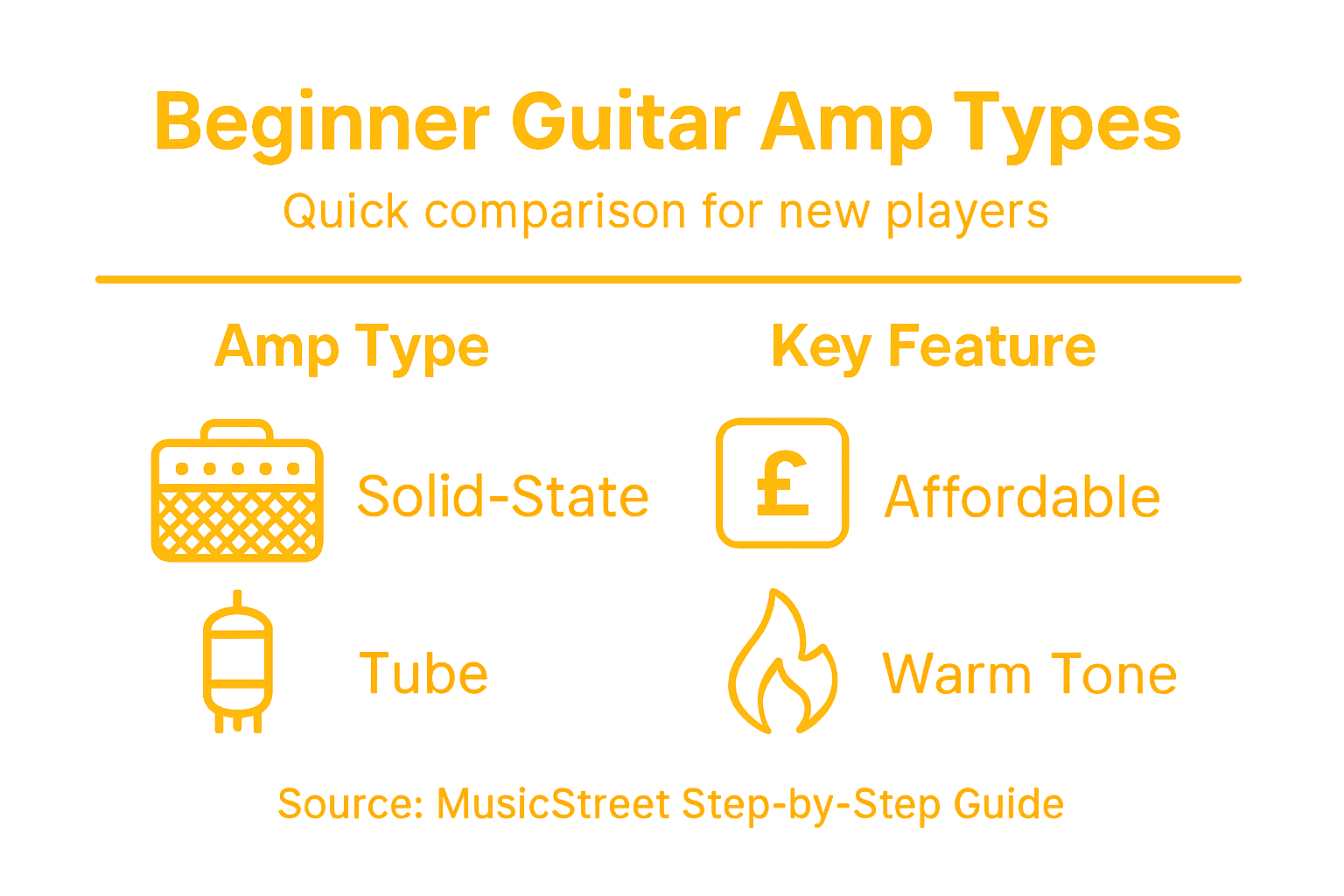
Solid-state amps use transistors to generate and shape your guitar signal. These amps are reliable, affordable, and generally lightweight. They respond instantly with no warmup time, and they’re hard to damage through heavy use. Most entry-level amps fall into this category because manufacturers can build them affordably without compromising playability. If you’re shopping on a tight budget, solid-state amps deliver honest value. They won’t give you the organic warmth some players chase, but they won’t disappoint you either.
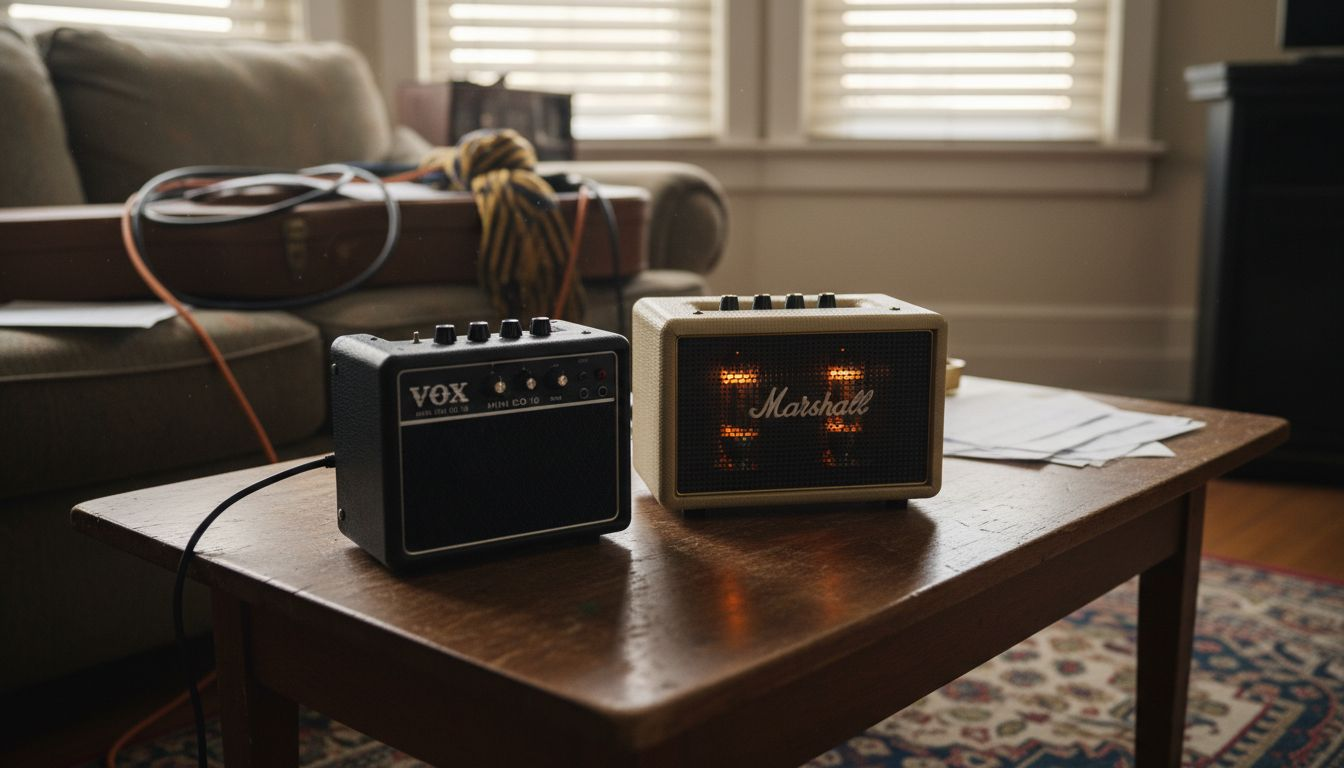
Tube amps (also called valve amps) use actual vacuum tubes to colour your tone. These amps warm up when you switch them on, they respond dynamically to your playing dynamics, and they distort musically when pushed hard. That warmth and responsiveness attracts seasoned players willing to pay more and accept greater maintenance needs. Tube amps cost significantly more than solid-state equivalents, weigh considerably more, and require occasional tube replacement. For beginners, tube amps represent unnecessary complexity and expense. You’ll learn faster on a simpler platform.
Hybrid amps blend both technologies, typically using tubes in the preamp section and solid-state amplification in the power amp. These offer some tonal character of tubes with the reliability and affordability of solid-state. They’re genuinely worth considering if you want flexibility without the full tube amp investment.
Here’s a summary of common amplifier types and their typical pros and cons for beginners:
| Amp Type | Key Advantage | Main Drawback | Typical Beginner Fit |
|---|---|---|---|
| Solid-state | Reliable, affordable, lightweight | Less “warmth” than tube amps | Excellent, low risk |
| Tube (Valve) | Warm, responsive, organic tone | Expensive, heavier, needs upkeep | Rarely ideal, complex |
| Hybrid | Mixes tube tone with reliability | May lack full tube character | Flexible, good compromise |
| Modelling/Digital | Highly versatile, built-in effects | Menu navigation can be confusing | Good for experimenting |
Beyond amp type, focus on power and wattage. Watts measure volume output, but the relationship isn’t linear. A 30-watt amp isn’t twice as loud as a 15-watt amp; the difference is subtle. What matters more is speaker size and quality. A 15-watt amp with a good 10 inch speaker often sounds better than a 30-watt amp with a tiny speaker. For bedroom practice, 15 to 30 watts offers more than enough volume. You’ll rarely need more unless you’re playing with a full band regularly.
Investigate speaker size and cabinet design. Larger speakers (10 inch, 12 inch) generally produce fuller, richer tone than smaller ones. The cabinet itself affects tone significantly. A sealed cabinet sounds different from an open-back one. Don’t obsess over these details as a beginner, but understand that speaker choice matters as much as amp wattage.
Look at control options next. Basic amps offer volume and tone controls. Better amps add separate treble, middle, and bass controls. Some include built-in effects like reverb or delay. Effects add flexibility but also complexity. As a beginner guitarist, you’ll benefit more from understanding basic tone control than from having effects you don’t know how to use properly. When you’re ready to expand your sonic possibilities, pairing your amp with essential guitar accessories lets you add effects gradually without paying for built-in features you won’t use.
Check connectivity features practically. Headphone outputs matter if you need silent practice. An auxiliary input lets you play along with backing tracks. Some amps include USB connections for recording. These features are genuinely useful, but don’t let them drive your decision if the amp sounds worse than simpler alternatives.
Finally, research brand reliability. Some manufacturers dominate the beginner market because their amps simply work without fuss. Others offer interesting features but struggle with quality control. Read owner reviews focusing on long-term reliability rather than brief first-impressions. A reliable amp you’ll keep for years beats a cheap amp you’ll replace within months.
Pro tip: Create a spreadsheet comparing three to five amps within your budget, listing wattage, speaker size, controls, and key features side by side; this visual comparison reveals which amp actually offers the best value for your specific situation.
Step 3: Set your budget and shortlist trusted brands
Money matters when buying an amp, but throwing cash at a problem doesn’t guarantee a solution. Setting a realistic budget and identifying brands worth your trust narrows your search dramatically and prevents wasting time on unsuitable options. This step transforms your research into actionable shortlists you can confidently explore.
Start by being honest about what you can actually spend. Don’t just grab a number from thin air. Account for the full cost: the amp itself, a cable to connect your guitar, and possibly a stand if you want to angle it properly. Hidden costs add up quickly. Set your total budget, then allocate roughly 80 percent to the amp and 20 percent to accessories. If you’ve only got £200, spend £160 on the amp and £40 on quality cables and accessories rather than forcing yourself into a cheap amp with no budget left for basics. Poor quality cables introduce noise and hum that’ll frustrate you endlessly.
Understand price brackets and what they deliver. Entry-level amps between £100 and £250 offer genuine playability from reputable manufacturers. These won’t embarrass you, and they’ll serve you well for years. Budget amps below £100 often skimp on speaker quality or build standards, creating poor learning experiences. Mid-range amps from £250 to £500 add features, better tone colouration, and improved build quality. Premium amps above £500 venture into territory most beginners simply don’t need. Save your money and invest it elsewhere as your playing advances.
Below are typical UK amp price brackets and what you should expect in each:
| Price Range | What You Get | Ideal User | Potential Pitfalls |
|---|---|---|---|
| Under £100 | Basic sound, limited features | Casual, home-only | Low quality, frustrating |
| £100–£250 | Decent sound, reliable brands | Most beginners | Fewer extras, simple |
| £250–£500 | Improved tone, better features | Serious learners | Unneeded complexity |
| £500+ | Premium build, advanced features | Professionals | Overkill for new players |
Now research which brands consistently deliver value at your price point. Certain manufacturers have built reputations specifically within the beginner and student market. These brands understand what learners actually need. They prioritise reliability and straightforward operation over complicated features. Read owner reviews on independent music websites, looking for patterns rather than individual opinions. A single negative review means little. Five reviews mentioning the same durability issue means something. Focus on reviews from players who’ve owned the amp for at least a year, not people writing excited first impressions. Long-term ownership reveals whether an amp stays reliable or develops problems.
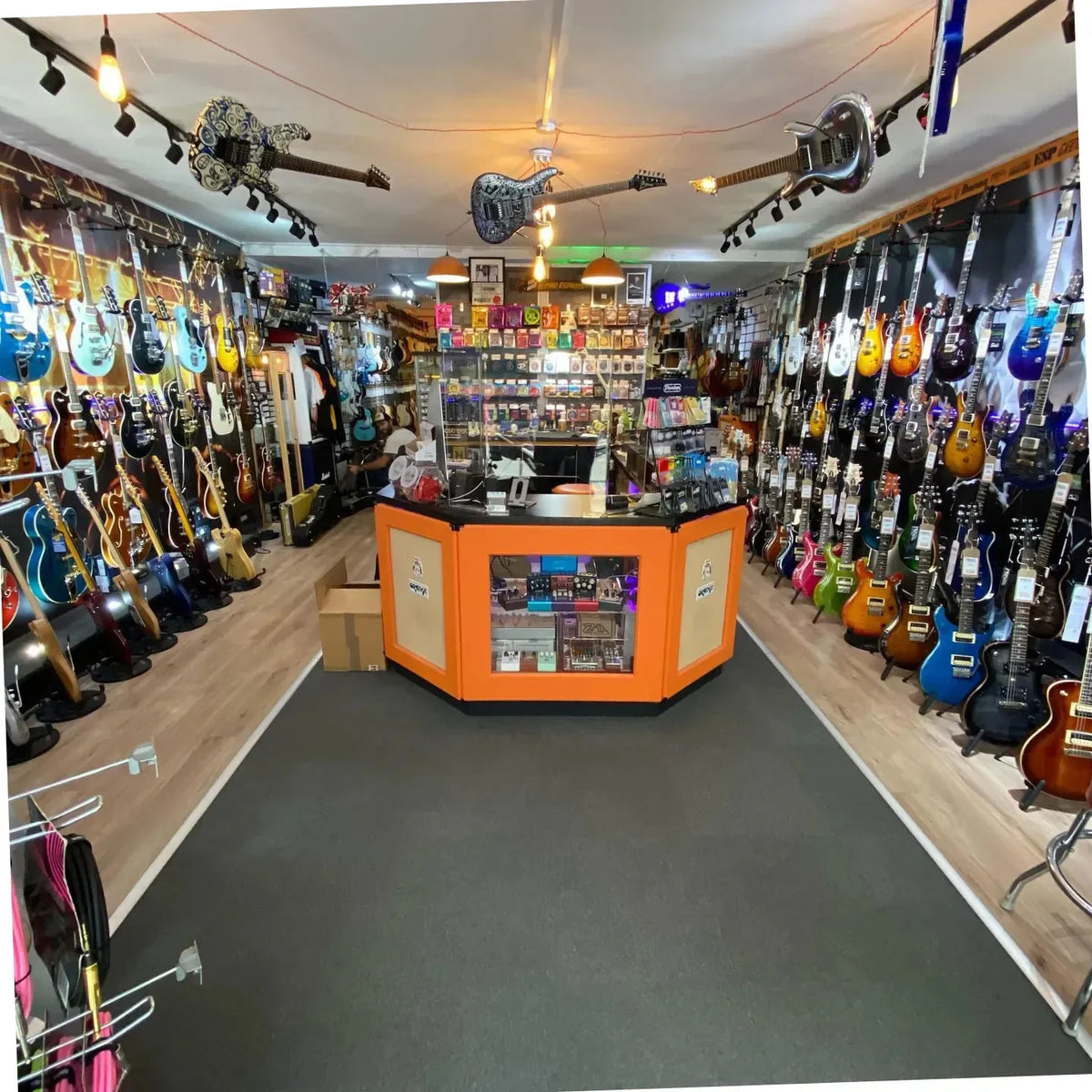
Check local availability too. Being able to see and try an amp before buying matters enormously. Music shops in Huntingdon and surrounding areas stock certain brands more readily than others. Choosing a widely available brand means you can access repairs and replacement parts if needed. It also means you can try similar models side by side, comparing their actual sound rather than relying on specs. When you’ve narrowed your choices down, visiting a local music retailer lets you test amps in person and receive expert guidance from staff who understand your needs.
Create a shortlist of three to five amps that tick your boxes. These should all fit your budget, come from reputable brands, and offer the features you actually identified earlier. Don’t include amps just because they’re cheap or trendy. Your shortlist should genuinely excite you. You’re about to spend money on one of these, and that money should feel well spent.
Read actual user manuals for your shortlisted amps before committing. Yes, manuals sound boring. They reveal how controls actually work, what connectivity options do what, and what maintenance the amp requires. A manual that’s clear and helpful tells you the manufacturer cares about users. A confusing manual suggests you’ll struggle during setup.
Check warranty coverage carefully. Reputable brands offer proper warranties covering manufacturing faults. Budget brands sometimes offer minimal warranties. A one-year or two-year warranty gives genuine peace of mind. Some retailers add their own extended warranties, which can be valuable insurance against unexpected failures.
Pro tip: Ring the music shop before visiting and confirm they have your shortlisted amps in stock; this prevents wasted journeys and ensures you can compare your top choices side by side when you visit.
Step 4: Try amps in-store and compare sound quality
Reading specs and reviews online helps, but nothing replaces plugging your guitar into an actual amp and hearing what it produces. In-store testing reveals whether an amp genuinely suits your ear and playing style. This is where research becomes reality, and where you discover whether your shortlist actually delivers what you need.
Arrive at the shop with your guitar, not a rental or borrowed one. Your instrument has unique tonal characteristics, and testing with an unfamiliar guitar gives misleading results. Bring your own cables too if you’re comfortable doing so. You know your cables work reliably, eliminating one variable during comparison. Wear comfortable clothes and plan to spend time there. This isn’t a quick visit. You’re making a significant purchase, and rushing through amp testing leads to buyer’s remorse.
Start by testing each shortlisted amp at realistic playing volumes. Many beginners make the mistake of cranking amps to maximum to hear their power. That’s pointless and exhausting for everyone nearby. Set the volume where you’d actually use the amp at home. If you’re a bedroom player, test at bedroom volumes. If you’re planning to jam with bandmates, test at those volumes. This reveals how the amp performs where you’ll actually play it. A beautiful-sounding amp at full volume might sound thin and disappointing at lower levels, or vice versa. Real-world volume matters more than theoretical maximum output.
Play actual songs you know well, not random noodling. Familiar passages reveal how an amp handles your specific playing style and technique. You’ll notice how it responds to your dynamics, how it handles string bending, and whether it colours your tone in ways that excite or frustrate you. Spend at least five minutes on each amp. Quick thirty-second tests reveal nothing reliable. Your ears need time to adjust and form genuine opinions.
Pay attention to how the amp feels, not just how it sounds. Some amps have responsive, interactive feel whilst others feel sluggish or disconnected. This responsiveness affects your playing experience profoundly. An amp that feels great encourages you to practise more. One that feels unresponsive makes playing feel frustrating. This is subjective, but it’s also real and important.
Compare amps directly by switching between two that you’ve narrowed down. Play the same passage on amp A, then immediately play it on amp B. This side-by-side comparison is far more revealing than testing amps hours apart. You’ll hear genuine differences in clarity, warmth, and responsiveness that vanish when you’re comparing from memory.
Talk to shop staff about your findings. Good staff understand different amp characteristics and can explain what you’re hearing. They’ve heard countless players through those amps and recognise patterns. They can tell you whether an amp suits your playing style and whether it’ll satisfy you long-term. Staff at reputable retailers genuinely want you to find the right amp, not just buy something. When exploring factors to consider when buying an amplifier, you’ll benefit from professional perspective that shop staff can provide based on their expertise.
Listen to other players testing amps too. Hearing how different guitars and playing styles sound through each amp teaches you how versatile that amp actually is. An amp that sounds incredible with one guitar might sound less inspiring with another. Understanding this versatility helps you predict how it’ll work with your own instrument.
Trust your gut feelings alongside analytical thinking. If an amp sounds objectively good on paper but doesn’t excite you, keep looking. You’ll be living with this amp for years, practising on it daily. It needs to inspire you, not just tick boxes. Conversely, if an amp sounds great but costs slightly more than your ideal budget, that extra money might be worth spending if it genuinely makes you happier.
Don’t feel pressured to decide immediately. A good shop will let you take time. If you’re genuinely torn between two amps, ask if you can think about it and return the next day. Sleeping on your decision often brings clarity. You’ll know within 24 hours which amp you actually wanted.
Pro tip: Record brief audio clips of your playing through each shortlisted amp using your phone; playing these back later at home reveals details your in-store ears might miss and removes the excitement or pressure of the shop environment from your decision.
Step 5: Test compatibility with your guitar and gear
Your amp doesn’t exist in isolation. It interacts with your guitar, cables, effects pedals, and existing gear to create your final tone. Testing this complete system together reveals whether your chosen amp truly works with what you already own. This step prevents costly mistakes where an amp sounds great alone but clashes with your existing equipment.
Bring your complete guitar setup to the shop. Include every cable you’ll actually use, any effects pedals you own, and any other gear that’ll connect to your amp. This means your pedalboard too, if you have one. Testing with your actual setup beats testing with shop gear because you’ll experience real-world compatibility issues before committing money. A cable that introduces noise or an effects pedal that doesn’t integrate well with the amp becomes obvious only when you test everything together. Many beginners discover problems weeks after purchase when it’s too late to return equipment.
Start by plugging in exactly as you would at home. If you use a pedalboard, connect it between your guitar and amp just as you would during practice. If you use individual pedals, set them up that way. Your amp’s tone interacts with everything in the chain, so testing with your actual signal path matters enormously. Play through your usual effects settings and notice whether the amp responds well to your effects. Some amps handle overdrive pedals beautifully whilst others sound harsh or thin when distortion circuits are stacked. Some amps compress dynamics too much when running through multiple effects, whilst others remain responsive.
Pay close attention to how your guitar’s pickups interact with the amp’s characteristics. Different pickup types colour tone in specific ways, and certain amps complement particular pickup styles better than others. A guitar with single-coil pickups creates bright, articulate tone that works wonderfully with some amps but sounds too thin through others. Humbucker pickups produce thicker, warmer tone that pairs well with some amps but might sound muddy through others. Understanding proven guitar and amp combinations helps you recognise whether your specific guitar type aligns well with the amp you’re testing.
Test your actual cables too. Bring the same cables you use at home and test with them. Cheap cables introduce noise, hum, or tone loss that expensive cables avoid. If your cables sound problematic through the amp, you’ve discovered an issue to address separately. Good amp, bad cable equals poor results. You can’t blame the amp if cable quality is the real problem.
Ask shop staff whether your specific guitar model pairs well with your shortlisted amps. Experienced staff recognise which combinations work harmoniously. They’ve heard countless guitars through those amps and can tell you whether your particular instrument will sing or struggle. This expertise saves you from discovering incompatibility after purchase.
Test at volumes you’ll actually use at home. If you’re running your rig through a pedalboard at bedroom volume, test exactly that scenario. The amp’s tone changes at different volumes, and compatibility changes too. An amp that sounds great at full volume might sound thin or harsh at lower levels when your effects are engaged.
Listen carefully to how your effects interact with the amp’s character. Some amps clean up beautifully when you reduce your overdrive pedal’s intensity, whilst others remain crunchy. Some amps respond dynamically to volume pedal adjustments, whilst others feel sluggish. These interactions profoundly affect your playability and tone shaping.
Consider whether you might add more gear later. Will you eventually buy a wah pedal, delay pedal, or other effects? Test your existing effects to predict how added effects might behave. An amp that handles your current pedalboard flawlessly might struggle when you add more complexity later.
Pro tip: Record a 30-second clip of your complete rig sounding through each shortlisted amp using your phone, capturing the exact tone you’ll get at home with your actual cables and effects; comparing these recordings later reveals compatibility issues that might escape your attention in the shop’s busy environment.
Step 6: Verify warranty, support and purchase options
Before you hand over your money, understand exactly what protection comes with your amp and what happens if something goes wrong. Warranty coverage, repair support, and purchase flexibility matter far more than most beginners realise. This step ensures you’re buying from retailers and manufacturers who’ll stand behind their products when problems arise.
Check the manufacturer’s warranty carefully. Most reputable amp makers offer at least one year of coverage against manufacturing faults and defects in materials. However, warranty lengths vary significantly between brands. Some manufacturers provide extended warranty options that protect you for two or three years if you register your amp promptly. Understanding warranty coverage details helps you recognise what genuine protection actually means and what you’re responsible for if something fails. Registration often matters more than you’d expect. Many manufacturers require you to register your amp within a specific timeframe to activate extended warranty protection. Skipping registration leaves you with minimal coverage, so ask the shop to walk you through registration before you leave.
Ask what the warranty actually covers. Most warranties cover manufacturing defects and component failures, but exclude damage from accidents, liquid spills, or misuse. This distinction matters. An amp that breaks because you accidentally spilled water on it won’t be covered. Neither will damage from dropping it or plugging in wrong cables. Warranties also typically exclude wear and tear from normal use, so don’t expect coverage for a speaker cone that eventually deteriorates from years of hard playing. Understanding these limits prevents disappointment when you eventually need repairs.
Investigate repair support availability. Even if your amp isn’t covered by warranty, you’ll eventually want repairs. Check whether the manufacturer has authorised service partners near you. An amp with no local repair options becomes a headache if something breaks. Repairing or replacing it means posting it away, waiting weeks without your gear, and paying shipping costs. Local service partners make everything simpler. Ask the shop which repair options exist for your chosen amp.
Learn about the retailer’s return policy. Reputable shops let you return gear within a reasonable timeframe if you genuinely aren’t happy with it. Some retailers offer 14-day returns, others offer 30 days. Knowing this policy matters because it gives you a safety net. If the amp sounds different at home than it did in the shop, or if it causes unexpected compatibility issues, you can return it without being stuck. Budget retailers sometimes offer no returns at all, which is a red flag. Always ask about return policies before purchasing.
Understand delivery and setup options. Will the shop deliver to your home? Do they offer setup assistance when delivering? Some retailers include basic setup in the delivery price, ensuring your amp arrives properly configured and tested. Others deliver a box and leave you to figure everything out. Setup assistance matters if you’re inexperienced. It’s worth paying extra for someone who’ll connect everything properly and verify everything works before leaving.
Check whether the retailer offers extended warranties. Beyond manufacturer coverage, many shops sell additional protection plans. These typically cover accidental damage and wear-and-tear that manufacturer warranties exclude. Extended warranties cost extra but provide peace of mind. For beginners investing in their first real amp, extended protection often justifies the cost. Read the fine print carefully. Some extended warranties have exclusions that make them nearly useless.
Confirm you’ll receive proof of purchase documentation. You’ll need this for warranty claims and potentially for returns. Make sure you get an itemised receipt showing the amp model, serial number, purchase date, and retailer details. Keep this somewhere safe.
Ask about trade-in options if relevant. Some retailers accept your old amp as partial payment towards a new purchase. This option reduces your net cost and removes the hassle of selling old gear yourself. It’s worth asking, even if you don’t think you have anything worth trading.
Verify that the retailer is authorised to sell the amp brand you’re choosing. Purchasing from unauthorised retailers can void warranties. Authorised retailers appear on manufacturer websites. If you’re buying from an online marketplace, verify the seller’s status carefully. Unauthorised sellers sometimes offer suspiciously cheap prices because they’re selling counterfeit or grey-market gear with no warranty support.
Pro tip: Request that the retailer provide warranty and support documentation in writing before you pay; having this information documented prevents future disputes about what coverage you actually purchased.
Find the Perfect Guitar Amp with Confidence at MusicStreet
Choosing the right guitar amp as a beginner can feel overwhelming with so many options and technical details to consider. The challenge lies in finding an amp that suits your playing environment, music style, and budget without wasting time or money on gear that does not fit your needs. Whether you are concerned about amp wattage for bedroom practice, matching pickups with amp tone, or understanding warranty coverage, MusicStreet is here to guide you through every step.
Explore our carefully curated selection of beginner-friendly amps and expert accessories designed to complement your guitar and playing goals. At MusicStreet, you can try amps in-store at our Huntingdon location, receive personalised advice from knowledgeable staff, and enjoy competitive pricing backed by insurance-supported warranties and free UK delivery. Start your journey on the right note by visiting MusicStreet and discover the perfect amp that will inspire your practice and elevate your sound today. Check out our essential guitar accessories and must-have guitar accessories guide to enhance your setup now.
Frequently Asked Questions
What factors should I consider when choosing a guitar amp as a beginner?
Choosing a guitar amp as a beginner requires you to consider your playing environment, music style, budget, and volume needs. Start by assessing where you’ll practice most often, such as a bedroom or a rehearsal space, to determine the appropriate amp size and wattage.
How do different amp types affect my sound as a beginner guitarist?
Different amp types, such as solid-state, tube, and hybrid amps, offer distinct sound qualities and functionalities. Familiarise yourself with these variations, as solid-state amps provide reliability and affordability, while tube amps are warmer in tone but more complex to maintain.
What budget should I set for my first guitar amp?
A realistic budget for your first guitar amp should be around £100 to £250, offering good quality without breaking the bank. Allocate about 80% of your budget to the amp itself and 20% to necessary accessories like cables and stands to ensure a complete setup.
How can I effectively test an amp before purchasing it?
To effectively test an amp, bring your own guitar and play familiar songs at realistic volumes in-store. Spend at least five minutes on each amp, comparing sound qualities directly to ensure the amp feels and sounds right for your playing style.
Why is it important to check the warranty and support options for a guitar amp?
Understanding the warranty and support options is crucial because it protects you against manufacturing faults and allows for repairs if needed. Before purchasing, verify the warranty length and what it covers, as well as availability of repair services in your area, to ensure your investment is safeguarded.
How can I determine if my existing gear is compatible with a new amp?
To determine compatibility, test your complete guitar setup—including cables and any effects pedals—while trying the new amp in-store. Ensure you use your actual gear to identify any potential issues before committing to a purchase.

Share:
Why Upgrade Guitar Pickups – Transform Your Tone
Chambered Body Guitars: Enhancing Tone and Comfort