

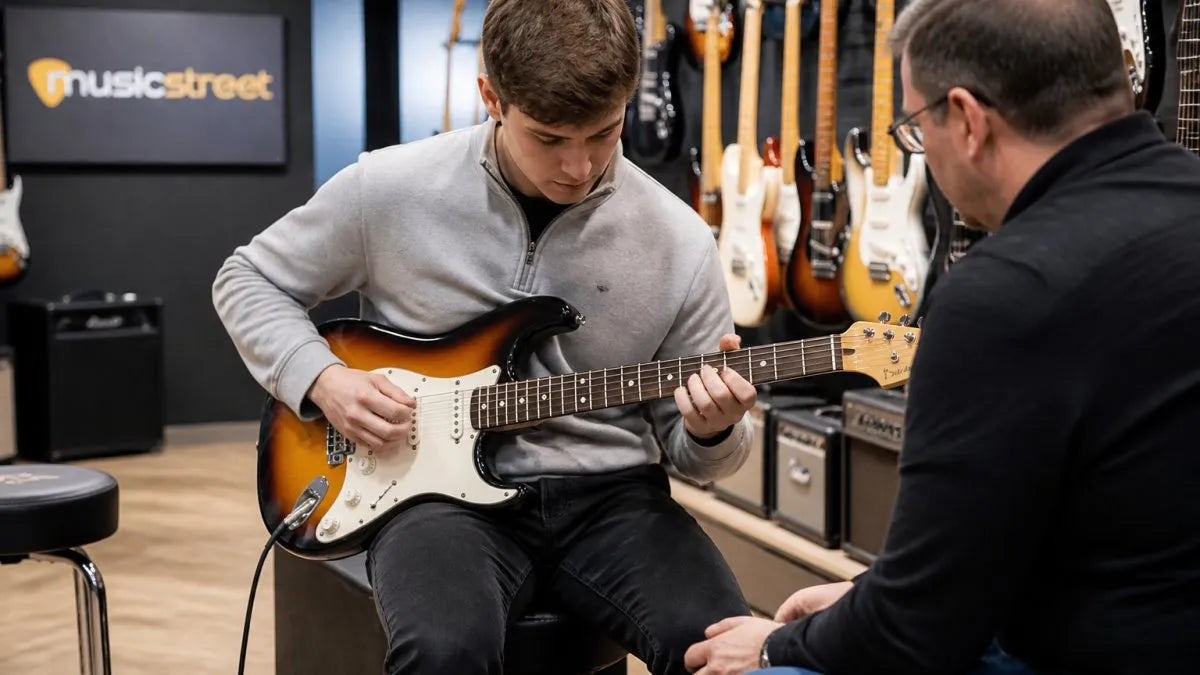
Table of Contents
- What to Bring and How to Prepare
- How to Test an Electric Guitar in Store: Start With a Clean Tone
- How to Check Guitar Action and Playability
- Testing Guitar Electronics in Store
- Guitar Shop Etiquette: What to Know Before You Play
- Common Mistakes to Avoid When Testing an Electric Guitar
- Frequently Asked Questions
Last Updated: September 27, 2026
What to Bring and How to Prepare
Walking into a guitar shop without a plan is the fastest way to buy the wrong instrument. The electric guitar market was valued at USD 26.10 billion in 2025 and is growing at 3.5% a year, according to Maximise Market Research's market report, which means more choice than ever and more ways to get it wrong.
At MusicStreet, we've watched hundreds of players audition guitars in our shop. The ones who leave happy all do the same thing: they prepare before they play a single note.
Here's your pre-shop checklist:
- Your own guitar cable (shop cables are often worn)
- A plectrum you're used to
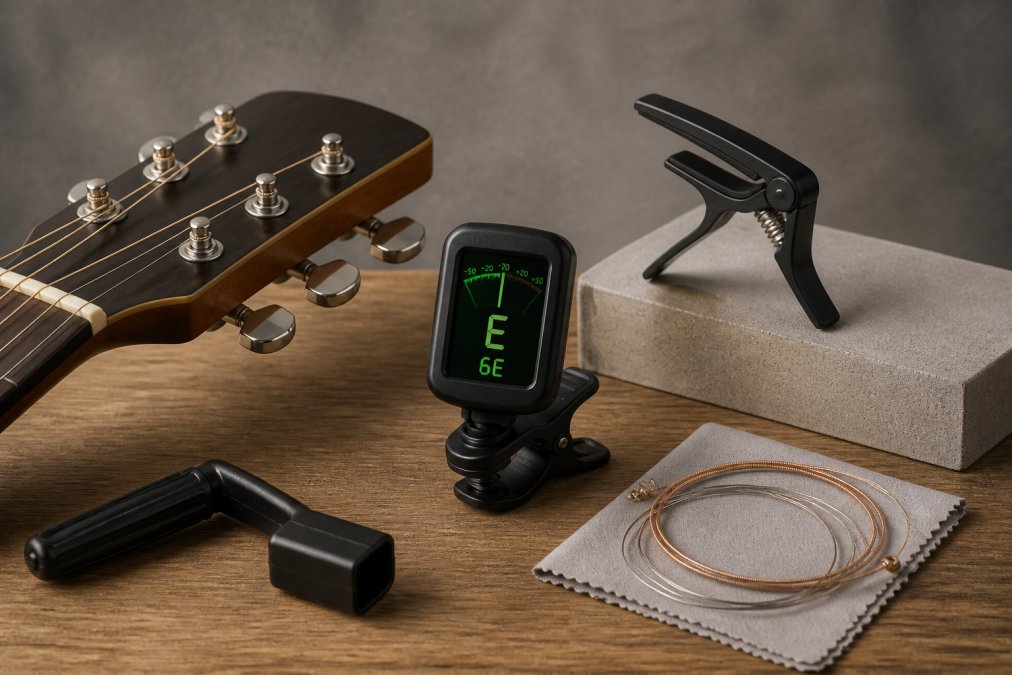
- A tuner or tuning app
- Two or three riffs you know inside out
- A phone note listing your budget and must-haves
That last point matters more than people think. Knowing your budget stops you falling for an instrument you can't afford.
How to test an electric guitar in store properly starts before you touch anything. Bring a reference: a song or tone you know well. You need a baseline to compare against.
How to Test an Electric Guitar in Store: Start With a Clean Tone
Start every audition with a clean amplifier setting. This is the single most important habit in the whole process.
Clean tone reveals the guitar's natural voice. Effects and distortion hide fret buzz, dead notes, and weak pickups. Retailers now actively advise customers to begin clean before adding anything else, according to MusicStreet's 2026 in-store audition guide.

Set the amp like this:
- Gain low, around 2 or 3
- Bass, middle and treble at noon
- Reverb off
- Volume at a comfortable level
Then play. Listen for clarity, sustain, and how the guitar responds when you play softly versus hard.
A good guitar sounds alive at low gain. A poor one sounds thin and lifeless.
Now here's what most buyers miss. Once you've heard the clean tone, test each pickup position one at a time. Bridge, middle, neck. Each should sound noticeably different. If two positions sound identical, something is wrong with the wiring.
How to Check Guitar Action and Playability
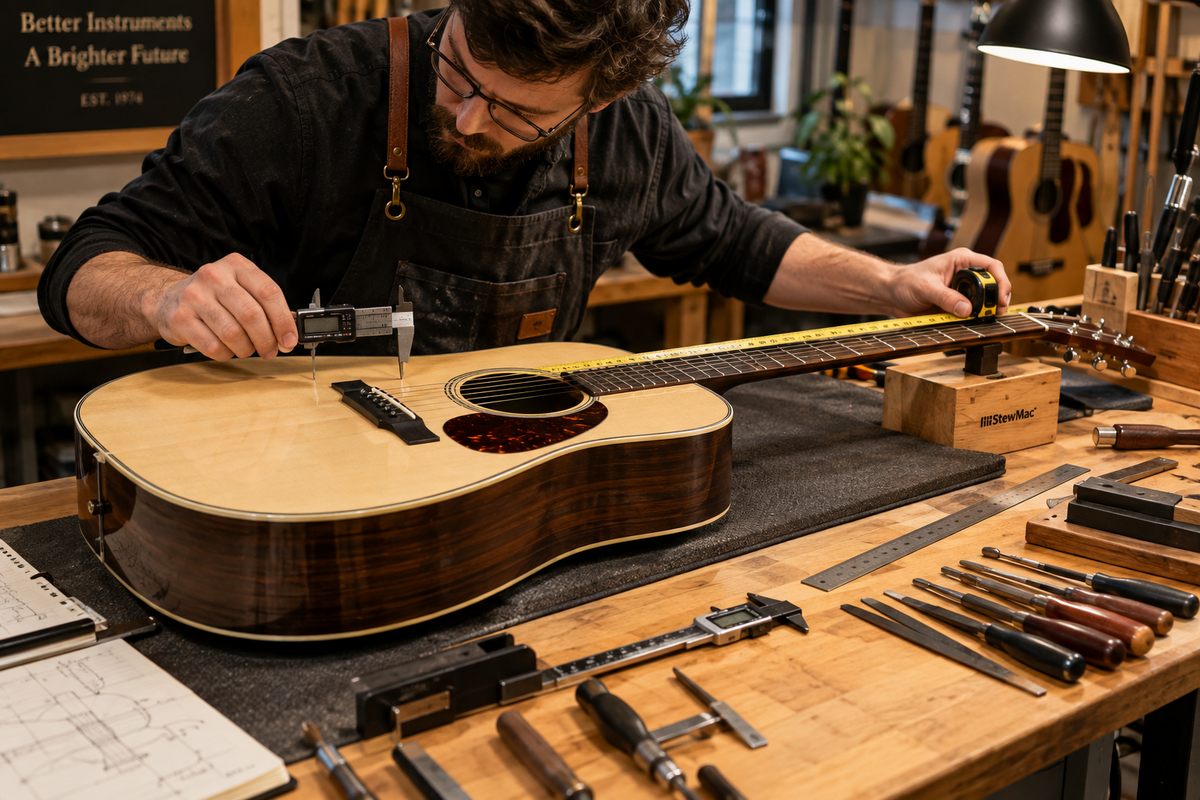
Guitar action is the distance between the strings and the fretboard. It decides how hard the instrument is to play.
Blackstar - Id Core 20W V2 Stereo →
High action makes fretting painful. Too low and the strings buzz against the frets. The sweet spot lets you play for an hour without hand fatigue.
Check action by pressing a string at the 12th fret. There should be a small gap, roughly the thickness of a credit card. If the string touches the fret, the action is too low. If you can fit two cards in the gap, it's too high.
Measuring Action and Neck Relief
Neck relief is the slight forward curve in the neck that lets strings vibrate freely. Too much curve and the action rises. Too little and strings buzz.
Here's a quick test anyone can do in a shop:
- Press the low E string at the 1st fret
- Press the same string at the last fret
- Look at the gap above the 7th or 8th fret
- A tiny gap, about 0.25mm, is about right
Industry consensus is clear: playability depends heavily on professional setup, not factory condition, as discussed by players on Reddit's r/Guitar community.
Testing Guitar Electronics in Store
Electronics are where hidden faults hide. Incomplete testing of used instruments leads to real financial losses from undetected structural or electronic faults, according to Vintage Guitar World's expert guide.
So test everything. It takes five minutes.
Checking Pickups, Switches and Knobs
Work through each control one at a time:
- Pickup selector: Click through every position. Each should give a clear, distinct sound.
- Volume knob: Turn it slowly. The sound should fade smoothly, with no crackling.
- Tone knobs: Roll each one. You should hear the treble soften as you turn down.
- Output jack: Wiggle the cable gently. Any crackle or cut-out means a loose jack.
Crackling usually points to dirty potentiometers. That's a cheap fix. A dead pickup or a faulty switch is a bigger job.
Play every fret on every string. Listen for dead spots, where a note chokes out instead of ringing. A dead note often means a high fret or a setup issue, but it can also mean a twisted neck.
Guitar Shop Etiquette: What to Know Before You Play
Guitar shop etiquette is simple: treat the shop like you'd want your own gear treated. Most staff are happy to let you play anything, as long as you ask first and handle it with care.
Follow these basics and you'll get better service:
Blackstar - Id Core 20W V2 Stereo →
- Ask before taking a guitar off the wall
- Turn the amp down before plugging in or unplugging
- Keep food and drinks away from the instruments
- Don't crank high-gain settings in a quiet shop
- Put the guitar back where you found it, or hand it to staff
There's a practical angle here too. Shops notice the customers who respect the gear. That goodwill often turns into honest advice about which guitar actually suits you.
If you're testing several guitars, tell the staff what you're after. A good shop will point you towards instruments that fit your budget and playing style, rather than pushing whatever's on the floor.
Common Mistakes to Avoid When Testing an Electric Guitar
Most bad guitar purchases come down to a handful of avoidable mistakes. Here are the ones we see most often.
| Mistake | Why It Hurts | What to Do Instead |
|---|---|---|
| Testing with heavy distortion | Hides fret buzz and weak pickups | Start clean, add gain later |
| Rushing the audition | Misses dead notes and faults | Spend 10-15 minutes per guitar |
| Ignoring the neck shape | Causes hand fatigue long-term | Play chords and lead lines |
| Skipping the electronics | Misses crackly pots and dead pickups | Test every knob and switch |
| Buying on looks alone | Tone and feel matter more | Play before you decide |
The biggest one is speed. A rushed audition tells you almost nothing.
One more thing worth knowing: in-store feel isn't the final word. A shop guitar often needs a professional setup before it plays its best. So judge the bones of the instrument, not just the setup it happens to have today.
That's why buying from a shop that sets up every guitar before it leaves matters. It's the difference between a guitar that plays well in the shop and one that plays well at home.
Buying an electric guitar is a decision you'll live with for years, and a rushed in-store test is how players end up with an instrument that never quite feels right. At MusicStreet, every guitar is expertly set up by players, for players, so it arrives ready to play rather than needing work. Our hand-selected inventory spans Fender, Gibson, PRS, Duesenberg, Yamaha and more, backed by an in-house repair and setup workshop and free delivery on orders over £99. [Browse our electric guitars](https://www.musicstreet.co.uk/collections/electric-guitars) and amplifiers to find the right fit, or get in touch for advice before you buy. Shop now with MusicStreet and play an instrument that inspires you from the first chord.
Frequently Asked Questions
What should I look for when testing an electric guitar?
Focus on three things: how it feels, how it sounds and how it is built. Check the action by pressing each string at the 12th fret, listen for fret buzz, test every plectrumup position and confirm the electronics work without crackles. Look for loose hardware, scratches or signs of repair. A structured test helps you spot problems before you buy.
Is it okay to bring my own amp to test a guitar?
Yes, many shops allow it, but always ask first. Bringing your own amp gives you a familiar reference point and helps you hear how the guitar sounds through gear you know. If you cannot bring your amp, use the shop's clean channel as a baseline. Start with a clean tone before adding effects so you hear the guitar's natural voice.
How do I check for fret buzz in a guitar shop?
Play every string at every fret, from the open string up to the highest fret. Listen for a metallic rattle or buzz. Some buzz may be fixed with a setup, but persistent buzz across multiple frets could mean uneven frets or a twisted neck. Ask the shop to check the neck relief and action before you commit.
What are the red flags to look for when buying a pre-owned guitar?
Watch for cracks around the headstock or neck joint, rusted screws, scratchy volume or tone knobs, and a truss rod that will not turn. Always play before you buy and ask about the guitar's history.



Share:
Play a four bar riff from tab: Read guitar tablature for UK beginners
3 Quick Checks to Tune Your Guitar to Open G With Pro Setup Tips