

Table of Contents
- The Tactile Shopping Advantage: Why Touch Matters
- Can You Trade In a Guitar with Minor Damage?
- How to Get the Best Trade-In Value for Guitars
- The Importance of Professional Guitar Setup for Trade-Ins
- Comparing the In-Store and Online Shopping Experience
- What to Look for in a Quality-Assured Instrument
- Conclusion: Making the Right Choice for Your Next Guitar
- Frequently Asked Questions
Last Updated: September 14, 2026
The Tactile Shopping Advantage: Why Touch Matters
Tactile shopping is the practice of handling, playing and physically assessing an instrument before you commit to buying it, and it remains the single biggest reason guitarists still walk into a shop rather than order blind. Nearly 80% of shoppers name the ability to see, touch and try products as the primary advantage of buying in person, according to Placer.ai's 2026 retail industry perspective. Among shoppers aged 18 to 44, that figure climbs to 86% who say touching a product is essential to their decision, per P2PI's 2026 study on physical retail.
At MusicStreet, we have watched this play out across the counter for over a decade. A guitar can look flawless in a listing photo and still feel wrong in your hands: the neck profile fights your thumb, the action sits too high past the seventh fret, the weight drags on your shoulder after twenty minutes. None of that shows up in a spec sheet.
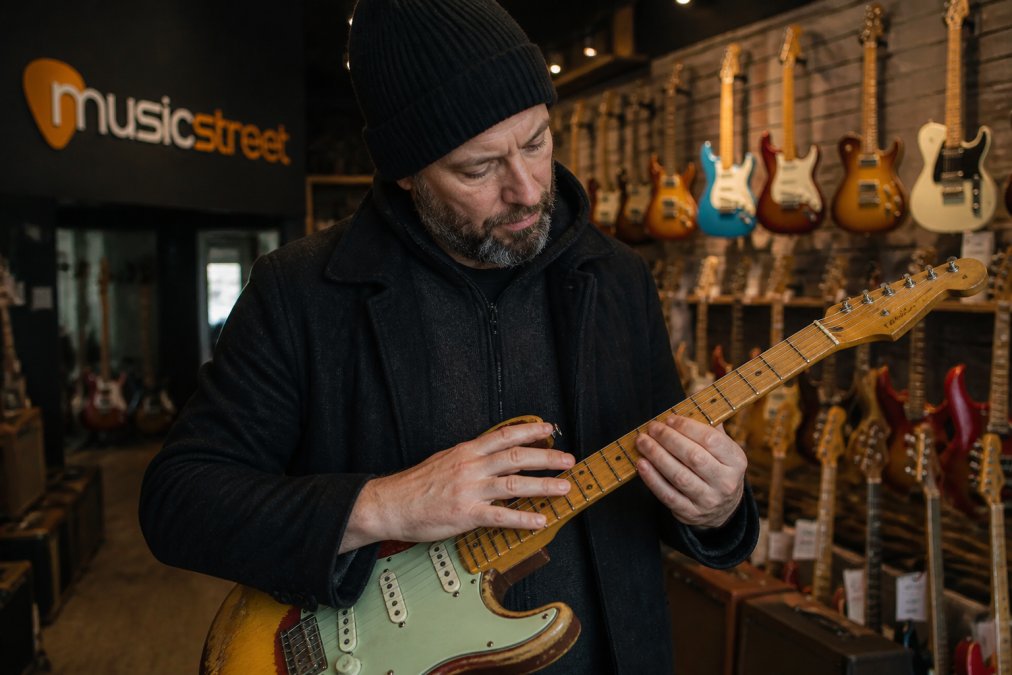
Here is the part most buying guides get wrong. You do not have to choose between touching an instrument and getting a fair trade-in deal. The two work together, and this comparison breaks down exactly how.
Can You Trade In a Guitar with Minor Damage?
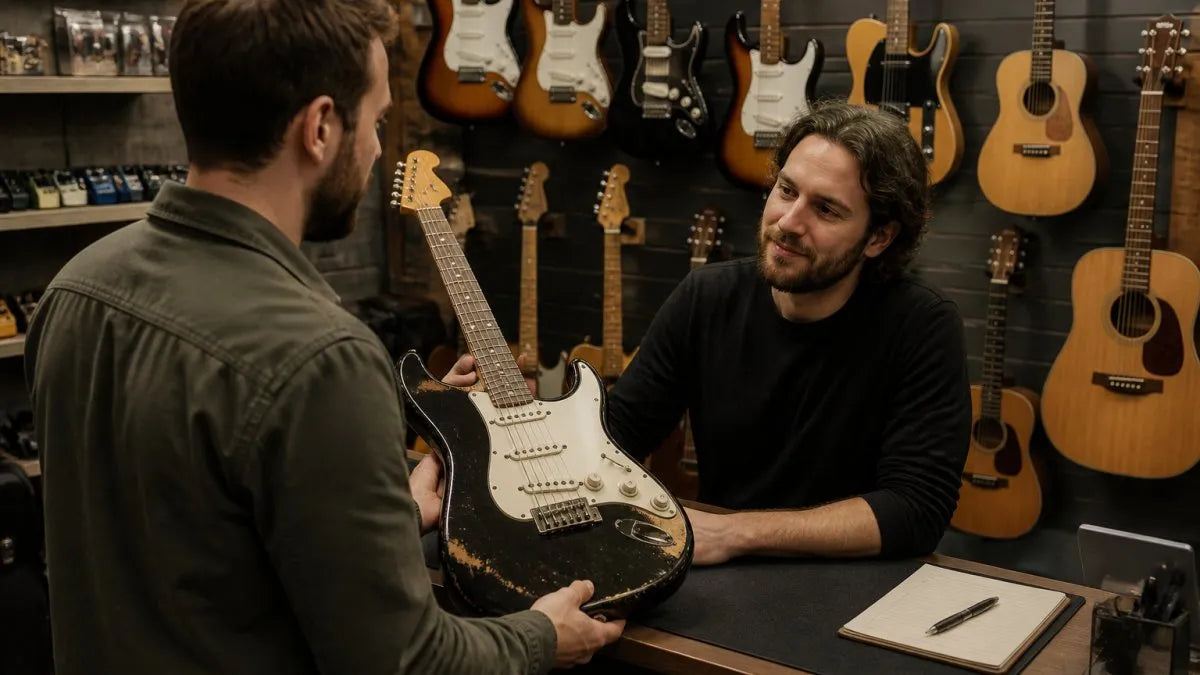
Yes, you can trade in a guitar with minor damage, and most shops will still make an offer. Scratches, buckle rash, a worn nut, faded hardware or a small lacquer chip rarely kill a deal. What matters is whether the damage is cosmetic or structural, because that distinction drives the number you are quoted.
Structural problems change the conversation. A lifted bridge, a twisted neck, a cracked headstock repair or water damage will reduce an offer sharply, and some shops will decline outright. Cosmetic wear is expected on any played instrument and is priced in from the start.
The practical rule: be honest and specific before you travel. Describe the damage, send photos, and ask whether it affects the valuation. A shop that quotes blind and then slashes the figure on inspection is the one to avoid.
How to Get the Best Trade-In Value for Guitars
Getting the best trade-in value for guitars comes down to preparation, not luck. Clean the instrument, fit fresh strings, and gather anything that proves its history: the original case, the receipt, the warranty card, the tremolo arm, the truss rod tool. Complete packages are worth more because the shop can resell them faster.
Then do three things before you accept any figure:
- Photograph every flaw in daylight, including the ones you would rather not mention
- Check recent sold prices for the same model and year, not asking prices
- Ask for the offer in writing, with the trade-in figure and the price of the guitar you are buying separated
That last point matters more than most players realise. A generous-sounding trade-in against an inflated sticker price is not a good deal. Two separate numbers keep everyone honest.
More than two-thirds of customers actively seek expert advice when buying higher-value items, according to Customer Experience Dive's 2026 analysis of in-store service. Use that advice. A specialist who knows the model's quirks will tell you whether your instrument is worth holding for a private sale or trading now.
The Importance of Professional Guitar Setup for Trade-Ins
Professional guitar setup is the process of adjusting neck relief, action, intonation and pickup height so an instrument plays accurately and comfortably. Its importance in a trade-in is simple: a well-set-up guitar presents better, plays better during the shop's assessment, and supports a stronger offer.
Setup is also where online buying most often disappoints. A guitar shipped straight from a warehouse arrives with factory settings that suit nobody in particular. The action may be high, the intonation slightly out, the frets unpolished. Beginners in particular struggle here, because they cannot yet tell whether a guitar is badly set up or whether they simply are not good enough yet. Professional adjustments bridge this gap, yet the broader dilemma of physical fitting versus online remains a fundamental consideration for every musician weighing the convenience of digital storefronts against the tactile certainty of a local shop.
The thing nobody tells you about setup is that it is not a one-off. Seasonal humidity shifts move the neck, and a guitar that played beautifully in July can buzz by November. Budget for a check-up rather than treating setup as a single purchase.
Comparing the In-Store and Online Shopping Experience
The in-store experience wins on certainty, and online wins on range and convenience. That is the honest summary. Which matters more depends entirely on what you are buying and how well you already know your preferences.
| Factor | In-Store | Online |
|---|---|---|
| Can you play before buying | Yes | No |
| Setup standard on arrival | Confirmed by staff | Varies by seller |
| Trade-in against purchase | Assessed same day | Rarely offered |
| Range of models | Limited to stock | Very wide |
| Expert advice available | Face to face | Email or chat |
| Returns if it feels wrong | Immediate | Postage and delay |
Three in five consumers say they specifically need to see and touch an item before completing a purchase, and the same research found AI-powered customer service often fails to provide that reassurance, according to Customer Experience Dive's 2026 retail report.
The trade-off is real, though. An independent shop cannot stock every finish and configuration, and pretending otherwise helps nobody. Where a specialist wins is in the instruments they do carry: hand-selected, checked over, and set up before they reach the wall.
What to Look for in a Quality-Assured Instrument
A quality-assured instrument is one that has been inspected, set up and verified as playable by a qualified person before it is sold, with any faults disclosed. That definition is the whole point of buying from a specialist rather than a marketplace listing.
Check these before you commit:
- Fret condition: no deep divots, no sharp ends catching your hand
- Neck straightness: sight down the edge, look for a twist or an over-bowed curve
- Electronics: every pickup position, every tone and volume sweep, no crackle
- Hardware: tuners that hold, a bridge that returns to pitch, a snug output jack
- Structural honesty: any repair disclosed, in writing, with what was done
Visually compensated tactile cues, where a buyer can read texture and wear from good imagery, measurably raise purchase intention even when the buyer never handles the item, per research published in the Journal of Theoretical and Applied Electronic Commerce Research. Good photography helps. It still is not the same as holding the neck.
That gap is why we keep an in-house workshop and set up every instrument before it goes out. It is also why a pre-owned guitar from a specialist tends to arrive closer to gig-ready than the same model from a general listing.
Conclusion: Making the Right Choice for Your Next Guitar
The choice is not really between touching a guitar and getting a fair trade-in figure. It is between certainty and convenience, and for anything above entry level, certainty usually pays for itself. Buy where you can play the instrument, ask the awkward questions about damage, and insist on a proper setup before you hand over money.
That is exactly how we work at MusicStreet. Every guitar is expertly set up by players, for players before it leaves us, our stock is hand-selected rather than bulk-ordered, and our in-house repair and setup workshop handles everything from a quick action adjustment to a full trade-in assessment. We have been family-run and independent since 2014, and we deliver free across the UK on orders over £99.
Bring your current guitar in, play a few candidates, and let us give you a straight answer on both the trade-in figure and the setup. Explore our range of new and pre-owned guitars and find the one that feels right in your hands.
Frequently Asked Questions
Can you trade in a guitar with minor damage?
Yes, many shops accept guitars with minor damage, but the trade-in value will reflect the cost of repairs. Cosmetic issues like scratches or dents typically have a small impact, while structural problems such as cracks or a warped neck may significantly lower the offer. To get a fair assessment, have the guitar inspected by a professional who can advise on repair costs and how they affect value. Some shops may even handle the repair in-house and adjust the trade-in price accordingly.
How do guitar shops determine trade-in value?
Shops consider the guitar's brand, model, age, condition, and current market demand. They also factor in any necessary repairs or setup work. For example, a professional guitar setup can increase value by ensuring the instrument plays well and has correct action. Shops often use industry pricing guides and their own sales data to make an offer. Transparency varies, so ask for a breakdown of how they arrived at their figure.
Why is the tactile experience important when buying a guitar?
Touching and playing a guitar before buying ensures it feels comfortable and sounds right for you. The neck profile, weight, and body shape all affect playability. Research shows that 86% of shoppers aged 18-44 say touching products is essential to their purchase decision. In-store, you can also compare different models side by side and get expert advice, which is especially valuable for high-value purchases where feel and tone are subjective.
How does professional setup affect the value of a used guitar?
A professional setup can significantly increase a used guitar's value by ensuring it plays comfortably and stays in tune. It involves adjusting the truss rod, action, intonation, and pickup height. A well-set-up guitar is more attractive to buyers because it's ready to play. When trading in, mention any recent setup work and provide receipts if possible. Some shops may even offer a higher trade-in price if the guitar has been recently serviced by a qualified technician.
Is it better to sell a guitar privately or trade it in at a shop?
Selling privately often yields a higher price, but it requires time, effort, and dealing with potential buyers. Trading in at a shop is faster and more convenient, and you can often put the value directly towards a new purchase. Shops also handle any necessary repairs and setup, so you don't have to. Consider your priorities: if you want maximum cash quickly, a trade-in might be better; if you're willing to wait, a private sale could net more.


Share:
Best Electric Guitar Setup Guide: 2026 Step-by-Step
7 Best Guitar Setup Tools for Home Maintenance in 2026