

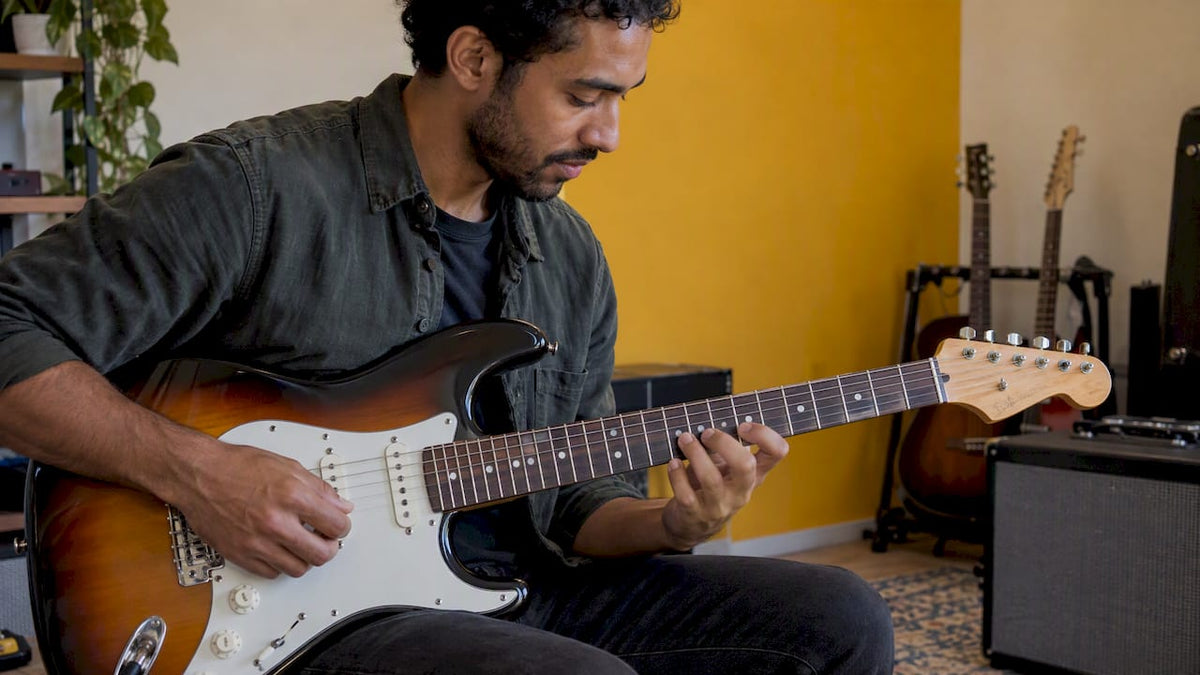
The seven modes are Ionian, Dorian, Phrygian, Lydian, Mixolydian, Aeolian and Locrian. Each one is the same seven-note major scale started from a different note, which gives it a different home note and a different mood. This guide sets them out in order, shows how each is built, and explains how to hear them and practise them on a guitar neck.
Table of Contents
- What a mode actually is
- The seven modes in order
- Interval patterns: the fingerprint of each mode
- Comparing modes from the same root
- How each mode sounds and where you will hear it
- Our view: stop memorising patterns, start hearing roots
- Finding the modes on the fretboard
- Modes and chords: where the sound really comes from
- Modes on bass
- Find a guitar that makes practice easy
- Common mistakes when learning modes
- FAQ
- Sources
What a mode actually is
A mode is a scale you get by rotating a major scale so that it starts on a different degree. The pitches stay the same. What changes is which note feels like home. Modes are similar to tonal scales, but they start and end on different notes, so only the order of tones and semitones differs from one to the next.
This is why a mode is not a new set of notes to learn. Play the white notes of a piano from C to C and you have C major. Play them from D to D and you have a different sound, even though you have not touched a single black key. Changing the tonic changes the gravity of the music, even when the underlying pitches stay identical.
For guitarists, that is good news. Modes do not require new scale patterns. They come from applying the notes and chords of the major scale with a different degree as the focus. If you already know a major scale shape, you already own the raw material for all seven modes.
Modes versus scales
People often ask whether a mode is a scale. It is, in the plain sense that it is an ordered set of notes. The useful distinction is about how you think of it. A major scale and its relative natural minor share the same notes, yet you treat them differently because you resolve to a different note. Modes extend that idea to all seven degrees.
The seven modes in order
Start with C major, because it has no sharps or flats. Starting on C, D, E, F, G, A or B and using the same notes through the octave gives C Ionian, D Dorian, E Phrygian, F Lydian, G Mixolydian, A Aeolian and B Locrian.
| Degree | Mode | Starting note (C major parent) | Notes |
|---|---|---|---|
| 1 | Ionian | C | C D E F G A B |
| 2 | Dorian | D | D E F G A B C |
| 3 | Phrygian | E | E F G A B C D |
| 4 | Lydian | F | F G A B C D E |
| 5 | Mixolydian | G | G A B C D E F |
| 6 | Aeolian | A | A B C D E F G |
| 7 | Locrian | B | B C D E F G A |
The order is fixed, and the names are worth memorising in that sequence. A simple memory aid is to remember that the major scale is first and natural minor is sixth. Everything else sits between or beyond them.
Why seven, and not more
There are seven because the major scale has seven notes, and each mode starts on a different one of them. The C major scale has seven notes, so there are seven modes, from C through B. Start on an eighth note and you are back at the octave, which is the first mode again.
Interval patterns: the fingerprint of each mode
Every mode has a pattern of whole steps (W, two frets on guitar) and half steps (H, one fret). The patterns are Ionian WWHWWWH, Dorian WHWWWHW, Phrygian HWWWHWW, Lydian WWWHWWH, Mixolydian WWHWWHW, Aeolian WHWWHWW and Locrian HWWHWWW.
Notice that it is one repeating loop of seven steps, WWHWWWH, with the starting point moved along. Read the Ionian pattern, drop the first letter onto the end, and you have Dorian. Do it again for Phrygian, and so on.
Here is the same idea shown on the white notes. Playing C to B from D to D produces Dorian, with the pattern W-H-W-W-W-H-W. On a guitar, that is simple to check: put your first finger on the 10th fret of the A string (D) and walk up in the pattern, using whole steps as two frets and half steps as one.
Comparing modes from the same root
The C-based table shows where the modes come from. For learning the sounds, though, it is more useful to compare them from the same root note. That way you hear only what has changed. Lydian is a major scale with a raised fourth, Ionian is the major scale unchanged, Mixolydian is major with a lowered seventh, Dorian is minor with a raised sixth, Aeolian is natural minor, Phrygian is natural minor with a lowered second, and Locrian is natural minor with a lowered second and lowered fifth.
That gives you this chart, all built on C:
| Mode | Compared with C major or C natural minor | Notes from C |
|---|---|---|
| Lydian | Major with a raised 4th | C D E F# G A B |
| Ionian | Major | C D E F G A B |
| Mixolydian | Major with a lowered 7th | C D E F G A Bb |
| Dorian | Minor with a raised 6th | C D Eb F G A Bb |
| Aeolian | Natural minor | C D Eb F G Ab Bb |
| Phrygian | Minor with a lowered 2nd | C Db Eb F G Ab Bb |
| Locrian | Minor with lowered 2nd and 5th | C Db Eb F Gb Ab Bb |
Read top to bottom, the table moves from the brightest mode to the darkest, with one note lowered at each step. The seven diatonic modes can be sequenced by the circle of fifths, each mode adding one more lowered interval. Once you see that ladder, you stop needing to memorise seven separate scales. You only need to know one major scale and which note to flatten.
How each mode sounds and where you will hear it
Brightness is relative. Lydian, Ionian and Mixolydian are the brighter modes because they keep a major third, while Dorian, Aeolian, Phrygian and Locrian are darker because they contain a lowered third. A handy way to group them is three major modes (Ionian, Lydian, Mixolydian), three minor modes (Dorian, Phrygian, Aeolian) and one diminished mode (Locrian).
Ionian
The ordinary major scale. It sounds settled, cheerful and familiar, and it is the sound behind most pop, folk and country melodies.
Dorian
Minor, but with a lifted sixth that stops it sounding gloomy. Guitarists reach for it for jazzy, soulful or bluesy minor lines. Dorian has a jazzy, soulful minor sound with a natural 6th.
Phrygian
The lowered second gives it a tense, dark pull towards the root. Much flamenco is Phrygian, and the sound has also been taken up widely in heavier rock and metal.
Lydian
Major with a raised fourth, which sounds floating and slightly dreamy. It is a favourite for film-style melodies and for open, airy lead lines.
Mixolydian
Major with a flattened seventh. It sounds relaxed and bluesy-bright, and it fits dominant seventh chords naturally. Irish traditional music uses Mixolydian, Dorian and Aeolian, so if you play folk or session tunes you are already close to it.
Aeolian
The natural minor scale. Sad, serious and the foundation of an enormous amount of rock, pop and ballad writing.
Locrian
A minor sound with a lowered second and a diminished fifth, so the home chord is unstable. It is the least used of the seven as a tonal centre, but it is useful for tense passages and over half-diminished chords.
These descriptions are guides, not rules. The word itself hints at this: the English word mode comes from the Greek modus, meaning mood, but what you actually hear depends heavily on what is going on underneath the melody.
Our view: stop memorising patterns, start hearing roots
We see a lot of players come into the shop who can recite all seven mode names but cannot say what makes one sound different from the next. Usually they have learned seven box shapes and never anchored them to a sound. Our advice is the reverse of the usual order.
First, play one major scale shape until it is automatic. Second, play a drone or a single sustained bass note on the root of the mode you want, and play the same shape against it. Third, change only the drone and listen to how the same notes change meaning. You will learn more about Dorian from ten minutes of this than from an hour of fretboard diagrams.
We also think the guitar you practise on matters more than people admit. A guitar that is set up properly, with sensible action and fresh strings, lets you hear a mode clearly instead of fighting buzzing frets. That is why we inspect and set up every instrument that leaves us, and why we offer setups and repairs in our Huntingdon shop. If a neck feels hard work, modes will feel harder than they are.
— Music
Finding the modes on the fretboard
Because the notes are the same as the parent major scale, there are two practical routes on the neck.
Route one: the parent scale method
Work out which major scale contains the mode. D Dorian is the second mode, so its parent is C major. Play your usual C major shape but treat D as home. This is the quickest way to start jamming in a mode, and it is a sound approach as long as you keep the root clear. Keeping the parent major scale in mind is a practical way to see how modes relate to it, though each mode should function as its own tonal centre.
Route two: the same-root method
Pick one root, say A, and play every mode from it: A Ionian, A Dorian, A Phrygian and so on. Use the comparison chart above to alter one note at a time. This route trains your ear far better, because the root never moves. You hear only the colour changing.

A practice routine that works
Joe Satriani’s advice for a mode like B Phrygian is a good template for any of them. He recommends memorising the fingering by playing it repeatedly, then recording sustained B5 chords and playing the modal exercises over them to reinforce the B root. Here is a version you can use in twenty minutes:
- Choose a root note and one mode.
- Write out its interval pattern, for example WHWWWHW for Dorian.
- Play it slowly up and down one octave on a single string, counting frets.
- Play it across the neck in one position, then in a second position.
- Record two minutes of the root as a power chord or a single low note, and play over it.
- Improvise four-note phrases that start and end on the root.
After a week, change the mode but keep the root. That contrast is where the learning happens.
If you already know the minor pentatonic, you have a head start. Most modes can be heard as a pentatonic shape with two extra notes added, and our guide to pentatonic scale theory for improvising shows how those boxes connect.
Modes and chords: where the sound really comes from
A scale on its own does not make a mode. The harmony beneath it does. Modes are defined by how notes and chords are applied, not simply by playing a pattern, so a D Dorian line played over a C chord just sounds like C major with a strange starting note.
To make D feel like home, you need chords that say so. For D Dorian, a Dm7, F/D and G/D progression can make D sound like the tonic. Notice that the bass note stays on D through the F and G chords. That pedal note is a classic way to hold a modal centre.
The chords that come from each mode follow the same rotation as the notes. Across the modes of the major scale you get three major chords, three minor chords and one diminished chord in each key, which matches the major, minor and diminished grouping above. Keep your first experiments simple:
- Mixolydian: a two-chord vamp, such as a major chord and the major chord a tone below it.
- Dorian: a minor seventh chord and the major chord a fourth above it.
- Lydian: a major chord moving to the major chord a tone above it.
- Phrygian: a minor chord moving to the major chord a semitone above it.
Two-chord vamps like these are easy to hear, easy to record, and make the modal sound obvious. They are also how a lot of players start writing riffs and backing tracks. For composers, seeing modes as modifications of a major scale is a useful mental shortcut to modal colours.
Modes on bass
Everything above applies to bass, with the bonus that the root is easier to hear and hold. If you play bass, work on the major scale first and then shift your focus. Our guides to mastering the major scale on bass guitar and to major and minor scale patterns on a 5-string lay out the fingerings you can reuse for every mode.
Find a guitar that makes practice easy
Modes reward long, relaxed practice, and that is easier on an instrument that plays well. In our Huntingdon shop and online we sell new and pre-owned guitars, and each is inspected and set up before it goes out. You can browse our electric guitars, acoustic guitars and bass guitars, or try something in person.

If your current guitar fights you, a setup or repair can be the cheapest improvement you make. Fresh strings help too, and our in-store restring service is there if you would rather not do it yourself.
Common mistakes when learning modes
- Playing the notes without the root. If the music never lands on the home note, the ear hears the parent scale instead.
- Treating modes as seven unrelated scales. They are one scale seen from seven positions.
- Ignoring the chords. Without a supporting chord or drone, modes blur together.
- Starting with Locrian. Learn the major and minor-type modes first, then come back to the unstable one.
- Rushing the ear work. Singing the root while you play is slow but very effective.
FAQ
What are the 7 modes of the major scale in order?
They are Ionian, Dorian, Phrygian, Lydian, Mixolydian, Aeolian and Locrian. Each starts on the next degree of the parent major scale. In C major that means C, D, E, F, G, A and B.
What is the difference between a mode and a scale?
A mode is a scale, but one built by starting a parent major scale on a different note. It uses the same pitches, so only the order of tones and semitones and the home note change. A major scale is simply the first mode, Ionian.
Which mode should a guitarist learn first?
Start with Ionian and Aeolian, since they are the major and natural minor scales you probably use already. Then add Mixolydian and Dorian, which sit close to them and are common in rock, blues and folk. Save Locrian for later.
Are modes the same as the pentatonic scale?
No. A pentatonic scale has five notes, while a mode has seven. They overlap, though: a pentatonic shape sits inside most modes, which is why pentatonic players find modes easier than they expect.
Do I need a special guitar to play modes?
No. Any six-string, bass or acoustic guitar will do, because modes use the same notes as a major scale. A well set-up guitar does make it easier to hear the differences clearly.
Sources
- BBC Bitesize: keys, scales, modes and ornaments
- The Seven Modes of the Major Scale on Piano
- Desi Serna: What Are Scale Modes?
- Ableton Learning Music: Modes
- Open Music Theory: Introduction to Diatonic Modes
- Mode (music)
- Classical Music: music modes and mood
- Film Music Theory: What Are Musical Modes?
- TheGuitarLesson.com: Guitar Modes
- Guitar Encyclopedia: Modes
- Guitar World: Joe Satriani on modal theory
- ArtistWorks: An Introduction to Modes
- Seymour Duncan: Mode Mania
- Jeremy Pat Martin: 7 Modes of the Major Scale




Share:
TRS Connector: What It Is and How to Use It