

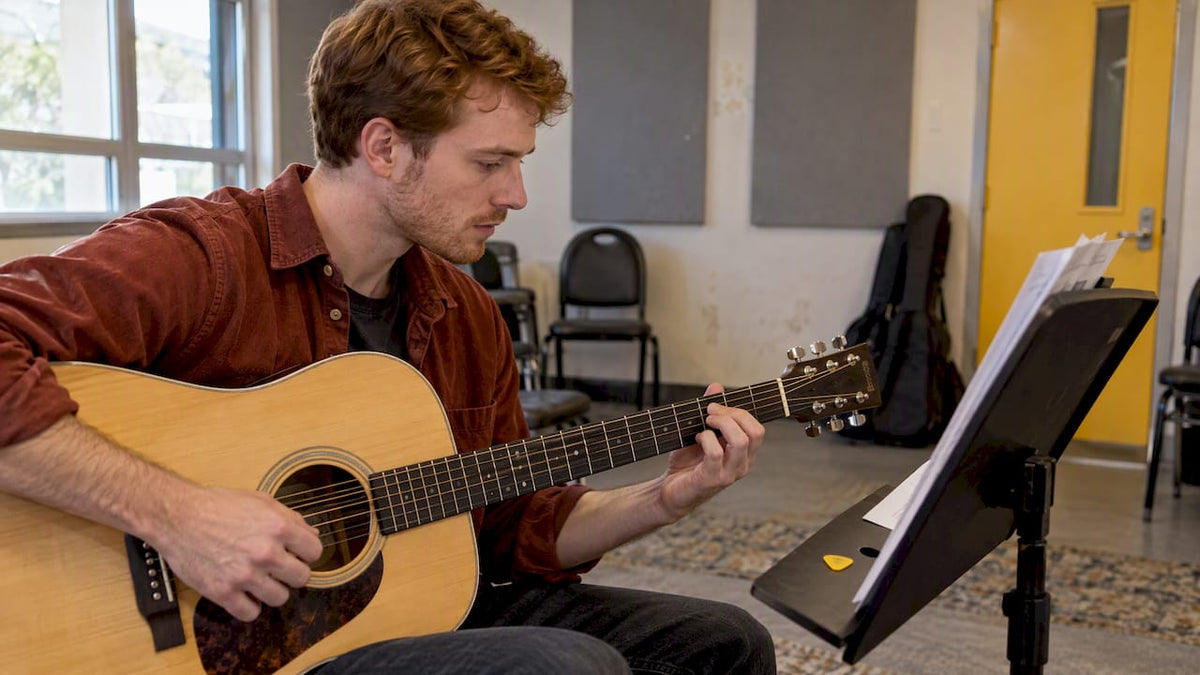
Guitar tab is a grid. Six horizontal lines stand for the six strings, and the numbers sitting on those lines tell you which fret to press. The top line is the thinnest, highest-pitched string and the bottom line is the thickest. Read left to right, play each number in order, and you are playing the tune.
That is the whole idea. The rest of this guide covers the details that trip people up: which way up the strings run, what the little letters mean, how to read chords, why tab seems to have no rhythm, and when it is worth learning standard notation as well.
Table of Contents
- What guitar tab actually shows
- The six lines: which string is which
- Reading the numbers
- Reading chords and notes played together
- The symbols between the numbers
- The catch: tab does not tell you the rhythm
- Check the tuning before you start
- Tab versus sheet music
- A first-week practice plan
- Common mistakes when reading tab
- Our perspective: tab is a doorway, and your guitar should help you through it
- Get the right guitar and kit for learning from tab
- Frequently asked questions
- Sources
What guitar tab actually shows
Tab is short for tablature. Tablature uses lines for the strings and numbers for the frets, with a zero meaning an open string that you play without pressing anything down. A guitar tab has six lines. A bass tab has four.
One school music resource puts it nicely: tab works like a grid reference, giving you the string and the fret rather than a note name. You do not need to know that the note is a B or an F sharp. You only need to know where your finger goes.
That is also why tab is so quick to pick up. It shows you the geography of the fretboard, while standard notation shows pitch and rhythm. We come back to that difference further down.
The six lines: which string is which
This is the first thing beginners get backwards. In tab, the lines run in the same order as the pitch of the strings, not the position of the strings as you look down at the guitar.
| Tab line (top to bottom) | String | Name | Thickness |
|---|---|---|---|
| Top line | 1st | High E (often written lower-case e) | Thinnest |
| 2nd line | 2nd | B | |
| 3rd line | 3rd | G | |
| 4th line | 4th | D | |
| 5th line | 5th | A | |
| Bottom line | 6th | Low E | Thickest |
In standard tuning, the strings from thickest to thinnest are E, A, D, G, B, E. A tab usually labels the lines at the start so you can check.
Here is a blank tab so you can see it:
e|---------------|
B|---------------|
G|---------------|
D|---------------|
A|---------------|
E|---------------|
A quick memory trick: the line nearest the top of the page is the string that is nearest the floor when you hold the guitar normally, and it makes the highest sound. Higher on the page, higher in pitch.
Reading the numbers
A number on a line is the fret you press on that string. Fret 1 is the one closest to the headstock, and the count rises as you move towards the body.
e|---------------|
B|---------------|
G|---------------|
D|-----------2---|
A|---0-----------|
E|---------------|
Read left to right. First, play the open A string (0 on the A line). Next, press the 2nd fret on the D string and play it. Two notes, one after the other.
Two habits help from day one:
- Press just behind the fret wire, not in the middle of the gap, so the note rings cleanly.
- Use one finger per fret in the area you are playing. If the numbers span frets 2 to 5, your first finger covers fret 2, second covers 3, and so on. This stops your hand jumping around and makes speed come naturally later.
Reading chords and notes played together
When numbers are stacked vertically in the same column, you play them at the same time.
e|---0---|
B|---1---|
G|---0---|
D|---2---|
A|---3---|
E|-------|
This is a C major chord. The empty low E line means you leave that string out. If you strum, aim from the A string down. Chord boxes are often easier for open chords, but tab is the standard way to show a chord inside a riff or a lead part.
When numbers are spread out across the page, you play them one after another. A column of numbers is a chord, a row of numbers is a melody.
The symbols between the numbers
Tab adds letters and signs to show how to get from one note to the next. Different sites use slightly different conventions, so check the key if the tab has one. These are the common ones:
| Symbol | Name | What to do | Example |
|---|---|---|---|
| h | Hammer-on | Pick the first note, then bring another finger down hard on the higher fret without picking again | 5h7 |
| p | Pull-off | Pick the first note, then pull the finger away so the lower note sounds | 7p5 |
| / or \ | Slide | Pick the first note and slide along the string to the second. / goes up, \ goes down | 5/7 |
| b | Bend | Push the string up to raise the pitch | 7b9 |
| r | Release | Let a bent string back down | 7b9r7 |
| ~ | Vibrato | Shake the note gently | 7~ |
| x | Muted note | Deaden the string and strike it for a percussive click | x |
| ( ) | Ghost or tied note | Often a note held over, or one played very lightly | (5) |
| PM | Palm mute | Rest the edge of your picking hand on the strings by the bridge | PM---- |
If you want a worked example of what several of these look like on the page, there is a plain run-through of tab markings that covers the basics of the grid before the techniques.
What 2h3 means
It reads: on the string you are on, play fret 2, then hammer on to fret 3 without picking again. The number before the letter is where you start, the number after it is where you land. The same pattern applies to 5p3 (pull off from fret 5 to fret 3) and 3/5 (slide from fret 3 up to fret 5).
The catch: tab does not tell you the rhythm
This is the real limitation, and the part most guides skip. Plain text tab usually shows which notes to play and in what order, but not how long each one lasts. Tab often lacks explicit rhythmic information, so players are expected to listen to the original recording to get the note lengths right.
Some tab does add rhythm. Professional tab editions often have stems, beams and note values above the numbers, and tab with standard notation above it is common in published books. A Faber Music beginner book describes tablature as one of the oldest forms of guitar notation, usually combined with standard notation.
So here is a sensible routine for text-only tab:
- Play the track and listen through once without the guitar.
- Tap the beat with your foot and count it out loud.
- Learn the notes slowly from the tab.
- Play along with the recording, nudging your timing until it matches.
Spacing in a text tab gives a loose clue. Notes far apart on the page usually have more time between them than notes squashed together, though this is a rough guide at best.
Check the tuning before you start
A surprising number of “it sounds wrong” moments come down to tuning. Many files online use drop D or another alternate tuning. Always check the tuning at the start of the tab, because a riff in drop D played in standard tuning will sound off. It will show as something like “Tuning: D A D G B E” at the top.
If your tab says drop D, tune only your low E string down a tone to D. The numbers on the other strings stay the same, and the bottom line now means D rather than E.
Tab versus sheet music
The two systems answer different questions. Tab tells you where to put your fingers. Standard notation tells you the pitch, duration and rhythm of each note, and leaves the choice of where to play it up to you.
| Guitar tab | Standard notation | |
|---|---|---|
| Shows | String and fret | Pitch and rhythm |
| Rhythm | Often missing or vague | Always specified |
| Learning time | Quick | Slower at first |
| Works for other instruments | No, guitar specific | Yes |
| Best for | Riffs, songs, getting playing fast | Reading with others, theory, exams |
There is a UK education angle here too. The Ealing Music Service guitar handbook notes that reading tablature is not compulsory for the disciplines it covers, lists basic tab reading as a skill (locating a note on the fretboard from a tab coordinate), and warns that students relying only on tab can reach a high grade with weak fretboard knowledge and music literacy. Its advice is to use tab as an entry tool rather than a permanent replacement for notation. Wessex school curriculum documents likewise list basic standard notation and ukulele tab together as part of KS3 progression, which shows how normal it is to learn both.
For Edexcel A level music, tab is also taught as a notation system in its own right. A revision resource on the topic describes it as showing which string to play and which fret to press instead of using a stave.
A first-week practice plan
You do not need an hour a day. Fifteen focused minutes beats a long, distracted session.
- Day 1: Name the six strings and match them to the six lines. Play each open string while pointing at its line.
- Day 2: Play single-string melodies on the high E and B strings using frets 0 to 3.
- Day 3: Read a four-note riff on two strings, slowly, with a metronome or a phone click at a gentle speed.
- Day 4: Add a chord column, such as the C chord above, between single notes.
- Day 5: Add one technique: a hammer-on (h) or pull-off (p).
- Day 6: Take a simple tab for a song you know. Listen first, then play.
- Day 7: Review. Pick one piece, play it three times through, and start it faster only once it is clean.
We have more structured walk-throughs on the blog if you want exercises to follow. Play a four bar riff from tab is a good first step, and four exercises for reading tabs faster builds speed. If you want to understand rhythm without being able to read a stave, the seven step plan for rhythm in tablature is aimed at exactly that. For the bigger picture, our guitar lessons for beginners guide covers what to learn and in what order.
Common mistakes when reading tab
- Reading the lines upside down. The top line is the thinnest string. If your riff sounds like it is in the wrong register, check this first.
- Ignoring the tuning. See above. Check the header every time.
- Treating tab as rhythm. Numbers on a page do not carry timing. Use your ears.
- Playing too fast, too soon. Slow, even playing builds accuracy. Speed follows.
- Never looking up from the page. Learn a phrase, then play it from memory. Tab should be a prompt, not a crutch.
- Not checking the guitar. If notes buzz or die, the problem may not be your reading. High action, old strings or a poor setup make fretting harder than it should be.
Our perspective: tab is a doorway, and your guitar should help you through it
We see the same pattern with new players in the shop. Someone picks up a guitar, finds a tab of a favourite riff and gets stuck, not because the tab is hard, but because the guitar fights them. Strings sitting too high off the fretboard, tired strings or a neck that has not been looked at all make a perfectly readable tab feel impossible.
That is why we inspect and set up the instruments we sell, and why we offer setups, servicing and repairs. A guitar that plays comfortably lets you concentrate on the numbers in front of you, and it makes the first few weeks far less discouraging.

On the learning side, our view lines up with the educators above. Use tab to get playing quickly and enjoy yourself, because that is what keeps people practising. Then gradually pick up rhythm reading, even if it is just crotchets and quavers, so you are not tied to a recording for every song. Learn fretboard names as you go. You will play better, and you will be able to talk to other musicians in their language.
If you are choosing a first guitar, try a few. Feel matters more than the badge on the headstock, and you can pick one up in our Huntingdon store or ask us questions before you order online.
— Music
Get the right guitar and kit for learning from tab
If you have been reading tab on a guitar that feels hard to play, we can help. At MusicStreet you can browse electric guitars, acoustic guitars, bass guitars and classical guitars, new and pre-owned. If you already own a guitar, our restring service and guitar strings are a quick way to bring a dull instrument back to life, and our setup, servicing and repair work deals with action and intonation. Our accessories guide lists the small extras worth having, such as a tuner, which is essential when a tab specifies an alternate tuning.

Frequently asked questions
What is the difference between tabs and sheet music?
Tab shows which string to play and which fret to press, so it maps directly to the guitar neck. Sheet music shows pitch, duration and rhythm on a stave and works for any instrument. Tab is faster to learn, but sheet music gives you the timing that tab often leaves out.
What does 2h3 mean in tabs?
The h stands for hammer-on. Play the 2nd fret, then hammer a finger onto the 3rd fret of the same string without picking again. The second note sounds from the force of your finger alone.
Does guitar tab show rhythm?
Plain text tab usually does not, so you need to listen to the original recording to learn the note lengths. Some published tab adds rhythm symbols above the numbers, and tab printed with standard notation always includes them.
Should I learn standard notation as well as tab?
It is not essential to start with, and tab is a good way to get playing quickly. Music educators, including the Ealing Music Service, advise adding standard rhythm reading over time so that you do not end up with gaps in your music literacy. If you plan to take graded exams or play with other musicians, it will help you.
Sources
- How to read and write Tab, Classic Guitar Tab archive
- Guitar handbook, Ealing Music Service
- Guitar tab and TAB as a grid reference, Y9 music resource
- Introduction to lead playing, Faber Music
- How to read guitar tabs, Rocksmith+ by Ubisoft
- Music curriculum model of progression, Wessex MAT
- Notation and dictation: guitar tablature, PastPaperHero


Share:
Bolt-On vs Neck-Through Guitars: Which Should You Buy?