

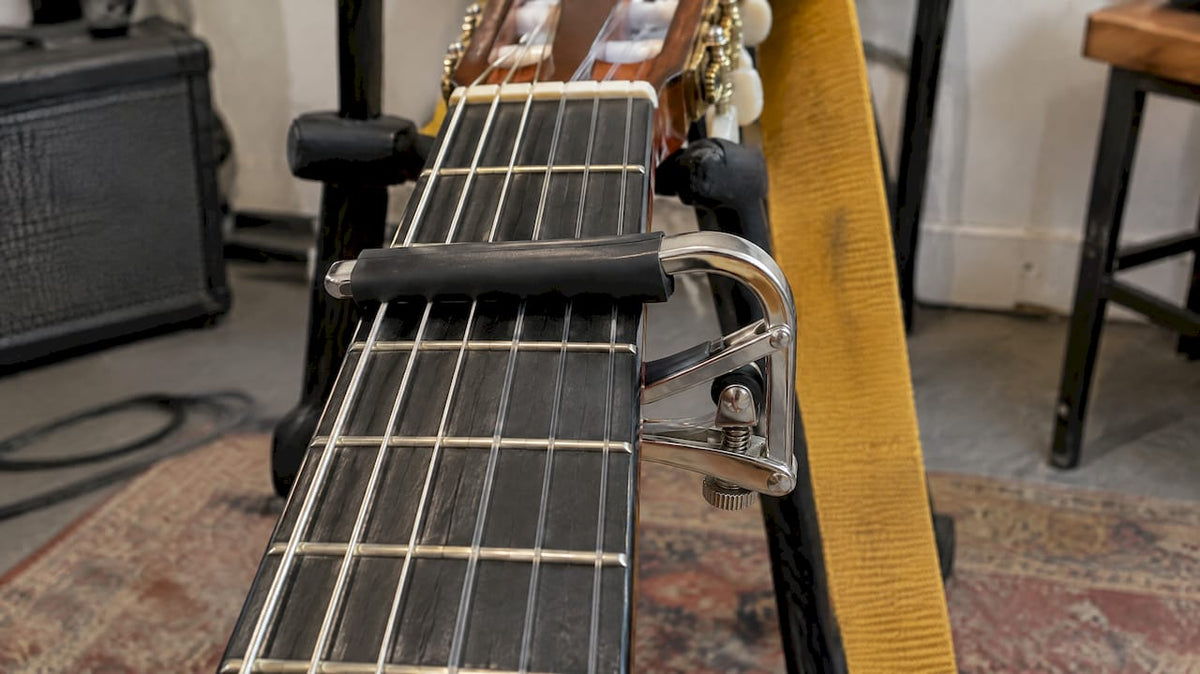
To use a capo, tune your guitar first, then clamp the capo across all six strings just behind the fret you want, so the bar sits parallel to the fret wire. Check the tuning again, then play the same chord shapes you already know. Every fret you move the capo up raises the pitch by one semitone. That is the whole trick, and the rest of this guide is about doing it cleanly, choosing the right fret and avoiding the mistakes that make a capo sound out of tune.
If you want a short drill-based companion to this guide, we also have a piece on how to put a capo on a guitar with three exercises for clean changes.
Table of Contents
- What a capo actually does
- How to put a capo on, step by step
- Which chord are you actually playing?
- How to know which capo fret to use
- Types of capo and which suits your guitar
- Using a capo on electric, bass and classical guitars
- Common capo mistakes and how to fix them
- Is using a capo cheating?
- Our view: what we tell customers in the shop
- Get a capo and a setup that works together
- FAQ
- Sources
What a capo actually does
A capo clamps down all the strings at one fret, which shortens their vibrating length. Your open strings now sound higher, and so does every chord shape you play. A capo at the 2nd fret turns an open G shape into an A chord, without you learning anything new.
There are three common reasons to reach for one, as Andy Guitar sets out:
- To match a singer’s range. If a song sits too low or too high for your voice, you move the capo up or down and keep the same shapes.
- To avoid awkward barre chords. Open chord shapes are easier on the hand than a run of full barres.
- To get a different tone. Playing open shapes higher up the neck gives a brighter, more chiming sound that is hard to copy in the lower positions.
Some songs also need one to sound right. The same source points to Oasis’s Wonderwall, which is played with a capo at the 2nd fret to match the recording.
How to put a capo on, step by step

1. Tune first, without the capo
Start in tune. Tommy Emmanuel’s view, reported by Guitar World, is that tuning matters most, because a badly placed capo will pull the guitar out of tune. If your ear or tuner skills are rusty, our guide to tuning your guitar fast, by ear or with a tuner takes about five minutes to work through.
2. Choose the fret
Count frets from the nut (the bridge-like strip at the headstock end). The 1st fret is the one nearest the nut. If you are working from a chord chart that says “capo 3”, the capo goes at the 3rd fret.
3. Place it just behind the fret wire
Position the bar parallel to the fret, close to the metal wire but on the nut side of it. Not on top of the wire, and not in the middle of the gap. Andy Guitar’s advice, quoted in the research for this piece, is the same: sit just behind the fret. Too far back and the strings buzz or go dull. Too close to the wire, or on it, and the notes sharpen or choke.
4. Clamp it evenly
The pressure should be enough for every string to ring clearly, and no more. Squeezing harder than you need pushes the strings sharp. With a spring-loaded capo, Tommy Emmanuel recommends resting the guitar at a slightly flat angle against your knee and, once the capo is on, pressing across the strings with your palm so the pressure settles evenly. Both tips come from the Guitar World lesson.
5. Re-check the tuning
The clamp changes the tension on the strings, so play each open string and fix any that have drifted. Do this every time you move the capo, not just the first time. Small tweaks are normal; big jumps tell you the capo is crooked or too tight.
6. Play your usual shapes
Finger the chords as though the capo were the nut. The shape name stays the same, but the sounding chord changes. Strum slowly and listen for buzzing on each string before you start the song.
Which chord are you actually playing?
This is where most beginners get confused. You hold a G shape, but the chord that comes out is not G. Move up the neck one fret at a time and the sounding chord rises a semitone each time.
Here are the common open shapes and what they sound like with the capo in place:
| Capo fret | G shape sounds as | C shape sounds as | D shape sounds as | E shape sounds as | A shape sounds as |
|---|---|---|---|---|---|
| 0 | G | C | D | E | A |
| 1 | A♭ | D♭ | E♭ | F | B♭ |
| 2 | A | D | E | F♯ | B |
| 3 | B♭ | E♭ | F | G | C |
| 4 | B | E | F♯ | A♭ | D♭ |
| 5 | C | F | G | A | D |
So a song in B with a lot of awkward barre chords can be played with G shapes and a capo at the 4th fret. A song in E can be played with C shapes and the capo at the 4th fret. Andy Guitar’s piece on working out what chords you are actually playing is a useful read if the arithmetic trips you up.
A quick way to work it out
Count the capo fret in semitones from the chord you are fingering. G with a capo at the 2nd fret: G to G♯ is one, G♯ to A is two, so you hear A. Write the result on your chord sheet the first few times, and soon you will do it in your head.
How to know which capo fret to use
There are two practical ways to answer this.
Start with the singer. Play the song without a capo and sing it. If the top notes strain, move the capo up a fret or two and sing again. If the low notes disappear, take it down. Keep the shapes you find comfortable (G, C, D, Em, Am are the friendliest) and shift the capo until the key suits the voice.
Start with the chords. If the chart is full of barres, work out the key, then pick the capo position that lets you play it with open shapes. A song in F with an F, B♭ and C progression is hard on a beginner, but with a capo at the 1st fret you can play E, A and B… and if the B is awkward, the 3rd fret and open D shapes give another route. Try a couple of positions and choose the one where your fingers are relaxed and the voice sits well.
If you are playing with others, agree the key first, then decide who uses a capo. Two guitarists in the same shapes sound thin. One player with a capo at the 5th fret and another in open position gives you two different voicings of the same chord, which sounds fuller.

Types of capo and which suits your guitar
Not every capo suits every guitar. The main designs are:
- Spring-loaded clamp. Quick to move, one-handed, great for live use. Pressure is fixed by the spring, so check tuning carefully.
- Adjustable-tension or screw type. Slower to move, but you can set the pressure precisely. Many players prefer these for studio and acoustic work.
- Partial capo. Covers only some strings, which opens up unusual voicings and drop-style sounds without retuning. Our Kyser partial capo for acoustic guitar is one example.
- Radius-matched capos. Classical guitars have flatter fingerboards and wider necks, so they need a capo made for them, like the Shubb classical capo.
- 12-string capos. Twelve strings need wider, stronger pressure. The Shubb 12-string capo is made for exactly that.
A flat-radius capo on a curved acoustic fretboard can leave the outer strings buzzing, and a standard capo on a classical neck may not even cover all six strings. If a capo never seems to work on your guitar, the capo design is often the real cause, not your technique.
We stock a range of capos and other small essentials in our guitar accessories collection. If you are building up your kit, our accessories guide covers the other items most players end up wanting.

Using a capo on electric, bass and classical guitars
Electric guitar
Capos work fine on electrics, and they are used for the same reasons: key changes and open voicings. Electric guitars usually have lighter strings and a flatter radius, so a gentle capo is enough. Over-squeezing is easier to do on an electric, so watch for notes going sharp. If you are choosing between guitar types as a beginner, our comparison of acoustic and electric guitars for beginners explains how they feel and sound different.
Acoustic guitar
This is the capo’s natural home. Acoustic strumming and fingerpicking in open shapes, with a capo to change the key, is what most singer-songwriters do. Check that the capo suits your neck profile and that the strings are fresh.
Classical and Spanish guitars
Nylon strings and a wide, flat neck call for a capo that spreads its pressure properly. Use one designed for classical guitar and place it as carefully as you would on steel strings. Browse our classical and Spanish guitars if you are looking for an instrument as well.
Bass
Capos are rare on bass, and the string thickness makes them awkward. Most bass players change key by moving position instead.
Alternate tunings
A capo works with tunings other than standard. In open D, for example, a capo at the 2nd fret puts you in open E without retuning anything. We explain the tuning itself in what open D tuning is and how to set it up, and the same logic applies to open G.
Common capo mistakes and how to fix them
| Problem | Likely cause | Fix |
|---|---|---|
| Buzzing strings | Capo too far from the fret wire, or too little pressure | Move it closer to the wire and tighten a little |
| Whole guitar sounds sharp | Clamp too tight, or capo on the wire | Loosen it, and re-tune |
| One string goes sharp or flat | Capo crooked, so it pulls one side | Straighten it parallel to the fret |
| Muted notes on the top or bottom string | Capo does not match the neck radius | Try a capo made for your neck type |
| Tuning drifts every song | Old strings, or tuning not re-checked after clamping | Change strings and tune with the capo on |
Old or worn strings are more easily pulled out of shape by the capo’s pressure, according to Andy Guitar. If you cannot get a capo to sit cleanly, a set of fresh strings is the cheapest thing to try first. You can pick them up from our guitar strings collection, and we also offer an in-store restring service.
Do not leave it on the neck
Take the capo off when you finish playing. Leaving one clamped on in storage can mark the strings, the fretboard and the capo’s own rubber padding, as Andy Guitar warns. Clip it to the headstock only while you play, and put it in the case pocket afterwards.
Is using a capo cheating?
No. Players from folk to pop use capos to change key, and many classic arrangements depend on them. The fair caveat is about balance. Experienced teachers warn that if you only ever use a capo to dodge barre chords, your technical growth can stall, and you may struggle if your capo breaks or goes missing, as Geoff Cooper’s guitar tips argue.
Our advice is to use both. Learn the barre shapes slowly alongside your capo playing, and understand why a capo works. A French-language guide to barre chords has clear diagrams that are easy to follow even if you do not read French. A little barre practice each day, with the capo for the songs you want to play now, is a sensible balance.
Our view: what we tell customers in the shop
We set up and inspect every instrument we sell, and the most common capo problem we see across the counter has little to do with the capo. It is a guitar that is slightly out of tune, on tired strings, with the capo clamped far too hard. Fix those three things and most “my capo does not work” complaints disappear.
Our advice is simple. Buy a capo that fits your neck, not just the cheapest one. Put it just behind the fret, with the lightest pressure that gives a clear note. Re-tune with it on. And try it in the shop on your own guitar if you can: it takes a minute and shows you whether the radius matches.
If the capo still will not sit cleanly, the issue may be the guitar itself, such as high action, uneven frets or a neck that needs adjusting. That is what a proper setup is for, and it is a job we do in the workshop.
— Music
Get a capo and a setup that works together
If you would like to try a capo on your own guitar, visit us in Huntingdon, Cambridgeshire, or browse online. We stock capos and accessories, new and pre-owned acoustic guitars and electric guitars, and can set up or repair the guitar you already own. See everything on musicstreet.co.uk.
FAQ
How do you know what capo to use?
Start with the song’s key and your voice. Sing the song and move the capo up until the melody sits comfortably. Then choose the open shapes that give you the chords you need. If the capo is for a specific recording, check the chart: it will normally say which fret to use.
Where should I put my capo for the key of A?
It depends on the shapes you want. With G shapes, put the capo at the 2nd fret. With C shapes, put it at the 9th, which is high and rarely practical. With E shapes, the capo goes at the 5th fret to give you A. D shapes need the 7th fret. Most players choose the 2nd fret with G shapes for A.
What chords can I play with a capo?
Any chord you can play without one. The shape stays the same and the pitch rises. The easiest open shapes for capo work are G, C, D, Em, Am and E. The sounding chord is the shape plus the number of semitones the capo adds.
Does a capo damage your guitar?
Not if you use it properly and remove it after playing. Leaving it on in storage can damage the strings, the fretboard and the capo’s rubber, according to Andy Guitar. Use a capo that fits your neck and avoid over-tightening it.
Sources
- How to put a capo on the right way: Tommy Emmanuel explains, Guitar World
- How to use a CAPO and WHY you should have one, Andy Guitar
- How To Use A ‘Capo’, Andy Guitar
- Capo confusion? How to know what chords we are actually playing, Andy Guitar
- Geoff Cooper’s Guitar Tips



Share:
How to Use a Capo: Fit, Fret Choice and Tuning