

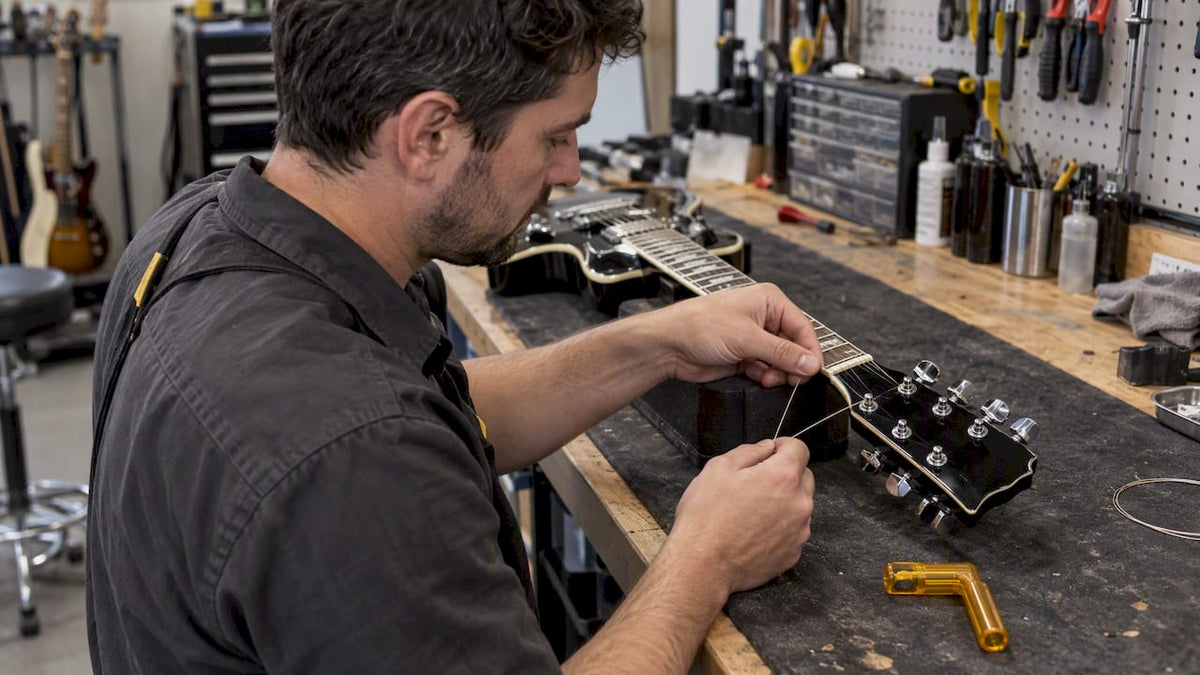
Locking tuners are simple to use once you know the one rule: the string is clamped at the post, so you do not wind it round and round. Thread the string through the post, take up a little slack, lock it, tighten it to pitch, stretch it, retune and trim. The lock stays shut while you play. You only open it when you change strings.
This guide covers that routine for the three common designs, how much slack to leave, the mistakes that damage tuners, and why a guitar with locking tuners can still drift out of tune.
Table of Contents
- What locking tuners actually do
- Identify your type first
- Before you start
- How to restring locking tuners, step by step
- What if my tuners are the auto-locking kind?
- Do you still wrap the string?
- Common mistakes
- Why you may still have tuning problems
- Fitting locking tuners to a guitar that does not have them
- Our view at Musicstreet
- Need a hand with strings or a setup?
- FAQ
- Sources
What locking tuners actually do
A standard machine head holds the string by friction and wraps. Each wrap is a place where the string can creep as you bend notes or use a tremolo arm. A locking tuner clamps the string inside or on top of the post, so there is no need for extra wraps and string changes get much quicker. That is why you see them on tremolo-equipped guitars and on stage, where a broken string has to be replaced in a hurry.
Two things they do not do are worth knowing before you start:
- They do not change how you tune. You still turn the same button the same way. The lock is not released to retune.
- They do not fix every tuning problem. StewMac’s own guide is blunt that locking posts remove slack at the tuner, but they do not cure a sticky nut or bridge friction. More on that below.
Identify your type first
The method differs slightly by design. StewMac sorts them into three types: rear thumbwheel (screw-lock), top-locking cap (PRS-style) and auto-locking (cam-lock). Look at your headstock and the back of it.
| Type | How to spot it | How you lock the string |
|---|---|---|
| Rear thumbwheel | A small knurled wheel on the back of the tuner, behind the headstock | Turn the wheel clockwise from behind |
| Top-locking cap (PRS-style) | A small cap or screw on top of the post | Turn the cap clockwise from the front |
| Auto-locking (cam-lock) | No extra wheel or cap, usually a standard-looking button | The clamp closes itself as you bring the string to tension |
If you are unsure which you have, check the maker’s instructions for your model before you cut any string. Guessing is how people end up forcing a clamp that was never meant to be turned.
Before you start
You need new strings, a pair of side cutters, a tuner and a clean, well-lit surface. If you do not have a tuner you trust, a clip-on is the easiest, for example the PRS clip-on headstock tuner. If you are new to the tuning itself, our step-by-step guitar tuning guide covers the basics.
A few preparation habits make everything smoother:
- Change one string at a time if the guitar has a floating tremolo, so the tension on the neck and bridge stays balanced.
- Open the lock fully on the old string, then slide the string out. Do not yank it through.
- Turn the post hole so it points straight along the string path towards the nut. A hole that sits sideways makes the string kink as it goes in.
- Wipe the fretboard while the string is off, if you are doing a full change.
Strings for any style are in our guitar strings collection.
How to restring locking tuners, step by step
This is the routine for a thumbwheel or top-locking design. Auto-locking owners can skip the lock and cap steps.
1. Loosen the lock and align the hole
Back the thumbwheel or cap off a few turns so the hole in the post is open. Rotate the post so the hole points at the nut slot for that string.
2. Thread the string and set the slack
Feed the new string through the bridge or tailpiece as normal, then through the post hole. The slack matters. You need a small amount so that the string can settle against the post as it comes up to tension. PRS’s instructions for its Phase II, III and S2 tuners say to pull the string through the hole and over two fingers, or about 1.5 inches, at the nut, which works out at roughly 5/8 to 3/4 inch of actual slack. Other makers publish figures in millimetres, usually in the region of 10 to 20 mm. Treat the manufacturer’s number as the answer for your guitar, and use the two-finger trick if you have no instructions.
Too little slack and the string runs out of length before it reaches pitch. Too much and you get a loose coil of string on the post, which defeats the point of the design.

3. Hold the string down and lock it
Keep light tension on the string with one hand, pulling it gently towards the nut, and turn the lock clockwise with the other. The “righty tighty” rule applies. Stop when it is snug.
Finger-tight is the target. For thumbwheel tuners you do not need pliers, and using them risks damaging the clamp or cutting into the string. PRS says its top-locking caps should be tightened finger-tight, with at most an extra 1/8 turn using a coin if really needed. Anything beyond that is over-tightening.
4. Tune up to pitch
Turn the tuner button as you always have. The string should wind on to the post with a quarter to half a turn at most, not a neat spiral. Make sure the string is sitting properly in the nut slot and the bridge saddle as it comes up.
5. Stretch the string
This is the step people skip, then blame the tuners. Clamping does not stretch a new string for you. Practitioners are consistent that you still stretch the string with your usual method: gently pull it away from the fretboard along its length, retune, and repeat until the pitch stops dropping. Be gentle, particularly on the thin strings.
6. Trim the excess
Once the string holds pitch, snip the surplus beside the post. Leave about a centimetre or so if you like a little margin, but remember a long sharp tail on a headstock will find your fingers. Do not trim before the string has settled, in case you need to pull more through.
What if my tuners are the auto-locking kind?
Cam-lock tuners have no wheel or cap. You feed the string through the hole, pull it taut with the right amount of slack, and wind it up. The clamp grips as tension builds. The trap is leaving too much slack, which stops the clamp biting cleanly, so measure the slack the same way and keep tension on the string as you start winding.
Do you still wrap the string?
No. On standard instruments, a straight-through approach is the design intention. You may see advanced players mention methods such as the 123345 method in Guitar World’s restringing feature, which some use for extra security on particular strings where headstock geometry creates tension problems. For most guitars you will never need it. Start with the plain method, and only experiment if you have a specific problem.
Common mistakes
- Over-tightening the lock. It risks the internal clamp or snapping the string core. Finger-tight, as above.
- Too much slack. The string wraps messily, then settles and goes flat.
- Too little slack. The string reaches full tension before the clamp has gripped it.
- Skipping the stretch. New strings go flat whether the tuners lock or not.
- Loosening the lock to retune. You do not need to. Once locked, you turn the button normally. You only release the lock when you remove the string.
- Hole not aligned. A twisted hole forces the string to bend sharply at the post.
Why you may still have tuning problems
Locking tuners can help, but a lot of guitars that drift are not suffering at the machine head. Nut slot friction and bridge setup are more common culprits than the tuners, and a pair of tremolo springs set badly can make things worse. Check these before you spend on hardware:
- Nut slots. A string that catches in a slot makes a faint “ping” as you tune and then releases its tension later. A tiny amount of graphite or lubricant can help, but badly cut slots need a proper fix.
- Bridge or tremolo. Does the bridge return to the same place after you use the arm? Are the saddles smooth?
- String gauge and age. Dead strings never hold pitch for long.
- Neck and action. Seasonal changes in the UK, from a cold car boot to a warm living room, move wood. If the guitar feels different, our post on five signs your guitar needs a setup is a good checklist.
Guitarist magazine has also noted that tuning stability problems on new guitars rarely come from the tuners alone, which fits what we see: the fix is usually a setup issue, not a part.
Fitting locking tuners to a guitar that does not have them
If you want to upgrade, MusicRadar’s fitting guide explains why: they clamp-lock the string at the tuner, which helps players who struggle to wind neatly and consistently. Before buying, measure three things on your existing tuners: the hole diameter in the headstock, the position of the mounting screw (single screw, two-pin or no-screw designs differ), and the post height. A mismatch can mean drilling into the headstock, which is permanent. If a headstock needs any modification, have a professional do the work. Keep the old tuners safe, too, in case you sell the guitar later and a buyer wants it original.

Our view at Musicstreet
We inspect and set up every instrument we sell, and tuning stability is one of the first things we check, long before anybody thinks about swapping parts. Most of the time a guitar that will not stay in tune has a nut, bridge or string problem, and a proper setup brings it back without any new hardware.
Our advice for UK players is simple:
- If your guitar already has locking tuners, learn the routine above and stop worrying about it. It takes a couple of strings to become second nature.
- If you are thinking of fitting them, get the guitar checked first. You may find you do not need them.
- If you play a tremolo guitar or change strings on gigs, they are a sensible upgrade, and well worth doing correctly.
- If you are not confident taking strings off a floating bridge, ask us. It is faster and cheaper than a snapped string or a damaged headstock.
For related tuning jobs, our guides to tuning a guitar quickly by ear or with a tuner and tuning down a half step cover what comes next.
— Music
Need a hand with strings or a setup?
If you would rather have it done properly, we offer guitar setups, servicing and repairs at our Huntingdon, Cambridgeshire shop, plus an in-store restring service. You can see the strings and the restring service on our guitar strings page, or start at musicstreet.co.uk for setups and repairs. If you are looking for a guitar that already has locking tuners fitted, browse our electric guitars and try them in store.

FAQ
Do you still need to wrap strings with locking tuners?
No. The clamp holds the string at the post, so you only need a quarter to half a turn of string to reach pitch. Extra wraps add slack and can lead to the very slipping that the tuner is designed to avoid.
Do I loosen the lock every time I tune?
No. You lock the string once when you fit it, then tune with the button as normal. You only loosen the lock when you take the string off. This is the question most beginners ask, and the answer is that tuning does not change.
Do locking tuners stay in tune better?
They can, by reducing slippage at the post. They are not a guarantee, though. If the nut slots bind or the bridge sticks, the guitar will still drift, so check those and your strings first.
How tight should I make the lock?
Finger-tight is enough. PRS suggests no more than an extra 1/8 turn with a coin on its top-locking caps if absolutely necessary. Do not use pliers on a thumbwheel.
Sources
- How to Use Locking Guitar Tuners, StewMac
- Using PRS Locking Tuners (Phase II, III, S2), PRS Guitars Europe
- How to restring locking tuners the right way, Guitar World
- How to upgrade your guitar by fitting new locking tuners, MusicRadar
- Fine Tuning, Guitarist, January 2025





Share:
Clean Matte Finish Acoustic Guitar Safely