


Open tuning is when the open strings sound a complete chord, usually major, instead of the jumbled intervals you get with standard tuning. That single change reshapes everything: chord shapes simplify to one-finger barrés, the strings ring with extra resonance and sustain, and slide and folk techniques become far more natural. This guide covers the main variants, including Open G, Open D, Open C and DADGAD, and how to move into them safely.
Table of Contents
- What open tuning actually means
- How open tuning differs from standard tuning in practice
- Common open tunings and when to use each
- How to tune safely and set up for open tunings
- Playing techniques that open tunings enable
- Notable songs and players who use open tunings
- Practical setup and services
- When I recommend open tuning to learners
- Get set up for open tuning the easy way
- FAQ
- Sources
What open tuning actually means
In standard tuning (E A D G B E), strumming the open strings gives you a cluster of unrelated notes rather than a chord. Open tuning rearranges those pitches so the open strings themselves form a triad. According to Wikipedia’s entry on guitar tunings, an open tuning is one where the strings form a chord, often major, when played without any fretting, and this category covers both chordal and modal variants used widely in blues and folk.
Chordal open tunings are the most common type. Open G, Open D, Open C and Open A all fall into this group: strum the open strings and you hear a major chord outright. That means a single finger laid flat across any fret produces a major chord at that fret’s root, which is why slide players gravitate towards them. Barre a finger at the fifth fret in Open G and you get a C major chord with no other fretting required.
Modal tunings work differently. DADGAD, for instance, does not produce a straightforward major or minor triad from the open strings: it creates a suspended, ambiguous sound that sits between major and minor. This is one of the reasons Wikipedia’s broader open tuning overview separates chordal tunings from modal ones, noting that both change the interval relationships across the strings and both appear regularly in folk, blues and slide repertoire.
The naming convention follows the chord the open strings produce. Open G means the open strings spell a G major chord. Open D means they spell D major. Once you know this, you can work out most tuning names without memorising a chart.
Here’s how the interval layout shifts when you move from standard tuning into a representative open tuning:
- Standard tuning: E A D G B E, no chord sounds when played open.
- Open G tuning: D G D G B D, the open strings ring out as a G major chord.
- Open D tuning: D A D F♯ A D, the open strings ring out as a D major chord.
Moving from standard to an open tuning usually means loosening some strings and tightening others, which changes the overall tension balance across the neck. That mechanical shift matters more than most beginners expect, and it shapes a lot of the practical advice later in this guide.
How open tuning differs from standard tuning in practice
The headline difference is chord shapes. In standard tuning, a major chord typically needs three or four fingers spread across different frets. In an open tuning, a single finger barred straight across one fret produces a full major chord, because the open strings are already voiced as that chord and every fret simply transposes it. This is why slide guitarists favour open tunings: a bottleneck slide can only really barre straight across the strings, so having a major chord available at every fret removes the need for complex fretting.
Transposition works differently too. In standard tuning, you can play the same song in a different key just by shifting your chord shapes up or down the neck using a capo, while keeping your fretting patterns. In an open tuning, you have two main options: retune the whole guitar to the new key, or stay in your current open tuning and use a capo to shift the key without retuning. Most gigging players favour the capo route for speed, since retuning mid-set costs time and risks drifting out of tune.
Tone changes noticeably as well. Open tunings tend to produce more ringing sustain and sympathetic resonance, because open strings are left to vibrate freely more often than in standard tuning, where most chord shapes mute at least one or two strings. That extra resonance is part of why open tunings suit drone-heavy folk, blues and roots styles.
- Chord shapes simplify to movable one-finger barrés in most chordal open tunings.
- Capo-based transposition is usually faster and safer than full retuning between songs.
- Open strings ring more freely, adding sustain and a fuller, droning quality to chords.
- Tuning up from standard adds tension and increases the risk of string breakage, which is why many players tune down instead.
There’s a real mechanical trade-off behind that last point. Tuning several strings up to reach a high-tension open tuning puts more strain on the neck and the strings themselves. Players who need a bright, high-pitched open tuning such as Open E often get there by tuning down to Open D first and capoing up two frets, which reaches the same pitch with far less strain, a practice noted on Wikipedia’s Open D tuning page.
Pro tip: When a song calls for a brighter open tuning, try capoing up from a lower open tuning before you retune strings upward. It gets you the same pitch with less risk to your strings and neck.
Common open tunings and when to use each
Each open tuning has its own character, and picking the right one depends on the sound and technique a song calls for.
- Open G (D G D G B D). This is the classic rock and blues open tuning, prized for its punchy mid-range and its suitability for slide work. Dummies’ guide to playing like Keith Richards explains that Open G frees the left hand from conventional chord shapes, supporting the syncopated rhythm work and melodic fills that are harder to pull off in standard tuning. Richards famously uses a five-string version, removing the low string entirely to clean up the low end and anchor his voicings.
- Open D (D A D F♯ A D). A favourite for slide and folk playing, Open D sits at lower overall tension than Open E, which makes it gentler on strings and necks while still giving that ringing, droning major chord quality.
- Open C and its variants, including CGCGGC. Open C produces a particularly rich, deep drone that suits fingerstyle and singer-songwriter material. Because it involves substantial downtuning on several strings, GTDB’s notes on Open C point out that it often calls for heavier string gauges and careful setup attention to keep tension and intonation stable.
- Open E and Open A. Both are bright, sustaining tunings well suited to slide and roots styles, but Open E in particular demands high tension since several strings are tuned up rather than down. Many players reach Open E by tuning to Open D and capoing the second fret instead, sidestepping the extra strain.
- DADGAD and other modal tunings. Rather than a straightforward major chord, DADGAD produces a suspended, modal texture that has become a staple of Celtic music and contemporary fingerstyle playing, prized for its open, ambiguous quality.
If you’re switching tunings regularly, it helps to settle on one tuning per song rather than improvising on the fly, and to label your guitar or keep a dedicated spare instrument tuned to your most-used alternate. That one habit saves more rehearsal time than almost anything else.
How to tune safely and set up for open tunings
Moving into an open tuning is straightforward, but doing it carelessly is one of the fastest ways to snap a string or throw a neck out of alignment. A chromatic tuner is essential here, since open tunings don’t follow familiar reference points the way standard tuning does.

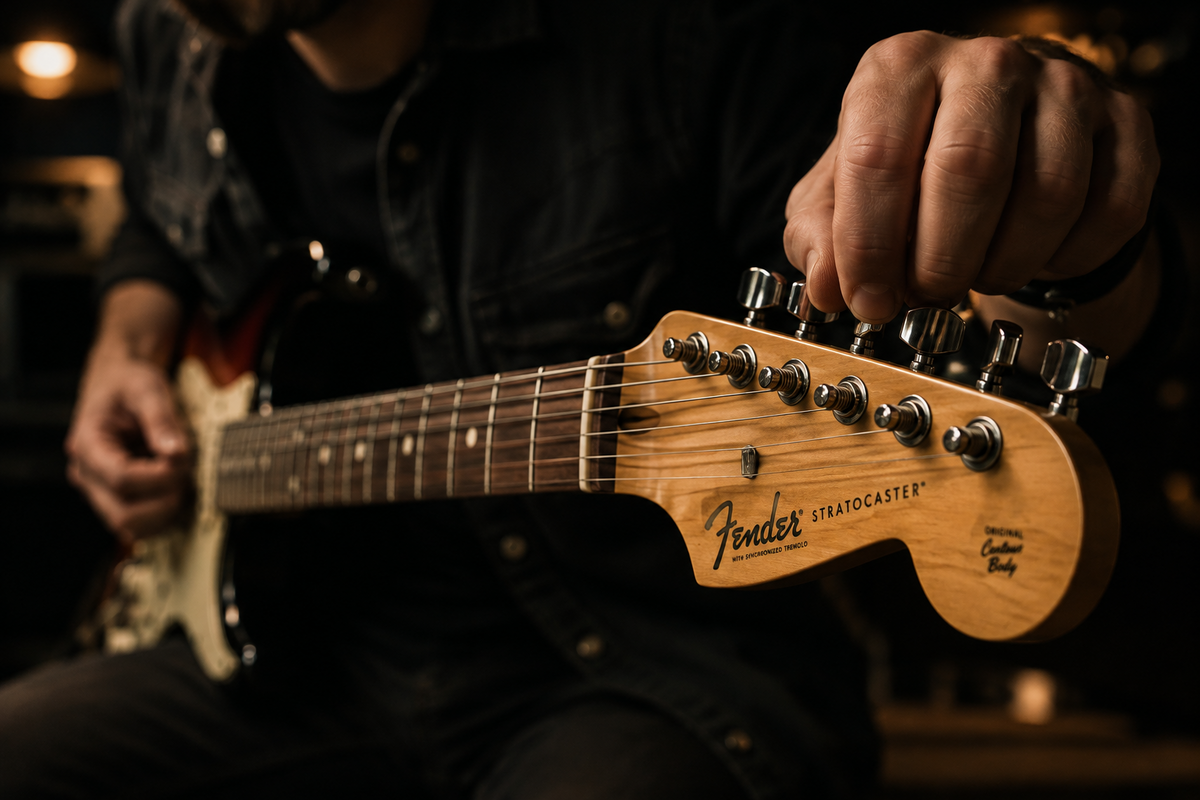
Work through the change gradually. Tune down towards your target pitches rather than cranking strings up to reach them, since tuning down is far gentler on both strings and neck tension. If a tuning genuinely needs higher pitches on certain strings, bring them up slowly and let the guitar settle for a minute or two before fine-tuning again, since wood and strings both need time to adjust to new tension.
String gauge matters more than most players expect. A tuning like Open C, which drops several strings well below standard pitch, often performs better with a heavier gauge set, since thicker strings keep healthier tension and intonation at lower pitches rather than going slack and buzzy. GTDB’s technical notes on Open C back this up directly.
- Use a chromatic tuner and tune down to your target pitches wherever the tuning allows it.
- Choose a heavier string gauge for tunings with substantial downtuning, such as Open C.
- Favour a capo over tuning strings sharp when you need a brighter open tuning.
- Book a professional setup after any significant gauge change or if you notice persistent fret buzz.
Pro tip: If you’re adopting an open tuning permanently rather than just for one song, get the guitar properly set up for it. A few minutes of truss rod and intonation adjustment saves you chasing tuning problems for months.
A capo is genuinely useful here, not just a beginner’s shortcut. Capoing up from Open D to reach Open E, for example, lets you access a higher-pitched tuning without the string breakage risk that comes from tuning several strings sharp, a point Wikipedia’s Open D tuning page makes explicitly.
If you’ve changed string gauges, moved permanently into an alternate tuning, or you’re hearing buzz or intonation problems that won’t resolve with retuning, it’s worth booking a proper setup. A technician checks truss rod relief, adjusts the saddle and nut for the new tension, and confirms intonation across the neck, which protects the instrument and keeps it playing properly under its new string loads. Our guide on tuning to Open G with pro setup checks walks through exactly what to look for before and after the change.
Playing techniques that open tunings enable
Slide playing is the technique most associated with open tunings, and for good reason. Because a flat barre across any fret already produces a full major chord, a bottleneck slide laid straight across the strings gives you clean chords and melody lines without needing to fret individual notes, something close to impossible in standard tuning.

Open tunings also make drones and call-and-response phrasing far easier to produce. Letting one or two open strings ring while you fret a melody on the others creates a constant harmonic backdrop, and doubling notes an octave apart across different strings adds extra depth to simple riffs.
Rhythm playing benefits too. Movable barre shapes become genuinely percussive tools: you can slap a finger down across all six strings at any fret and get a full, in-tune chord instantly, which suits rhythmic strumming patterns that would need far more left-hand movement in standard tuning.
- Practise sliding a bottleneck slowly up and down a single string first, listening for clean intonation before adding chords.
- Let one open string ring as a drone while fretting a simple melody on an adjacent string.
- Work on quick, percussive one-finger barre changes to build rhythmic control.
- Record yourself and check that slide notes land precisely on pitch rather than slightly flat or sharp.
Notable songs and players who use open tunings
Keith Richards built much of his signature sound on a five-string Open G setup, and tracks like ‘Brown Sugar’ and ‘Honky Tonk Women’ are worth studying closely for how the tuning supports his syncopated rhythm style, as Dummies’ breakdown of his technique explains.
Joni Mitchell is closely associated with Open C variants, using them extensively in her fingerstyle songwriting, with ‘Carey’ being a well-known example of how an open tuning supports intricate, singer-songwriter guitar parts. Ry Cooder, meanwhile, is a reference point for slide playing in open tunings across blues and roots music, demonstrating how the format suits melodic slide lines as much as rhythm work.
- Slow a recording down and isolate a short riff before attempting to transcribe it.
- Work out which open tuning the riff likely uses by comparing the chord it implies when played open.
- Adapt the riff to your own tuning rather than copying fingerings blindly, since hand size and guitar setup vary.
Practical setup and services
If you’re changing string gauge for a tuning like Open C, or settling into an alternate tuning as a permanent setup rather than a one-song experiment, that’s generally the point to book a professional check. Signs worth acting on include persistent buzz after retuning, strings that won’t hold pitch, or a neck that feels different under the new tension.
Our step-by-step post on tuning to Open G with pro setup tips walks through the checks worth running before you commit to a gauge change, and our guide to tuning up a guitar by ear or tuner covers the basics if you’re still building confidence with a tuner.
For the tools themselves, we recommend a few specific products for anyone working regularly in open tunings:
- The PRS Clip-On Headstock Tuner gives fast, accurate pitch readings, which matters when a tuning doesn’t follow familiar reference notes.
- The G7Th Newport Partial5 0218 capo lets you shift between related open tunings, such as Open D to Open E, without retuning strings sharp.
- The John Walker Tuning Fork B 466.2Hz offers a reliable acoustic reference pitch for players who prefer tuning partly by ear alongside an electronic tuner.
A paid setup after a gauge or tuning change typically covers truss rod relief, saddle and nut adjustments, and full intonation checks, which keeps the instrument stable under its new tension rather than slowly drifting out of tune.
When I recommend open tuning to learners
Open tuning is worth learning when a specific song or sound calls for it, not as a general shortcut to easier chords. It genuinely does simplify some voicings, but it also narrows your available chord vocabulary at any given fret, and switching tunings mid-practice session costs time that’s easy to underestimate when you’re starting out.
If you can manage it, keeping one guitar in standard tuning and a second permanently set up for your most-used alternate saves a lot of friction. If that’s not practical, label your guitar or write the tuning on a sticky note on the headstock, and build retuning time into your rehearsal plan rather than treating it as an afterthought.
Once you’ve settled on an alternate tuning as a long-term setup rather than a one-off experiment, it’s worth getting a technician to check gauge, intonation and neck relief properly rather than guessing.
— Music
Get set up for open tuning the easy way
Switching into an open tuning is far less stressful when you’ve got the right reference tools and a setup that actually suits the new string tension. We recommend the PRS Clip-On Headstock Tuner for fast, reliable pitch checks, the G7Th Newport Partial5 0218 capo for moving between related open tunings without retuning strings sharp, and the John Walker Tuning Fork B 466.2Hz for players who like a solid acoustic reference alongside their tuner.

When you’re ready to commit to an alternate tuning permanently, or you’ve just changed string gauge for something like Open C, our guitar setups, servicing and repairs cover truss rod, intonation and nut adjustments so your instrument holds up properly under the new tension. We also run an in-store restring service if you need a heavier gauge fitted correctly rather than guessing at home. Browse our setup options or book a service through our site whenever you’re ready to make the switch.
FAQ
What tuning did Kurt Cobain use?
Kurt Cobain used several tunings across his recordings, including standard tuning and various drop and detuned variants, rather than a single fixed open tuning throughout his work. For general background on how open and alternate tunings function, Wikipedia’s guitar tunings overview explains the broader categories these variants fall into.
What is an open C tuning?
Open C tuning arranges the open strings so they ring out as a C major chord, with the CGCGGC variant being a well-known version. It requires substantial downtuning on several strings, which often calls for a heavier string gauge and careful setup attention, as GTDB’s notes on Open C describe.
What guitarists use open G tuning?
Keith Richards is the player most closely associated with Open G, particularly in his five-string configuration that removes the low string for a cleaner, punchier mid-range. Dummies’ guide to his technique explains how the tuning supports his syncopated rhythm style and melodic fills.
What is the easiest open tuning for guitar?
Open G and Open D are generally considered the most approachable open tunings, since both involve moderate tension changes from standard tuning and produce straightforward major chords across the open strings. Open D is especially popular with beginners moving into slide playing because of its comparatively gentle string tension relative to tunings like Open E.
How does open tuning change chord shapes?
In an open tuning, a single finger barred flat across any fret produces a full major chord, because the open strings already form that chord and every fret simply shifts it up in pitch. This replaces the multi-finger shapes needed for most major chords in standard tuning, as outlined across Wikipedia’s open tuning overview.




Share:
Aria Pro II Bass: Quality & Value Guide