


Open D tuning sets your six open strings to a D major chord, from low to high: D, A, D, F#, A, D. Strum without fretting anything and you hear a full, ringing chord. From standard tuning you lower four strings and leave two alone, and a single finger laid across the fretboard then gives you a major chord at almost any fret.
That is the short answer. The rest of this guide covers how to tune into it, why players love it, which chords to learn first, and what the change does to your guitar. If you only want the steps, jump to the tuning section.
Table of Contents
- The notes in open D tuning
- How to tune your guitar to open D
- Why guitarists use open D
- Chord shapes to learn first
- What open D does to your guitar
- Our view on open tunings
- Get your guitar ready for open D
- Related tunings to try next
- FAQ
- Sources
The notes in open D tuning
Standard tuning runs E-A-D-G-B-E. Open D runs D-A-D-F#-A-D. The Music Encoding Initiative’s tuning definitions write it in scientific pitch as D2 A2 D3 F#3 A3 D4, which tells you something useful: the pitch range is much the same as standard tuning. The guitar is still a guitar. Only the relationships between the strings have changed.
Look at what those notes are made of:
- D appears three times (strings 6, 4 and 1).
- A appears twice (strings 5 and 2).
- F# appears once (string 3).
D, F# and A are the three notes of a D major triad. Every open string belongs to the chord, so nothing clashes. That is why Andy Guitar’s open D lesson describes the unfretted strings as a full, resonant D major chord.
One point of confusion: open D is not the same as drop D. Drop D lowers only the sixth string to D and leaves the rest alone, so the open strings do not form a chord. The London Guitar Institute treats open D as a step further on from drop D, with a few more strings altered.

How to tune your guitar to open D
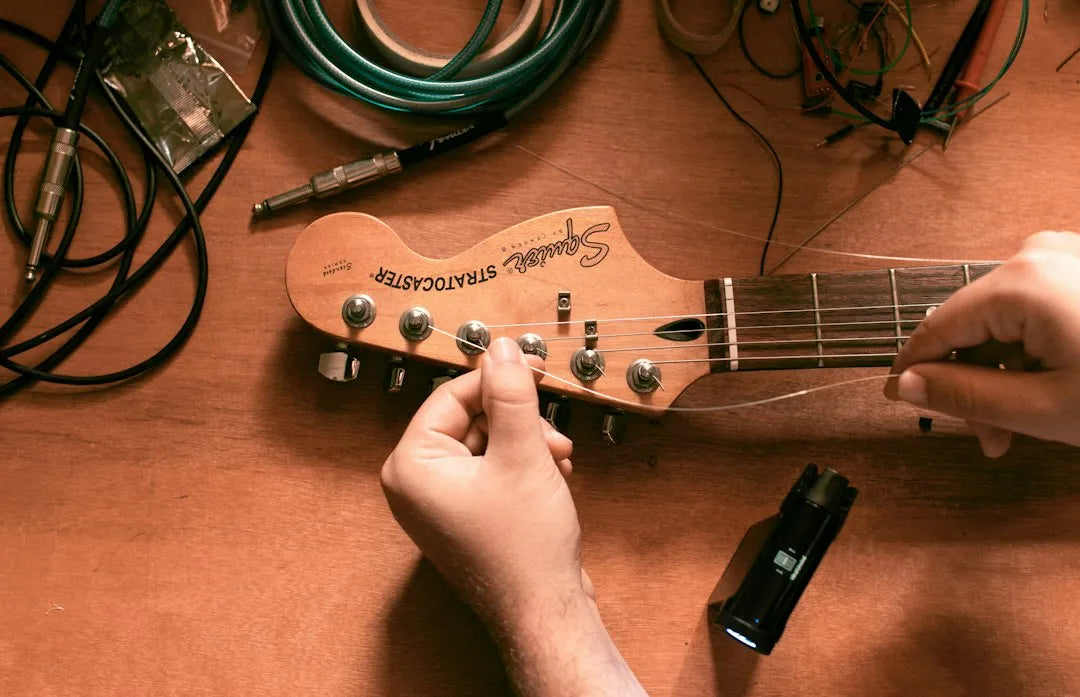
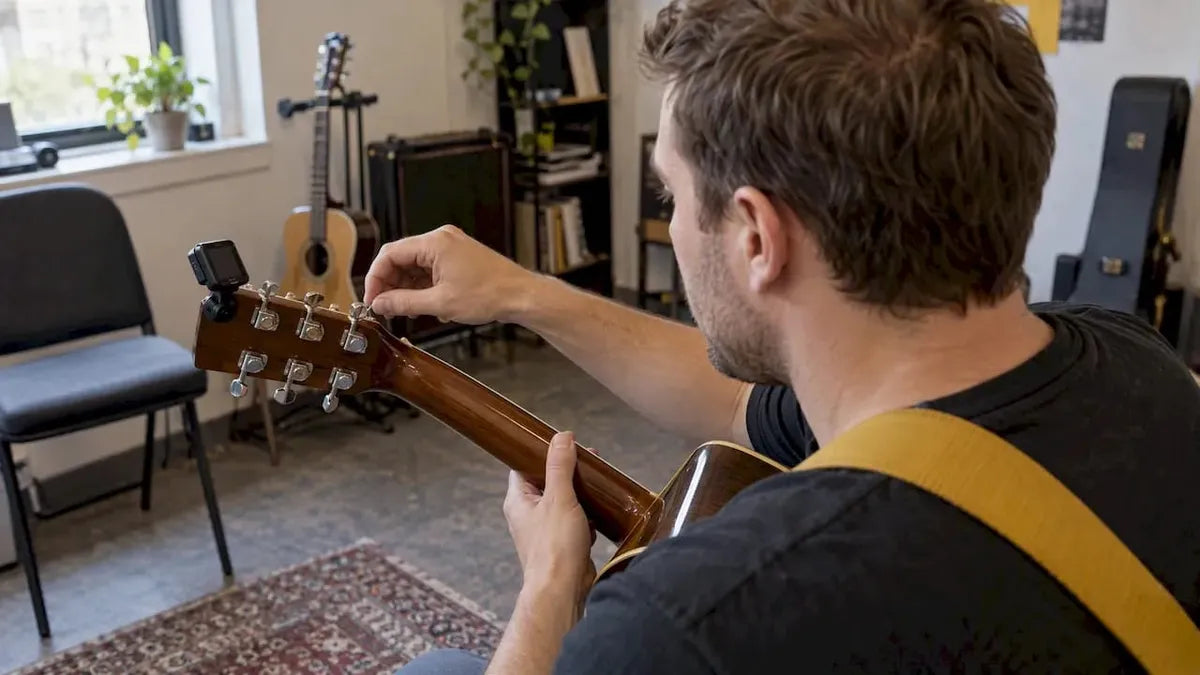
You need a tuner you trust. Because the tension changes on four strings at once, the London Guitar Institute recommends a chromatic tuner for accuracy. A clip-on tuner such as the D’Addario Eclipse Tuner works well, and there is a USB rechargeable version if you would rather not carry spare batteries.
Start from standard tuning (E-A-D-G-B-E), in tune. If you are not confident about that step, our step-by-step guitar tuning guide walks through it.
- 6th string (low E): lower it a whole step to D.
- 5th string (A): leave it alone.
- 4th string (D): leave it alone.
- 3rd string (G): lower it a half step to F#.
- 2nd string (B): lower it a whole step to A.
- 1st string (high E): lower it a whole step to D.
A handy check: the 4th string D and the 1st string D should sound two octaves apart, and the 6th string D should sit an octave below the 4th. Play the 5th and 2nd strings and you should hear the same A, again an octave apart.
Tune down, not up
Every string you move goes lower, which suits you. Guitar-chord.org advises tuning by decreasing tension where you can, as it is kinder to the neck and helps strings settle. If you overshoot and go flat, drop a little below the note and come back up slowly, then check again after a minute, because strings stretch and drift.
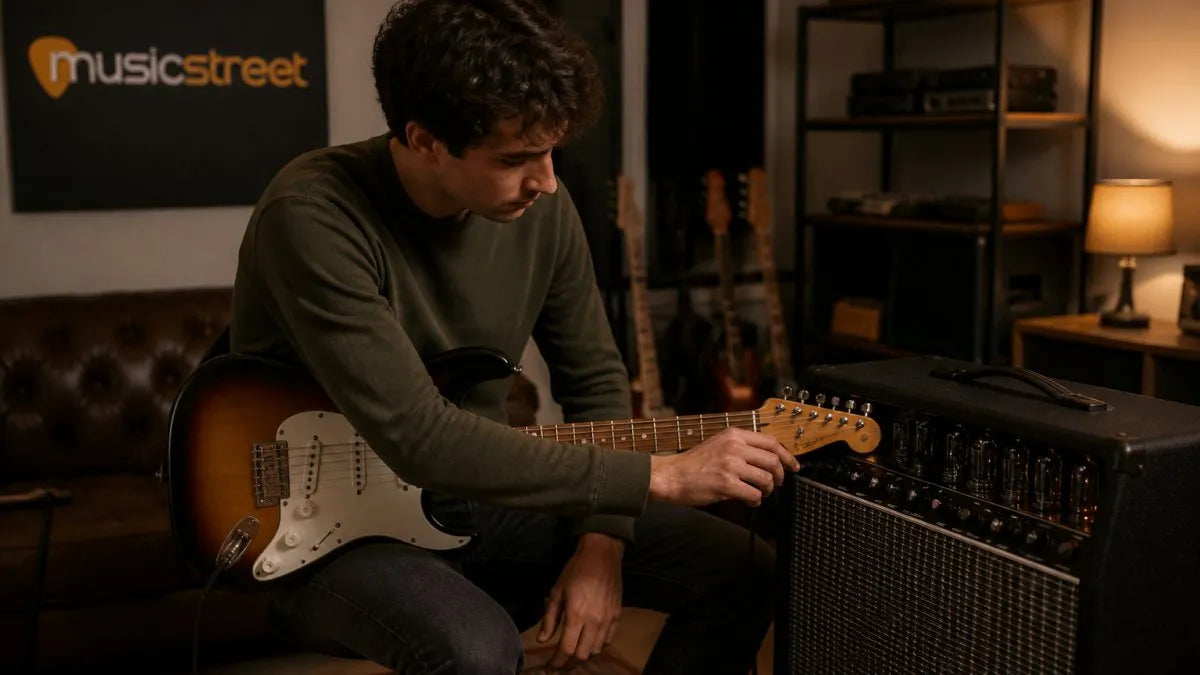
The whole tuning is looser than standard. On an acoustic, that can leave the strings feeling slack and slightly buzzy, particularly on the low D. That is normal, and it is the first sign of what we discuss in the setup section below.
Going from open E, or to a minor version
If you already know open E, you can get to open D by tuning every string down one whole step, as one guide to open tunings notes. Open D minor (D-A-D-F-A-D) is one string away: lower the third string a further half step from F# to F. The Sethares collection of tunings places open D in a family of related tunings, alongside modal DADGAD, and learning one helps you with the others.

Why guitarists use open D
One finger, one chord
This is the beginner’s hook. Lay one finger flat across all six strings and every fret gives you a major chord. Alex Abramovich, writing in the London Review of Books, describes how players can bar the strings straight across with one finger and move it fret by fret up the neck. The chords you get at the key positions are the ones most songs lean on:
| Fret (barred) | Chord | Role in the key of D |
|---|---|---|
| Open | D major | I |
| 5th | G major | IV |
| 7th | A major | V |
| 12th | D major (octave up) | I |
Those three shapes, open, fifth fret and seventh fret, give you the I-IV-V progression that underpins countless folk, blues and rock songs. You can play along with a basic song within minutes of tuning up, which is a rare thing on guitar.
The drone effect
Because three strings are D and two are A, you can let those notes ring while you pick a melody on the others. The Sethares document and its commentators point to this as the main beauty of the tuning: a rich, almost harp-like sound that is hard to copy in standard tuning. It is a big part of why open D is popular for folk fingerstyle, which Andy Guitar’s lesson calls out among other genres.
Slide guitar
With every open string part of the chord, a slide laid across any fret sounds right, as long as you land accurately. Guitar-chord.org notes that open D is especially popular with slide players, and also associated with folk. The London Guitar Institute lists Ry Cooder among the well-known users, along with Joni Mitchell and Bob Dylan, whose Blood on the Tracks is the album the institute singles out.
Breaking out of a rut
Losing your familiar shapes is a feature. Stefan Joubert of the London Guitar Institute advises embracing the unfamiliar: it may feel disorienting, but re-mapping the fretboard is what unlocks new ideas and breaks repetitive habits. Many players write their best new riffs in a tuning that stops their hands going on autopilot.
Chord shapes to learn first
Start with these before you attempt anything fancy. Fret numbers refer to a barre across all six strings unless stated.
- D major: all strings open.
- G major: barre at the 5th fret.
- A major: barre at the 7th fret.
- E major: barre at the 2nd fret.
- C major: barre at the 10th fret.
- B minor feel: try barring the 4th fret, then fretting the 3rd string up a fret to lower the third. Moving the F# note down a fret on a barred chord turns it minor.
Once the barres feel natural, add single fingers. Fret the second string at the 2nd fret to add a colourful sixth to an open D chord, or fret the third string a fret higher for suspended sounds. Then try a few lines of tab. If tab is new to you, our guide to reading guitar tablature covers a simple four-bar riff.
Capos work beautifully here. The Sethares document notes that experienced players clamp a capo on an open D guitar to reach other keys while keeping the voicing of the tuning. Capo at the 2nd fret and you are in open E shapes; at the 3rd you are in open F. Your finger patterns stay the same.
What open D does to your guitar
This is the part most tutorials skip. Retuning is not harmful in itself, but it is not free.
Tension and feel
Lowering four strings reduces overall tension. On a light set, the strings can flap against the frets when you dig in, and bends on electric guitars feel looser. Some players move to a slightly heavier gauge to compensate. If that appeals, ask us about your guitar first, because the right set depends on the instrument and the scale length.
Nut slots and stability
Guitar-chord.org points out that constantly switching between standard and open D can wear the nut slots, and that you may notice tuning instability if your guitar setup is not optimised for the changing string gauge and tension. A well-cut nut and a properly set up guitar make a real difference here. A guitar that sits in tune after moving to open D will be more enjoyable to play.
String action and neck relief
Lower tension changes how the neck sits. A neck that was perfectly straight in standard can show a little more relief in open D, which makes the action feel higher or the low strings buzz. It is worth reading our guide to lowering string action before reaching for the saddle, since relief is often the real cause.
Dedicated guitar or shared guitar?
If you play open D often, many players keep a guitar permanently in the tuning. A second-hand acoustic or an electric with a slide-friendly setup is a sensible choice for the job, and it spares your main guitar the strain of constant retuning. If you are weighing it up, browse our acoustic guitars and electric guitars, where new and pre-owned instruments are inspected before they are sold.
Our view on open tunings
We set up and inspect guitars every day, and open D comes up often with customers who have just picked up a slide or want to try folk fingerstyle. Our advice is consistent.
Try it. It is one of the most rewarding tunings you can learn, and it costs nothing but a few minutes with a tuner. If your guitar goes out of tune quickly afterwards, or the low strings buzz, that is usually a setup issue rather than a fault in you or the guitar, and it is fixable. Nut slots, string gauge and neck relief are exactly what a proper setup deals with.
If you will live in the tuning, set the guitar up for it. If you only visit it, tune down slowly, check the pitch after a minute and accept that the first few attempts will not hold perfectly. If you want to read more about the wider idea, our guide on open tuning, safe retuning and when to book a pro goes deeper.
— Music
Get your guitar ready for open D
If you would like a guitar that handles alternate tunings without fuss, come and try one in our Huntingdon, Cambridgeshire shop, or order online. We offer guitar setups, servicing and repairs, an in-store restring service, and a range of accessories from tuners to cases. Every instrument we sell is inspected, and we support you after the sale.

Related tunings to try next
Open D opens the door to several neighbours:
- DADGAD: a modal tuning that is neither major nor minor, loved in Celtic and folk playing. Andy Guitar’s lesson shows how to move from open D to DADGAD in about 14 minutes.
- Open D minor (DADFAD): one string different, with a darker sound.
- Open G: the tuning of choice for many slide players, covered in our open G guide.
- Drop C and half-step down: heavier tunings, explained in our guides to Drop C and tuning down a half step.
If you play a twelve-string, take extra care, because the thin octave strings break easily when you retune. Our guide to tuning a 12-string guitar explains how.
FAQ
How do I tune my guitar to open D?
From standard tuning, lower the 6th string a whole step to D, the 3rd string a half step to F#, the 2nd string a whole step to A and the 1st string a whole step to D. Leave the 5th (A) and 4th (D) strings where they are. Use a chromatic tuner and tune down to each note rather than up, which is gentler on the neck.
Is open D tuning good for beginners?
Yes, in many ways. Barring across the fretboard with one finger gives you major chords, and the 5th and 7th frets give you the I-IV-V progression. The catch is that standard chord shapes will not work, so if you are also following a standard-tuning course, practise in each tuning separately.
What is the difference between open D and drop D?
Drop D lowers only the 6th string to D, so the open strings are not a chord. Open D alters four strings so that the open strings sound a D major chord. They share the low D, but they feel and sound quite different.
Will open D tuning damage my guitar?
Not by itself, and every string moves lower, so overall tension drops. Frequent switching between tunings can wear nut slots and cause tuning instability on a guitar that is not set up well. A professional setup, or a dedicated guitar for the tuning, solves this.
Sources
- Alternate Tunings to Try on the Guitar, London Guitar Institute
- Open D Tuning, Fingerstyle, Andy Guitar
- From Open D to DADGAD Tuning in 14 Minutes, Andy Guitar
- Tune the Guitar thus, Alex Abramovich, London Review of Books
- Chords for Open D tuning, guitar-chord.org
- Alternate tunings, Sethares
- Music Encoding Initiative Guidelines, course tunings



Share:
Is a Tube Amp Worth It for Beginners?