

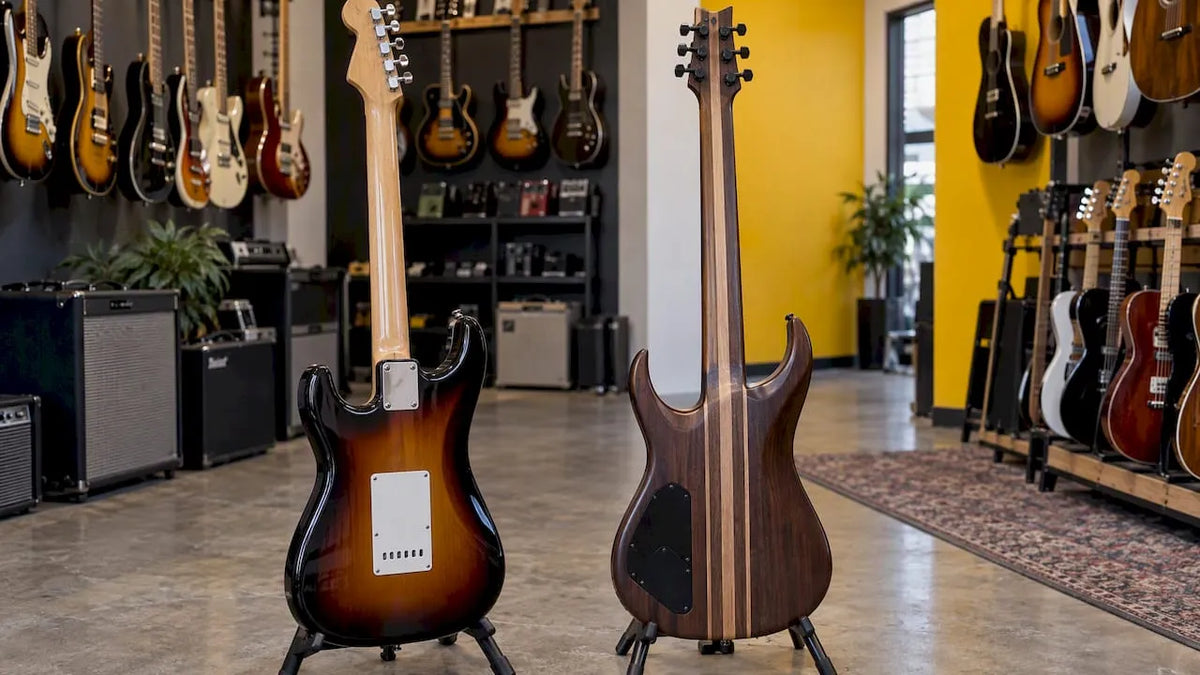
Bolt-on necks are screwed to the body. Neck-through guitars have a neck that runs the full length of the instrument, with the body “wings” glued on either side. Neck-through is usually described as smoother, with easier upper-fret access. Bolt-on is usually described as punchier, simpler to adjust and far easier to repair. Both claims hold some truth, but the gap is smaller than forum arguments suggest. For most players, neck shape, setup and how the guitar feels in your hands matter more than the joint.
Below we cover what each construction is, what it changes in practice, what the evidence says about sustain, and how to choose.
Table of Contents
- What the two constructions actually are
- The quick comparison
- Sustain: how much does the joint really matter?
- Playability: the upper frets
- Repair, adjustment and long-term ownership
- Cost and what you get for your money
- Which should you choose?
- Our view
- Try both before you decide
- A few pre-owned guitars to look at
- Setting up whichever you choose
- FAQ
- Sources
What the two constructions actually are
The neck joint is where the neck meets the body. There are three common ways to build it. Guitar Gear Finder’s overview of neck joints lists them as bolt-on (attached with screws), set neck (glued into the body) and neck-through (the neck runs all the way through the body).
Bolt-on
The neck sits in a routed pocket in the body and is held by screws, usually four, through a metal plate or directly into the wood. It is the classic construction of Telecaster-style and Stratocaster-style guitars, and it is common on bass guitars too. It is also the method most budget and mid-range instruments use, because it suits efficient production.
Neck-through
A long central strip of timber forms the neck and also runs under the pickups and bridge. Two body wings are glued either side. There is no pocket and no heel, so the body can be sculpted to fall away behind the neck. You will see this on many metal-oriented guitars, plenty of basses and a lot of boutique builds.
Where set necks fit
A set neck is glued into a pocket. It is the traditional route on many single-cut and double-cut guitars. It is not the focus of this article, but it sits between the two in feel and repairability. If you are weighing that option as well, our own tone tests in Hear the Truth: 4 Tests to Compare Bolt On and Set Neck Tone show you how to judge it by ear.
The quick comparison
| Factor | Bolt-on | Neck-through |
|---|---|---|
| Construction | Neck screwed into a body pocket | Neck runs the full length, wings glued on |
| Upper-fret access | Depends on heel shape; contoured heels help | Usually the easiest, no heel in the way |
| Tone reputation | Snappy, percussive, “jangly” | Smoother, warmer, more even |
| Sustain | Often claimed to be less; evidence is weak | Often claimed to be more; evidence is weak |
| Neck adjustment | Can be shimmed or swapped | Fixed, cannot be removed |
| Repair | Straightforward; neck can be taken off | Specialist work; damage can be costly |
| Typical use | Country, blues, funk, rock, pop, many basses | Metal, shred, lead playing, many basses |
Sustain: how much does the joint really matter?
This is the question behind most searches for this topic, so it is worth being straight about it.
The traditional view is that a neck-through design passes string energy through one continuous piece of wood, with no joint to absorb it, and so rings on for longer. It sounds logical. But the Guild of American Luthiers published a piece on exactly this, Sustain and Electric Guitar Neck Joint Type, which opens by calling the link between joint type and sustain a long-standing piece of conventional wisdom, then goes on to test it rather than accept it.
Builders’ guidance points the same way. StewMac’s guide to bolt-on necks and how they compare with set necks treats the joint as one part of the design, not the deciding factor. The things that shape how long a note lasts include:
- the mass and density of the wood and hardware
- how firmly the bridge couples the strings to the body
- the nut and its slots
- the quality of the fretwork
- how tight and accurate the neck pocket is on a bolt-on
- your pickups, amp and gain, which often matter more than any wood
A poorly cut neck pocket will hurt a bolt-on. A well-made bolt-on with a snug pocket and good timber can sound full and sustain well. A cheap neck-through is not automatically better than a good bolt-on. That is why we suggest you treat sustain as a tiebreaker, not a reason to rule an instrument in or out.
What you will actually hear
Players do describe a difference in character. Bolt-ons tend to be described as having a sharper attack and a more percussive, spanky quality. Neck-throughs tend to be described as smoother and rounder, with notes that bloom rather than snap. That character is as much about attack and the way the note decays as it is about raw sustain time.
Whether you like it depends on your music. Chords with a crisp pick attack, chicken-picking, funk and clean blues often suit the bolt-on snap. Smooth lead lines, high-gain tones and long singing notes can suit the more even response of a neck-through. Heavy distortion hides a lot of the difference anyway.
Playability: the upper frets
The most dependable advantage of neck-through is not tone. It is access. With no heel, your thumb and hand can travel up the neck without hitting a block of wood. If you play a lot of solos above the 17th fret, that matters.

Modern bolt-ons have narrowed the gap. Sculpted heels, contoured neck joints and angled neck plates give far better access than older designs did. If you are choosing between two specific guitars, pick each one up and play the 19th to 24th frets. A well-contoured bolt-on may feel better than a chunky neck-through. Your hand is a better judge than a spec sheet.
Neck profile counts for more than the joint. A slim, flat “shred” profile and a deep, rounded “C” or “D” feel completely different, and the same joint can be paired with either. For a refresher on how that part of the guitar affects choice, our electric guitars range spans plenty of shapes you can compare.
Repair, adjustment and long-term ownership
Here bolt-on wins clearly.
If a bolt-on neck is damaged, say after a fall off a stand, the neck can be unbolted and repaired or replaced. If the angle needs adjusting, a technician can shim the pocket. If you want a different neck later, perhaps a different profile or fingerboard, the swap is realistic. Refretting is also simpler with a neck that can be taken off the body.
A neck-through is one integrated structure. A break in the neck is a break in the body’s core. Repairs are possible but generally need a specialist and cost more. You also cannot remove the neck to adjust the angle, so the instrument has to be right from the factory. In practice, that is rarely a problem on a well-made guitar, but it is a reason why insurance and a solid case matter more.
Both designs still need good setup. Truss rod adjustment, action, intonation, nut slots and fret dressing are the same jobs on either. A setup does more for how a guitar feels than the joint ever will. If you are unsure of the condition of an instrument, the setup and repair work we offer is covered on our setup, servicing and repairs page.

Cost and what you get for your money
Bolt-on construction is simpler to manufacture, so you will find it across the whole price range, from entry-level to premium. Neck-through construction takes more material and more careful work, which is why it appears more often at mid to higher prices and on boutique instruments.
That has two consequences when shopping:
- At a given budget, a bolt-on often gives you better hardware, pickups and finish, because less of the money goes into the construction method.
- If a neck-through guitar sits at a low price, check the rest of the build carefully, including fret ends, nut, tuners and electronics.
Buying pre-owned changes the picture. A second-hand instrument can give you a higher-spec guitar for the money, whichever joint it uses. We inspect every instrument before it goes on sale, so you are not guessing at neck angle or fret wear.
Which should you choose?
Use these criteria in order.
- How it feels. Play it. Neck profile, scale length, weight and balance decide whether you will pick the guitar up every day.
- How you play. If you spend most of your time above the 17th fret, favour a neck-through or a bolt-on with a deep heel contour. If you play rhythm, funk, country or blues, a bolt-on suits well.
- How you treat your gear. If you gig, travel and take risks, the repairability of a bolt-on is a real asset.
- What you want from the sound. Snap and clarity lean bolt-on. Smoothness and sustain-led lead tones lean neck-through. Do not expect miracles either way.
- Budget. Spend on the guitar, not on the label of its construction.
Beginners
If this is your first guitar, a bolt-on is a sensible, forgiving choice. It is common, easy to service and suited to a wide range of styles, so the decision is hard to regret. The setup matters far more at this stage: low action and good intonation make learning easier. Our acoustic guitars and electrics are checked before they leave us.
Bass players
The debate is just as lively on basses. Neck-through basses are popular for their smooth, even response and easy access to the top of a long neck. Bolt-on basses are prized for punch and for being easy to look after. Both are well represented in our bass guitars collection. Try each with the amp and strings you actually use.
Lead players and metal guitarists
If you play fast, high-gain lead, a neck-through (or a heavily contoured bolt-on) removes obstacles. Check the neck profile and the scale length at least as carefully as the joint.
Our view
We see a lot of guitars come through the shop, new and pre-owned, and the same thing keeps happening. A customer comes in convinced they need one construction for the sustain, then picks up an instrument of the other type and that is the one they buy, because it simply feels right.
That matches what the luthier literature suggests: the joint is one factor among many, and the build quality around it decides the result. A tight pocket, good wood, a well-cut nut and a proper setup matter more than a label on the spec sheet.
We would also say that serviceability is underrated. A guitar is something you will play for years, and being able to adjust it, refret it and repair it without drama is worth a lot. That is part of why we inspect and set up every instrument we sell, and why we stay in touch after the sale.
Our advice: decide on neck shape and feel first, use the joint as a tiebreaker, and come and try a few if you can.
— Music
Try both before you decide
The quickest way to settle this is to hold a bolt-on and a neck-through side by side, through the same amp. We are a boutique guitar shop in Huntingdon, Cambridgeshire, and you can try instruments in store. If you prefer to browse from home, you can explore our electric guitars, including new and pre-owned stock, each inspected and set up before sale, with support after you buy.

A few pre-owned guitars to look at
If you want to compare feel and tone without paying new prices, our pre-owned range is a good place to start. For example, you could look at the Schecter Diamond Series Synyster Standard or the ESP LTD KH202 with EMGs if you lean towards heavier styles. For a more vintage-flavoured feel, there is the Squier '72 Thinline Telecaster. Stock changes, so check each listing for current details, and ask us about the neck construction of any guitar you are considering.
Setting up whichever you choose
After you buy, small upgrades can change how a guitar feels more than the neck joint ever could.
- Nut. A properly cut nut improves tuning stability and string spacing. We stock items such as a slotted bone nut.
- Strings. Fresh strings in the right gauge change both feel and tone. Browse our guitar strings, or ask about our in-store restring service.
- Case. Particularly if you choose a neck-through, which is harder to repair, a decent case or gig bag is cheap protection.
FAQ
Is neck-through better than bolt-on?
Not in any absolute sense. Neck-through usually gives easier upper-fret access and a smoother character, while bolt-on gives a snappier attack and much easier repair. Builders such as those quoted by StewMac treat the joint as one part of the whole design. Choose by feel and playing style.
Do neck-through guitars really sustain longer?
The idea is widely repeated, but the evidence is thin. The Guild of American Luthiers has examined the claim directly, and builders point to bridge coupling, wood and hardware as larger factors. You may hear a difference in character, but it is not a guarantee of longer notes.
Are bolt-on necks cheaper and lower quality?
They are often cheaper to make, which is why they appear across the price range, but that does not make them lower quality. Many professional instruments are bolt-on, and a tight, well-cut pocket with good timber can perform superbly. Judge each guitar on its build, not its joint.
Can you repair a neck-through guitar?
Yes, but it is more involved than repairing a bolt-on, because the neck and body core are one piece. It generally needs an experienced repairer. A bolt-on neck can simply be removed, so repairs and replacements are easier.
Sources
- Bolt-On Necks: Pros & Cons + Set Necks Comparison, StewMac
- Sustain and Electric Guitar Neck Joint Type, Guild of American Luthiers
- Bolt-On vs Set Neck vs Neck-Through Guitar Necks, Guitar Gear Finder






Share:
How to Tune to Open D: Step-by-Step Guide for Guitarists
How to Read Guitar Tab: A Clear Guide for Beginners