

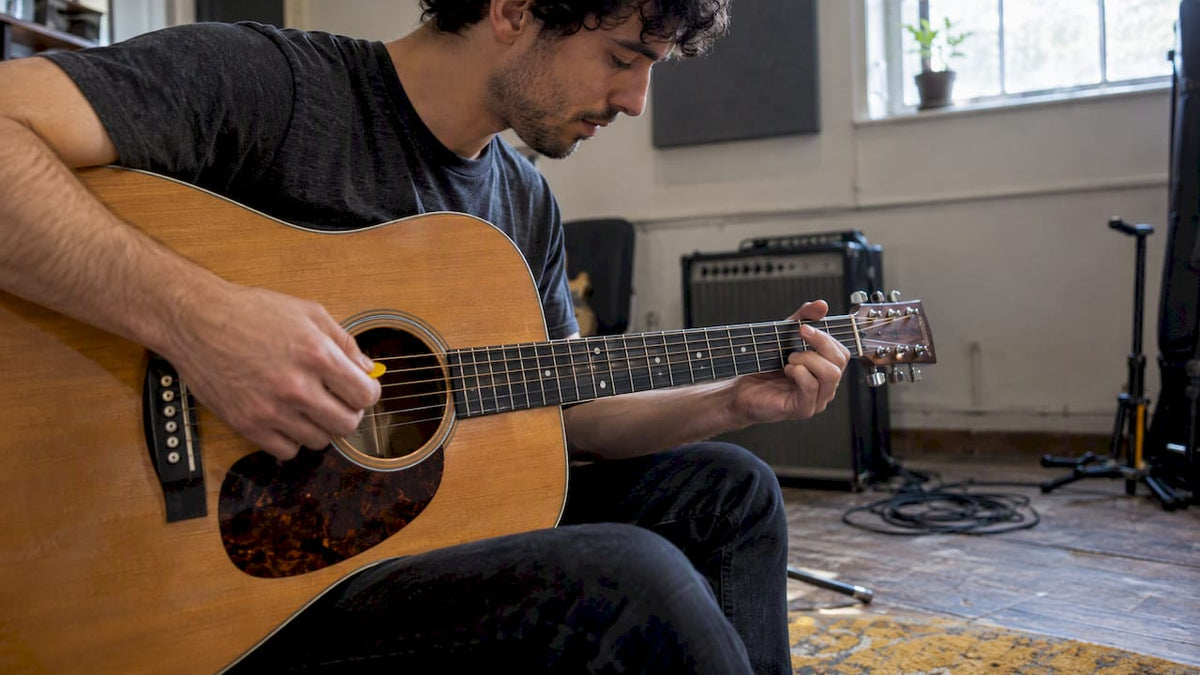
To tune to open D, start from standard tuning (E A D G B E) and lower four strings: the low E down a whole tone to D, the G down a semitone to F#, the B down a whole tone to A, and the high E down a whole tone to D. The A and D strings stay where they are. You end up with D A D F# A D from low to high, and every open string together sounds a D major chord.
The rest of this guide walks through each string, how to check the result by ear and with a tuner, what the lower tension does to your guitar, and how to keep the tuning stable. If you want the theory and chord shapes afterwards, our companion piece on what open D tuning is covers them.
Table of Contents
- Open D at a glance
- What you need before you start
- How to tune to open D, step by step
- Tuning to open D from a drop D guitar
- What about open D minor?
- What happens to your guitar when you tune down
- A note on open E and capos
- Why players choose open D
- Our view: tune with care, then set up for the way you play
- Fixing common problems in open D
- Choosing a guitar for open D
- Get your guitar ready for open D
- Frequently asked questions
- Sources
Open D at a glance
| String | Standard | Open D | Change |
|---|---|---|---|
| 6 (thickest) | E | D | Down a whole tone (two semitones) |
| 5 | A | A | None |
| 4 | D | D | None |
| 3 | G | F# | Down a semitone |
| 2 | B | A | Down a whole tone |
| 1 (thinnest) | E | D | Down a whole tone |
Notice that nothing goes up. Every change is a downward tune, which is the safe direction for your strings and your neck. A technical breakdown of the tuning makes the same point: tuning down is generally safe, while tuning strings up by several semitones can strain them.
The tuning is called open because strumming the strings without fretting anything gives you a chord. The London Review of Books blog describes it in just those terms: the six open strings sound a D major chord, and you can make other chords by barring one finger across the strings and sliding it up the neck.
What you need before you start
- A tuner. A clip-on or plug-in tuner is the most reliable choice, because it reads vibration from the guitar itself and ignores room noise. The CDM Academy guide to guitar apps recommends a physical clip-on or plug-in tuner for accuracy, while accepting that some phone apps are decent. If you want one that stays on the headstock, take a look at the D’Addario Eclipse Tuner we stock.
- Reasonably fresh strings. Old strings go dull and drift out of tune, and that is much more obvious in an open tuning, where all six strings ring together.
- Ten minutes and a quiet room. You will be retuning slowly and checking twice.
If your tuner or app has a preset for open D, you can use it. Be aware that in some apps, alternate tuning presets sit behind a paid tier: CDM Academy noted that, as of 2022, such presets could cost around £4.99 a month, though standard chromatic mode lets you tune manually to any note for nothing. Either way, you only need to know the six target notes, and you now do.
How to tune to open D, step by step
Begin with your guitar in standard tuning and in tune. Starting from a good baseline means each change is a small, predictable move.
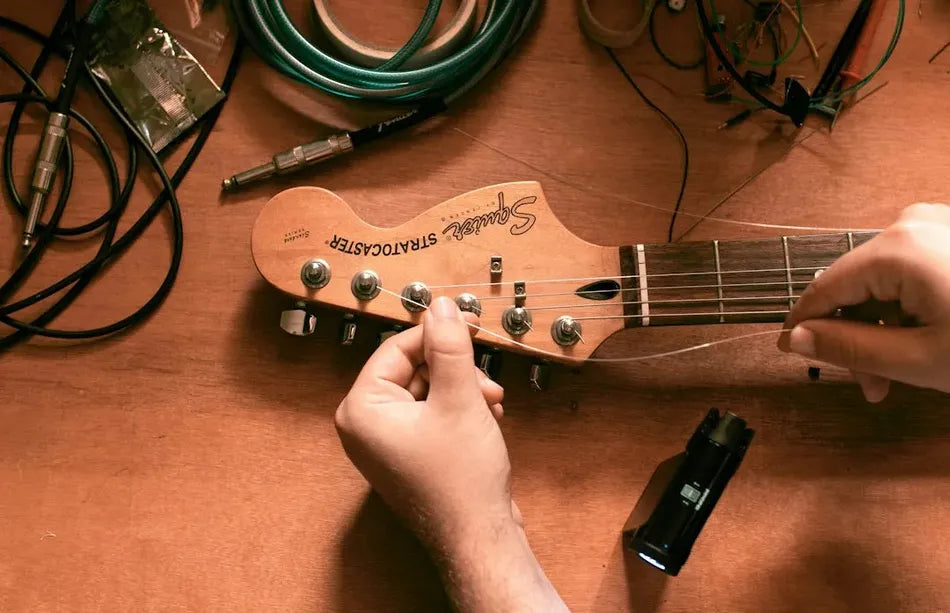
- Low E (6th string) down to D. Turn the tuning peg slowly while plucking the string. Watch the tuner: you are moving from E through D# to D. When it reads D, the string should sound exactly one octave below your open 4th string. Play the two together to confirm.
- A string (5th): leave it. Just check that it is in tune at A.
- D string (4th): leave it. Check it as well. These two strings are your anchors, and the rest is tuned against them.
- G string (3rd) down to F#. This is only a semitone. Lower it until the tuner shows F# (sometimes written Gb on a tuner display; it is the same note).
- B string (2nd) down to A. Drop it a whole tone. Compare it with your open 5th string: they should be the same note, an octave apart.
- High E (1st) down to D. Again a whole tone. It should match your open 4th string two octaves above the low D and one octave above the 4th.
Now strum all six strings. You should hear a clean, full D major chord. If it sounds sour, one string is off, usually the F# on the 3rd string, since it is the note that makes the chord major.
Check by ear using the fretted method
Once you are near pitch, you can cross-check with fretted notes, the same way many people tune standard:
- Fret the 6th string at the 5th fret: it should match the open 5th string (A).
- Fret the 5th string at the 5th fret: it should match the open 4th string (D).
- Fret the 4th string at the 4th fret: this gives F#, which should match your open 3rd string.
- Fret the 3rd string at the 2nd fret: this gives A, matching the open 2nd string.
- Fret the 2nd string at the 5th fret: this gives D, matching the open 1st string.
Note that the 5th-fret rule still holds for the lower strings, but the spacing shifts further up because the 3rd string is now F#. If every fretted note matches its neighbour, you are in tune with yourself, and your tuner then confirms you are in tune with the world.
Do a second pass
Lowering several strings changes the tension on the neck, and the strings you tuned first will have drifted slightly by the time you finish. Go round all six again with the tuner. Most people need two passes before open D holds steady.

Tuning to open D from a drop D guitar
If you are already in drop D (D A D G B E), you have done the low string. From there you only need to:
- lower the G string to F#,
- lower the B string to A,
- lower the high E to D.
That is three small moves instead of four. For more on the neighbouring tuning, see our guide to drop C in four steps, which uses a similar approach of lowering strings gradually and checking as you go.
What about open D minor?
People often ask how to tune to open D minor. The only difference is the 3rd string: instead of F#, you tune it down one more semitone to F natural. That gives D A D F A D, and the open strings now sound a D minor chord. It is a darker, moodier tuning, and the move from open D is a single semitone on a single string.
What happens to your guitar when you tune down
Open D lowers the pitch of four strings, which brings the overall tension down. You will notice a few things.
The strings feel looser. The low D in particular can feel floppy, and it can buzz against the frets if your action is low or you dig in. Play a little lighter, or ask for a setup adjusted for your tuning (more on that below).
Intonation shifts slightly. Intonation is how accurately notes play in tune up the neck. Your guitar was set up for standard tuning. After a big change in tension, chords up the neck can sound a touch off even when the open strings are perfect. For most casual playing this is fine. If you plan to stay in open D, it is worth having it checked.
Tuning stability takes a while. New tensions mean strings stretch and the neck adjusts. Expect to retune a few times in the first hour, and again the next day.
Different string gauges can help. A lot of players who live in open D, particularly slide players, choose a slightly heavier set so the lower strings stay taut. This is a matter of taste and feel, not a requirement, and it is worth trying a set before you commit.
If you bring your guitar to us in Huntingdon, we can check the action, nut and intonation for the way you actually play. That is the job of our guitar setups, servicing and repairs service.
A note on open E and capos
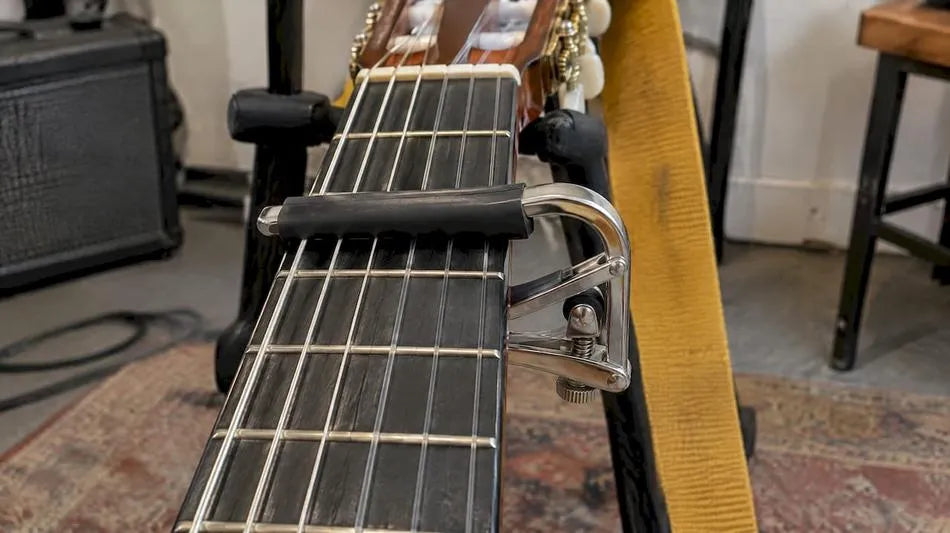
You will sometimes see open D described alongside open E, which is the same shape of tuning raised a whole tone (E B E G# B E). The overview of open tunings on guitar groups them as traditional open major chord tunings. Raising a string to open E puts much more strain on the neck and strings than open D does, so many players stay in open D and place a capo at the 2nd fret to get the same chord shapes in E. That is easier on the guitar and keeps the string tension friendlier.
Why players choose open D
The appeal is simple: you can sound good immediately, and the ringing open strings give a natural resonance.
Alex Abramovich’s LRB piece notes that the tuning is used by absolute beginners and by slide players such as Ry Cooder and Duane Allman, who make use of its resonance and the ease of moving a bar chord shape up the neck.
Practical uses include:
- Slide guitar. Andy Aledort’s column on slide guitar in open D describes it as one of the most common open tunings for slide, alongside open G.
- Folk fingerstyle. Andy Guitar describes open D as a great tuning for folk fingerstyle, and his lesson includes common chord shapes and example songs.
- Simple songwriting. One finger across all six strings at any fret gives you a major chord. A player of The Black Crowes, Nico Bereciartua, shows how much you can do with just two chord shapes in open D.
If you want a first taste of the sound, play your open strings, then lay one finger flat across the 5th fret and strum: that is a G chord. Move it to the 7th fret for A. Three positions already cover the main chords of a simple blues or folk song.
For a wider look at the idea, our article on open tuning, one-finger chords and safe retuning explains when it is worth booking a professional. If you prefer G, see how to tune to open G.
Our view: tune with care, then set up for the way you play
We look at a great many guitars, new and pre-owned, and we inspect and set up each instrument we sell. From that, our advice on open tunings is practical.
First, go slowly. Open D is a gentle tuning for a guitar, because everything goes down, but a snapped string from turning a peg too quickly is still annoying. Move the peg in small turns and let the tuner settle.
Second, fresh strings matter more than most players expect. A tired set will never hold an open chord cleanly. If it has been months, restring first. We offer an in-store restring service, and you can browse guitar strings online as well.
Third, decide whether the guitar is a one-tuning instrument. Many players keep one guitar permanently in an open tuning, usually an acoustic or an older electric, and leave the others in standard. A guitar that lives in open D can have its setup tailored to it, so that is often the best way to avoid constant retuning and the compromises that come with it.
Fourth, if something feels wrong (persistent buzzing, notes that will not tune accurately up the neck, a peg that slips), do not fight it. It usually points to a setup issue that is fast for a technician to fix.
— Music
Fixing common problems in open D
The tuning will not stay put. Stretch new strings gently, retune, and repeat. Check that the strings are wound neatly around the posts and that the tuning machines are not loose. If one string keeps slipping, the nut slot or the machine head may be the culprit.
The low D buzzes. It is under less tension than in standard tuning. Try playing a little more lightly, or raise the action slightly. This is a quick adjustment during a setup.
Chords sound sour high up the neck. That points to intonation. A setup can bring it back in line for your chosen tuning.
The sound is dull. Replace the strings. A new set makes open tunings ring far better.
You keep forgetting the tuning. Write it on a bit of paper and stick it inside the case lid: D A D F# A D. A handy case helps, and you can see our cases and gig bags if yours is looking worn.

Choosing a guitar for open D
Any six-string will do the job, but certain instruments reward the tuning.
- Acoustic guitars give the most natural resonance for folk, fingerstyle and bottleneck slide. See our acoustic guitars.
- Electric guitars suit slide and bluesy rock playing, particularly if you add a little overdrive. Take a look at our electric guitars.
- Classical guitars can be tuned down to open D, but nylon strings behave differently and need extra care, so lower them slowly. Browse classical and Spanish guitars.
If you are choosing between them, play before you buy. We welcome in-store tryouts at our shop in Huntingdon, Cambridgeshire, and every instrument we sell is inspected and set up first.
Get your guitar ready for open D
If you would like help, we can restring your guitar, check the setup for open tunings and advise on the right strings. You can also pick up a tuner, strings or accessories online. Browse our guitar accessories, or start from the MusicStreet home page to see new and pre-owned guitars, setups and repairs.

Frequently asked questions
What are the notes in open D tuning?
From the thickest string to the thinnest, they are D, A, D, F#, A, D. Together they make a D major chord when strummed open. Only the 5th and 4th strings stay the same as standard tuning.
What is open D tuning used for?
It is popular for slide guitar, folk fingerstyle and simple songwriting. Because the open strings form a chord, one barred finger gives you a major chord at any fret. Beginners and professional slide players both use it.
How do I tune my guitar to open D minor?
Tune to open D first, then lower the 3rd string from F# by one more semitone to F. The notes become D A D F A D. The open strings then sound a D minor chord.
Is open D bad for my guitar?
No, as long as you tune downwards, from standard, and turn the pegs slowly. The lower tension can cause buzzing or slight intonation changes, which a setup can address. Avoid raising strings well above their standard pitch, as that adds strain.
How do I get back to standard tuning?
Reverse the steps. Raise the low D to E, the F# to G, the A (2nd string) to B, and the high D to E. Check every string with a tuner and go round twice, since the tension changes as you go.
Sources
- DADF#AD Open D guitar tuning, chords and scales
- Alex Abramovich, Tune the Guitar thus (London Review of Books blog)
- The best apps for guitar: 5 essential apps for guitar students (CDM Academy)
- In Deep with Andy Aledort: Slide Guitar in Open D
- Open D Tuning, Fingerstyle (Andy Guitar)
- Magic of Open D Tuning and Slide Guitar with Nico Bereciartua

Share:
Can You Fix a Cracked Acoustic Guitar Bridge?