


Most musicians and sound engineers in British studios or live venues know the frustration of unwanted hum or dull, noisy instrument tones. Achieving crystal-clear sound quality is more than just a wish—over 80 percent of professional audio setups rely on DI boxes to overcome signal issues. Whether you play guitar at a British pub gig or record tracks for a London album, understanding DI boxes can transform your sound, preserve instrument tone, and simplify connections across any system.
Table of Contents
- DI Boxes Explained: Core Function And Purpose
- Different Types Of DI Boxes For Musicians
- How DI Boxes Work With Guitars And Gear
- Live Versus Studio Applications Of DI Boxes
- Common DI Box Mistakes And Solutions
Key Takeaways
| Point | Details |
|---|---|
| Functionality of DI Boxes | DI boxes convert unbalanced, high-impedance signals into balanced, low-impedance signals for professional audio transmission, ensuring compatibility and sound integrity. |
| Types of DI Boxes | DI boxes come in three main types: passive, active, and tube, each catering to different instruments and audio requirements. |
| Applications in Live and Studio Settings | DI boxes facilitate direct connections in live performances and capture pure sonic qualities in studio recordings, adapting to diverse audio environments. |
| Common Mistakes and Solutions | Proper signal level matching, cable quality, and selecting the right type of DI box are crucial to avoid audio distortion and ensure pristine sound transmission. |
DI Boxes Explained: Core Function and Purpose
A Direct Injection (DI) box is a pivotal piece of audio equipment that transforms instrument signals into professional sound transmission formats. Radial Engineering explains that these compact devices convert unbalanced, high-impedance instrument signals into balanced, low-impedance microphone-level signals, enabling pristine audio transmission across significant distances.
The core purpose of a DI box revolves around three fundamental technical functions. First, it performs signal level matching between instruments and professional audio systems, ensuring compatibility across different equipment. Second, it converts unbalanced signals to balanced signals, which Palmer Germany highlights as critical for reducing unwanted electrical noise and interference. Third, these devices suppress ground loops, eliminating potential humming or buzzing that can compromise sound quality.
Musicians and sound engineers rely on DI boxes in various scenarios - from recording studio sessions to live performance environments. They are particularly essential when connecting instruments like electric guitars, bass guitars, keyboards, and acoustic instruments with piezo pickups directly to mixing consoles, audio interfaces, or professional sound systems. By standardising signal characteristics, DI boxes ensure consistent, clean audio transmission that maintains the instrument’s original tonal qualities while minimising technical complications.
Key benefits of using a DI box include:
- Noise reduction in audio signals
- Impedance matching between instruments and audio systems
- Enabling long cable runs without signal degradation
- Providing galvanic isolation to prevent electrical interference
- Converting unbalanced to balanced signal pathways
Whether you’re a professional musician or a home recording enthusiast, understanding the role of DI boxes can significantly elevate your audio signal management and overall sound quality.
Different Types of DI Boxes for Musicians
Event Technology explains that DI boxes are primarily categorised into three distinct types: passive, active, and tube. Each type offers unique characteristics and performance capabilities suited to different musical scenarios and audio requirements, making them essential tools for musicians and sound engineers seeking optimal signal transmission.
The passive DI box represents the most straightforward design, utilising transformers to convert signals without requiring external power. These boxes are renowned for their reliability and simplicity, making them ideal for instruments with strong output levels like electric guitars and bass guitars. In contrast, active DI boxes incorporate electronic circuitry and demand external power, providing additional signal amplification and tone-shaping capabilities. They excel in handling lower-output instruments such as acoustic guitars with passive pickups.

Tube DI boxes represent a specialised category that introduces distinctive sonic characteristics. By employing vacuum tubes in their signal path, these devices add subtle harmonic warmth and colouration to the audio signal, which many musicians find musically pleasing. Canford Audio highlights manufacturers like Radial offer sophisticated models such as the ProDI passive mono, ProD2 passive stereo, and ProD8 passive 8-channel configurations, demonstrating the versatility of modern DI box design.
Key considerations when selecting a DI box include:
- Signal strength of your instrument
- Required frequency response
- Need for additional signal processing
- Connectivity requirements
- Performance environment
Whether performing live or recording in a studio, choosing the right DI box can significantly enhance your instrument’s sound quality and ensure clean, professional audio transmission.
How DI Boxes Work With Guitars and Gear
Guitar players encounter numerous signal challenges when connecting their instruments to professional audio systems. Radial Engineering explains that DI boxes solve critical signal transmission problems by converting unbalanced guitar signals into balanced ones, enabling audio signals to travel up to 100 metres without significant noise or degradation.
The interaction between guitars and DI boxes involves several sophisticated technical processes. When a guitar’s unbalanced output signal enters the DI box, the internal transformer or active electronics immediately convert the high-impedance, unbalanced signal into a low-impedance, balanced signal suitable for professional mixing consoles and recording interfaces. This conversion is crucial for maintaining signal integrity, reducing electromagnetic interference, and preventing unwanted noise that can compromise audio quality.
Musicians use DI boxes across various scenarios, from recording studio sessions to live performances. Acoustic guitars with piezo pickups, electric guitars, bass guitars, and even synthesisers can benefit from DI box technology. The device acts as a critical intermediary, ensuring that the instrument’s original tonal characteristics remain intact while providing the technical compatibility required by professional audio systems.
Key advantages of using DI boxes with guitars include:
- Noise reduction in audio signals
- Signal level standardisation
- Extended cable run capabilities
- Preservation of instrument’s original tone
- Compatibility with professional audio equipment
Understanding how DI boxes interact with guitars empowers musicians to achieve cleaner, more professional sound transmissions across diverse performance and recording environments.
Live Versus Studio Applications of DI Boxes
Radial Engineering highlights the critical differences between live and studio applications of DI boxes, demonstrating how these versatile devices adapt to varying professional audio environments. In live performance settings, DI boxes serve as essential signal transmission tools, enabling direct connections between instruments and front-of-house mixing consoles, while studio environments leverage them for pristine, uncoloured signal recording.
During live performances, sound engineers rely on DI boxes to manage complex audio challenges. These devices allow multiple instruments to connect directly to mixing consoles, ensuring consistent signal levels and minimising stage noise. The robust design of professional DI boxes enables musicians to transmit signals across long cable runs without degradation, which is crucial in large venues where stage and mixing desk distances can be significant. Active DI boxes with additional headroom become particularly valuable in high-volume live scenarios, providing stable signal transmission and preventing audio clipping.
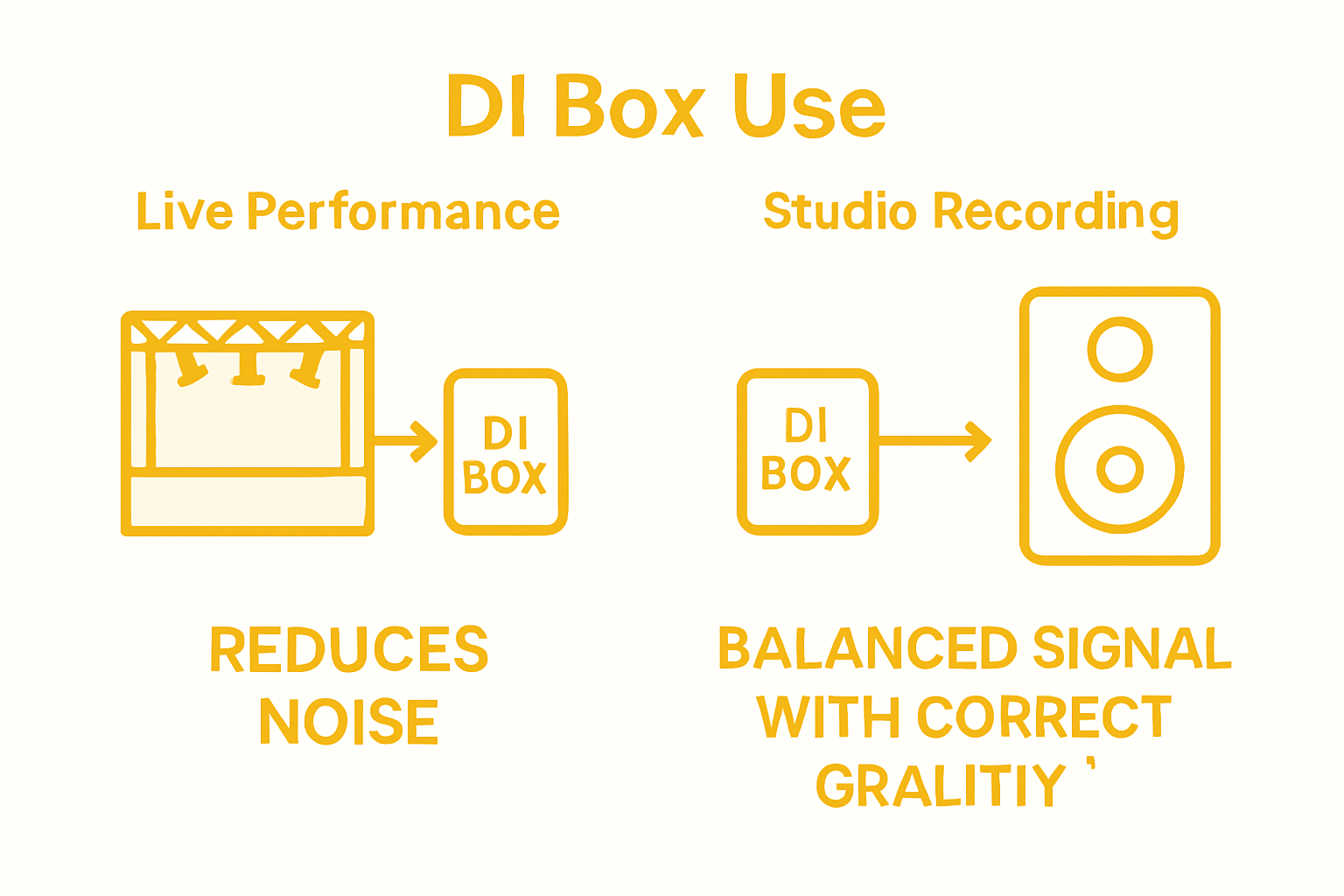
In recording studio environments, DI boxes offer a different yet equally important function. They provide clean, direct signals that capture an instrument’s pure sonic characteristics without ambient interference. Sound engineers often use DI boxes alongside microphone captures, creating layered, nuanced recordings that preserve the instrument’s intrinsic tonal qualities. This approach is especially prevalent with instruments like electric guitars, bass guitars, keyboards, and acoustic instruments equipped with electronic pickups.
Key distinctions between live and studio DI box applications include:
- Signal transmission requirements
- Noise management strategies
- Dynamic range handling
- Impedance matching complexity
- Audio processing needs
Understanding these contextual variations empowers musicians and sound professionals to select and deploy DI boxes most effectively across different performance and recording scenarios.
Common DI Box Mistakes and Solutions
Palmer Germany identifies several critical mistakes musicians and sound engineers frequently make when using DI boxes, which can significantly compromise audio signal quality. Understanding these common pitfalls and their solutions is essential for maintaining pristine sound transmission across various performance and recording scenarios.
One of the most prevalent errors involves incorrect signal level matching, which can lead to signal distortion and unwanted noise. Musicians often overlook the importance of properly setting input levels, resulting in either signal clipping or insufficient gain. Radial Engineering emphasises that understanding the specific impedance requirements and input sensitivity of both the instrument and the audio system is crucial for preventing these technical complications. Professional sound engineers recommend carefully adjusting gain levels and using the ground lift switch to eliminate potential ground loop issues that can introduce unwanted electrical hum.
Another significant mistake involves neglecting the importance of cable quality and connection techniques. Many musicians use substandard or damaged cables, which can introduce electromagnetic interference and degrade signal integrity. The solution involves investing in high-quality, well-shielded cables and ensuring proper connection techniques. Additionally, understanding the differences between active and passive DI boxes and selecting the appropriate type for specific instruments can prevent signal loss and maintain optimal audio characteristics.
Key strategies for avoiding DI box mistakes include:
- Carefully matching input signal levels
- Using ground lift switches when encountering hum
- Selecting appropriate DI box type for your instrument
- Investing in high-quality, well-maintained cables
- Regularly checking and testing audio signal paths
By developing a comprehensive understanding of DI box functionality and potential pitfalls, musicians and sound professionals can ensure consistently clean and professional audio transmission.
Elevate Your Sound with the Right DI Box and Premium Guitars
Achieving pristine sound quality starts with the right equipment. This article highlights how DI boxes solve common audio challenges such as noise reduction, impedance matching, and clean signal transmission. To truly unlock your instrument’s potential, pairing a high-quality guitar with a suitable DI box is essential. Whether you play electric, acoustic, or bass guitar, understanding these technical solutions can transform your performance and recording experience into something exceptional.

Explore MusicStreet’s outstanding range of electric, acoustic, and bass guitars expertly selected and inspected for professional sound and reliability. Combine your instrument with our recommended accessories to ensure your signals remain clear and powerful every time you play. Discover how our personalised service, expert setup, and ongoing support can help you achieve flawless tone and effortless connectivity. Start your journey to superior sound today by browsing our collection at MusicStreet. Don’t wait – experience the difference a quality guitar and the right DI box setup can make.
Frequently Asked Questions
What is the primary function of a DI box?
A DI box converts unbalanced, high-impedance instrument signals into balanced, low-impedance microphone-level signals, ensuring clean audio transmission and compatibility with professional audio equipment.
What are the different types of DI boxes available?
There are three main types of DI boxes: passive, active, and tube. Passive DI boxes utilise transformers, active DI boxes feature electronic circuitry for amplification, and tube DI boxes offer unique sonic characteristics by incorporating vacuum tubes.
How do DI boxes reduce noise in audio signals?
DI boxes convert unbalanced signals to balanced signals, which significantly reduces unwanted electrical noise and interference. They also suppress ground loops that can introduce hum or buzzing into the audio signal.
When should I use an active versus a passive DI box?
Use a passive DI box for high-output instruments like electric guitars, while an active DI box is recommended for lower-output instruments, such as acoustic guitars with passive pickups, as it provides additional amplification and tone-shaping abilities.






Share:
Guitar Strap Adjustment Tips for Comfort and Playability
Role of Guitar Pickups – Shaping Your Unique Sound