

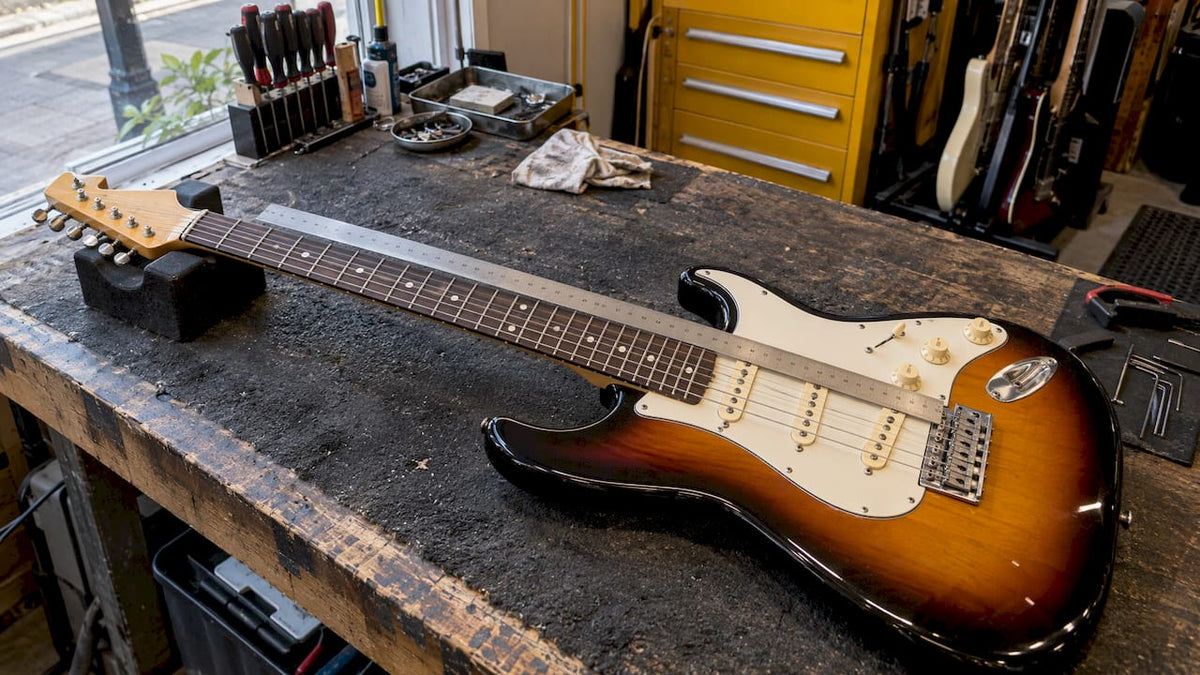
Scale length is the length of the part of the string that vibrates, measured from the nut (the slotted piece at the top of the neck) to the saddle (the part on the bridge the string rests on). It is usually quoted in inches: 25.5" (648 mm) on a Fender Stratocaster, 24.75" (629 mm) on a Gibson Les Paul. A longer scale means more string tension and wider fret spacing, so the guitar feels stiffer and a little brighter. A shorter scale feels slacker and closer together, with a warmer character. Setup decides how well either one plays, and that is where a properly inspected instrument pays off.
Below you will find how to measure it yourself, the scale lengths you will meet on electric, acoustic, classical and bass guitars, what the number does to feel and tone, and how to pick the right one for your hands and style.
Table of Contents
- What scale length actually means
- How to measure scale length
- Common scale lengths by guitar type
- What scale length changes: spacing, tension and feel
- Does scale length change the tone?
- Short scale or long scale: what to choose
- Why you should try before you commit
- Our view on scale length
- Find the right scale length with us
- Frequently asked questions
- Sources
What scale length actually means
Play an open string and the part that sounds is the stretch between two fixed points: the nut at the headstock end and the bridge saddle at the other. That distance is the scale length. The 12th fret sits exactly halfway along it, which is why the octave note is played there. Guitar.com’s 2025 guide describes it in these terms and points out that it is nearly always given in inches, even in countries that otherwise use metric.
Scale length is not the same as the overall length of the guitar, the length of the neck or the body size. Two guitars of identical outline can have different scales. It is also a theoretical figure. As Guitarist magazine explains, the scale length is used to calculate where every fret goes, while the string you can physically measure is slightly longer and needs intonation adjustment so that notes play in tune up the neck.
That is why two guitars both labelled 25.5" can feel marginally different, and why the number should be treated as a very good guide rather than an exact law.
How to measure scale length
Measuring from nut to saddle with a tape sounds simple, but most bridges have angled or adjustable saddles. The heavier strings are set a little further back to keep them in tune, so a direct reading is unreliable. Acoustic Guitar magazine recommends a neater method:
- Measure from the front edge of the nut to the centre of the 12th fret wire.
- Double the result.
For example, if you get 32.4 cm, the scale length is 64.8 cm, which is 25.5 inches. Divide centimetres by 2.54 to convert to inches, or multiply inches by 25.4 for millimetres.
A few practical tips:
- Use a steel rule or a flexible tape laid flat along the fretboard, not a cloth tape that stretches.
- Measure to the middle of the fret wire, not the edge.
- Expect a small variation from the published figure. Gibson’s 24.75" scale, for instance, is a nominal number that real guitars can drift from, because it has shifted slightly over the decades with changes in production equipment.
If you would rather not measure, the manufacturer’s specification is the first place to look, and our product listings give the scale on instruments where it is known. If you are in Cambridgeshire, you can also pick up and compare guitars in our Huntingdon store.
Common scale lengths by guitar type
There is no single standard across makers. Here are the figures you will meet most often in the UK market.
| Scale length | Millimetres | Typical examples |
|---|---|---|
| 24.594" | 625 | Some PRS models |
| 24.75" | 629 | Gibson Les Paul style guitars |
| 25" | 635 | Most PRS models, such as the Custom 22 and Custom 24 |
| 25.5" | 648 | Fender Stratocaster and Telecaster, many superstrat designs |
| 26.5" | 673 | Some PRS models, and many 7-string guitars |
| 34" | 864 | Standard long-scale bass |
The electric figures come from Guitarist magazine and PRS’s own support page, which lists 25" as the PRS standard with other models at 24.594", 25.5", 26.5" and 27.7". Guitarist adds that the commonly quoted Gibson number is a little misleading, so treat 24.75" as a close description, not a precise measurement.
Acoustic and classical guitars
Steel-string acoustics commonly sit around 25.5" as well, with shorter-scale designs for those who want an easier reach. Classical guitars tend to be built to a scale of about 650 mm, close to the 25.5" figure, with 640 mm common for smaller-handed players. The 650 mm norm is described by luthier Douglas Niedt, who also notes that some older Spanish guitars run slightly longer.
If you are weighing up a smaller-bodied acoustic, our guide to 38 vs 41 inch guitars and fit covers how body size and posture interact with scale. Remember that overall size and scale length are related but separate things.
Bass guitars
Bass scale lengths are much longer. D’Addario’s string tension reference lists 30" as short scale, 32" as medium, 34" as long and 36" as extra long for bass, against 25.5" for standard guitar. Most basses you will see are 34". Short-scale basses suit smaller hands and players who like a looser, rounder feel.

Seven-string, eight-string and baritone guitars
Extra low strings need extra length to hold tension. Many 7-strings use 26.5", and baritones and 8-strings go further. Some builders use fanned frets so that each string has its own scale: strandberg’s multi-scale design on its 8-string runs from 28" on the lowest string to 26.5" on the highest, so the thick low string tunes cleanly while the thin top string still bends comfortably. If you are looking at extended-range instruments, our 7-string scale length guide goes through the common options.
What scale length changes: spacing, tension and feel
Three things change together when the scale gets longer or shorter.
Fret spacing
On a longer scale the frets sit further apart. On a shorter scale they are slightly closer, which, as Acoustic Guitar’s 2026 Ask the Expert piece notes, some players find more comfortable. Chords with wide stretches, such as extended jazz voicings, are the obvious place you notice it. Players with smaller hands, and many beginners, often find a shorter scale less tiring.
String tension
To sound the same note, a string at a longer scale must be pulled tighter. Acoustic Guitar magazine gives real numbers: a light .012 to .053 acoustic set totals about 160.5 lbs of tension at 25.5 inches and about 151.24 lbs at 24.75 inches. A change of roughly 3% in scale length makes about a 6% change in tension, so a small difference on paper is clearly felt in the hands.

PRS makes the same point on its support page: shorter scales give lower tension and longer scales greater tension.
Feel and bending
With the same gauge and tuning, a longer scale feels stiffer and holds its pitch well when you dig in. A shorter scale feels slinkier, so string bends take less effort. This is why many blues and rock players who bend a lot are drawn to the shorter-scale designs, and why many players who tune low or play hard rhythm prefer a longer one.
Guitar.com’s guide gives a useful rule of thumb: players who bend heavily may prefer lower tension through thinner strings, a shorter scale or both, and a player who wants to tune lower can keep tension constant by using thicker strings or a longer scale, or both.
Does scale length change the tone?
Yes, mainly through tension. Lower tension generally suits a warmer, rounder sound, while higher tension gives a snappier, brighter attack. That is the usual contrast between a Gibson-style 24.75" guitar and a Fender-style 25.5" one, and our PRS vs Gibson sound comparison looks at how those differences play out in practice.
PRS’s support team adds a more detailed explanation: tension shifts where harmonics and overtones fall, so shorter scales tend to have denser overtones, while longer scales give more articulated highs and lows and clearer individual notes.
Still, the scale is one ingredient among many. Wood, pickups, string gauge, bridge type and amp all shape the sound. A good way to think about it is that scale length sets the feel and the character of the strings, and everything else builds on that.
Short scale or long scale: what to choose
What a short scale offers
Short-scale guitars bring easier reach, lower tension and gentler bending. They suit smaller hands, younger players, and anyone who wants a comfortable, warm-sounding instrument for rhythm and blues. Acoustic examples include the Sigma DSME short-scale dreadnought with 14-fret neck join, and on bass the Sandberg California TT Short Scale is a good example of a bass that is easier on the hands.

Because lower tension is more sensitive to action height and string choice, shorter-scale guitars reward a careful setup. Acoustic Guitar’s experts point out that they are more demanding to set up, since fret buzz and intonation need attention. That is a good reason to buy from a shop that inspects and sets up each instrument before it leaves, rather than taking a guitar straight out of a box.
What a long scale offers
Long-scale guitars bring higher tension, a tighter feel, clear low notes and stable pitch under heavy picking. They suit players who like a firm response, who tune down, or who use heavier strings. Guitarist’s summary of the principle is that, with tuning and gauge equal, a longer scale feels stiffer but holds its pitch more steadily when hit hard.
A quick way to decide
| If you… | Lean towards |
|---|---|
| Have smaller hands or are just starting out | Shorter scale (24" to 24.75") |
| Bend strings a lot and like a slinky feel | Shorter scale, or lighter strings |
| Want a bright, tight, punchy attack | Longer scale (25.5") |
| Tune down or play 7-strings | Longer scale (26.5" and up) |
| Play bass and want a compact feel | Short-scale bass (30" to 32") |
String gauge can bridge the gap. A heavier set on a short scale or a lighter set on a long scale can bring two guitars closer in tension. Our guide to string gauges for different scale lengths explains how to match them.
Why you should try before you commit
Numbers only get you so far. A 0.75-inch difference sounds tiny, but what you feel depends on your hand size, how you pick, your preferred strings and the way you hold the guitar. Pick up a Strat-style guitar and a Les Paul-style guitar back to back and the difference in reach and tension is obvious within a minute.
If you change strings, the scale determines which gauge gives the tension you like. Our in-store restring service and guitar strings range make it easy to experiment with that once you have your guitar.
Our view on scale length
Most buyers ask us about scale length when a guitar they already own feels wrong: too stiff to bend, too slack to play cleanly, or cramped on the upper frets. The number on the spec sheet explains part of that, and the setup explains the rest.
That is why every instrument we sell is inspected and set up by us before it goes out, and why we recommend trying guitars in our Huntingdon shop where you can. Two guitars with the same scale length can play very differently depending on action, nut slots and string choice, and a short-scale guitar in particular rewards a careful setup.
We offer new and pre-owned electric, acoustic, classical and bass guitars, so you can compare a 24.75" and a 25.5" side by side and choose the feel that suits your hands. After the sale, our setup, servicing and repair support is there to keep that feel right.
Music
Find the right scale length with us
Whether you are after a short-scale acoustic for comfortable chords or a long-scale electric for a tight, bright attack, you can browse our electric guitars, acoustic guitars, bass guitars and classical and Spanish guitars. Each comes with expert setup and inspection, post-sale support and insurance-backed warranties, and orders over a minimum amount ship free in the UK.

If you already own a guitar that feels off, our guitar setups, servicing and repairs can adjust action and intonation to suit your strings and playing style.
Frequently asked questions
What is the most common guitar scale length?
For electric guitars, 25.5 inches (648 mm) is the figure most often seen, thanks to Fender, with many other brands following it. The Gibson-style 24.75 inches (629 mm) and PRS’s 25 inches (635 mm) are the other common choices. Basses are typically 34 inches.
What is a Gibson scale length?
Gibson’s classic figure is 24.75 inches (about 629 mm), used on the Les Paul. Guitarist magazine calls that number a little misleading, so real guitars may measure slightly differently. The 1954 Les Paul Junior launched with this scale, according to Guitar World’s Les Paul timeline.
Is a short-scale guitar easier to play?
For many players, yes. Shorter scales have lower string tension and slightly closer frets, which makes bends and stretches easier. They do respond more to setup, so action and intonation are worth getting right from the start.
Can I change a guitar’s scale length?
Not in any practical way: the scale length is built into the position of the nut, frets and bridge. What you can change is string gauge and tuning, which alter tension and feel. If a guitar feels too stiff or too slack, a setup and a different string set often make a noticeable difference.
Sources
- Ask the Expert: Understanding Acoustic Guitar Scale Length, Acoustic Guitar
- Ask the Expert: Scale Length and 12- vs. 14-Fret Designs, Acoustic Guitar
- A Question Of Scale, Guitarist, October 2021
- Scale length and baritone guide, Guitar.com
- Scale Length and PRS Guitars, PRS support
- String tension reference, D’Addario
- Multi-Scale Guitars, strandberg
- Gibson Les Paul: how it changed from 1952 to 1978, Guitar World



Share:
How to String an Electric Guitar: Step-by-Step Guide