


Matching impedance and power ratings is essential for safe and effective guitar amplifier and speaker cabinet pairing. Proper impedance matching protects the equipment and influences the tone, while choosing a cabinet with appropriate power handling shapes sound quality. Using dedicated speaker cables and following correct connection procedures ensure safety and optimal performance.
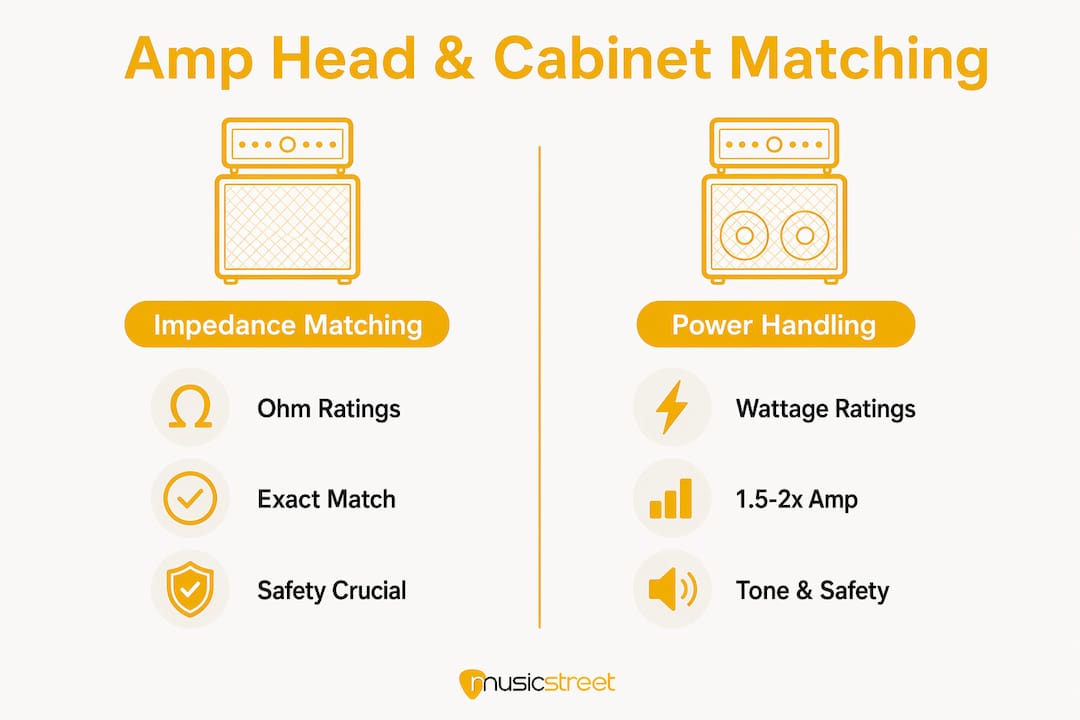
You cannot use any amp head with any speaker cabinet without first verifying two things: impedance and power handling. These are not optional checks. Get either wrong and you risk destroying your amplifier, your cabinet, or both. Impedance, measured in Ohms, must match between the amp head’s output and the cabinet’s input. The cabinet’s power handling should meet or exceed the amp’s wattage to keep things safe. Once you understand these two rules, mixing and matching amp heads with speaker cabinets becomes one of the most rewarding ways to shape your tone.
Can I use any amp head with any speaker cabinet safely?
The short answer is no, not without checking compatibility first. The two non-negotiable parameters are impedance (Ohms) and power handling (watts). Every amp head has an output impedance rating, and every speaker cabinet has an input impedance rating. These must match.

Impedance is the measure of electrical resistance in an AC circuit. In practical terms, it tells you how much load the speaker cabinet places on the amplifier. Common impedance values for guitar cabinets are 4 Ohms, 8 Ohms, and 16 Ohms. Your amp head will have one or more output taps labelled with these values.
Power handling is the second check. A cabinet rated at 1.5 to 2 times your amp’s wattage gives you clean, controlled sound with plenty of headroom. A cabinet rated at or below the amp’s wattage will break up earlier, which can be a tonal choice or a recipe for damage if pushed too hard.
Skipping these checks is the most common cause of blown speakers and damaged output transformers. A few minutes of reading your gear’s manual saves you an expensive repair bill.
What is impedance matching and why does it matter?
Impedance matching is the practice of aligning the Ohm rating of your amp head’s output with the Ohm rating of your speaker cabinet. Tube amps require strict impedance matching to protect the output transformer. Solid-state amps are more forgiving but still have minimum impedance thresholds you must not go below.
Why tube amps are less forgiving
A tube amplifier uses an output transformer to convert the high-voltage signal from the power tubes into a usable signal for the speaker. That transformer is tuned to a specific impedance. Connecting an 8-Ohm amp to a 16-Ohm cabinet causes the transformer to work outside its design range. The result is increased heat, distortion, and eventual failure.
Solid-state amps use transistors instead of transformers. They can generally handle loads of 4 Ohms or above without damage, though you should always check the manufacturer’s minimum rating. Going below the minimum Ohm rating on any amp, tube or solid-state, risks overheating and failure.
Here are the key impedance rules to follow:
- Always match the amp’s output Ohm tap to the cabinet’s rated impedance.
- If your amp has multiple output taps (4, 8, 16 Ohms), use the tap that matches your cabinet.
- Running two cabinets in parallel halves the total impedance. Two 8-Ohm cabs in parallel give you 4 Ohms.
- Running two cabinets in series doubles the impedance. Two 8-Ohm cabs in series give you 16 Ohms.
- Never run a tube amp without a cabinet connected. Running without a load causes near-instant output transformer failure.
Pro Tip: If your amp head has a single output tap and your cabinet’s impedance does not match exactly, a one-step difference (for example, an 8-Ohm amp into a 16-Ohm cab) is generally safer than going lower. Going lower than the rated impedance is always the more dangerous direction.
How do power ratings affect your tone and safety?
Power ratings are not just a safety specification. They are a tonal tool. Cabinet power ratings shape your sound as much as the amp head itself, and understanding this gives you real control over your rig.
A cabinet rated at 1.5 to 2 times your amp’s wattage will stay clean and tight even at high volumes. The speakers have plenty of headroom and will not distort unless you push the amp into clipping first. This suits players who want clarity, definition, and a clean platform for pedals.
A cabinet rated at or below the amp’s wattage will reach its mechanical limits sooner. The speakers begin to compress and distort, producing what engineers call speaker breakup or “grind.” This is the warm, slightly compressed character you hear on classic rock and blues recordings. It is not damage if used within reason. It becomes damage when you consistently overdrive a cabinet well beyond its rating.
| Wattage ratio (cab vs amp) | Tonal character | Safety level |
|---|---|---|
| Cabinet rated 2x amp wattage | Very clean, maximum headroom | High |
| Cabinet rated 1.5x amp wattage | Clean with slight warmth at volume | Good |
| Cabinet rated equal to amp wattage | Early speaker breakup, vintage character | Moderate |
| Cabinet rated below amp wattage | Strong speaker grind, compressed feel | Low, risk of damage |
Pro Tip: Many players run a 50-watt amp through a 100-watt cabinet for clean headroom, then switch to a 25-watt cabinet when they want natural speaker compression at lower stage volumes. The cabinet swap does more for your tone than most pedals.
Understanding amp headroom in detail helps you make this choice deliberately rather than by accident.
Tube vs solid-state amp heads: how does cabinet matching differ?
The type of amplifier you use changes how strictly you need to follow impedance rules. Tube amplifiers demand exact impedance matching. Solid-state amplifiers offer more flexibility, but they are not without limits.
Tube amp cabinet requirements
Tube amps are sensitive to impedance mismatches because of the output transformer. The transformer is wound to a specific ratio, and deviating from that ratio stresses the components. Many tube amp failures traced back to impedance mismatch are misdiagnosed as “the amp just died.” The output transformer is expensive to replace and often costs more than the repair is worth on a budget amp.
Modern tube amps sometimes include protection circuits or switchable impedance outputs to give you more flexibility. Always use these features rather than guessing.
Solid-state amp cabinet requirements
Solid-state amps are built around transistors and do not use output transformers. This means they tolerate a wider range of impedance loads. Most solid-state heads will operate safely with cabinets rated at 4 Ohms or above. Going below the minimum rated load causes the output transistors to overheat.
Key differences to keep in mind:
- Tube amps: always match impedance exactly; never run without a cabinet load.
- Solid-state amps: stay at or above the minimum impedance rating; brief mismatches are less catastrophic but still inadvisable.
- Some modern amp heads include a built-in load box or reactive load, allowing silent operation without a cabinet. Check your manual before attempting this.
- Hybrid amps (tube preamp, solid-state power section) generally follow solid-state rules for cabinet matching.
Can you pair guitar and bass cabinets with different amp heads?
Mixing guitar amp heads with bass cabinets, or vice versa, is technically possible if impedance and power ratings match. The electrical safety rules are the same. The tonal results, however, are a different matter.
Bass cabinets are designed to reproduce low frequencies. They use larger speakers with heavier cones that do not move quickly enough to reproduce the upper midrange and high-frequency content that gives a guitar its presence and cut. Running a guitar amp head through a bass cabinet produces a thick, dark sound with reduced clarity. Some players use this deliberately for a heavy, scooped tone.
Running a bass amp head through a guitar cabinet is riskier tonally and physically. Guitar speakers are not designed to handle the low-frequency energy of a bass signal at volume. The cone excursion required to reproduce bass frequencies can physically damage guitar speakers, even if the wattage rating appears adequate.
Practical guidance for cross-pairing:
- Guitar head into bass cabinet: safe electrically if impedance and wattage match; expect a darker, less defined tone.
- Bass head into guitar cabinet: avoid at high volumes; guitar speakers can be damaged by sustained bass frequencies.
- Full-range cabinets (FRFR) work with both guitar and bass heads and are the safest option for cross-use.
- Always start at low volume when experimenting with unfamiliar combinations.
What practical steps help you manage multiple amp and cabinet combinations?
Safe experimentation with different heads and cabinets comes down to three things: the right cables, the right connection sequence, and the right switching tools.
Use dedicated speaker cables. Instrument cables are unsuitable for connecting amp heads to cabinets. Speaker cables carry high current and are unshielded by design. Instrument cables are shielded and have thin conductors that cannot handle the current. Using an instrument cable between an amp head and cabinet causes signal loss, cable damage, and potential amplifier failure.
Follow this connection sequence every time:
- Power off the amp completely before connecting or disconnecting any speaker cable.
- Connect the speaker cable from the amp’s output to the cabinet’s input.
- Verify the impedance tap on the amp matches the cabinet’s rating.
- Power on the amp and set volume to minimum before playing.
- Power off before disconnecting any cables, especially with tube amps.
For players who regularly switch between multiple heads and cabinets, A/B/Y switchers and dedicated amp-to-cabinet routing devices remove the need to re-plug between sets. Amp switchers allow instant routing between different heads and cabinets without powering down. This is standard practice for touring musicians who need flexibility without risk.
Pro Tip: Label every speaker cable in your rig with its impedance rating and length. When you are setting up quickly before a gig, the last thing you want is to grab an instrument cable by mistake or connect the wrong impedance tap in low light.
Key takeaways
Matching impedance and power handling are the two non-negotiable rules for pairing any amp head with any speaker cabinet safely and effectively.
| Point | Details |
|---|---|
| Impedance must match | Always align the amp’s Ohm output tap with the cabinet’s rated impedance. |
| Power rating shapes tone | A cabinet rated 1.5–2x the amp’s wattage stays clean; equal or lower ratings produce speaker breakup. |
| Tube amps are less forgiving | Tube amps require exact impedance matching to protect the output transformer. |
| Never run a tube amp dry | Operating a tube amp without a cabinet load causes immediate output transformer failure. |
| Use speaker cables only | Instrument cables cannot handle the current between an amp head and cabinet. |
Why I think most players get this backwards
Most musicians I speak with treat impedance matching as a safety rule and wattage matching as a tone rule. The reality is the opposite. Impedance is both a safety and a tone issue. Running a mismatched impedance does not just risk damage. It changes the way the output transformer loads the power tubes, which shifts the amp’s character in ways that are hard to diagnose. I have heard players spend hundreds on new valves trying to fix a tone problem that was actually a cabinet mismatch.
Wattage, meanwhile, is almost entirely a tonal decision once you stay within safe margins. The single biggest tone change I have made to any rig was swapping a 120-watt cabinet for a 30-watt cabinet behind the same amp head. The difference in feel and compression was more dramatic than any pedal or valve change. Players who understand this stop chasing gear and start using what they have more intelligently.
The other thing worth saying clearly: the head and cabinet format exists precisely because it gives you this flexibility. A combo amp locks you into one speaker. A head and cabinet setup lets you build a rig that suits the room, the style, and the volume. That flexibility is worth the extra knowledge required to use it safely.
— Music
Amp heads, cabinets, and guitars at Musicstreet
Musicstreet stocks a carefully selected range of electric and bass guitars alongside expert gear guides to help you build the right rig. Whether you are pairing a new head with a cabinet for the first time or upgrading an existing setup, the team at Musicstreet’s Huntingdon store can talk you through the options in person.

If you are looking to complete your setup with a quality instrument, the Ibanez GSR200 bass guitar is a strong choice for players building a bass rig around a new head and cabinet combination. Musicstreet offers free UK delivery on qualifying orders and post-sale support to make sure your gear works exactly as it should. Visit Musicstreet to browse the full catalogue.
FAQ
Can I use any amp head with any speaker cabinet?
No. You must match the impedance (Ohms) of the amp head’s output to the cabinet’s rated impedance, and the cabinet’s power handling should meet or exceed the amp’s wattage to avoid damage.
What happens if impedance does not match?
For tube amps, a mismatch stresses the output transformer and can cause permanent failure. Solid-state amps are more tolerant but still risk overheating if the load drops below the minimum rated impedance.
Can I run a guitar amp head through a bass cabinet?
Yes, provided the impedance and power ratings are compatible. Expect a darker, less defined tone, as bass cabinets are not designed to reproduce the upper midrange frequencies that give guitar its clarity.
Do I need special cables to connect an amp head to a cabinet?
Yes. You must use dedicated speaker cables, not instrument cables. Instrument cables are shielded and have thin conductors that cannot handle the high current between an amp head and cabinet.
Is it safe to leave a tube amp on without a cabinet connected?
No. Running a tube amp without a cabinet load causes near-instant output transformer failure. Always connect a properly rated cabinet before powering on a tube amp.








Share:
Acoustic vs electric acoustic guitar: which should you buy?
How to choose an acoustic guitar: a complete buyer's guide