


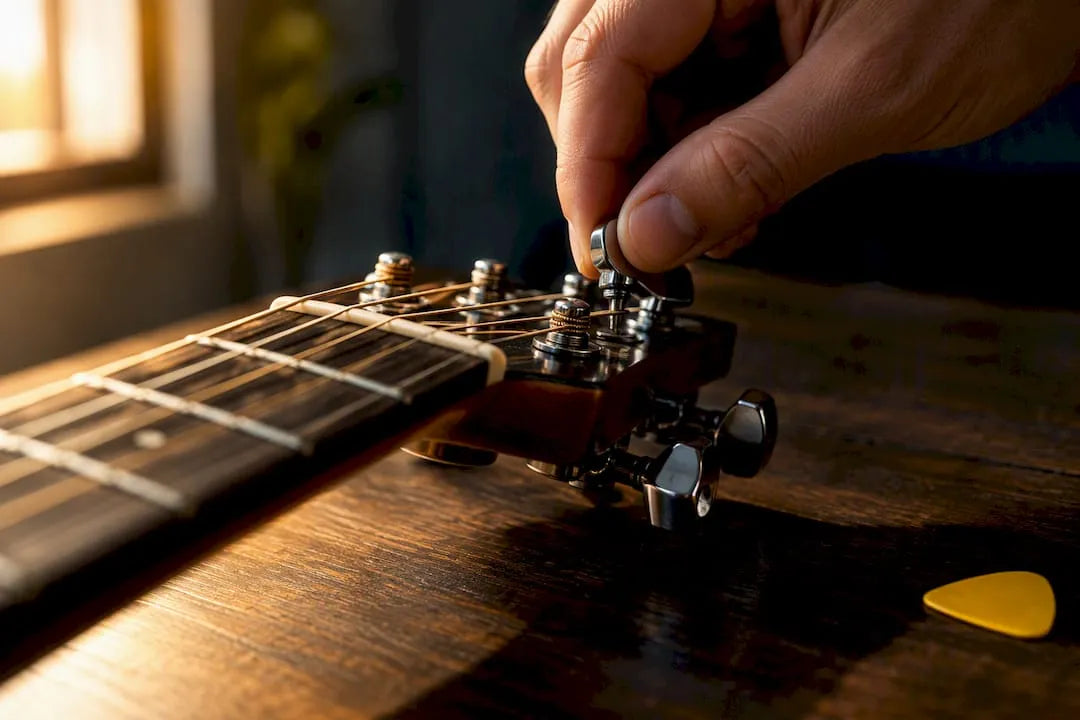
Tablature is a six-line map of the fretboard: each line stands for a string, and the numbers written on it tell you which fret to press. Tune up, find the string line for the note you want, fret the number shown and play it slowly in time with a beat. Tab shows you where to put your fingers, but for timing you will often need the recording, a metronome, or standard notation alongside it.
Table of Contents
- How tablature maps to strings and frets
- Finding the rhythm when tab leaves it out
- Reading the symbols for common guitar techniques
- A step-by-step practice plan for reading tab
- Avoiding common tab-reading mistakes
- Working out timing and rests when tabs go quiet
- How guitar tab compares with bass and ukulele tab
- Making sense of tuning changes and alternate tunings
- How we think about tab, practice and instrument care
- Tools worth adding to your practice
- Sources
- FAQ
How tablature maps to strings and frets
Guitar tab uses six horizontal lines, one for each string, with the bottom line representing the low E string and the top line the high E string, according to Berklee Online. A number sitting on a line tells you the fret to press on that string, and a 0 means you play the string open, with no finger down at all. Two-digit numbers such as 10, 11 or 12 work the same way: they just point further up the neck, so a “12” on the top line means the twelfth fret of the high E string.
Hold the tab so its lines match the strings in front of you as you look down at the fretboard, with the low E nearest the floor and the high E nearest the ceiling. If that feels backwards at first, a simple fretboard diagram alongside the tab can help until the orientation becomes automatic.
Two quick examples to try:
- A single-note line reading 0, 2, 3 on the low E string means play it open, then fret 2, then fret 3, one after another.
- A simple open chord pattern with several 0s stacked vertically means strum those open strings together.
Because tab states the exact string and fret for every note, it removes much of the guesswork that standard notation can leave around fretboard position, Berklee Online points out.
Finding the rhythm when tab leaves it out
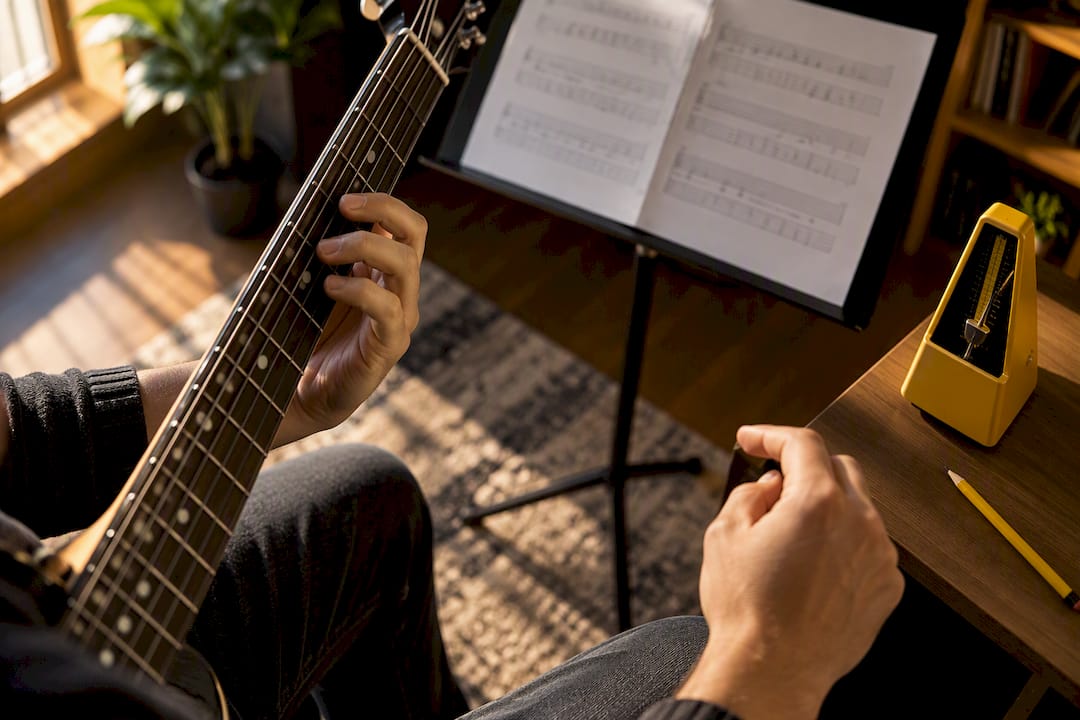
Tab tells you where to put your fingers, but on its own it rarely tells you how long to hold a note or when to rest. Tab is often printed beneath standard notation specifically so that bar lines and rhythmic figures line up, and Yamaha Music recommends using that alignment to work out timing when the tab alone gives you none. When there is no notation above the tab, the recording becomes your rhythm guide: listen closely, count the beats aloud, and set a metronome to keep you honest.
Most beginner material you meet will sit in 4/4 time, counted “1, 2, 3, 4” per bar, sometimes with a tempo marking such as “quarter note = 100” printed above the staff. A few simple drills fix rhythm problems quickly:
- Clap the rhythm of a phrase before you touch the guitar, so your ear knows the pattern first.
- Tap the beat with your picking thumb on an open string until it feels steady.
- Add the fretted notes from the tab once the rhythm sits comfortably on its own.
Pro Tip: Record yourself playing along with a metronome, then listen back. Timing slips are far easier to hear than to feel while you play.
Reading the symbols for common guitar techniques
Tab uses a small set of letters and symbols to show techniques beyond a plain picked note, and learning them removes most of the guesswork from a written part. The common ones are h for hammer-on, p for pull-off, / for a slide up, ** for a slide down, b for a bend, r for a release, ~ for vibrato and PM for palm mute. A marking such as “5h7” means fret the fifth fret, then hammer your finger onto the seventh fret on the same string without picking again.
Each symbol describes a physical action:
- Hammer-on (h): press a higher fret sharply onto the string without picking it separately.
- Pull-off (p): pluck the string with a fretting finger as you lift off a higher fret, sounding the lower note.
- Slide (/ or ): fret a note and slide your finger up or down to the next one without lifting.
- Bend (b): push or pull the string sideways to raise its pitch, then often release ® back down.
- Vibrato (~): rock the string slightly to add a wavering quality to a sustained note.
MusicRadar notes that beginners should not be discouraged by these names: hammer-ons, pull-offs and slides are learnable with focused repetition and are part of what makes lead guitar sound musical rather than mechanical. Practise one technique at a time, one bar at a time, well under tempo before speeding up.
Pro Tip: Isolate a single hammer-on or slide and repeat it slowly for a minute before dropping it back into the full phrase.
Tab cannot capture every nuance of feel, so use a recording as your reference for how firm a bend should be or how wide a vibrato should sound.
A step-by-step practice plan for reading tab
A short, sequenced routine turns tab reading from a puzzle into a habit within a couple of weeks. The stepwise approach below borrows from simple call-and-response methods used in beginner method books, where you identify a note, play it, and say its fret and finger number aloud before moving on, a technique Yamaha Music highlights for building fluency quickly.
- Day 1: tune up, identify each string by name, and play single fretted notes between the open string and the third fret, slowly and one at a time.
- Day 2 to 3: work through short two or four-bar phrases, counting the beats aloud, starting a metronome at 60 beats per minute and nudging it up by 5 to 10% once the phrase feels solid.
- Introduce one technique, a hammer-on or a slide, and practise it in isolation on a single string before adding it back into a phrase.
- Set a weekly goal: play a short tabbed phrase from start to finish in time with the recording or the metronome, without stopping.
Keep each session short and focused rather than long and scattered. Five focused minutes on a single bar beats twenty distracted minutes on a whole song.
Avoiding common tab-reading mistakes
Most early reading errors come down to orientation and counting rather than the technique itself. Reading the tab upside down, so the low E line is mistaken for the high E, is one of the most frequent slips, alongside miscounting which of the six lines you are actually on. Multi-digit frets can also trip up new readers, since a “1” followed by a “0” is the fret twelve, not fret one followed by fret zero.
Common errors to watch for:
- Upside-down reading: double-check that the bottom line is genuinely your lowest-sounding string before you start.
- Miscounted strings: count from the bottom line every time until it becomes automatic.
- Fret confusion: read two-digit numbers as a single fret, not two separate ones.
When a passage leaves the fingering choice open, favour patterns that keep your hand in one position rather than jumping around, since minimal movement tends to stay more accurate at speed. Tab also has real limits: it struggles with rhythm-heavy passages, ensemble parts where multiple instruments interact, and expressive phrasing, and Yamaha Music notes that tab alone often lacks rests and precise rhythmic values, which can limit understanding unless you pair it with notation or a recording. In those cases, a spell of standard notation study or a few lessons with a teacher fills the gap tab leaves behind.
A poorly set-up instrument makes all of this harder before you even get to the reading: high action or poor intonation turns a straightforward bend or hammer-on into a fight with the guitar itself, so a professional setup is worth considering if your playing feels stiffer than the tab suggests it should.
Working out timing and rests when tabs go quiet
Plenty of tabs give you frets and techniques but say nothing about how long a note should ring or where a rest falls, and that gap is one of the most common reasons beginners feel stuck. The fix starts with the recording: play the original track alongside the tab and let your ear fill in what the page does not show. Count the beats aloud as you listen, and mark rests yourself in pencil above the tab wherever the music clearly stops.
Where no recording is available, look for any aligned standard notation above the tab, since bar lines and note stems there carry the rhythmic information tab usually strips away, as Yamaha Music explains. A metronome set to a steady, slow tempo gives you a fixed grid to place notes against, which is often enough to work out whether a note is held for one beat or two even without notation.
When timing is genuinely ambiguous, a practical shortcut is to treat every unmarked note as equal in length until you find evidence otherwise, then adjust once you hear the phrase played back. This will not always be exact, but it keeps you playing rather than stuck decoding, and your ear will correct the details as you get more familiar with the piece.

How guitar tab compares with bass and ukulele tab
Guitar tab, bass tab and ukulele tab all share the same basic idea: horizontal lines for strings, numbers for frets. The difference comes down to how many strings each instrument has and how they are tuned. Guitar tab uses six lines for the standard six strings, tuned low E to high E, while bass tab typically uses four lines for a four-string bass tuned E, A, D and G, an octave below the guitar’s lower strings, as Yamaha Music sets out for bass players moving between the two notations.
Ukulele tab, by contrast, uses four lines as well, but the top line is not necessarily the lowest-pitched string because of the instrument’s re-entrant tuning, where the fourth string is tuned higher than the third. That single difference means a beginner who reads guitar tab fluently cannot simply assume the same string order applies when picking up a ukulele chart. The technique symbols, hammer-ons, pull-offs, slides and bends, carry across all three instruments in much the same form, so skills learned on guitar tab transfer directly once you have relearned the string layout.
Making sense of tuning changes and alternate tunings
Alternate tunings show up often enough in tabbed music that spotting them early saves a lot of confusion. Most tabs state the tuning at the very top of the sheet, usually as a set of six letters reading from the low string to the high string, such as D A D G A D in place of the standard E A D G B E. If that line is missing and the notes sound wrong compared with the recording, retuning is the first thing to check.
Playing in an alternate tuning does not change how you read the numbers: a “3” on the bottom line still means the third fret of whichever string that line represents, it is simply tuned to a different pitch than usual. What changes is the sound each open string and fretted note produces, so chord shapes you know from standard tuning will often produce a different chord in a dropped or open tuning. Some tabs also mark a capo position near the top, which shifts every open string up in pitch without you needing to retune at all, and reading that instruction before you start saves you wondering why your open chords sound a semitone or two off from the track.
How we think about tab, practice and instrument care
We see tab as the fastest way to get a beginner actually playing, and that speed matters more early on than technical completeness. Rhythm study can follow once a phrase feels comfortable under the fingers, built up through counting, a metronome, and the aligned notation approach covered above. What often gets missed is that the guitar itself shapes how easy any of this feels.
Expert setup and inspection can make a difference on many instruments, as can personalised service and learning resources for players working through exactly this kind of material. If bends feel stiff or intonation seems off no matter how carefully you practise, a setup or a visit to the store is usually the quicker fix.
— Music
Tools worth adding to your practice
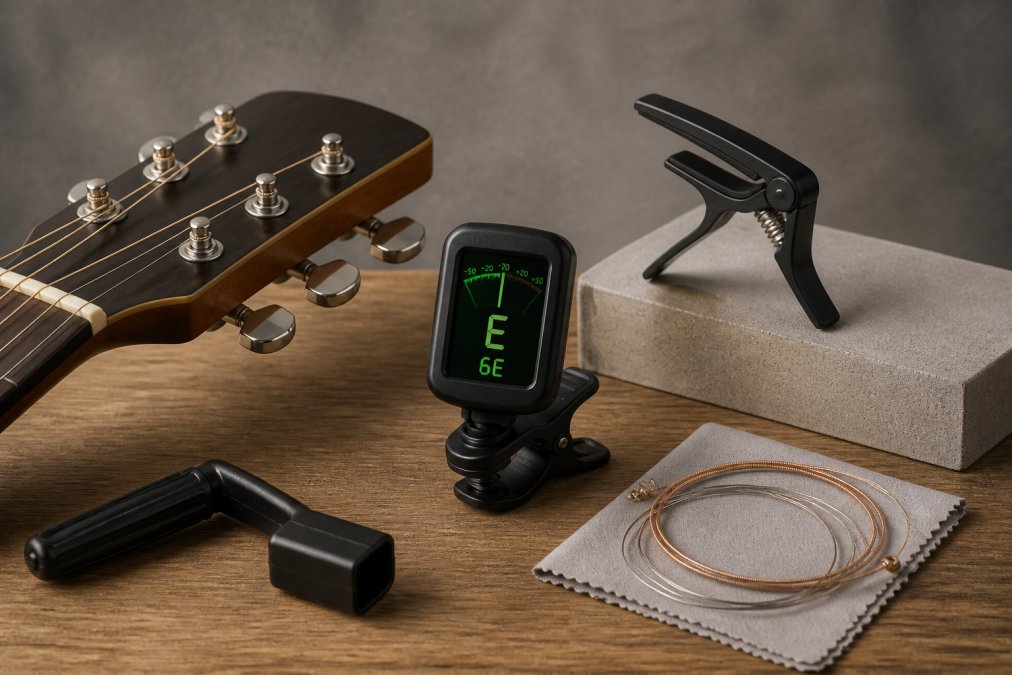
Once tab reading starts to click, a few practical purchases make the next stage easier rather than adding complexity. The Vaieology - Music Theory Book for Guitar Players is a sensible next step for anyone who wants to understand rhythm and notation properly rather than relying on tab alone. A Shubb C4 Curved Nickel Capo is worth having in reach too, since so many tabbed songs are written with a capo position that changes the key without changing the shapes you already know.

If you are starting out on bass rather than guitar, the Aria TAB Classic Wine Red - Bass Guitar is a solid four-string option for working through bass tab using the same reading skills covered here.
- Book a guitar setup or repair if action or intonation is making techniques harder than they should be.
- Get fresh strings fitted through our restring service so bends and slides feel as they should.
- Browse electric guitars or acoustic guitars if your current instrument is holding your progress back.
Visit us in store or online to talk through what would help most.
Sources
For a fuller grounding beyond this guide, Berklee Online covers hammer-ons, pull-offs and slides in more depth, including the finger strength work behind them. Yamaha Music has practical method-book approaches for beginners, and BBC Bitesize offers a clear primer on notation for readers who want to move beyond tab altogether.
- Guitar notation basics | Berklee Online
- A guitarist’s guide to reading sheet music and tablature | Yamaha Music
- Guitar basics: getting started with lead playing | MusicRadar
FAQ
What does the number 0 mean in guitar tab?
A 0 on any line means you play that string open, without pressing down any fret. It is one of the simplest symbols in tab and appears constantly in beginner phrases and chords.
Why does my tab have no rhythm markings?
Basic tab often shows only string and fret, leaving timing out entirely, according to Yamaha Music. Use the original recording, a metronome, or any standard notation printed above the tab to work out how long each note should last.
Is tablature easier to learn than standard sheet music?
Tab is generally quicker to pick up for beginners because it shows the exact string and fret rather than requiring you to translate a note on a staff into a fretboard position, as Berklee Online explains. Standard notation carries more information about rhythm and expression, so many players use both together as they progress.
Can I use the same reading skills for bass or ukulele tab?
The core idea, lines for strings and numbers for frets, carries across guitar, bass and ukulele tab. You do need to check the number of strings and the tuning order for each instrument, since bass typically uses four lines and ukulele’s top line is not always the lowest-pitched string.
What should I do if a song uses an alternate tuning?
Check the top of the tab sheet for a tuning line, usually six letters from the low string to the high string, and retune before you start playing. The numbers still refer to frets in exactly the same way, only the pitch of each open string changes.





Share:
3 Quick Checks to Tune Your Guitar to Open G With Pro Setup Tips