

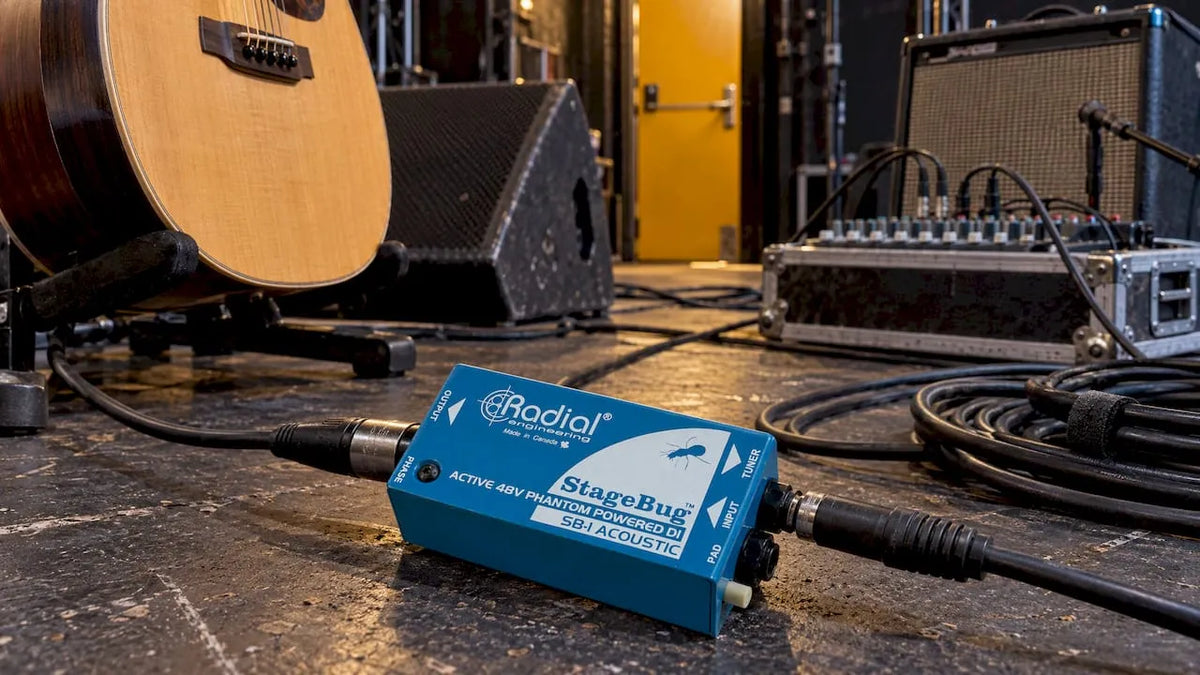
A DI box (short for direct injection) takes the signal from an instrument such as an acoustic guitar, bass or keyboard and changes it into the kind of signal a mixing desk expects. It lowers the level to microphone level, converts the signal from unbalanced to balanced, and presents a low-impedance output, so a long cable run to the stage box or desk stays clean. Many DIs also have a second output so your own amp keeps working, and some have a ground-lift switch to stop hum.
That is the short answer. The rest of this guide explains what each of those changes means in practice, when you actually need a DI, how to wire one up, and how to choose between the main types.
Table of Contents
- What a DI box does to your signal
- Do you need a DI box?
- How to connect a DI box
- Active or passive DI box?
- What does the ground lift do?
- Choosing a DI box
- Common mistakes with DI boxes
- A DI box from our point of view
- Find the right gear at MusicStreet
- FAQ
- Sources
What a DI box does to your signal
A guitar pickup is a high-impedance source with an unbalanced output. That works perfectly for a short lead into an amp, which is designed to receive exactly that. A mixing desk is a different story. Its microphone inputs expect a low-level, low-impedance, balanced signal on an XLR connector. Plug a guitar straight into one and you get a thin, noisy or dull sound, and the longer the cable, the worse it gets.
According to Sound On Sound’s explanation of DI boxes, a DI gives the instrument a suitable high-impedance load to work into, reduces the signal to microphone level, converts it from unbalanced to balanced, and provides a low-impedance output for a mixer or microphone preamp. It can also isolate the grounds of the source and destination, and split the signal so a copy can go to an amplifier.
In other words, it does four jobs in one small box.

1. It matches impedance
Impedance is, loosely, how much a circuit resists the flow of an alternating signal. Your guitar’s pickups want to see a high-impedance input, and a mic preamp is a low-impedance one. The DI sits between them and acts as a go-between, so the instrument is not loaded down and keeps its full tone. Yamaha’s UK PA guide describes a DI as converting high impedance to low impedance, which makes the signal more suitable for long cable runs to a mixer.
2. It converts unbalanced to balanced
A standard guitar lead carries an unbalanced signal on two conductors: signal and shield. Over a long run, that shield can pick up interference from lighting dimmers, mobile phones and power cables. A balanced connection uses three conductors, and the desk cancels out the noise that arrives on both signal lines equally. This is why microphones and DI boxes use XLR cables.
The practical benefit is distance. Radial Engineering says a DI’s balanced output can travel about 100 metres (300 feet) without appreciable noise, which matters when the front-of-house desk is a long way from the stage.
3. It reduces the level to mic level
Instrument-level signals are hotter than microphone-level signals. If you feed them to a mic input unchecked, you risk distortion at the preamp. The DI brings the level down to what the preamp expects, and the preamp then raises it again cleanly.
4. It isolates and splits
Most DIs have a second output, often labelled THRU or AMP, that passes the instrument signal on to your own amplifier in parallel. One feed goes to the amp for you to hear on stage, while the other goes to the desk for the audience and the engineer. Many also offer a ground-lift switch, covered further down.
Do you need a DI box?
If you play an electric guitar through a guitar amp that is miked up, you generally do not need one. The microphone does the job. A DI becomes useful whenever the instrument itself has to go into a mixer or recording input, rather than through a mic.
The usual cases:
- Acoustic guitar with a pickup. The output of an under-saddle pickup or soundhole system is high impedance and needs a DI or a preamp with a DI output to reach the PA properly.
- Bass guitar. Many bassists send a DI feed to the desk while using their own amp on stage. Sound On Sound notes that DIs are used for guitars, basses, keyboards and similar instruments feeding a stage sound system.
- Keyboards, laptops and tablets. These usually output line-level signals, often in stereo, and a DI turns them into a balanced signal for the stage box.
- Long cable runs. If the desk sits at the back of the room, the balanced output keeps the signal clean.
- Recording a clean track. A DI split lets you capture the guitar before the amp and effects.
Do you need one with an audio interface?
Often you do not. Most audio interfaces have at least one input marked Hi-Z or Instrument, which already provides the right impedance for a guitar. If yours has one, plug in directly.
A DI earns its place with an interface when you want to record and amplify at the same time. Focusrite’s guidance explains that a DI can split the guitar signal so one feed goes to an amplifier and the other to the interface. That lets you record the amp and the direct sound together, or reamp the clean track later through a different amp or simulation. It is a sensible habit because the clean recording keeps your options open after the session.
It also helps if your interface has only microphone inputs, or if you are combining it with other equipment such as a mixing desk.
How to connect a DI box
Setting one up takes a couple of minutes and three leads.
- Guitar to DI input. Use a standard quarter-inch instrument cable from your guitar, or from your pedalboard output, into the DI’s input jack.
- DI output to the mixer. Run an XLR cable from the DI’s XLR output to a microphone input on the mixer or stage box.
- DI thru to the amp (optional). Connect the DI’s THRU or AMP output to your amplifier’s input if you want to hear yourself through your own amp.
- Check power. If the DI is active and has no battery, phantom power (+48V) must be switched on at the mixer channel.
Yamaha’s PA guide describes this same layout for a bass: the instrument goes into the DI by a phone connector, the DI output goes to the mixer by XLR, and the DI’s amp output goes to the bass amplifier. The balanced signal serves the PA, while the parallel connection keeps your stage sound unchanged.
Two tips from experience at the bench. Keep the DI close to the instrument or pedalboard, and let the long run be the balanced XLR, not the instrument cable. And turn the channel gain down before you plug in or switch phantom power on, so nothing pops through the speakers.
Active or passive DI box?
This is the choice that confuses most people, and it comes down to power and the strength of the source.
| Passive DI | Active DI | |
|---|---|---|
| Power | None needed | Battery or phantom power |
| Typical sources | Hot signals such as keyboards, line-level outputs, active basses | Passive pickups, acoustic guitars and quieter sources |
| Strengths | Simple, robust, nothing to run out | Can add a preamp stage and handle very high input impedance |
| Watch for | Cannot boost a weak signal | Needs power switched on |
A passive DI uses a transformer and no electronics, so there is nothing to power and little to go wrong. An active DI contains a buffer or preamp, so it can handle quiet sources with higher impedance. Yamaha notes that active DIs take power from a battery or from the mixer’s phantom supply, and if you are not using batteries, phantom power must be enabled.
As a rule of thumb, passive suits strong signals and simple setups, while active tends to be the better match for acoustic guitars with piezo pickups and for passive instruments that need a high-impedance input. Check the manual for the instrument and the DI you are pairing.
What does the ground lift do?
Sometimes you plug everything in correctly and still hear a low hum. That is often a ground loop: two pieces of equipment connected to earth by different routes, creating a small circulating current that the audio picks up.
Sound On Sound explains that a DI isolates the grounds of the source and the destination to avoid ground loops, and can provide electrical isolation for safety where necessary. The ground-lift switch is the control that disconnects the ground connection between the input side and the output side, breaking the loop.
Try it like this: if you hear hum, flip the ground lift and listen. If the hum disappears, leave it. If nothing changes, flip it back; it is not a cure for every noise. Never remove the earth pin on a mains plug to cure hum. That is a safety hazard. The ground lift on a DI works on the audio connection only.
Choosing a DI box
Prices and features run across a wide range, so decide what you need before you decide what to spend. These are the questions worth asking:
- What is the source? An acoustic guitar with a piezo pickup, a bass, a keyboard and a laptop each suit different input stages.
- Do you need to blend or shape the tone? Some units are more than a simple DI. They include an EQ, a notch filter, a feedback control or a phase switch, which is useful on a loud stage.
- Do you want an amp feed? If you play through your own amp as well, make sure there is a THRU output.
- Will you be using batteries or phantom power? Check what the unit takes and whether you have a mic input with phantom available.
- Is it going to travel? Gigging players want a tough metal case and sensible connectors.
DI boxes and preamps for acoustic players
Acoustic guitarists often find that a combination of pickup and preamp gives better results than a plain DI. A preamp lets you shape the tone, adjust the volume and handle the feedback at the guitar, then send a ready-to-go signal to the desk. If you want something compact, the Radial Stagebug SB-1 acoustic DI is a small unit built for just this job. The LR Baggs Para Acoustic D.I. adds a parametric EQ to the DI, so you can shape the sound of the guitar before it reaches the PA.
If you want to fit a pickup system to your guitar, the LR Baggs X-Bridge preamp and the LR Baggs iBeam dual channel system are worth a look, and for budget-minded players we sometimes have a used Behringer acoustic preamp in stock. Stock changes, so check each page for what is available now.
Bassists who want a DI built to go with a bass rig can look at the Ampeg SGT-DI, which combines a preamp and DI output in one unit.
How much does a DI box cost?
There is no single price. Simple passive boxes sit at the budget end, while active units with a preamp, EQ and extra outputs cost more, and multi-feature acoustic preamps with a DI output sit higher still. Rather than quote a figure that will date, we suggest you open the product pages above, compare the features you need against the price shown, and ask us if you are unsure which suits your instrument.
Common mistakes with DI boxes
- Using the wrong input on the mixer. The DI’s XLR output goes into a mic input, not a line input, unless the mixer says otherwise.
- Forgetting phantom power. An active DI with no battery will sound dead or faint until phantom is switched on.
- Leaving phantom on when plugging in. Mute the channel or lower the gain first.
- Running the long cable on the instrument side. Keep the quarter-inch lead short and send the distance down the XLR.
- Putting effects after the DI. If you want your pedalboard sound on the PA, plug the pedalboard output into the DI. If you want a clean signal for recording, take the DI feed before the pedals.
- Expecting a DI to sound like an amp. A DI delivers the instrument’s own signal. For the sound of a guitar amp or speaker cabinet, you need a mic on the cab or a cab simulator.
A DI box from our point of view
Most of the DI questions we hear in the shop are really questions about the whole chain: the guitar, its pickup, the lead, the pedals, the amp and the PA. A DI is a small part of it, but it is the part that decides whether the sound you built at home survives the trip to the audience.
That is why we set up and inspect every instrument we sell, and why we like to talk through what you are plugging into what. A well-set-up guitar with the right pickup and the right DI or preamp will always give a sound engineer less to fix. If you are unsure about a connection, bring your guitar in and we can look at it with you.
Our advice is simple: work out the source first, then choose the DI. Acoustic players tend to be happiest with a DI that has some tone control, bassists with a unit that also feeds their amp, and keyboard and laptop users with a straightforward passive box.
Music
Find the right gear at MusicStreet
We are a guitar retailer with a shop in Huntingdon, Cambridgeshire, and an online store that delivers across the UK. Every instrument we sell is set up and inspected, and we can talk you through the pickups, preamps and DI options that suit your guitar.

If you are building a stage or recording setup, browse our guitar amps and combos, our accessories and our cases and gig bags, or visit MusicStreet to see what is in stock. If you need a guitar set up before a gig or session, we also offer setups, servicing and repairs.
FAQ
Can I plug my guitar directly into a DI box?
Yes. Connect the guitar to the DI’s quarter-inch input, then run an XLR cable from the DI’s output to the mixer’s microphone input. If you also want to hear your own amp, connect the DI’s THRU or AMP output to the amplifier’s input. This is the same arrangement Yamaha describes for a bass in its UK PA guide.
What does a ground lift do on a DI box?
It disconnects the ground between the input and output sides of the DI, which can stop the low hum caused by a ground loop. Sound On Sound describes the DI’s role as isolating the source and destination grounds. Switch it on if you hear hum, and leave it off if it makes no difference.
Do I need a DI box if I have an audio interface?
Not always. If your interface has an instrument or Hi-Z input, you can plug a guitar straight in. A DI is useful when you want to send one feed to an amp and another to the interface, or when you have no instrument input. Focusrite describes this split as a way to record amp and direct signals together or reamp later.
What is the difference between an active and a passive DI?
A passive DI needs no power and uses a transformer. An active DI needs a battery or phantom power and can include a preamp stage. Passive units suit strong signals and simple setups, while active units are often chosen for acoustic guitars with pickups and other quiet, high-impedance sources.
How much does a DI box cost?
It depends on the type and features. Basic passive boxes cost the least, while active units with EQ, a preamp or several outputs cost more. Check the product pages for the current price of each model, and ask us if you would like help choosing.
Sources
- Prepare to DI!, Sound On Sound
- PA Beginners Guide, Yamaha Commercial Audio
- Choosing the right approach, Focusrite User Guides
- What is a DI?, Radial Engineering




Share:
What Effects Go in an Effects Loop? A Guitarist's Guide