

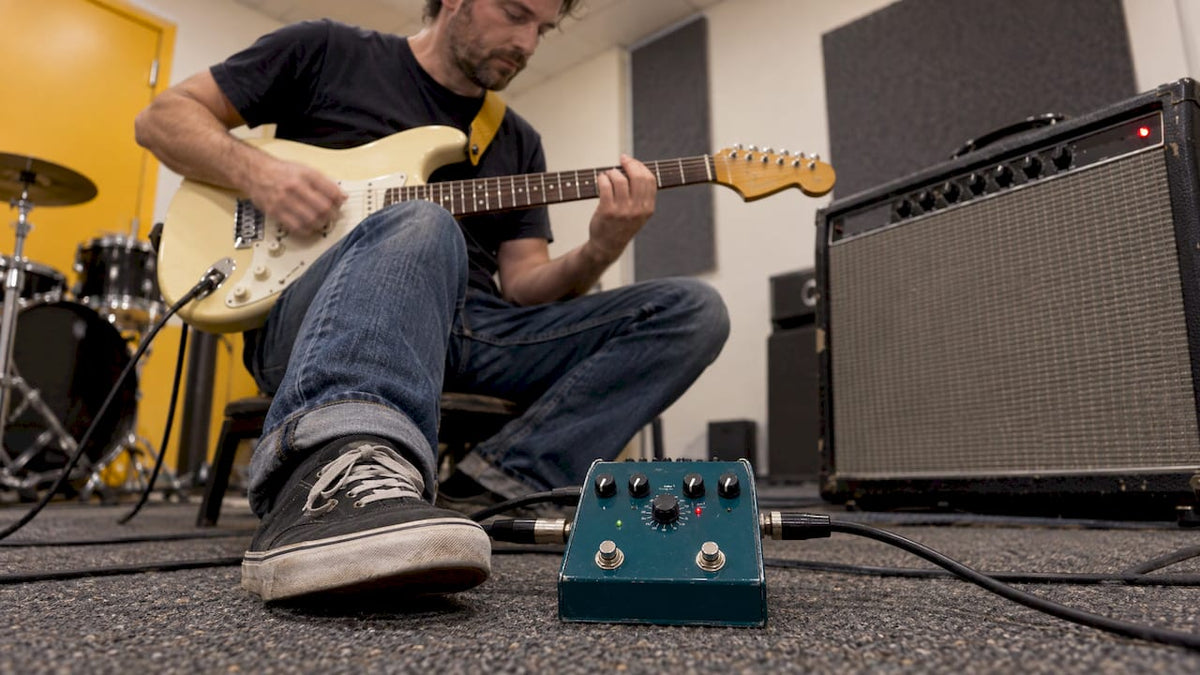
An echo is a distinct repeat of a sound, heard after a short gap. On guitar, an echo effect is a pedal or unit that records your signal and plays it back one or more times, mixed with your original notes. If you came looking for the heart scan, that is a medical test, so ask your GP or the NHS. This guide is about the guitar effect: how it works, how it differs from delay and reverb, and how to set one up so it improves your playing.
Table of Contents
- Echo in plain terms
- Echo, delay and reverb: what is the difference?
- How echo effects are made
- What the controls do
- Setting up your first echo
- Where echo goes in your signal chain
- Three echo techniques to try
- Choosing an echo pedal
- Try echo at Musicstreet
- Our view on echo
- FAQ
- Sources
Echo in plain terms
In the natural world, an echo happens when sound bounces off a single distant surface and returns to your ears more than about 30 milliseconds later. You hear it as a separate repeat, not as part of the original sound. Native Instruments describes it this way, and the 30 ms figure is a handy marker. Below it, the repeat blends into the original and just thickens the note. Above it, you hear a second, separate note.
Guitar.com’s guide to echo points out that echo occurs in nature, so it is hardly surprising it was among the first effects engineers tried to simulate electronically. Think of a handclap bouncing off a canyon wall: one clap, then a clear copy of it.
A guitar echo effect does the same job on purpose. It takes your signal, holds it for a set time, then plays it back. Turn up the feedback and the copy is itself copied, giving a trail of repeats that fade away.
Echo, delay and reverb: what is the difference?
Players use these words loosely, and shop shelves do too. Here is how they separate.
- Echo is the acoustic phenomenon: a distinct repeat from a distant surface.
- Delay is the audio effect that can imitate echo. According to Native Instruments, it captures a signal and plays it back after a set period, and it can also do far more than imitate echo, from adding space to a mix to sculpting unusual sounds.
- Reverb is a dense cloud of reflections. Guitar.com’s guide describes it as many echoes so close together that they sound continuous.
In practice, “echo pedal” and “delay pedal” usually mean the same thing. The word “echo” tends to hint at a vintage, tape-style flavour, while “delay” covers everything from clean digital repeats to experimental textures. If you want one clear repeat at a rhythmic distance, you want echo or delay. If you want your notes to sit inside a room or hall, you want reverb. Many players use both: a short, tidy delay for rhythm and a gentle reverb for space.
If reverb is what you are after, the Boss RV6 reverb pedal and the Electro Harmonix Holy Grail are both in our range.
How echo effects are made
The way an echo is produced shapes how it sounds. There are three main routes.
Tape echo
The earliest method used a loop of magnetic tape. Guitar.com explains that the delay time is set by the distance between the record and playback heads and by the tape speed. Roland’s UK blog describes a typical machine with three heads (erase, record and playback). The erase head clears the tape, the record head writes your signal, and the playback head reads it a few milliseconds later. Mixed with the original, that gives the classic echo.
The numbers are easy to picture. Guitar.com gives an example: with one inch between the heads and the tape running at 15 inches per second, the delay is about 66 milliseconds. Halve the speed to 7.5 ips and it doubles to roughly 133 milliseconds, which Guitar World’s history of guitar delay ties to the slapback sound of 1950s rockabilly and rock ‘n’ roll records.
Roland also notes that tape machines run the repeats through filters to reduce noise. The side effect is a tone that changes through the repeats, whereas a digital delay produces exact copies. That darkening, slightly wobbly repeat is much of what people mean by “tape echo”.
British players have a particular link to this sound. Guitar Player credits the Watkins Copicat, devised by Charlie Watkins with engineer Bill Purkis in 1958, as the first independent tape-loop echo unit in the world, and a major part of the British sound heard on Hank Marvin and the Shadows records.

Analogue delay
Analogue pedals typically use bucket-brigade chips, which pass the signal along a chain of tiny stages. Each pass slightly degrades it, so the repeats come out darker and softer, and they decay naturally. Many players choose analogue-style repeats because they sit behind the dry note without competing with it.
Digital delay
In a digital unit, the signal is converted to digital data, stored in a memory buffer and recalled a short time later. Feeding some of the delayed audio back into the buffer creates multiple repeats. The result can be a precise copy of your tone, and digital designs usually offer longer delay times, tap tempo, presets and several delay modes in one box.
Many modern pedals combine approaches, with digital circuits modelling tape or analogue behaviour. That is why a single pedal can cover slapback, rhythmic delays and long ambient washes.
What the controls do
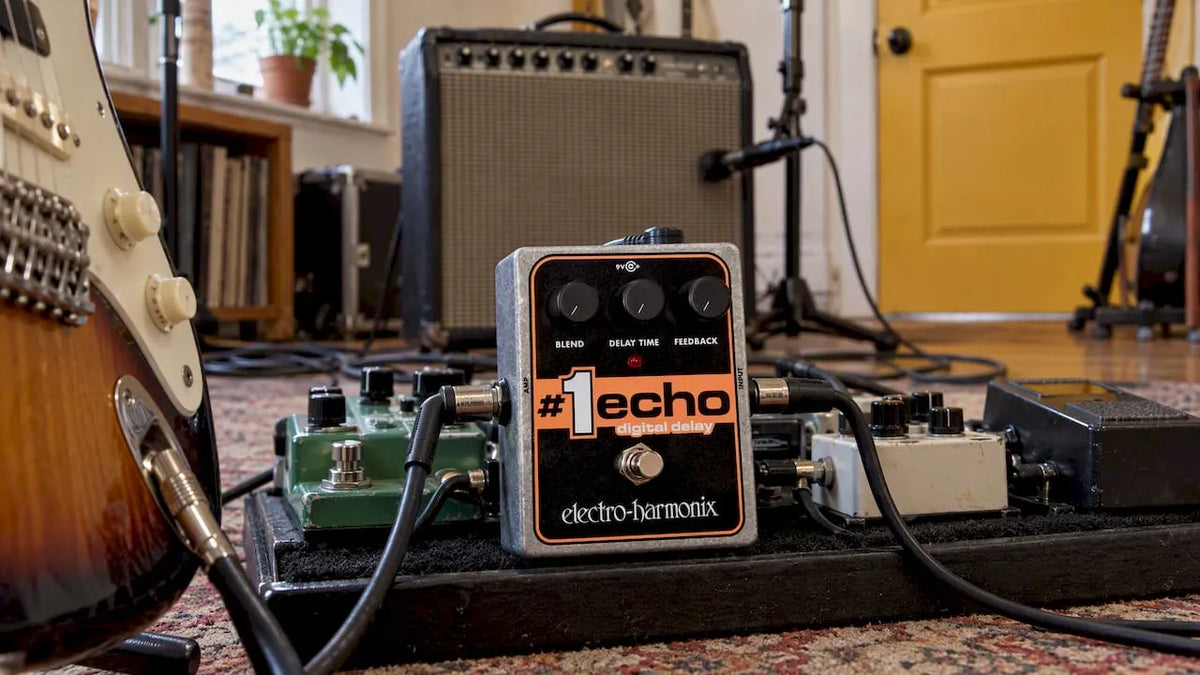
Echoes are simple once you know three knobs. BOSS’s guide to delay pedals lists them as effect level, feedback and time.
| Control | What it changes | Turn it down | Turn it up |
|---|---|---|---|
| Time | The gap between your note and each repeat | Short, tight repeats | Longer, more spaced repeats |
| Feedback (repeats) | How many times the echo repeats | Fewer repeats | A long trail of repeats |
| Mix (effect level) | Volume of the echo against your dry signal | Subtle, background echo | Prominent, obvious echo |
BOSS notes that turning feedback down gives fewer repeats, while very high settings can produce a near-endless series of repeats that build into self-oscillation, a rising, chaotic wash of sound. Some players use that deliberately for noise and texture, but for everyday playing, keep feedback comfortably below that point.
Many pedals add extras: a modulation control to make repeats waver like an old tape, a tone control to darken them, and a tap-tempo footswitch. Astral-style tap buttons let you set the time by tapping the beat rather than dialling in a number, which is very handy on stage when the song’s tempo is not exactly what you rehearsed.
Setting up your first echo
The simplest echo is a single repeat. Sound on Sound’s Digital Delay Tactics suggests starting with a straight, single delay: modulation at zero, feedback at zero and the mix at around halfway. Then you add a little at a time.
A sensible routine for a first session:
- Set feedback to minimum and mix to about halfway, so you hear one clean repeat.
- Pick a time. Sound on Sound says delays between 30 and 100 ms give slapback, which works well on rock guitar and vocals. Longer delays can be tuned to fall in with the song’s tempo.
- Bring the mix down until the echo supports your playing instead of crowding it.
- Add feedback slowly. Per Sound on Sound, once you pass 100 ms, increasing feedback gives the familiar tape-echo sound, which warms up guitar and, on a clean electric tone, recreates the old Shadows sound.
- Play along to a track. Echo always sounds different with a band than alone in your bedroom, so check it against a drum loop or backing track.
If you play through a dirty amp, the starting point shifts. Premier Guitar’s tone tip on echo and the dirty amp advises starting with mix and feedback both low and keeping the mix just above its minimum, because repeats multiply the grit.
Where echo goes in your signal chain
The general approach is to place delay or echo after your distortion and gain pedals, according to the same Premier Guitar article by Pete Thorn. Time-based effects can sound out of control and muddy when they run before distortion, and effects loops were created so you could put delay there. If your amp has an effects loop, run the echo through it. If it does not, put the pedal last in the chain, after drive and modulation.
A useful rule of thumb: drive first, modulation next, then delay, then reverb. Reverb after delay means the repeats get their own space, which is how most players want it.
If you are building a board from scratch, our guitar accessories range covers the practical bits: patch cables, power and the rest.
Three echo techniques to try
Slapback
Slapback is a single, quick repeat at roughly the same volume as the original. One source puts it at 80 to 150 ms, and it is closely tied to the early rock and roll records of the 1950s. Feedback stays low so you only hear one repeat. It thickens a rhythm part and gives lead lines a vintage edge.
Dotted eighth
This is the rhythmic echo behind the chiming, repeating figures many players associate with The Edge. Guitar World’s dotted 8th lesson explains that if you play straight quarter notes, each echoed note lands between the following played notes. The formula in the lesson is to divide 45 by your BPM. The answer is in seconds, so at 120 BPM you get 0.375 seconds, or 375 ms. The lesson stresses that the delay’s feedback should be at zero and the delayed note should be the same volume as the original.
If your pedal has tap tempo, tap quarter notes and select the dotted-eighth subdivision instead of working it out by hand.
Tape-style repeats
Set a longer time, bring feedback up to three or four repeats, and keep the mix modest. If your pedal has a tone or modulation control, roll off the highs and add a touch of wobble. On a clean electric tone, this gives the warm, fading repeats of vintage echo machines.
Choosing an echo pedal
Start with the sound you want, not the feature list.
- For classic slapback and tape-style repeats, look for a pedal built around vintage echo voicings. The Strymon Dig Vintage Delay sits in that territory.
- For atmospheric, spacious repeats, the Boss TE-2 and the Ernie Ball Ambient Delay are worth a look.
- For delay plus looping in one box, the used TC Electronic Alter Ego combines both.
- For frozen, held sounds, the Electro Harmonix Freeze sustains a note rather than repeating it.
- For a lower-cost way into echo, pre-owned units such as the Danelectro Dan-Echo and the DLS Echotap are listed in our used range, which changes as stock sells.
Ask three questions before you buy. Does it give you a time range that covers short slapback and longer rhythmic echoes? Does it have tap tempo if you gig? And does it fit the space you have left on your board?
Try echo at Musicstreet
We are a guitar shop with a store in Huntingdon, Cambridgeshire, and we sell new and pre-owned guitars, amps and effects online. Every instrument is inspected and set up by our team, and we offer in-store try-outs, so you can plug into an echo pedal through a real amp before you decide. Browse the effects range or come in and hear the difference between a tape-style and a clean digital repeat for yourself.

Already have a pedal and an amp that needs matching? Our guitar amps and combos are worth hearing with it, and our team can help with setup, servicing and repairs if your guitar needs attention first.
Our view on echo
Echo is the first time-based effect most guitarists fall for, and the reason is simple: it makes you listen. A single repeat tells you immediately whether your timing is tight, and a well-set echo makes an ordinary chord feel bigger.
We would encourage every player to hear echo through their own amp, with their own guitar, because the pedal, the amp and the pickups all shape the result. That is why we offer in-store try-outs and why we inspect and set up every instrument before it leaves us. A clean, well-set-up guitar gives an echo something worth repeating.
Start with one repeat and a modest mix. Learn what time, feedback and mix do. Then explore tape-style, rhythmic and ambient settings as your ear develops. Our team is happy to talk you through the options, whether you play bass, acoustic or electric.
Music
FAQ
What does an echo effect do on a guitar?
It records your playing and plays it back after a short delay, mixed with the original. Depending on the settings, you get one quick repeat (slapback), rhythmic repeats timed to the song, or long trails that fade away. The three main controls are time, feedback and mix.
Is echo the same as reverb?
No. An echo is a distinct repeat of a sound, while reverb is made of many reflections so close together they sound continuous. Echo gives clear repeats, and reverb gives a sense of space around your notes. Many players use both together, with the delay first and the reverb after it.
Where should an echo pedal go in the signal chain?
Usually after your distortion and overdrive pedals, or in your amp’s effects loop if it has one. Time-based effects placed before distortion can sound muddy and out of control, as Premier Guitar’s Pete Thorn explains. Reverb normally comes after the delay.
What are good starting settings for an echo?
Set feedback to minimum and the mix to around halfway for a single clean repeat, as Sound on Sound suggests. Choose a delay of 30 to 100 ms for slapback, or a longer time for rhythmic echo. Then lower the mix until the effect supports your playing.
Sources
- How to use delay and echo in music production, Native Instruments
- All About… Echo, Guitar.com
- Demystifying the Magic of Tape Echo, Roland UK
- The history of guitar delay, Guitar World
- How the Watkins Copicat helped define the sound of an era, Guitar Player
- The Complete Guide to Delay Pedals, BOSS Articles
- Digital Delay Tactics, Sound on Sound
- Tone Tips: Echo and the Dirty Amp, Premier Guitar
- The Dotted 8th Echo Technique, Guitar World

Share:
A Dorian Mode on Guitar: Notes, Shapes and Chords