


Many guitarists believe that heavier bracing automatically delivers stronger construction and better tone. Research shows that excessive brace mass reduces resonance by 10-15%, actually harming sound quality. Understanding how different bracing patterns shape your guitar’s voice and structural integrity helps you select the perfect instrument for your musical style and tonal goals.
Table of Contents
- Introduction To Guitar Bracing Patterns
- Major Guitar Bracing Patterns And Acoustic Principles
- How Bracing Patterns Modify Sound Projection, Sustain, And Tonal Balance
- Common Misconceptions About Guitar Bracing And Clarifications
- Comparison Of Bracing Patterns For Different Guitar Types
- Practical Implications Of Bracing For Guitar Selection And Customization
- Conclusion And Recommendations
- Discover Your Ideal Guitar And Accessories At Musicstreet
Key Takeaways
| Point | Details |
|---|---|
| X-Bracing Dominates Steel-String Guitars | This pattern enhances sustain by 15-20% and provides balanced tonal projection across frequency ranges. |
| Pattern Choice Affects Playability | Different bracing designs modify volume output, tonal warmth, and dynamic response characteristics distinctly. |
| Heavy Bracing Reduces Resonance | Overly stiff internal supports decrease soundboard vibration and can diminish overall tonal richness. |
| Match Bracing to Playing Style | Your preferred genre, tonewood selection, and performance requirements should guide bracing pattern selection. |
| Expert Modification Essential | Changing guitar bracing requires skilled luthier intervention to avoid structural damage and tonal deterioration. |
Introduction to Guitar Bracing Patterns
Guitar bracing refers to the internal wooden supports glued beneath the soundboard that control vibration patterns and maintain structural stability. These precisely positioned struts balance opposing forces, allowing the top to resonate freely while withstanding string tension exceeding 150 pounds. The bracing configuration fundamentally shapes how your guitar projects sound and responds to your playing technique.
Historical development transformed guitar construction dramatically. Early instruments used simple ladder bracing with parallel struts running perpendicular to the strings. In the 1850s, Christian Frederick Martin revolutionized acoustic guitar design by introducing X-bracing, which spread tension more evenly across the soundboard. This innovation enabled larger guitar bodies and brighter, more powerful tones that suited emerging musical styles.
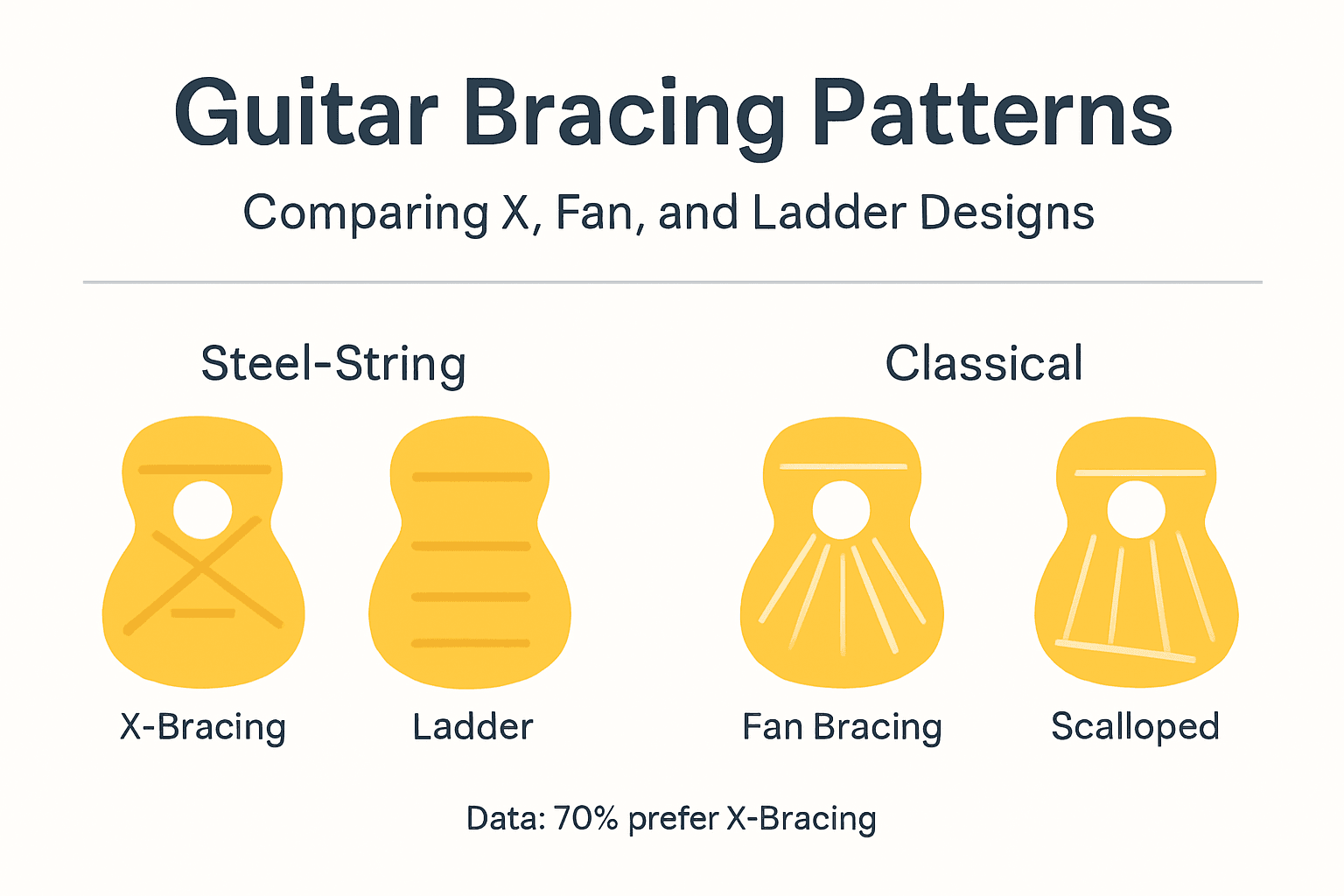
Modern luthiers employ several distinct bracing architectures:
- Ladder bracing features parallel supports providing structural simplicity
- X-bracing uses crossed diagonal struts for balanced resonance
- Fan bracing radiates outward from the sound hole in classical guitars
- Scalloped bracing removes material from standard patterns to increase flexibility
Understanding these options helps you appreciate why different guitar types revealed produce characteristic voices. The bracing pattern works alongside types of guitar bridges to define your instrument’s sonic personality. Balancing structural integrity with tonal quality requires careful engineering, making bracing one of the most crucial yet invisible aspects of guitar construction.
Major Guitar Bracing Patterns and Acoustic Principles
X-bracing remains the predominant choice for steel-string acoustic guitars worldwide. This pattern positions two diagonal braces crossing beneath the sound hole, distributing string tension outward toward the edges. The crossed configuration allows the soundboard center to vibrate more freely while maintaining structural strength. Players gain 15-20% longer sustain compared to ladder-braced instruments because the design permits controlled flexing that sustains note decay.
Ladder bracing predates X-bracing and continues serving specific tonal applications. Parallel struts running width-wise across the soundboard create a stiffer top that produces bright, focused treble response. This pattern excels for fingerstyle playing requiring articulate note separation. However, reduced soundboard movement limits sustain duration and overall volume output compared to more flexible bracing systems.
Fan bracing defines classical guitar construction with five to nine struts radiating outward from below the sound hole like a hand-held fan. This asymmetric pattern complements nylon string tension and produces warmer, bass-rich tones characteristic of classical repertoire. Volume output typically measures 10-20% lower than X-braced steel-string guitars because the design prioritizes tonal balance over projection.
Scalloped bracing represents an advanced variation where luthiers carve material away from standard brace profiles. Removing wood between support points increases soundboard flexibility without sacrificing structural integrity. Players experience enhanced vibration amplitude and improved projection, particularly beneficial for recording situations requiring dynamic tonal range. The technique demands expert craftsmanship to avoid weakening critical stress points.
Each bracing architecture delivers distinct acoustic signatures. Your musical requirements and playing style determine which pattern best serves your needs. Understanding guitar sustain explained clarifies how bracing choices directly impact your instrument’s voice and responsiveness.
How Bracing Patterns Modify Sound Projection, Sustain, and Tonal Balance
Bracing patterns control soundboard vibration modes, which determine how your guitar transforms string energy into audible frequencies. The struts act as nodal boundaries where the top’s movement changes direction. Lighter, more flexible bracing allows greater amplitude vibration across broader frequency ranges. Conversely, heavier bracing restricts movement, focusing energy into narrower resonance bands.
Sustain duration directly correlates with how efficiently the soundboard continues vibrating after initial string excitation. X-bracing’s crossed design permits controlled flexing that prolongs note decay without sacrificing volume. The pattern’s geometry distributes stress evenly, preventing premature damping that shortens sustain. Tonal richness increases because extended vibration allows harmonic overtones to develop fully and interact with fundamental frequencies.

Dynamic range describes the volume difference between your softest and loudest playing. Brace weight and placement dramatically affect this characteristic. Overly stiff bracing compresses dynamic response by limiting how much the soundboard can move under varying string attack intensity. Properly engineered bracing maintains linear response across your full playing dynamics, delivering expressive control from whisper-soft fingerpicking to aggressive strumming.
Key Acoustic Interactions:
- Lighter bracing increases bass response but may reduce structural stability
- Strategic brace placement shapes midrange character and clarity
- Soundboard thickness works with bracing to determine overall stiffness
- Tonewood density interacts with brace mass affecting vibration efficiency
Different tonewoods require corresponding bracing adjustments to optimize performance. Stiff woods like spruce pair well with lighter bracing that compensates for natural rigidity. Softer woods such as cedar benefit from slightly heavier bracing providing necessary support without over-damping natural resonance. Understanding guitar sustain importance helps you evaluate how bracing choices align with your tonal preferences.
Changing guitar bracing is a complex luthier process that can dramatically alter tonal characteristics but risks structural instability if not properly engineered. Professional luthier guide to bracing modifications provides detailed technical specifications for safe adjustments.
Common Misconceptions about Guitar Bracing and Clarifications
The widespread belief that heavier bracing automatically improves structural strength and tonal quality contradicts acoustic physics. Excessive brace mass reduces resonance by 10-15% because the added weight restricts soundboard movement. While adequate support prevents structural failure, over-engineered bracing chokes the vibration that produces rich, full-bodied tone. Finding the optimal balance requires sophisticated engineering knowledge.
Many players assume one bracing pattern suits all steel-string guitars universally. In reality, pattern suitability varies significantly based on tonewood selection, body size, and intended musical application. Dreadnought guitars benefit from robust X-bracing that handles aggressive flatpicking. Smaller parlor guitars often perform better with modified patterns that maximize projection from limited soundboard area. Your specific instrument design demands appropriate bracing architecture.
Critical Bracing Truths:
- Structural priorities and tonal goals require different engineering approaches
- Factory bracing represents compromise between durability and performance
- Custom bracing modifications demand precise calculations and skilled execution
- Environmental factors like humidity affect bracing performance over time
Unprofessional bracing customization frequently causes irreversible damage. Amateur modifications may crack the soundboard, create uneven stress distribution, or produce unpleasant tonal artifacts. Some well-intentioned changes actually worsen the guitar’s voice by disrupting carefully calculated resonance frequencies. Structural failures from improper bracing work can render instruments unplayable and worthless.
Pro Tip: Before modifying your guitar’s bracing, document its current tone with quality recordings. This baseline lets you accurately assess whether modifications deliver genuine improvements or simply produce different characteristics that may not suit your playing style long term.
Comparison of Bracing Patterns for Different Guitar Types
Steel-string and classical guitars employ fundamentally different bracing philosophies reflecting their distinct string types and musical traditions. Steel strings generate roughly twice the tension of nylon strings, requiring robust X-bracing that withstands sustained mechanical stress. Classical guitars use fan bracing optimized for nylon strings’ gentler tension and the warmer tonal palette classical repertoire demands.
| Bracing Pattern | Volume Output | Tonal Character | Durability | Climate Adaptability |
|---|---|---|---|---|
| X-Bracing | High | Balanced, bright | Excellent | Very good |
| Fan Bracing | Moderate | Warm, bass-rich | Good | Moderate |
| Ladder Bracing | Moderate | Bright, focused | Very good | Excellent |
| Scalloped X-Bracing | Very high | Rich, complex | Good | Moderate |
X-bracing delivers 20-30% greater volume than fan bracing because the crossed struts permit larger soundboard movement amplitude. The pattern’s symmetry produces balanced frequency response across treble, midrange, and bass registers. This versatility makes X-braced guitars suitable for diverse musical genres from folk to rock. The robust design handles UK climate variations well, maintaining stability through seasonal humidity changes.
Fan bracing prioritizes tonal warmth and complexity over raw volume. The asymmetric pattern emphasizes bass frequencies while maintaining refined treble articulation perfect for fingerstyle classical technique. Lower volume output suits intimate performance settings and recording environments where projection matters less than tonal beauty. The design shows moderate climate sensitivity, requiring careful humidity control in environments with extreme seasonal variation.
Matching Bracing to Your Playing:
- Aggressive strumming and flatpicking benefit from robust X-bracing’s projection and durability
- Fingerstyle and classical technique suit fan bracing’s refined tonal balance
- Blues and traditional folk styles work well with ladder bracing’s focused articulation
- Studio recording and performance diversity favor scalloped bracing’s dynamic range
Your musical context should guide bracing selection as much as personal tonal preference. Consider venue sizes, typical playing dynamics, and genre requirements when evaluating different patterns.
Practical Implications of Bracing for Guitar Selection and Customization
Selecting a guitar requires evaluating how bracing interacts with multiple design elements. Body shape determines soundboard size and geometry, directly affecting how bracing patterns function. Larger dreadnought bodies need substantial X-bracing to control increased top area. Smaller concert and parlor guitars may perform better with modified patterns optimizing their limited soundboard dimensions. Tonewood selection compounds these considerations because different species exhibit varying stiffness and density.
Playing style fundamentally influences ideal bracing characteristics. Aggressive players generating high string attack energy need robust bracing that withstands mechanical stress without compromising tone. Gentle fingerstyle players benefit from lighter, more responsive bracing that articulates subtle dynamics and harmonic nuances. Genre requirements also matter significantly because different musical styles demand specific tonal qualities that bracing patterns either enhance or diminish.
Selection Factors:
- Body size and shape compatibility with bracing architecture
- Tonewood stiffness requiring corresponding brace mass adjustments
- Playing dynamics determining necessary structural robustness
- Desired tonal character alignment with pattern strengths
- Environmental conditions affecting long-term stability
Custom bracing modifications offer potential tonal improvements but carry substantial risk without expert implementation. Changing guitar bracing is a complex luthier process that can dramatically alter tonal characteristics but risks structural instability if not properly engineered. Successful modifications require acoustic modeling, structural analysis, and precise craftsmanship. Failed attempts frequently cause soundboard cracks, uneven stress distribution, or tonal degradation worse than the original configuration.
Consulting professional luthiers before modifications protects your investment and ensures desired outcomes. Experienced builders assess whether your guitar’s construction permits safe alterations. They calculate appropriate brace dimensions maintaining structural integrity while achieving tonal goals. This expertise prevents costly mistakes that amateur modifications often produce.
Pro Tip: When choosing the right guitar, play multiple instruments with different bracing patterns in environments matching your typical performance settings. Tone that sounds impressive in a music shop may not translate to your home studio or stage venues.
Beginners benefit from standard X-bracing’s versatility and durability while developing playing technique and tonal preferences. Intermediate players gain from understanding how bracing affects instruments they’re considering for purchase. Advanced players seeking specific voices may explore custom options with expert luthier advice on bracing guidance. Resources like choosing a guitar for beginners provide foundational knowledge supporting informed decisions.
Conclusion and Recommendations
Guitar bracing patterns fundamentally shape tonal quality, sustain duration, volume projection, and structural longevity. X-bracing dominates steel-string guitars for good reason, delivering balanced frequency response and robust construction suitable for diverse playing styles. Fan bracing serves classical guitars with warm, refined voices ideal for fingerstyle technique. Understanding how these patterns work helps you select instruments matching your musical requirements.
When purchasing guitars, assess bracing configuration alongside body shape, tonewood selection, and hardware quality. Play multiple instruments comparing how different patterns respond to your technique and dynamics. Consider long-term durability, particularly climate adaptability for UK conditions with seasonal humidity variation. Factory-installed bracing represents tested engineering balancing performance with reliability.
Before modifying existing guitar bracing, consult experienced luthiers who can evaluate feasibility and potential outcomes. Professional assessment prevents structural damage and disappointing tonal results from poorly executed changes. Expert modifications can genuinely improve instruments, but amateur attempts frequently cause irreversible harm.
You now possess knowledge enabling informed guitar selection aligned with your tonal goals and playing style. Apply this understanding when evaluating instruments, and don’t hesitate seeking expert guidance for complex decisions. Your guitar’s internal architecture matters as much as visible features, directly influencing musical satisfaction and long-term value.
Discover Your Ideal Guitar and Accessories at MusicStreet
Understanding bracing patterns equips you to select guitars delivering the tone and playability your music demands. MusicStreet offers comprehensive buying guides helping you navigate acoustic guitar selection with confidence. Our first acoustic guitar buying guide walks you through essential considerations matching instruments to your skill level and musical ambitions.

Explore our curated collection of premium acoustic and electric guitars featuring diverse bracing configurations and tonewoods. Whether you’re seeking bright, balanced X-braced dreadnoughts or warm, nuanced classical guitars with fan bracing, our expert team helps you find instruments perfectly suited to your playing style. Visit choosing the perfect guitar for personalized selection guidance, then browse our premium guitar shop for new and pre-owned instruments from renowned brands, all professionally inspected and set up for optimal performance.
FAQ
What are the most common guitar bracing patterns and their differences?
X-bracing provides balanced tone with 15-20% enhanced sustain for steel-string acoustic guitars. Fan bracing appears in classical guitars, radiating outward from the sound hole to produce warmer, bass-rich tones with 10-20% less volume. Ladder bracing uses parallel struts creating bright, focused sound with excellent structural stiffness but reduced sustain.
How does guitar bracing influence playability and durability?
Bracing affects soundboard stiffness, directly impacting how strings feel under your fingers and how the guitar responds to playing dynamics. Proper bracing ensures structural strength withstanding string tension while adapting to humidity changes common in UK climates. Excessive or poorly designed bracing makes guitars feel rigid and unresponsive, while inadequate support risks soundboard damage and reduced longevity.
Is it safe to modify my guitar’s bracing to improve sound?
Changing guitar bracing can dramatically alter tone but risks instability if not properly engineered. Amateur modifications frequently cause soundboard cracks, uneven stress distribution, or worse tone than the original configuration. Always consult skilled luthiers before attempting changes, as expert advice on bracing mods prevents costly structural damage while achieving desired tonal improvements safely.
Which bracing pattern is best for beginners choosing their first acoustic guitar?
X-bracing in spruce-top guitars offers versatile, balanced tone suitable for learning diverse playing styles with minimal maintenance requirements. Fan bracing suits classical technique with warmer sound but requires different playing approaches. Beginners benefit most from X-braced instruments providing durability, climate stability, and tonal characteristics supporting skill development across musical genres. Consult our beginner acoustic guitar guide for detailed selection recommendations.






Share:
What Is Slide Guitar? 3 Key Tips for UK Players 2026
Best Professional Guitars 2026: ESP E-II Leads at 78.5