

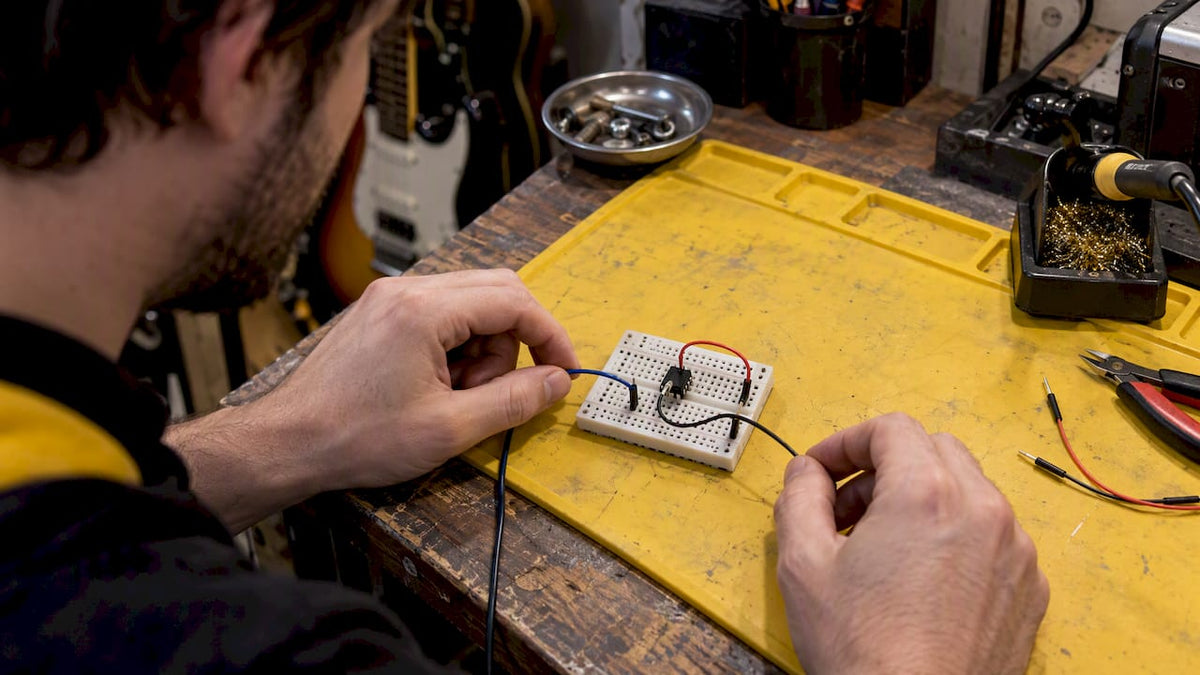
A unity gain amplifier is an amplifier whose voltage gain is exactly one: the output voltage matches the input voltage. It adds no level, but it changes how the signal is delivered. The circuit takes almost no current from the source and can drive the next stage from a low impedance. That is why it is also called a voltage follower or buffer, and why it turns up everywhere from lab benches to guitar pedalboards.
This guide explains what the circuit does, how the op-amp version is wired, what the numbers mean (including the 0 dB question), which specifications matter when you pick a chip, and where unity gain sits in the signal path of a guitar rig.
Table of Contents
- What a unity gain amplifier does
- How the op-amp voltage follower is wired
- Is unity gain 0 dB?
- What it is used for
- Choosing an op amp for a unity gain stage
- Where unity gain shows up in a guitar rig
- Our perspective: buffers are a tool, not a magic ingredient
- Amps, load boxes and gain staging
- Building or buying: a short decision guide
- Find the right gear at Musicstreet
- Frequently asked questions
- Sources
What a unity gain amplifier does
The definition is short: output equals input, Vout = Vin. Analog Devices’ university lab guide defines the unity-gain buffer, also called a voltage follower in exactly those terms. The University of Colorado Boulder describes a voltage buffer as a non-inverting amplifier with a gain of 1 whose output follows its input.
If the voltage does not go up, why bother? Because voltage is only half the story. A signal source such as a sensor, a piezo pickup or a guitar pickup can only supply a tiny amount of current. Connect it to a hungry load and the voltage sags. A buffer sits between the two. It reads the source gently and then re-creates the same voltage with a stronger, low-impedance drive. The Analog Devices guide makes the same point: the circuit does not increase voltage, but it isolates the source and provides a stronger drive.
Think of it as a translator that repeats every word at the same volume but with a much stronger voice, so it carries down a long corridor.
Why “unity”?
Unity simply means one. A gain of 1 leaves the signal size unchanged. A gain of 2 would double the voltage, and a gain below 1 would attenuate it. The word you will also see is “buffer”, which describes the job rather than the gain.
How the op-amp voltage follower is wired
The classic version uses a single operational amplifier and no other components. The signal goes to the non-inverting input (+). The output is connected straight back to the inverting input (−). Nothing else is needed for the basic circuit, which is why the follower is the simplest op-amp configuration there is.
ROHM’s technical explainer notes that this wiring gives a feedback factor of 1. Negative feedback then drives the output toward whatever voltage is on the input. If the output drifts below the input, the difference at the op-amp’s inputs grows and pushes the output back up. If it overshoots, the reverse happens. The loop settles when the two inputs sit at practically the same voltage.

Why it is close to 1, not exactly 1
A real op amp has a very high but finite open-loop gain, A. MIT OpenCourseWare’s lecture notes show that for the unity-gain non-inverting connection, Vout = A·Vin/(1+A), which approaches Vin when A is very large. ROHM derives the same result as a tracking error: Vin − Vout = Vin/(1+A).
A quick worked example makes this concrete. Say an op amp has an open-loop gain of 100,000 and you feed it 1 V. The error is 1 V divided by 100,001, about 10 microvolts. For audio work that is irrelevant. It is the reason textbooks write Vout = Vin and get away with it.
The important lesson is that feedback does the heavy lifting. As the MIT notes show, returning the output to the inverting input converts the chip’s huge, unpredictable open-loop gain into a precise closed-loop gain.
Is unity gain 0 dB?
Yes, for voltage gain. Decibels express a ratio on a logarithmic scale, and the University of Washington circuits lab manual gives voltage gain in decibels as Av,dB = 20 log10(Av), with a gain of 100 corresponding to 40 dB. Put Av = 1 into the formula and log10(1) is 0, so the result is 0 dB.
| Voltage gain (Av) | Gain in dB | What it means |
|---|---|---|
| 0.5 | about −6 dB | Output is half the input |
| 1 | 0 dB | Unity gain: output equals input |
| 2 | about +6 dB | Output is double the input |
| 10 | +20 dB | Output is ten times the input |
| 100 | +40 dB | Output is one hundred times the input |
One caveat matters. 0 dB describes voltage only. A buffer can still deliver far more current, and therefore more power, than the source gave it. So a unity gain amplifier is not “doing nothing”: it has a power gain, even though the voltage gain is one.
What it is used for
The main job is impedance matching in practice: isolating a source from a load. UC Berkeley’s electronics lecture notes state that the follower’s input impedance is nearly infinite, so it does not load the source, while its output impedance is very low. The same notes frame it as impedance transformation: a weak, high-impedance source ends up behaving like a low-impedance voltage source.
The University of Colorado lab gives the practical payoff. Buffering prevents the voltage-divider errors that appear when a load or a measuring instrument has an impedance comparable to the source’s. Texas Instruments’ classic op-amp applications note adds that the unity-gain buffer offers the highest input impedance of any op-amp circuit, and lists a wide range of op-amp uses, from simple and transducer amplifiers to wave shapers, generators and power supplies.
In day-to-day electronics that translates into a few recurring roles:
- Sensor and transducer interfaces, where the source can supply almost no current.
- ADC and DAC buffering, so a converter sees a stable, low-impedance signal.
- Active filter stages, where one section must not load the next.
- Reference voltages, where a divider needs protecting from whatever it feeds.
- Line drivers, pushing a signal down a cable without losing high frequencies.
If you build or repair audio circuits yourself, a signal source on the bench makes testing these stages far easier. A pocket-sized audio generator kit is one way to feed a known tone into a buffer and watch what comes out on a scope.
Choosing an op amp for a unity gain stage

Not every op amp is happy as a follower. Wiring the output straight to the inverting input is the most demanding case for stability, because there is no gain-setting resistor network to help. Texas Instruments’ application note lists what to check: unity-gain compensation, common-mode range, output swing, stability with capacitive loads, and errors from bias current and offset.
A datasheet that says “unity-gain stable” is telling you the chip is compensated to be used in this configuration. Here is how a few Texas Instruments parts compare on the headline figures, all taken from their datasheets:
| Part | Unity-gain details | Slew rate | Notable spec |
|---|---|---|---|
| OPA604 | Unity-gain stable, 20 MHz gain-bandwidth | 25 V/µs typical | ±4.5 V to ±24 V supply, drives 600 ohms |
| OPA593 | Unity-gain stable, 10 MHz gain-bandwidth | 45 V/µs rising | 250 mA output, 85 V maximum supply |
| THS4631 | 325 MHz unity-gain bandwidth | 1000 V/µs | 95 mA output |
| OPA698 | Unity-gain stable, 650 MHz small-signal bandwidth at gain 1 | 1800 V/µs | Wideband voltage limiting |
The spread is huge. A part like the OPA604 suits audio, while the THS4631 and OPA698 are aimed at wideband work. Most guitar-related buffers never need more than audio-grade performance, so extreme bandwidth buys you nothing.
Slew rate in plain terms
Slew rate is the fastest rate at which the output voltage can change, usually quoted in volts per microsecond. Analog Devices’ lab guide explains that a real op amp cannot respond instantaneously. In its exercise, a square-wave output turns from an ideal edge into something closer to a trapezoid as you raise the frequency.
The University of Washington manual adds that slew rate depends on the op-amp design, the supply voltages and the loading, and that operating beyond the limit distorts the waveform. Bigger signals at higher frequencies need more slew rate, so check it against the loudest, brightest signal you expect.
Loading rules of thumb
The same University of Washington manual gives a useful check for the ideal-model assumptions to hold up: the op amp’s input resistance should be at least ten times the connected input resistances, and its output resistance at least ten times smaller than the load resistance. A follower normally meets both easily, which is its whole purpose.
Where unity gain shows up in a guitar rig
This is where the theory meets a pedalboard. A passive guitar pickup is a high-impedance source. A long cable adds capacitance, and a chain of pedals each loads the signal a little. A buffer restores a low-impedance signal so the top end survives the journey. Many pedals include a buffer in the bypass path for this reason, and a good number of effects units are built around op-amp stages.
Unity gain also means something slightly different on pedals and amps, so it helps to separate the two uses of the phrase.
Unity gain as a level setting
On a drive, boost or volume pedal, “unity” usually means the effect is set so the level when it is on matches the level when it is off. You are matching volume, not necessarily wiring a follower. Setting every pedal to unity is a sensible starting point for a board, and then you add boost only where you choose to. Our guide to building a five-stage pedal chain covers ordering so that delays and modulation stay clear rather than muddy.
Unity gain in a signal chain
A clean line with the right buffer behaves as a unity gain stage between pickups and the amp input. Where noise is the problem rather than tone loss, a gate such as the Boss NS-2 Noise Suppressor deals with hiss when you are not playing, which is a separate job from buffering.
Preamps and acoustic pickups
Piezo and under-saddle pickups are very high impedance, and they need an input stage that does not load them. That is why acoustic preamps almost always start with a buffer-like stage. Products such as the LR Baggs X-Bridge preamp are designed to take a pickup signal and present it correctly to the next piece of kit.
Our perspective: buffers are a tool, not a magic ingredient
We set up and inspect every guitar we sell, and a lot of the “my tone has gone dull” questions we hear trace back to the same few causes: tired strings, a poorly set-up instrument, a poor cable, or a long chain of pedals that each take a little of the signal. A buffer can help in the last case, but it is not the first thing to reach for.
Our advice, in order:
- Start with the guitar. A proper setup and fresh strings change more than most pedals. Our in-store restring service and string range is the cheapest first step.
- Shorten and simplify. Fewer pedals and shorter cable runs mean less to buffer.
- Add a buffer only where you hear loss. If the tone is bright and full at the end of a short chain, you do not need one. If it softens as the chain grows, put a buffer near the start.
- Keep levels honest. Set each effect to unity, then boost deliberately.
The maths above explains why this works. A buffer does not make the signal louder or better. It stops a delicate, high-impedance signal being dragged down by what follows it. If the signal is not under strain, there is nothing for the buffer to fix.
— Music
Amps, load boxes and gain staging
The same “don’t load the source” idea runs through amps. A preamp stage should hand a clean voltage to the power stage, and the power stage then does the heavy current work into the speaker. If you are choosing your first or next amp, our guide to amp types for beginners matches each type to real use cases.
A few related pieces of kit are worth knowing about if you record or play quietly:
- A load box lets a valve amp run at full power into a dummy load, such as the used Mesa Boogie cab clone simulator and load box (8 ohm), so you can capture the tone without a loud speaker.
- Cabinet simulation and impulse responses shape what the signal sounds like after the load. Our explainer on impulse responses for guitarists shows how they work.
- Clean, quiet power matters for any pedal with active circuitry, and a dedicated supply such as the Strymon Ojai power supply avoids the noise that cheap shared supplies can add.
A note on names: Blackstar sells an amp range called Unity. That is a product name, not a reference to unity gain as a circuit property, so do not confuse the two when searching. If you do want a Blackstar Unity cabinet, the Unity 250ACT extension cab is on our site.
Building or buying: a short decision guide
If you want a unity gain amplifier for a project, a single op amp and a few passive parts will do the job. If you want better guitar tone, buying a well-made pedal or preamp usually makes more sense than a home build, because power supply, input protection and enclosure matter as much as the chip.
Use this quick guide:
| Your situation | What to do |
|---|---|
| Electronics project with a sensor or ADC | Use a unity-gain-stable op amp as a follower, and check slew rate, output swing and capacitive-load stability |
| Guitar sounds dull at the end of a long pedal chain | Try a buffer early in the chain, or a pedal with a buffered bypass |
| Acoustic with a piezo pickup | Use a preamp or DI with a high-impedance input |
| Pedals jump in level when switched on | Reset each to unity gain by ear, then adjust |
| Noise when you stop playing | Add a noise gate and check your power supply |
Find the right gear at Musicstreet
If your signal chain needs attention, we can help in person or online. Our Huntingdon shop lets you try instruments and kit before you buy, and our workshop handles setups and repairs. Browse our guitar amps and combos, see effects, setups and repairs on the main site, or check the range of accessories for cables, straps and more.

Frequently asked questions
What does a unity gain amplifier do?
It outputs a voltage equal to its input, so it adds no voltage gain. What it does add is isolation: the source sees a very high input impedance, and the load sees a low-impedance drive. That prevents signal loss when a weak source feeds a demanding load.
Is unity gain the same as 0 dB?
For voltage gain, yes. A gain of 1 gives 20 × log10(1) = 0 dB. Current and power gain can still be large, so a buffer is not passive in the power sense.
What is a voltage follower circuit?
It is an op-amp wired with the signal on the non-inverting input and the output connected directly to the inverting input. Negative feedback holds the output at the input voltage. Because the op amp’s open-loop gain is finite, the output is extremely close to the input rather than perfectly identical.
Do I need a buffer on my pedalboard?
Not always. Short cables and a few pedals often sound fine without one. If your tone loses brightness as the chain or cable length grows, a buffer near the front of the chain is the usual remedy. Have your guitar set up first, since a worn setup or old strings can cause similar complaints.
Sources
- Analog Devices: Activity, Simple Op Amps for ADALM2000
- University of Colorado Boulder: Lab 4, Operational Amplifiers I
- ROHM: What Is an Operational Amplifier?
- MIT OpenCourseWare: Dynamics and Control II, lecture 12
- University of Washington: BEE 233 Lab 3, Opamp circuits
- UC Berkeley: Electronics lecture 9
- Texas Instruments: AN-20 An Applications Guide for Op Amps
- Texas Instruments: OPA604 datasheet
- Texas Instruments: OPA593 datasheet
- Texas Instruments: THS4631 datasheet
- Texas Instruments: OPA698 datasheet







Share:
How to Put On a Capo: Step-by-Step for Clean Tone