


Most guitarists chase the elusive magic of legendary British tones at some point in their musical journey. Whether you crave the raw punch of classic British amps or the subtle ambiance of iconic European studios, understanding impulse responses is key. Over 90 percent of modern recording setups now use impulse responses to emulate spaces and gear, making this technology indispensable for musicians aiming to craft authentic, world-class sound.
Table of Contents
- Impulse Response: Definition And Key Concepts
- Types Of Impulse Response For Guitar Applications
- How Impulse Response Shapes Guitar Tone
- Real-World Uses In Modern Guitar Gear
- Common Pitfalls And Buying Tips
Key Takeaways
| Point | Details |
|---|---|
| Understanding Impulse Response | An impulse response captures a system’s reaction to brief stimuli, enabling musicians to manipulate sound environments effectively. |
| Types of Impulse Responses for Guitar | Guitarists can explore various impulse response types, including Cabinet, Microphone, Room, and Pedal IRs, each offering unique tonal possibilities. |
| Impact on Guitar Tone | Impulse response technology allows guitarists to achieve consistent and nuanced sounds, simulating iconic recording spaces and guitars without physical relocation. |
| Purchasing Considerations | When purchasing impulse responses, it is crucial to focus on recording quality, tonal authenticity, and compatibility with existing gear to avoid common pitfalls. |
Impulse Response: Definition and Key Concepts
In the realm of signal processing and audio engineering, an impulse response represents a critical technical concept describing how systems react to momentary stimuli. An impulse response captures the output of a dynamic system when presented with a brief input signal, providing musicians and audio professionals with profound insights into acoustic characteristics.
Musicians and sound engineers utilise impulse responses as powerful tools for understanding and manipulating audio environments. In the audio domain, an impulse response specifically captures the reflective characteristics of a room or the unique filtering properties of a particular system. This means guitarists can effectively simulate different acoustic spaces, from tiny rehearsal rooms to grand concert halls, by analysing and reproducing these precise sonic signatures.
The technical process involves generating a short, intense sound pulse and measuring the system’s subsequent response. This allows for comprehensive characterisation of acoustic environments, enabling musicians to understand how sound waves interact with physical spaces. Key applications include:
- Recreating realistic room acoustics
- Designing digital audio effects
- Modelling speaker and microphone responses
- Developing advanced sound processing techniques
Pro Tip for Guitarists: Experiment with different impulse response recordings to discover unique tonal variations that can dramatically enhance your guitar’s sound character and spatial perception.
By understanding impulse responses, musicians gain sophisticated tools for sonic exploration and creative sound design.
Types of Impulse Response for Guitar Applications
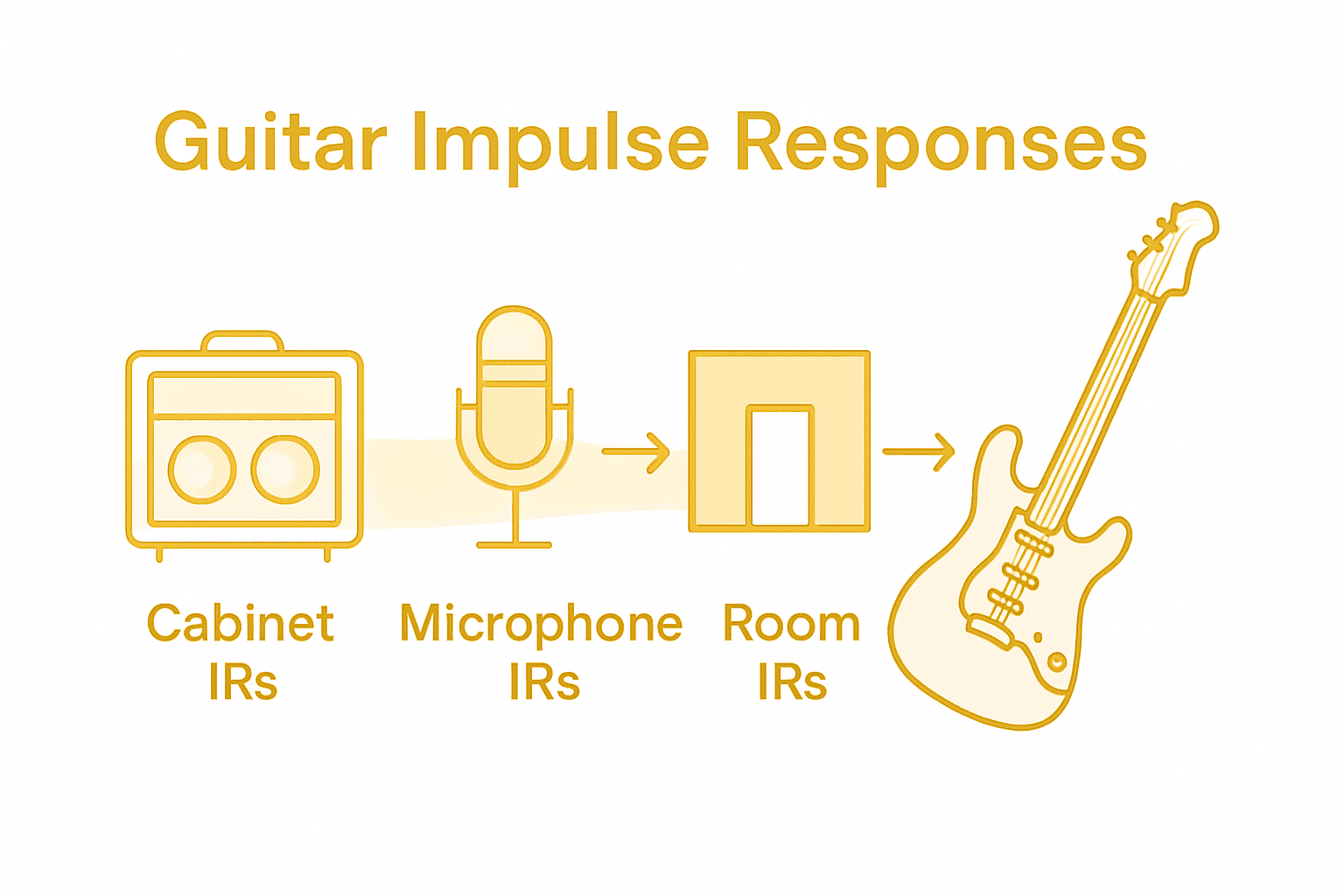
Impulse responses are diverse and multifaceted tools that guitarists can leverage to transform their sound. Guitar impulse responses can be categorised based on the equipment and environment they capture, offering musicians unprecedented flexibility in sonic exploration.
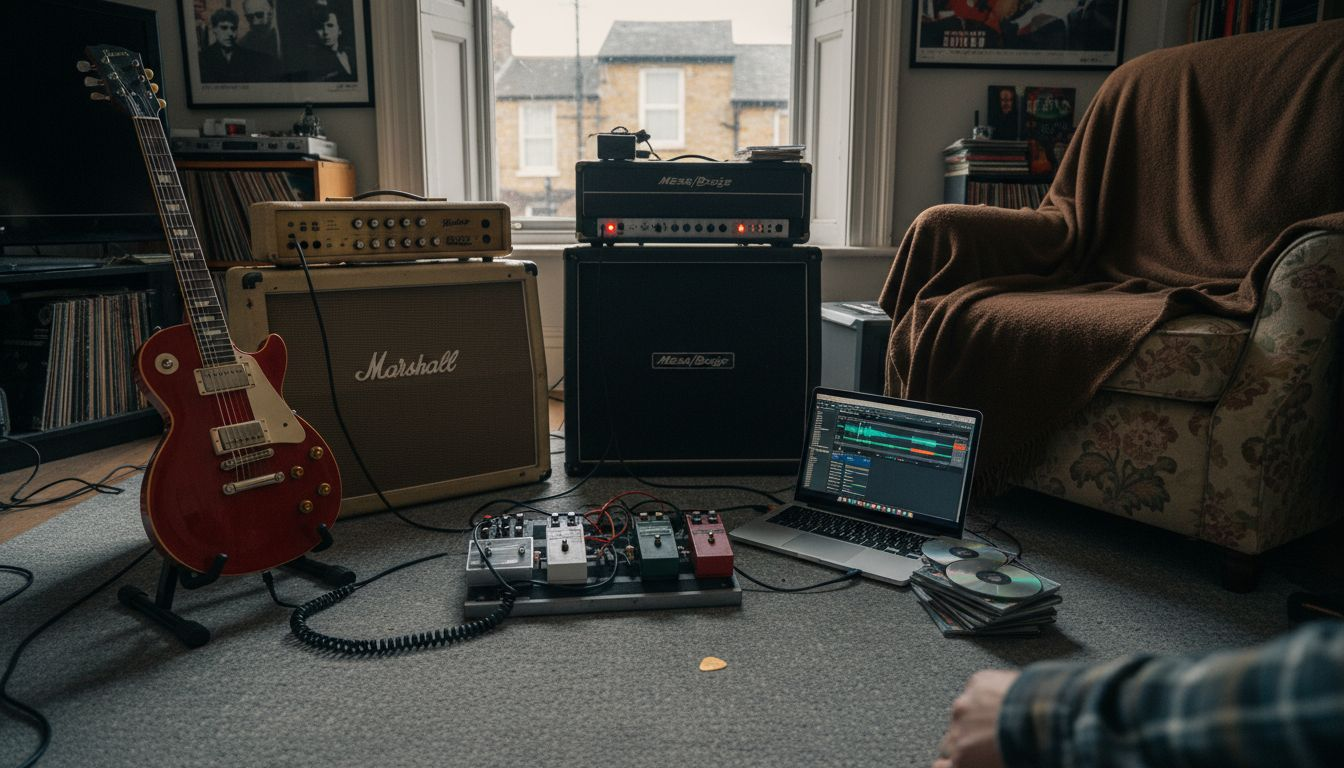
Cabinet IRs represent the most common type of impulse response for guitarists. These specialised recordings emulate the precise sonic characteristics of specific guitar amplifier cabinets, allowing musicians to recreate legendary tones without hauling massive speaker stacks. By recording guitar sounds in different settings, musicians can simulate various acoustic spaces and devices, enabling extraordinary sound design possibilities.
The primary categories of guitar impulse responses include:
- Cabinet IRs: Capturing speaker cabinet characteristics
- Microphone IRs: Documenting microphone placement and sonic qualities
- Room IRs: Replicating acoustic environments and spatial characteristics
- Pedal IRs: Simulating effect pedal response and tonal nuances
Each type of impulse response offers unique sonic possibilities, enabling guitarists to craft intricate and personalised sound landscapes. The technology allows musicians to experiment with tones from legendary studios, rare vintage equipment, and acoustic spaces around the world.
Here’s a comparative look at impulse response types relevant for guitarists:
| IR Type | Core Application | Strengths | Example Use Case |
|---|---|---|---|
| Cabinet IRs | Emulates speaker cabinets | Authentic speaker character | Recreating classic amp sounds |
| Microphone IRs | Captures mic position and style | Scoped tonal control | Simulating vintage mic techniques |
| Room IRs | Models room acoustics and ambience | Natural sense of space | Replicating iconic recording rooms |
| Pedal IRs | Reproduces effects pedal behaviour | Subtle timbral enhancements | Simulating rare vintage effects |
Pro Tip for Sound Crafting: Collect impulse responses from diverse sources and experiment systematically, treating each IR as a unique sonic palette that can dramatically expand your musical expression.
Understanding these different impulse response types empowers guitarists to transcend traditional tone limitations and explore boundless creative territories.
How Impulse Response Shapes Guitar Tone
The sonic landscape of guitar playing has been revolutionised by impulse response technology, offering musicians unprecedented control over their tonal characteristics. Impulse responses capture the complete character of a guitar amplifier setup, including the speaker, microphone, mic placement, and room acoustics, enabling guitarists to achieve remarkably consistent and nuanced sounds across different environments.
By applying impulse responses, musicians can meticulously simulate specific tonal environments that were previously difficult or impossible to recreate. This technology allows guitarists to capture the essence of legendary recording spaces, vintage amplifiers, and unique acoustic settings without physically relocating or acquiring expensive equipment. The precision of impulse response technology means that every subtle sonic characteristic can be precisely mapped and reproduced.
The transformative power of impulse responses in shaping guitar tone can be understood through several key mechanisms:
- Amplifier Simulation: Replicating specific amp characteristics
- Spatial Acoustics: Capturing room reflections and ambience
- Microphone Positioning: Emulating precise recording techniques
- Tonal Colour: Preserving unique harmonic qualities
These sophisticated sonic tools provide guitarists with an unprecedented level of tonal flexibility, allowing them to experiment with sounds from different eras, genres, and recording environments without complex physical setups.
Pro Tip for Tone Crafting: Start by collecting impulse responses from diverse sources and systematically compare their subtle tonal variations to develop a nuanced understanding of your preferred sound.
Ultimately, impulse responses represent a powerful technological bridge between creative imagination and sonic reality, empowering guitarists to explore sound with extraordinary precision and depth.
Real-World Uses in Modern Guitar Gear
Impulse responses have transformed modern guitar gear, providing musicians with unprecedented flexibility and creative potential. Modern guitar equipment, such as digital amp modellers and software plugins, now utilise impulse responses to emulate the sound of different speaker cabinets and recording environments, enabling guitarists to achieve desired tones without maintaining extensive physical equipment collections.
Convolution plugins integrated with impulse responses allow guitarists to replace traditional guitar cabinets in both live and studio settings, providing remarkable sonic versatility. This technological innovation means musicians can instantly switch between vintage Marshall stacks, boutique American amplifiers, and classic British rock tones with a simple digital preset.
The practical applications of impulse responses in modern guitar gear span multiple domains:
- Digital Amp Modellers: Simulating classic amplifier sounds
- Recording Software: Providing studio-quality tone reproduction
- Live Performance Rigs: Enabling compact, versatile sound systems
- Home Recording Studios: Offering professional-grade tone shaping
These advanced tools democratise high-end sound engineering, allowing guitarists of all skill levels to access professional-quality tones without significant financial investment. The technology bridges the gap between bedroom musicians and professional recording artists.
Pro Tip for Gear Exploration: Experiment with diverse impulse response libraries, focusing on subtle variations between different cabinet and microphone simulations to develop a nuanced understanding of your preferred tone.
Ultimately, impulse response technology represents a revolutionary approach to guitar tone, transforming how musicians conceptualise and create their signature sound.
Common Pitfalls and Buying Tips
Impulse response purchasing requires careful consideration and strategic approach. When selecting impulse responses, guitarists must prioritise quality and authenticity of IR files, as poorly captured recordings can lead to unnatural or undesirable tones, making thorough evaluation critical before making any investment.
Not all impulse responses are created equal, with factors like recording environment, equipment, and processing techniques significantly impacting the final sonic characteristics. Musicians should develop a systematic approach to evaluating and selecting impulse responses that align precisely with their specific tonal objectives and musical style.
Key considerations when purchasing impulse responses include:
- Recording Quality: Assess clarity and precision of the captured sound
- Tonal Authenticity: Verify true representation of original equipment
- Compatibility: Ensure seamless integration with existing gear
- Processing Transparency: Check for minimal unwanted artifacts
- Versatility: Determine potential across multiple playing styles
Beyond technical specifications, musicians should also consider the reputation of IR creators, sample libraries, and community feedback. Professional sound engineers and experienced guitarists often provide valuable insights into the nuanced world of impulse response selection.
The following table summarises common pitfalls and how to address them when selecting impulse responses:
| Pitfall | Description | Solution |
|---|---|---|
| Poor Recording Quality | Leads to harsh or weak tones | Choose files from reputable creators |
| Incompatibility Issues | IR not working with your hardware or software | Verify supported formats before purchasing |
| Overprocessing | Artificial sound due to heavy post-processing | Prefer IRs with clear, natural recordings |
| Lack of Versatility | Only fits a narrow musical style | Test IRs with multiple genres and setups |
Pro Tip for Smart Purchasing: Always download and extensively test free impulse response samples before committing to expensive libraries, comparing them systematically across different playing techniques and musical genres.
Ultimately, successful impulse response selection demands a blend of technical understanding, critical listening skills, and personal sonic exploration.
Elevate Your Guitar Tone with Expert Gear and Knowledge at MusicStreet
Mastering impulse responses is essential for guitarists aiming to unlock authentic amplifier and room acoustics without hauling heavy equipment or investing in costly vintage gear. This technology challenges you to explore your sound with precision but also presents the difficulty of selecting high-quality impulse responses that truly capture tonal authenticity and inspire creativity.
At MusicStreet, we understand these challenges and offer you more than just guitars. Whether you are searching for the perfect electric, acoustic, or bass guitar, our specialist team provides expert setup and guidance to complement your sonic experimentation. Discover our carefully curated range of instruments and accessories designed to harmonise with impulse response technology and elevate your tone.

Ready to transform your sound and confidently integrate impulse response technology into your playing? Visit MusicStreet and browse our collection of new and pre-loved high-quality guitars. Benefit from personalised service, professional inspection, and ongoing support that empowers you to shape your ideal tone. Explore now to experience how the right instrument combined with impulse responses can unlock extraordinary sonic possibilities.
Frequently Asked Questions
What is an impulse response?
An impulse response is a representation of how a dynamic system reacts to a brief input signal, capturing the output and allowing for analysis of acoustic characteristics in audio environments.
How can guitarists benefit from impulse responses?
Guitarists can use impulse responses to simulate different acoustic spaces and amplifier characteristics, enabling them to recreate unique tones and enhance their sound without needing physical equipment.
What types of impulse responses are most useful for guitar applications?
The most common types include Cabinet IRs (emulating speaker cabinets), Microphone IRs (capturing mic placement), Room IRs (replicating acoustic environments), and Pedal IRs (simulating effect pedal responses).
How can I effectively use impulse responses to shape my guitar tone?
To shape your guitar tone effectively, experiment with various impulse responses, focusing on their subtle tonal differences and finding combinations that enhance your sound and suit your musical style.



Share:
Guitar Strap Materials: Impact on Comfort and Playability
How Long Does It Take to Learn Guitar?