


Many guitarists encounter confusion when choosing between amp heads and combo amps, often uncertain about what an amp head actually does or why it matters for their sound. An amp head is a separate amplifier unit containing the preamp and power amp stages but no built-in speakers, requiring connection to an external speaker cabinet. Understanding how amp heads work, how they interact with cabinets, and why they offer superior flexibility can transform your approach to tone shaping and live performance. This guide explains the core components of amp heads, how to match them with speaker cabinets, and how to select the right setup for your playing style in 2026.
Table of Contents
- Understanding The Basic Components Of An Amp Head
- How Amp Heads Interact With Speaker Cabinets
- Comparing Amp Heads And Combo Amps: Flexibility And Sound Control
- Selecting The Right Amp Head For Your Playing Style And Needs
- Discover Premium Guitar Amps And Gear At MusicStreet
Key takeaways
| Point | Details |
|---|---|
| Amp heads are modular units | They contain preamp and power amp stages but require separate speaker cabinets to produce sound. |
| Impedance matching is critical | Speaker cabinet impedance must match the amp head’s output rating, typically 4, 8 or 16 ohms. |
| Preamp shapes your tone | The preamp section controls gain, equalisation, and tonal character before signal amplification. |
| Never use without speakers | Operating an amp head without a connected cabinet can cause permanent equipment damage. |
| Flexible sound customisation | Amp heads allow you to mix and match cabinets for personalised tonal characteristics. |
Understanding the basic components of an amp head
An amplifier head houses the preamp and power amp stage, boosting electrical signals before sending them to a speaker cabinet. This modular design separates the amplification circuitry from the speakers, giving you control over both signal processing and speaker characteristics independently. The two main sections work together to transform your guitar’s weak electrical signal into powerful audio output.
The preamp section is where your tone takes shape. The preamp section shapes the tone, with controls for volume, equalisation, and sometimes effects, whilst the power amp amplifies the signal. You’ll find controls for gain, treble, middle, bass, and often multiple channels for clean and overdriven sounds. Each gain stage in the preamp progressively increases signal strength whilst adding harmonic content and tonal colour. Modern amp heads often feature separate equalisation controls for each channel, allowing you to craft distinct voices for rhythm and lead playing.
The power amp receives the shaped signal from the preamp and amplifies it to levels capable of driving speakers. This section typically includes a master volume control, which determines overall output level, and sometimes presence or resonance controls that fine-tune high and low frequency response. The power amp’s design, whether valve or solid-state, significantly influences the amp’s dynamic response and tonal character under different playing intensities.
Gain staging between preamp and power amp determines your overall sound character. Pushing the preamp hard whilst keeping power amp volume lower produces saturated, compressed tones at manageable volumes. Conversely, driving the power amp harder with moderate preamp gain yields dynamic, touch-sensitive response with natural compression. Understanding this relationship helps you achieve professional tones without excessive volume.
Pro tip: Experiment with different ratios of preamp gain to master volume to discover how your amp head responds. Many classic rock tones come from cranking the power amp whilst keeping preamp gain moderate, whilst modern high-gain sounds often reverse this approach.
How amp heads interact with speaker cabinets
Amp heads are used in conjunction with a speaker cabinet, allowing players to mix and match for their desired sound. This modular approach gives you flexibility to pair different amplifier characteristics with various speaker configurations, creating unique tonal combinations impossible with combo amps. The connection between head and cabinet involves critical technical considerations that directly affect performance and equipment safety.
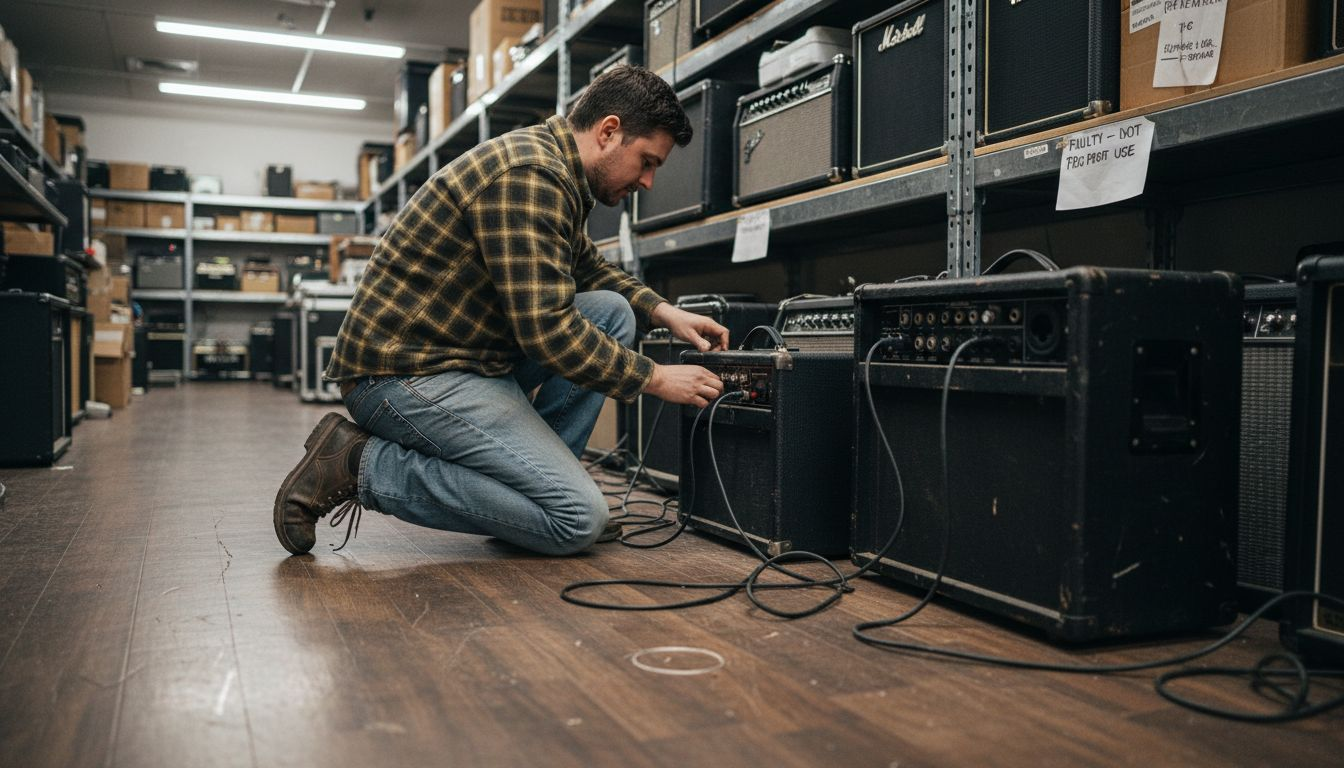
Impedance matching forms the foundation of proper amp head and cabinet pairing. The pairing of amplifier heads and speaker cabinets is determined by their impedance, measured in ohms. Most amp heads specify compatible impedance ratings, commonly 4, 8 or 16 ohms, and some offer multiple output options. Mismatched impedance can reduce power output, damage your amplifier, or create unstable operation. Always verify that your cabinet’s impedance matches one of your amp head’s rated outputs before connecting.
Power handling capacity ensures your speakers can safely manage the amplifier’s output. The power handling of the speaker cabinet should be at least equal to or greater than the amp head’s wattage. A 100-watt amp head pairs safely with a cabinet rated for 100 watts or more, providing headroom that prevents speaker damage during peaks. Underpowered cabinets risk blown speakers, whilst significantly overpowered cabinets may sound underwhelming at lower volumes.
Speaker cabinet design dramatically influences your overall tone. Closed-back cabinets produce tight, focused sound with pronounced midrange, ideal for rock and metal. Open-back designs offer wider dispersion and airier highs, favoured in blues and country styles. Cabinet size, speaker quantity, and construction materials all contribute to the final sonic character you hear on stage.
Using an amp head without a cabinet can damage it permanently. Valve amp heads particularly require a load to function safely, as operating without speakers creates dangerous voltage conditions. Dummy loads provide resistance for testing or silent recording, but they’re not substitutes for regular playing. Always ensure your cabinet is properly connected before powering on your amp head.
| Amp head wattage | Minimum cabinet power rating | Recommended impedance options |
|---|---|---|
| 15-30 watts | 30 watts | 8 or 16 ohms |
| 50-60 watts | 60 watts | 4, 8 or 16 ohms |
| 100 watts | 100-120 watts | 4, 8 or 16 ohms |
| 120+ watts | 150+ watts | 4 or 8 ohms |
Pro tip: Always use proper speaker cables, not instrument cables, to connect your amp head to the cabinet. Speaker cables handle high current without signal loss, whilst instrument cables can overheat and fail under speaker-level loads.
Comparing amp heads and combo amps: flexibility and sound control
Combo amps integrate preamp, power amp, and speakers into a single enclosure. The term ‘combo’ amp refers to an amplifier with the preamp, power amp, and speaker all in one unit. This all-in-one design offers convenience and simplicity, particularly for rehearsals and smaller venues. You simply plug in your guitar and play, without worrying about impedance matching or cable connections between separate components.
Amp heads offer more flexibility and greater sound precision compared to combo amps. The modular nature lets you swap speaker cabinets to suit different venues, recording situations, or tonal preferences. You might use a compact 1x12 cabinet for studio work, then switch to a 4x12 for live performances, all whilst keeping the same amplifier voicing. This adaptability proves invaluable as your playing situations evolve.
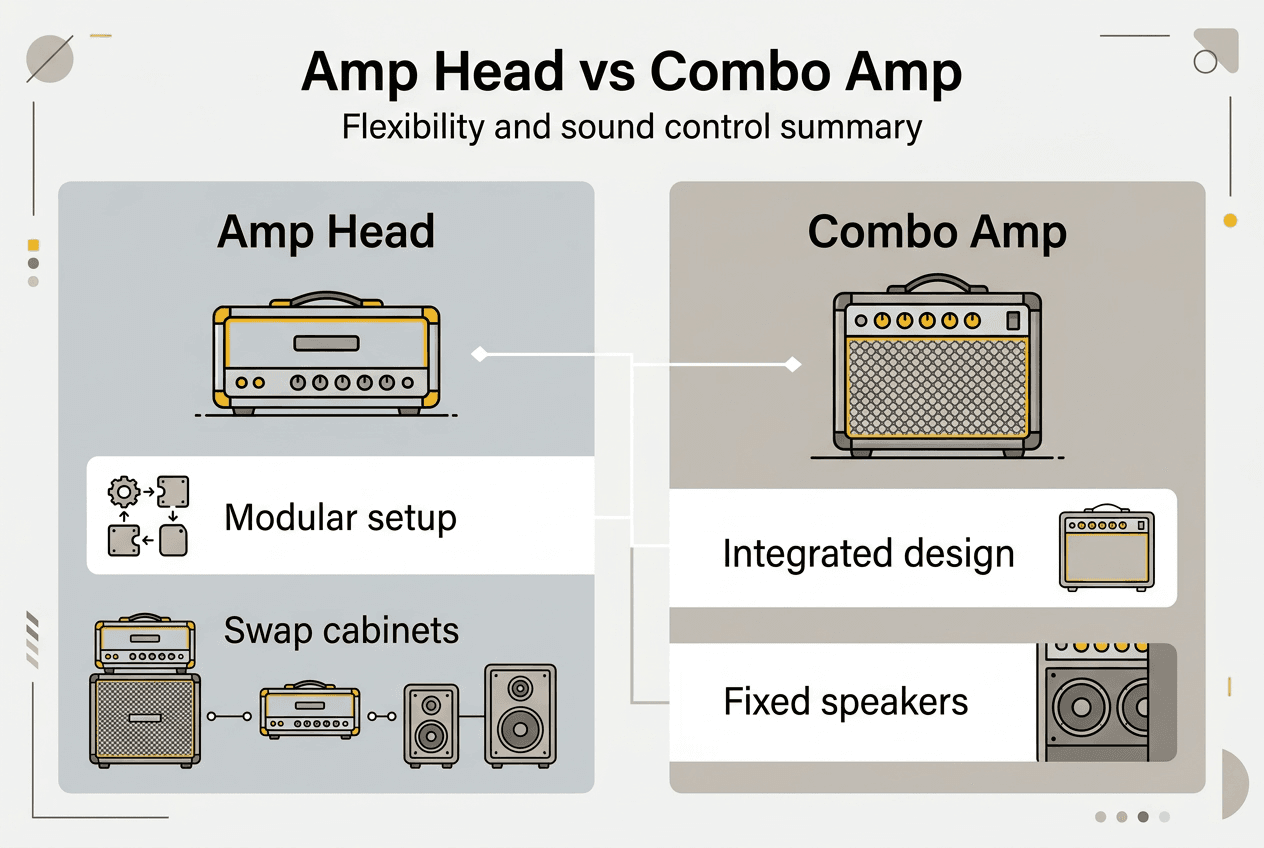
Maintenance and upgrades become simpler with separate components. When a speaker fails in a combo amp, you must transport the entire unit for repairs. With an amp head setup, you can troubleshoot components individually, replace speakers more easily, or upgrade your cabinet without replacing your entire amplification system. This modularity extends the lifespan of your investment and allows incremental improvements.
Stage volume control presents another practical advantage. Positioning your amp head and cabinet separately lets you angle the cabinet for optimal monitoring whilst keeping the head at a comfortable height for adjustments. Many professionals place cabinets off to the side or even off-stage, using the cabinet purely for stage volume whilst taking a direct signal to the front-of-house system.
Combo amps excel in specific scenarios despite these limitations. For guitarists who play primarily in one venue or prefer simplicity, a quality combo delivers excellent tone without the complexity of matching components. Transport becomes straightforward with everything in one package, though larger combos can be heavier and more awkward to move than separate head and cabinet units.
| Feature | Amp head | Combo amp |
|---|---|---|
| Flexibility | High: mix and match cabinets | Low: fixed speaker configuration |
| Sound control | Precise: separate tone and speaker choices | Limited: single integrated design |
| Portability | Moderate: two pieces to transport | Variable: single unit but potentially heavy |
| Maintenance | Easier: components serviced separately | Harder: entire unit must be transported |
| Initial cost | Higher: requires separate cabinet | Lower: complete system in one purchase |
Understanding different guitar amplifier types helps you make informed decisions about which configuration suits your playing style and practical requirements.
Selecting the right amp head for your playing style and needs
Valve and solid-state amp heads produce fundamentally different tonal characteristics and power delivery. Valve amps generate warm, dynamic compression and harmonic richness that many players consider essential for classic rock, blues, and vintage tones. Solid-state designs offer clean headroom, consistent performance, and lower maintenance requirements, making them popular for modern high-gain styles and players who need reliable operation in demanding conditions.
Power output requirements depend on your playing situations and amp technology. The ‘3:1 rule’ suggests that a watt of valve amp power is generally about three times as loud as a watt of solid-state power. A 30-watt valve head can compete with a 100-watt solid-state amp in live situations. Consider where you’ll perform most: bedroom practice requires 5-15 watts, rehearsal spaces suit 15-50 watts, and large venues demand 50-100+ watts depending on PA support.
Tonal preferences should guide your amp head selection. Different heads offer different tones, power outputs and connectivity options. Clean-focused players benefit from amps with headroom and transparent equalisation, whilst high-gain enthusiasts need multiple preamp stages and aggressive voicing. Some amp heads specialise in specific sounds, whilst others provide versatile channel switching for diverse musical styles.
Compatibility with your chosen speaker cabinet ensures optimal performance. Beyond impedance and power matching, consider how your amp head’s voice complements your cabinet’s characteristics. Bright-sounding amps pair well with warm-voiced speakers, whilst dark amplifiers benefit from cabinets with enhanced high-frequency response. This synergy creates balanced, professional tone.
Follow these steps to identify your ideal amp head:
- Assess your primary playing environments and required volume levels to determine appropriate wattage.
- Decide between valve and solid-state based on tonal preferences, maintenance willingness, and budget constraints.
- List must-have features such as channel switching, effects loops, or specific equalisation controls.
- Research amp heads within your budget that meet these criteria and read reviews from players in similar styles.
- Test shortlisted models with your own guitar and preferred cabinet to evaluate real-world performance.
- Verify technical compatibility including impedance options and power requirements before purchasing.
Pro tip: Bring your guitar to the shop and test multiple amp heads through the same cabinet, then try your favourite head through different cabinets. This reveals which component contributes which tonal characteristics, helping you make informed decisions about your complete rig.
Explore comprehensive guidance on selecting the right guitar amp to deepen your understanding of amplifier selection across all formats and technologies.
Discover premium guitar amps and gear at MusicStreet
Now that you understand how amp heads function and how to choose the right setup, explore the carefully curated selection of amplifiers and accessories at MusicStreet. Whether you’re building your first modular rig or upgrading existing equipment, you’ll find premium amp heads, speaker cabinets, and essential accessories from trusted manufacturers.

Our expert team provides personalised guidance to help you match components perfectly for your playing style and technical requirements. Beyond amplifiers, discover detailed resources on topics like guitar preamp functions and choosing quality cables to optimise every element of your signal chain. Visit our Huntingdon showroom to test equipment in person, or browse online with confidence knowing every product receives professional inspection and setup before delivery.
FAQ
What is an amp head on a guitar amplifier?
An amp head is the component of a guitar amplification system containing the preamp and power amp circuitry but no built-in speakers. It processes and amplifies your guitar’s electrical signal, shaping tone through equalisation and gain controls before sending the boosted signal to a separate speaker cabinet. This modular design allows you to customise your sound by pairing different amplifier characteristics with various speaker configurations.
Can I use an amp head without a speaker cabinet?
Operating an amp head without a speaker cabinet can cause permanent damage, particularly to valve amplifiers which require a load to function safely. The lack of resistance creates dangerous voltage conditions that can destroy output transformers and valves. Dummy load devices exist for silent recording or testing purposes, providing the necessary resistance without producing sound, but these are not suitable for regular playing situations.
How do I match an amp head to a speaker cabinet?
Match the speaker cabinet impedance to the amp head’s specified impedance, typically 4, 8 or 16 ohms, checking the ratings on both components before connecting. The cabinet’s power handling capacity should equal or exceed your amp head’s wattage to prevent speaker damage during loud playing. Many amp heads offer multiple impedance outputs, giving you flexibility to use different cabinets, but always verify compatibility before powering on your equipment.
What are the main advantages of using an amp head instead of a combo amp?
Amp heads provide superior flexibility by allowing you to swap speaker cabinets for different tonal characteristics, venues, or recording situations without changing your core amplifier voice. Maintenance becomes simpler as you can service or upgrade components independently rather than transporting an entire combo unit. The modular design also enables better stage positioning, letting you angle cabinets for optimal monitoring whilst keeping controls accessible, and you can build your rig incrementally as budget allows.
How many watts do I need in an amp head for live performance?
Required wattage depends on venue size, musical style, and whether you have PA support, but remember that valve watts sound approximately three times louder than solid-state watts. For small clubs with PA support, 15-30 watts of valve power or 50-75 watts solid-state typically suffices. Larger venues without extensive PA reinforcement may require 50-100 watts valve or 150+ watts solid-state. Consider that excessive wattage in small spaces forces you to play at unsatisfying volumes to avoid overwhelming the room.






Share:
What is a practice amp? A guide for guitarists in 2026
Understand fretboard radius for better guitar playability